Pioneer Life in Kentucky, 1785-1800
by Daniel Drake
On This Page
Description
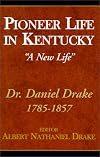
The book is a pastorical account of formative boyhood influences in the form of letters by Doctor Daniel Drake to his adult children written in 1847. The letters were originally published in a book by his son, Charles Drake in 1880. Dr Drake, an infant when his family moved from New Jersey to Kentucky, was initiated into a lifetime love of adventure. He learned work by helping his family carve a life from the forest. He rose from poverty to be a true self made man. A modern social worker show more would wince at pioneer living conditions that Drake transcended. As an adult, he traveled extensively, gathering and writing valuable environmental facts about the mid-west. He became a nationally known, brilliant, compassionate doctor and lecturer. He was a pioneer throughout his life. His letters to his children describe his family pastoral life .The essence of the book is a conversion of the personal to social meaning. show lessTags
Member Reviews
In December of 1845 Daniel Drake, a well known physician and educator in America’s west during the first half of the 19th century, widowed years before he found himself alone in Louisville teaching at the Louisville Medical Institute. His family was miles up river in Cincinnati and the river was flooding, interrupting river travel, his line of communication with his family. Perhaps feeling isolated he began to write what would become a series of letters to his children that would detail his early life. In 1788 his parents brought him, at the age of three, from their home in New Jersey to make a new home in the Virginia wilderness. They were among the earliest families to immigrate into the region that would become Kentucky. Drakes show more son, Missouri Senator and chief justice of the United States Court of Claims collected and edited those letters into this book, “Pioneer Life in Kentucky 1785-1800” and had it published 1870, 18 years after his father’s death. Daniel Drake was a fine writer, he lived in interesting times, and his book holds up very well 150 years after he wrote the words.
The popular book was reissued in 1907 and again in 1948. This is the 1948 edition which was edited by Dr. Emmet Horne M.D. Horne, a dedicated fan of Drake, found that the original letters had been edited by Charles Drake before publication and decided to restore them to their original form. I am not a fan of Horne, his 1963 biography of Drake seemed to be an argument for sainthood rather than an honest biography of a complicated, real, human being. Here however I think Horne has done us a service. In addition to restoring short sections of text he added biographical sketches to explain who the letters were to and who the people that Drake mentioned were. Personally I was very please to see that Horne had even restored Drake’s original misspellings. In Drake’s time spelling was not as standardized as it is today but it filled me with joy to see someone as successful as Dr. Drake could also be so creative in his spelling.
Horne also points out how important this account was, how often it was cited and quoted, by other historians and biographers. Today it seems to have faded in importance, we have a much longer history to look at and we understand that a memoir written a half century after the fact is unreliable at best. The book is still worth reading. Although I don’t trust that the name of the man Drakes father worked with as a teamster, one time, when Drake was three years old is recorded accurately I do feel that he got the feeling of the era right. The mundane details that I found so interesting were simple facts Drake grew up with. I am as confident that Drake’s memory of his family's second cabin being built on a hill with a space underneath to safely lock livestock in night is as accurate as my memory that my families second home boarded a golf course.
In addition to giving us a look at pioneer life in pre-Kentucky Virginia, Drake’s letters give us a look at Drake’s family and professional life as a professor of medicine on the Ohio River at the middle of the 19th century. As Horne pointed out, this was a very popular book, a few pages into it I started to suspect that I had read it many years ago in school. If the feeling is correct I laid it down after getting through the part about Indians and the wilderness because the feeling faded after the first fifty or so pages. If you are interested in the history of the early United States you might want to take a look at this book. Even if you think you may have read it years ago there is much more here than Indian stories. show less
The popular book was reissued in 1907 and again in 1948. This is the 1948 edition which was edited by Dr. Emmet Horne M.D. Horne, a dedicated fan of Drake, found that the original letters had been edited by Charles Drake before publication and decided to restore them to their original form. I am not a fan of Horne, his 1963 biography of Drake seemed to be an argument for sainthood rather than an honest biography of a complicated, real, human being. Here however I think Horne has done us a service. In addition to restoring short sections of text he added biographical sketches to explain who the letters were to and who the people that Drake mentioned were. Personally I was very please to see that Horne had even restored Drake’s original misspellings. In Drake’s time spelling was not as standardized as it is today but it filled me with joy to see someone as successful as Dr. Drake could also be so creative in his spelling.
Horne also points out how important this account was, how often it was cited and quoted, by other historians and biographers. Today it seems to have faded in importance, we have a much longer history to look at and we understand that a memoir written a half century after the fact is unreliable at best. The book is still worth reading. Although I don’t trust that the name of the man Drakes father worked with as a teamster, one time, when Drake was three years old is recorded accurately I do feel that he got the feeling of the era right. The mundane details that I found so interesting were simple facts Drake grew up with. I am as confident that Drake’s memory of his family's second cabin being built on a hill with a space underneath to safely lock livestock in night is as accurate as my memory that my families second home boarded a golf course.
In addition to giving us a look at pioneer life in pre-Kentucky Virginia, Drake’s letters give us a look at Drake’s family and professional life as a professor of medicine on the Ohio River at the middle of the 19th century. As Horne pointed out, this was a very popular book, a few pages into it I started to suspect that I had read it many years ago in school. If the feeling is correct I laid it down after getting through the part about Indians and the wilderness because the feeling faded after the first fifty or so pages. If you are interested in the history of the early United States you might want to take a look at this book. Even if you think you may have read it years ago there is much more here than Indian stories. show less
Members
- Recently Added By
Author Information
45 Works 89 Members
Classifications
Statistics
- Members
- 18
- Popularity
- 1,393,462
- Reviews
- 1
- Rating
- (4.50)
- Languages
- English
- Media
- Paper
- ISBNs
- 6
- ASINs
- 3