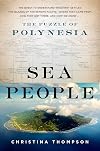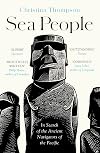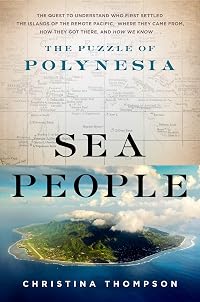
Sea People: The Puzzle of Polynesia
by Christina Thompson
On This Page
Description
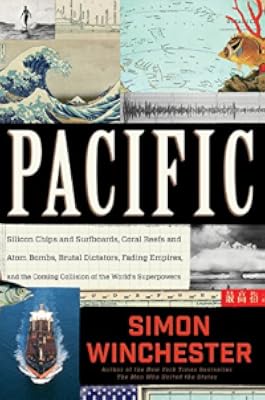
A blend of Jared Diamond's Guns, Germs, and Steel and Simon Winchester's Pacific, a thrilling intellectual detective story that looks deep into the past to uncover who first settled the islands of the remote Pacific, where they came from, how they got there, and how we know. For more than a millennium, Polynesians have occupied the remotest islands in the Pacific Ocean, a vast triangle stretching from Hawaii to New Zealand to Easter Island. Until the arrival of European explorers they were show more the only people to have ever lived there. Both the most closely related and the most widely dispersed people in the world before the era of mass migration, Polynesians can trace their roots to a group of epic voyagers who ventured out into the unknown in one of the greatest adventures in human history. How did the earliest Polynesians find and colonize these far-flung islands? How did a people without writing or metal tools conquer the largest ocean in the world? This conundrum, which came to be known as the Problem of Polynesian Origins, emerged in the eighteenth century as one of the great geographical mysteries of mankind. For Christina Thompson, this mystery is personal: her Maori husband and their sons descend directly from these ancient navigators. In Sea People, Thompson explores the fascinating story of these ancestors, as well as those of the many sailors, linguists, archaeologists, folklorists, biologists, and geographers who have puzzled over this history for three hundred years. A masterful mix of history, geography, anthropology, and the science of navigation, Sea People combines the thrill of exploration with the drama of discovery in a vivid tour of one of the most captivating regions in the world. show lessTags
Recommendations










Member Reviews
Simply superb. A history of efforts to discover where the Polynesians came from and how they colonized the remote Pacific. It considers cultural, scientific, and practical methods; mistakes, prejudices, and revelations along the way; Polynesian and Western perspectives. A model of writing and of how to blend the hardness of evidence with a sensitivity to diverse ways of seeing the world.
The Pacific is very big, as everyone who has had anything to do with it will tell you, and the islands in it are for the most part very small and a long way apart. Yet when the first European sailors reached Polynesia in the 16th century, they found people living on just about all of those tiny specks of land. What's more, those people all seemed to speak closely-related languages and share many of the same domestic animals, food-plants and cultural traditions, and in many cases they had obviously been settled where they were for a long time.
Thus, Western science was confronted with the famous "puzzle of Polynesia" — how did "primitive" people, without access to metal tools, nails, compasses, sextants and Admiralty charts, manage to show more migrate effectively across such vast areas of ocean? And where did they start?
Thompson's approach in this book is not so much to resolve that puzzle but rather to tease out the history of the interaction between Polynesian peoples and western scientists, looking at it as far as possible from both sides, and focussing as much on the long tradition of false preconceptions and intercultural misunderstandings as on the occasional isolated outbreaks of serious research and willingness to listen to each other that eventually made it possible for the two cultures to gain some kind of mutual understanding. I was particularly struck by her observation that a major stumbling-block for western scientists was the blind assumption that Polynesian cultures, being "primitive", were necessarily static: in many cases a famous "mystery" stopped being mysterious as soon as you allowed for the possibility that the way of life of a community had changed over the centuries to adapt to changes in its environment.
Obviously, it's not really possible to present a completely balanced view when one of the two parties in the discussion has all the written records, but Thompson does what she can with the handful of Polynesian thinkers who did leave some trace, like the Tahitian navigator Tupaia who sailed with Cook and Banks, and the early 20th century Maori ethnologist Te Rangi Hiroa (Peter H Buck).
The book is pitched at general readers, and whilst making us look critically at some of the things we remember from our schoolbooks (and all of the things we remember from Thor Heyerdahl) it also seems to give a useful broad overview of the main topics involved and how they fit together in time and space, without going into very much detail about any particular place or particular technical or cultural aspect of Polynesian life. show less
Thus, Western science was confronted with the famous "puzzle of Polynesia" — how did "primitive" people, without access to metal tools, nails, compasses, sextants and Admiralty charts, manage to show more migrate effectively across such vast areas of ocean? And where did they start?
Thompson's approach in this book is not so much to resolve that puzzle but rather to tease out the history of the interaction between Polynesian peoples and western scientists, looking at it as far as possible from both sides, and focussing as much on the long tradition of false preconceptions and intercultural misunderstandings as on the occasional isolated outbreaks of serious research and willingness to listen to each other that eventually made it possible for the two cultures to gain some kind of mutual understanding. I was particularly struck by her observation that a major stumbling-block for western scientists was the blind assumption that Polynesian cultures, being "primitive", were necessarily static: in many cases a famous "mystery" stopped being mysterious as soon as you allowed for the possibility that the way of life of a community had changed over the centuries to adapt to changes in its environment.
Obviously, it's not really possible to present a completely balanced view when one of the two parties in the discussion has all the written records, but Thompson does what she can with the handful of Polynesian thinkers who did leave some trace, like the Tahitian navigator Tupaia who sailed with Cook and Banks, and the early 20th century Maori ethnologist Te Rangi Hiroa (Peter H Buck).
The book is pitched at general readers, and whilst making us look critically at some of the things we remember from our schoolbooks (and all of the things we remember from Thor Heyerdahl) it also seems to give a useful broad overview of the main topics involved and how they fit together in time and space, without going into very much detail about any particular place or particular technical or cultural aspect of Polynesian life. show less
Fantastic book. It's a history of the "puzzle of Polynesia" - how did the islands of the Pacific, so far from each other and so remote from any continent, come to be populated by a common people, making Polynesians "both the most closely related and the most widely dispersed people in the world"?
Christina Thompson doesn't attempt to provide a definitive answer to that question, because a definitive answer is likely impossible to find. Rather, she takes us through the history of the question itself, and how answers to it have grown and evolved since Europeans first came to Polynesia.
It's a story that's part history, part anthropology, part archeology, part genetic research, and part cultural renaissance, and she makes all of it show more interesting. There are a number of personalities highlighted in this book. I was especially taken with the story of Nainoa Thompson, the young Hawaiian who was instrumental in returning Polynesian voyaging as a skillset and a way of living to Hawaii and Polynesia at large.
The book is capped off with Thompson's well thought out and beautifully written Coda, where she talks about the "two ways of knowing", one arising from the Polynesian culture, one from the European.
I rate Christina Thompson's Sea People 5 Stars ⭐⭐⭐⭐⭐ - it is a fantastic book. If you have any interest in the history of Polynesia, or of European exploration, or of cultural "contact", do yourself a favor and pick this up. show less
Christina Thompson doesn't attempt to provide a definitive answer to that question, because a definitive answer is likely impossible to find. Rather, she takes us through the history of the question itself, and how answers to it have grown and evolved since Europeans first came to Polynesia.
It's a story that's part history, part anthropology, part archeology, part genetic research, and part cultural renaissance, and she makes all of it show more interesting. There are a number of personalities highlighted in this book. I was especially taken with the story of Nainoa Thompson, the young Hawaiian who was instrumental in returning Polynesian voyaging as a skillset and a way of living to Hawaii and Polynesia at large.
The book is capped off with Thompson's well thought out and beautifully written Coda, where she talks about the "two ways of knowing", one arising from the Polynesian culture, one from the European.
I rate Christina Thompson's Sea People 5 Stars ⭐⭐⭐⭐⭐ - it is a fantastic book. If you have any interest in the history of Polynesia, or of European exploration, or of cultural "contact", do yourself a favor and pick this up. show less
The author, having met, married, and had a family with a Maori man she met while conducting academic research in New Zealand, continues and expands her own exploration of Polynesian origins and culture in her second book. There's no geographical entity on the planet larger than the Pacific Ocean, nor any firm origin stories as to the background of its people and how they managed to navigate to and to populate so many distant, tiny islands even before European explorers appeared. Her writing style is simultaneously compelling and comfortable, a rare combination in a book of history and adventure - and still unsolved mysteries. She details modern attempts to recreate ancient voyages using techniques passed down via oral legends. If Thor show more Hyerdahl's Kon-Tiki was dry stuff, this is the fascinatingly juicy version. show less
What this book does best is convey how incredible an achievement the settlement of Polynesia was. Untangling the timeline and methods was an intellectual puzzle that Thompson relates with the taut pacing of a mystery novel. With each unexplained piece of evidence, the instinct of many investigators seems to have been to doubt or diminish the skill of the Polynesian navigators; at times, they appear to have been looking for any other explanation, regardless of plausibility. Thompson shows how misguided this instinct was, and instills the appropriate respect for those navigators.
Truly excellent. Not a history of Polynesia, but an narrative of the way the prehistory of the Polynesians has been thought about from the West's first interactions in the eighteenth century through to the present.
Starting with endpapers that are the relevant maps for easy consultation - to quirky and informative title headings, the book is an absolute delight.
The interaction between Tupaia, a Tahitian navigator and Captain Cook could serve as a paradigm for the entire book: the intertwining of traditional knowledge (legend, language and navigational techniques) have interacted with scientific knowledge (from linguistics, somatology to DNA and radio-carbon dating) is developed in a clear and accessible way for the lay reader.
Starting with endpapers that are the relevant maps for easy consultation - to quirky and informative title headings, the book is an absolute delight.
The interaction between Tupaia, a Tahitian navigator and Captain Cook could serve as a paradigm for the entire book: the intertwining of traditional knowledge (legend, language and navigational techniques) have interacted with scientific knowledge (from linguistics, somatology to DNA and radio-carbon dating) is developed in a clear and accessible way for the lay reader.
There was a whole lot of information in here about those who tried to figure out the puzzle of Polynesia -- how did these people get there and how did they spread across the gigantic Pacific Ocean in tiny canoes? It was interesting but a bit dense and tedious in parts. My interest was really peaked by those who worked to replicate those voyages in order to bolster or dismiss some of the theories out there. The author did a good job of bringing it all together in the end and showing how many people throughout the centuries figured out parts of the story that, in the end, appear to be accurate.
Members
- Recently Added By
Lists

Top Five Books of 2019
387 works; 111 members

Books Read in 2019
4,052 works; 110 members

Australia, New Zealand and Oceania
88 works; 20 members

Top Five Books of 2023
767 works; 317 members
Author Information

11+ Works 871 Members
Awards and Honors
Awards
Distinctions
Notable Lists
Common Knowledge
- Original publication date
- 2019-03-12
- People/Characters
- Captain James Cook, RN, FRS; Tupaia; Te Rangi Hiroa (Peter H. Buck); Edward Tregear; Abraham Fornander; Nainoa Thompson (show all 9); David Lewis; Andrew Sharp; Thor Heyerdahl
- Important places
- Polynesia; New Zealand; Hawaiian Islands; Society Islands; Marquesas Islands; Easter Island (Rapa Nui) (show all 8); Tonga; Samoa
- Important events
- James Cook's First Voyage; James Cook's Third Voyage; Voyage of the Kon-Tiki
- Epigraph
- For we are dear to the immortal gods,
Living here, in the sea that rolls forever,
Distant from other lands and other men.
--Homer, the Odyssey
(translated by Robert Fitzgerald) - Dedication
- For Tauwhitu
- First words
- Kealakekua Bay lies on the west, or leeward, side of the Big Island of Hawai'i, in the rain shadow cast by the great volcano Mauna Loa.
- Last words
- (Click to show. Warning: May contain spoilers.)But one moment the sounds of the island were those of wind and sea and the cries of birds, and the next, the air was filled with voices and the thud of feet and the scrape and rumble of hulls being run up the shore.
- Blurbers
- Sobel, Dava; Marshall, Megan; Hoare, Philip; Weatherford, Jack; Fisher, Paul; Matsuda, Matt K. (show all 8); Kirch, Patrick V.; Rhodes, Richard
- Original language
- English
Classifications
Statistics
- Members
- 575
- Popularity
- 51,275
- Reviews
- 19
- Rating
- (4.09)
- Languages
- English
- Media
- Paper, Audiobook, Ebook
- ISBNs
- 16
- ASINs
- 5