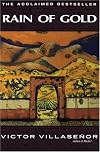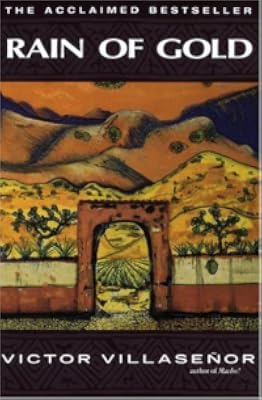
Rain of Gold
by Víctor E. Villaseñor
On This Page
Description
Rain of Gold is a true-life saga of love, family and destiny that pulses with bold vitality, sweeping from the war-ravaged Mexican mountains of Pancho Villa's revolution to the days of Prohibition in California.It all began when Villaseñor's maternal grandmother sat him down in their little home in the barrio of Carlsbad, California, gave him sweet bread and told him the story of their past. Of his mother Lupe, the most beautiful girl in the whole village who was only a child when Villa's show more men came shooting into their canyon. And of his father Juan and his family, reduced to rags and starvation as they sought escape across the border, where they believed that endless opportunity awaited.
Lupe and Juan met and fell in love in California, but they found that the doors to the Promised Land were often closed to those from south of the border. His father was forced to take the law into his own hands, in spite of his wife's objections. With love and humor, Villaseñor shares this passionate love story that celebrates the triumph of the human spirit.
An all-American story of struggle and success, Rain of Gold focuses on three generations of Villaseñor's kin, their spiritual and cultural roots back in Mexico, their immigration to California and overcoming poverty, prejudice and economic exploitation. It is the warm-hearted and spirited account of the wily, wary, persevering forebears of Victor Villaseñor.
. show less
Tags
Recommendations



Member Reviews
Finished it and then cried all through the Author’s Notes! A testament to the strength and perseverance of the author’s family, as they fled the Mexican Revolution and struggled to make their way in the US against so many odds (extreme poverty, labor exploitation, racism, etc.), yet truly lived their lives with passion, joy, and faith....which carried them through generations.
There are some aspects of nostalgia and longing that are universal to most immigrants that touched me as an immigrant myself...the longing for a home or past that is no more and yet still feeling like a fish out of water in your new home!
There were some sections on the last 3rd of the book that dragged a bit too much for me, but other than that, a rewarding read.
There are some aspects of nostalgia and longing that are universal to most immigrants that touched me as an immigrant myself...the longing for a home or past that is no more and yet still feeling like a fish out of water in your new home!
There were some sections on the last 3rd of the book that dragged a bit too much for me, but other than that, a rewarding read.
A story of nonviolence – amazingly. This is not a meek nonviolence, but a full-throated, bloody one. It’s about faith, too, and family and the consequences of losing faith and arching struggle to keep it. This is how we die: by loving.
To read these 500 pages is to immerse oneself in a different culture. I love the descriptions of Juan’s uneasiness when he dares another culture and his courage to dare it nonetheless. Venture into the particular (and true) story of a Mexican family crossing the border and you will feel your own uneasiness rise! Take courage! Love is to be gained.
To read these 500 pages is to immerse oneself in a different culture. I love the descriptions of Juan’s uneasiness when he dares another culture and his courage to dare it nonetheless. Venture into the particular (and true) story of a Mexican family crossing the border and you will feel your own uneasiness rise! Take courage! Love is to be gained.
There is no good without evil, no light without dark, and no love without hatred and fear, the sages say, and Villaseñor’s family memoir is replete with all of these in the extreme. Generations of his family lived in the Mexico of revolution, from Hidalgo’s call for independence in 1820 until the last bloody overthrow of a sitting president in 1920. His mixed-race ancestors attempted to make a living off the land, but never succeeded in being remote enough to escape the ravages of rag-tag soldiers from both sides of the conflict.
Villaseñor’s grandmother, Doña Marguerita, emerges as the star of his tale—a tiny, toothless, brittle little Indian woman. Each day, in the early morning while she sits in her outhouse with her cup of show more coffee and cigarette, she exchanges gossip with the Virgin Mary. Sometimes occasions arise that call for a special visit to the church, where the Holy Mother steps down from her pedestal and joins Doña Marguerita for a heart-to-heart.
Villaseñor’s father, Salvadore, was Doña Marguerita’s last born, miraculously past her expected age of fertility. She expects Salvadore to be better than her other sons and frequently delivers long rants, imparting her wisdom or punishing his shortcomings. Her favorite topics are love, forgiveness, bigotry, and racism.
Every family in America should have such a grandmother. “I tell you, this hate has got to stop right now! Here! Inside your soul!” she berates him. “And you’ve got to grab hold of your tanates and grow bigger than your personal disappointments, or the devil has won before you even begin!”
From twenty years of recorded interviews with members of both his father’s and mother’s families, Villaseñor weaves a magnificently adventurous story of how his family survived a harrowing journey north into the U.S. to escape the neverending violence of war. It is a story of two families, but in the process of the telling, a portrait of a people emerges—the Mexican immigrants who forged a new culture as Mexican Americans. For this reason alone, Villaseñor’s colorful family memoir is worth the read. show less
Villaseñor’s grandmother, Doña Marguerita, emerges as the star of his tale—a tiny, toothless, brittle little Indian woman. Each day, in the early morning while she sits in her outhouse with her cup of show more coffee and cigarette, she exchanges gossip with the Virgin Mary. Sometimes occasions arise that call for a special visit to the church, where the Holy Mother steps down from her pedestal and joins Doña Marguerita for a heart-to-heart.
Villaseñor’s father, Salvadore, was Doña Marguerita’s last born, miraculously past her expected age of fertility. She expects Salvadore to be better than her other sons and frequently delivers long rants, imparting her wisdom or punishing his shortcomings. Her favorite topics are love, forgiveness, bigotry, and racism.
Every family in America should have such a grandmother. “I tell you, this hate has got to stop right now! Here! Inside your soul!” she berates him. “And you’ve got to grab hold of your tanates and grow bigger than your personal disappointments, or the devil has won before you even begin!”
From twenty years of recorded interviews with members of both his father’s and mother’s families, Villaseñor weaves a magnificently adventurous story of how his family survived a harrowing journey north into the U.S. to escape the neverending violence of war. It is a story of two families, but in the process of the telling, a portrait of a people emerges—the Mexican immigrants who forged a new culture as Mexican Americans. For this reason alone, Villaseñor’s colorful family memoir is worth the read. show less
I read this as a freshman in high school and it has remained one of my favorite books ever since. Villasenor writes with a beautiful rhythm and his words and images stick in the reader's mind long after they have finished reading the book. In an age where kids grow up hating their parents, it's wonderful to see the love and care he puts into reconstructing his parents' lives.
This family history is beautifully told in a sort of magical realism style. It's a little over the top, but it wonderfully reflects the ways in which stories came down to the author. (He totally justifies it in the footnote.) I was particularly interested in the picture of Southern California in the 1920s, since my family didn't move out here until 1950.
This is a fabulous family saga made more fascinating because it is a true story. This family must have had great storytellers through the ages! It details the life of the authors parents, from both of their very early childhoods in different locations in Mexico, through their courtship and marriage in the United States. The story is told in an alternating format switching between the families until they eventually merge and become the same story. The families are very different - one on the edge of the law, one always within its bounds; one bootlegging, the other follwing the crops to survive; one hard drinking, the author teetolling. At the same time, they are more similar than the story line would suggest. The similarities are show more revealed through the characters and their interactions, especially the mothers. Both mothers use the same pet word for their sons/daughters, both have a very strong and deep faith, both adore their children and would do anything for them, both give sage advice that is heeded at crucial moments. At the same time, the children - especially the main two characters, Lupe and Juan Salvador - revere their mothers in a manner that bonds them forever to their mothers and to each other. show less
Here's what I wrote about this read in 2008: "Loved it! Great story, fictionally told, but based on author's family history. Provides more insight in history of Mexico, effects of the Mexican revolution, and the early Californian Mexican-American experience."
Members
- Recently Added By
Author Information

28+ Works 1,678 Members
Victor Villasenor lives in California, on the ranch where he was raised. He is the author of numerous bestselling and critically acclaimed works, including Rain of Gold, Jury: The People vs. Juan Corona, and Macho!
Work Relationships
Is abridged in
Common Knowledge
- Original publication date
- 1991
- People/Characters
- Salvadore Villasenor; Doña Marguerita
- Important events
- Mexican Revolution
Classifications
- Genre
- Biography & Memoir
- DDC/MDS
- 979.400468720730922 — History & geography History of North America Great Basin and Pacific Slope region of United States California General California History
- LCC
- PS3572 .I384 .R35 — Language and Literature American literature American literature Individual authors 1961-
- BISAC
Statistics
- Members
- 764
- Popularity
- 36,888
- Reviews
- 17
- Rating
- (4.23)
- Languages
- English, French, Spanish
- Media
- Paper, Audiobook, Ebook
- ISBNs
- 17
- ASINs
- 5