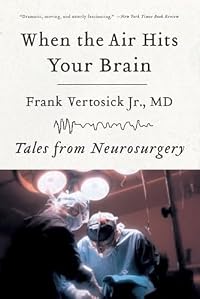
When the Air Hits Your Brain: Tales from Neurosurgery
by Frank Vertosick Jr.
On This Page
Description
With poignant insight and humor, Frank Vertosick, Jr., MD, describes some of the greatest challenges of his career, including a six-week-old infant with a tumor in her brain, a young man struck down in his prime by paraplegia, and a minister with a .22-caliber bullet lodged in his skull. Told through intimate portraits of Vertosick's patients and unsparing yet fascinatingly detailed descriptions of surgical procedures, When the Air Hits Your Brain, the culmination of decades spent struggling show more to learn an unforgiving craft-illuminates both the mysteries of the mind and the realities of the operating room. show lessTags
Recommendations




Member Reviews
I’ve read several of these “doctor tells all” books, and this was unusual in that almost all of it was about Frank Vertosick’s actual career as a neurosurgeon. Several of his stories, which he tells the reader in the preface are composites rather than verbatim recountings of actual patient experiences, are really interesting, and one pulls at the heartstrings. Vertosick loses a patient on the operating table because of a mistake he made. His colleagues seemed very blasé about the mistake and brush it off as simply the cost of doing brain surgery. Vertosick almost changes careers because he is so despondent over it. Vertosick is obviously dedicated to his profession, which (spoiler alert) he eventually has to give up because of show more a physical impairment of his own. I highly recommend “When the Air Hits Your Brain” for both its entertainment value and its educational lessons. show less
This is a fascinating and emotionally frank collection of stories taken from the author's professional life, from the humble beginnings of a Neurosurgery resident to the humbling culmination of a Neurosurgeon. I especially appreciate how he doesn't avoid those cases that had a less than great ending and that he recognizes how much you can learn from failure. Anyone with an interest in Neurosurgery should read this, not only because of Vertosick's talent as a story-teller, but because of his honesty when it comes to patients, his sense of humor regarding this very serious topic, and his seemingly unending passion for that lump in our head which is the brain.
This was an engaging memoir of the medical school and training experiences, from internship to fellowships, of the author on his journey to become a neurosurgeon. It includes some fascinating case histories, but mostly focuses on the author's evolving relationship with and attitude towards his patients.
When he began training, he would find himself emotionally touched by his patients. Then, "Trauma experiences hardened me to death and pain patients made me cynical about suffering. I felt my personality shifting away during this arduous process of becoming 'one of them.' Clinical cases no longer evoked the strong emotions they once had."
*****************
"Yet my emotional numbness was still only partial. I still hadn't progressed to the show more status of true surgical psychopath, wherein one's humanity is placed under general anesthesia."
He also discusses the mistakes made and the effect they had on him in his training. At a certain point, as he became more skilled, he learned he had to guard against overconfidence:
"Before reaching my surgical adulthood, I would again stumble into the inferno of overconfidence. And come perilously close to emotional incineration."
Ultimately (thankfully), the author came to the conclusion that "surgical psychopathy" was not the best way to handle the difficulties of his profession. He learned that some caring is a necessary element to be a good surgeon.
I enjoyed this book, focusing as it does on the emotional development of a surgeon. I recommend it if this sounds interesting to you.
3 1/2 stars show less
When he began training, he would find himself emotionally touched by his patients. Then, "Trauma experiences hardened me to death and pain patients made me cynical about suffering. I felt my personality shifting away during this arduous process of becoming 'one of them.' Clinical cases no longer evoked the strong emotions they once had."
*****************
"Yet my emotional numbness was still only partial. I still hadn't progressed to the show more status of true surgical psychopath, wherein one's humanity is placed under general anesthesia."
He also discusses the mistakes made and the effect they had on him in his training. At a certain point, as he became more skilled, he learned he had to guard against overconfidence:
"Before reaching my surgical adulthood, I would again stumble into the inferno of overconfidence. And come perilously close to emotional incineration."
Ultimately (thankfully), the author came to the conclusion that "surgical psychopathy" was not the best way to handle the difficulties of his profession. He learned that some caring is a necessary element to be a good surgeon.
I enjoyed this book, focusing as it does on the emotional development of a surgeon. I recommend it if this sounds interesting to you.
3 1/2 stars show less
Dr. Vertosick provides a very lively and personal account of his neurosurgery career. He has a very good sense of humour, while trying to correct some TV-induced wrong assumptions about the medical field he doesn't hesitate to talk about how he received some little but critical help from a patient who watched some medical TV series :)
He describes his transition from being a very young student of medicine, to becoming an assistant at the world's best neurosurgery department, and finally to becoming an expert neurosurgeon under the supervision of another very disciplined and famous expert doctor. While doing that he helps the reader see the intricacies and beauty of that small, fatty, bloody tissue which makes us what we are: the show more brain.
After all the difficult cases he describes I truly believe that one has to be really crazy to become a neurosurgeon and operate on brain, or really love that field of study (maybe both). Dr. Vertosick made me realize once again what a miraculous thing that brain of ours is.
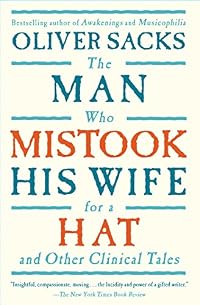
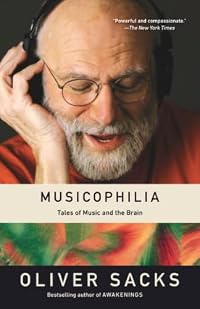
As a book of popular science I can compare the quality and smoothness of narration to one of my favorite authors, Oliver Sacks.
PS: It was nice to see the name of a Turkish neurosurgeon Prof. Dr. Gazi Yaşargil in the book, too. show less
He describes his transition from being a very young student of medicine, to becoming an assistant at the world's best neurosurgery department, and finally to becoming an expert neurosurgeon under the supervision of another very disciplined and famous expert doctor. While doing that he helps the reader see the intricacies and beauty of that small, fatty, bloody tissue which makes us what we are: the show more brain.
After all the difficult cases he describes I truly believe that one has to be really crazy to become a neurosurgeon and operate on brain, or really love that field of study (maybe both). Dr. Vertosick made me realize once again what a miraculous thing that brain of ours is.
As a book of popular science I can compare the quality and smoothness of narration to one of my favorite authors, Oliver Sacks.
PS: It was nice to see the name of a Turkish neurosurgeon Prof. Dr. Gazi Yaşargil in the book, too. show less
My post-surgery review meeting (for 2 craniotomies), was with Mark Wilson, my Specialist Registrar. He recommended this book to me. I purposely held off getting the book as I knew some of the content was going to be difficult for me to cope with. After a couple of months of the title sitting on my to-do list, I had to order it. I was right, it is a gut wrenching book, it's also very, very good and I recommend it to you, if you have a passing interest in your 'wetware'.
Here in the U.S., we generally believe all surgeons are arrogant SOB’s. Vertosick’s book is proof that not all surgeons fit that mold. If you like memoir’s with a medical focus, this one is worth reading.
Full review at TheBibliophage.com
Full review at TheBibliophage.com
A decent story of the author's neurosurgery residency. It starts out extremely stilted, like bad fiction, with in the made-up dialog the other characters conveniently explaining for us each acronym and procedure as it arises. But it gets better, and even achieves some emotional heft by the end. I think "Do No Harm: Stories of Life, Death and Brain Surgery," by Henry Marsh, is probably still the better book—more honest—but this does have some very good descriptions of cases and surgeries. (Vertosick makes a number of mistakes when talking about science beyond neurosurgery, but as far as I can tell he is accurate within his specialty.)
Members
- Recently Added By
Author Information
10 Works 619 Members
Frank T. Vertosick, Jr., M.D., is a neurosurgeon A former president of the Pennsylvania Neurosurgical Society and a Fellow of the American College of Surgeons, he lives in Pittsburgh, Pennsylvania
Some Editions
Common Knowledge
- Epigraph
- Surgeons must be very careful
When they take their knife!
Underneath their fine incisions
Stirs the Culprit--Life!
--Emily Dickinson - Dedication
- To Frank and Veronica, who raised me to be whatever I wanted to be.
- First words
- Neurosurgery is an arrogant occupation.
- Last words
- (Click to show. Warning: May contain spoilers.)Isn't that what it's all about?
Classifications
Statistics
- Members
- 419
- Popularity
- 73,494
- Reviews
- 10
- Rating
- (4.15)
- Languages
- English, French
- Media
- Paper, Audiobook, Ebook
- ISBNs
- 7
- ASINs
- 7