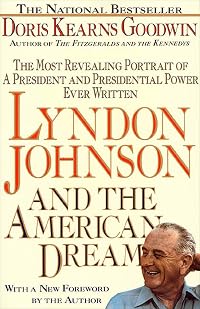
Lyndon Johnson and the American Dream
by Doris Kearns Goodwin
On This Page
Description
An engrossing biography of President Lyndon Johnson from the Pulitzer Prize-winning author of Team of Rivals. Doris Kearns Goodwin's extraordinary and insightful book draws from meticulous research in addition to the author's time spent working at the White House from 1967 to 1969. After Lyndon Johnson's term ended, Goodwin remained his confidante and assisted in the preparation of his memoir. In Lyndon Johnson and the American Dream she traces the 36th president's life from childhood to his show more early days in politics, and from his leadership of the Senate to his presidency, analyzing his dramatic years in the White House, including both his historic domestic triumphs and his failures in Vietnam. Drawn from personal anecdotes and candid conversation with Johnson, Goodwin paints a rich and complicated portrait of one of our nation's most compelling politicians. show lessTags
Recommendations


















Member Reviews
Former US President Lyndon Johnson is one of the more difficult to understand presidents. He reached the heights of politics through an assassination. He changed America permanently through the Civil Rights Acts of 1964-5. Pragmatically, he attempted to build a nation based on equal opportunity through the Great Society. He had an unparalleled genius for administrative leadership in the Senate and Oval Office. Yet he led the nation down a horrific course in Vietnam and seemed to disregard basic facts and popular sentiment – to his and the nation’s detriment.
This book put Kearns Goodwin on the map as an articulate biographer and won her a Pulitzer Prize. Readers are often struck by the psychoanalytic parts of this book. Much of that show more stems from her unfettered access to Johnson after his presidency. She wanted to understand the man, not just the historical leader, and the main lens she had to offer was an understanding of his childhood. Whether or not the reader appreciates this is out of her control. The veracity of this understanding of LBJ seems to have stood the test of time.
Now a national gem, Kearns Goodwin is at her best in this book when describing how Johnson handled the civil rights of African Americans. She does not portray him as a white savior but as someone reasonably reacting to the events of his time. She also explains the backstory to the escalation in Vietnam. The events of Vietnam take a step to the rear as she explains how this tragedy unfolded in this great man’s mind. She clearly respects Johnson yet struggles openly to understand his tragic flaws.
Although written 40-50 years before this review, this book maintains much relevance to American readers. As the baby-boom generation ages, its psychological deficits – moored in no small part in the experiences of Vietnam – continue to be displayed on newspapers’ front pages. These features were defined with the events of the JFK assassination, the presidency of Johnson, and the subsequent presidency of Nixon. Unfortunately, America still seems mired in the shortcomings of this era, now displayed in ideological partisanship. Perhaps a better understanding through Kearns Goodwin’s original epic might serve us well. show less
This book put Kearns Goodwin on the map as an articulate biographer and won her a Pulitzer Prize. Readers are often struck by the psychoanalytic parts of this book. Much of that show more stems from her unfettered access to Johnson after his presidency. She wanted to understand the man, not just the historical leader, and the main lens she had to offer was an understanding of his childhood. Whether or not the reader appreciates this is out of her control. The veracity of this understanding of LBJ seems to have stood the test of time.
Now a national gem, Kearns Goodwin is at her best in this book when describing how Johnson handled the civil rights of African Americans. She does not portray him as a white savior but as someone reasonably reacting to the events of his time. She also explains the backstory to the escalation in Vietnam. The events of Vietnam take a step to the rear as she explains how this tragedy unfolded in this great man’s mind. She clearly respects Johnson yet struggles openly to understand his tragic flaws.
Although written 40-50 years before this review, this book maintains much relevance to American readers. As the baby-boom generation ages, its psychological deficits – moored in no small part in the experiences of Vietnam – continue to be displayed on newspapers’ front pages. These features were defined with the events of the JFK assassination, the presidency of Johnson, and the subsequent presidency of Nixon. Unfortunately, America still seems mired in the shortcomings of this era, now displayed in ideological partisanship. Perhaps a better understanding through Kearns Goodwin’s original epic might serve us well. show less
I would give the first few chapters five stars plus. The story of LBJ's childhood, school years, years as a teacher and his work in the National Youth Administration, his courtship and marriage to Lady Bird and his time as a congressional aide were absolutely fascinating. LBJ was a born political force and so incredibly smart and intuitive in reading people. The chapters on his time in the senate, as vice president and his early years as president were equally fascinating. His thought process on the Great Society reforms was mind-blowing at times. He was a very complicated man. But the chapters on Vietnam and the end of his presidency were just downright depressing. He lost his way with that war and his justifications became more and show more more divorced from reality. He went from being a heroic (yet very flawed) figure to being pitiful, paranoid and unable to accept any criticism. It was very sad. I do appreciate that Kearns Goodwin did not equivocate when it came to LBJ's flaws. You can tell that she very much admired him, but she never apologized for his shortcomings and often did a beautiful job of speculating as to his motives and motivations. Very interesting for anyone wanting to know more about LBJ. show less
I am a man of ambition. Lesser ambition than some, my ambition extend towards actually reading Caro's magnum opus on LBJ. But until volume five arrives, there's Goodwin's biography. Goodwin has the advantage of personal knowledge. She was a White House fellow working on the Great Society, even as she was an anti-war figure on the New Left. After his presidency, she collaborated on his failed memoirs. When she speaks of the LBJ charm, the way that he could make you the center of the universe or freeze you out entire, it is from personal experience. This very closeness is both the strength and weakness of the book. As much as she is an expert, Goodwin uses a rather hoary psychodynamic theoretical paradigm, explaining Johnson's actions in show more relation to his mother and his childhood. The book becomes as much about Johnson's perceptions of events as the events themselves.
Johnson's early childhood was centered around his mother, an intellectual and aesthetic woman stifled by the strictures of Texas society, and his slightly disreputable and perennially hustling father, an entrepreneur and local politician in the prairie populist vein. Through his early career, Johnson made an art of two principles of power. The first was apprenticeship to powerful men, from the head of his college to leaders in the House and Senate. The second was master of hidden structures of meeting scheduling, office space, and using agenda setting to toss out a complacent old guard in favor of Johnson. For LBJ power was defined by patronage and negotiation. He could get you what you wanted, as long as you gave him what he wanted, which seemed like an eminently reasonable trade at the time. But what Johnson really wanted was 'just a little appreciation for what he did'. The goal of Johnson's political maneuvers was always to cast the other party into a potentially limitless sense of obligation, a tactic which worked against equals who had their own bases of support.
Johnson's ascension to the presidency meant that he had no equals. Final able to wield power, fettered only by the Constitution, Johnson embarked on his Great Society, a mass of new social programs. He also escalated America's involvement in Vietnam, seeing it as a necessary test of America's commitment to its allies and principles. Both endeavors ended in fiasco. Vietnam became a quagmire, the strategy of 'controlled escalation bombing' a fiasco. Distracted by the war, Johnson did not devote his talents to the Great Society, and its programs were consumed in a similar quagmire. A master of small groups, Johnson froze when speaking before a large audience, when he was unable to understand and mirror their psychological needs. The public image he had crafted of the all-powerful technocrat crumbled under the realities of the late 60s. Johnson had carefully avoided testing his public support, trusting in a 'solid center' that turned out not to exist after the early primaries.
This is often a fascinating book, and best when it quotes Johnson extensively. But it's also oddly underspecified for a serious history, without much of a sense of the details of the time. At something like 10% of the pagecount of Caro's books, less detail is a natural authorial choice, but this book may go too far in the other direction. show less
Johnson's early childhood was centered around his mother, an intellectual and aesthetic woman stifled by the strictures of Texas society, and his slightly disreputable and perennially hustling father, an entrepreneur and local politician in the prairie populist vein. Through his early career, Johnson made an art of two principles of power. The first was apprenticeship to powerful men, from the head of his college to leaders in the House and Senate. The second was master of hidden structures of meeting scheduling, office space, and using agenda setting to toss out a complacent old guard in favor of Johnson. For LBJ power was defined by patronage and negotiation. He could get you what you wanted, as long as you gave him what he wanted, which seemed like an eminently reasonable trade at the time. But what Johnson really wanted was 'just a little appreciation for what he did'. The goal of Johnson's political maneuvers was always to cast the other party into a potentially limitless sense of obligation, a tactic which worked against equals who had their own bases of support.
Johnson's ascension to the presidency meant that he had no equals. Final able to wield power, fettered only by the Constitution, Johnson embarked on his Great Society, a mass of new social programs. He also escalated America's involvement in Vietnam, seeing it as a necessary test of America's commitment to its allies and principles. Both endeavors ended in fiasco. Vietnam became a quagmire, the strategy of 'controlled escalation bombing' a fiasco. Distracted by the war, Johnson did not devote his talents to the Great Society, and its programs were consumed in a similar quagmire. A master of small groups, Johnson froze when speaking before a large audience, when he was unable to understand and mirror their psychological needs. The public image he had crafted of the all-powerful technocrat crumbled under the realities of the late 60s. Johnson had carefully avoided testing his public support, trusting in a 'solid center' that turned out not to exist after the early primaries.
This is often a fascinating book, and best when it quotes Johnson extensively. But it's also oddly underspecified for a serious history, without much of a sense of the details of the time. At something like 10% of the pagecount of Caro's books, less detail is a natural authorial choice, but this book may go too far in the other direction. show less
Summary: A biography of the 36th president exploring his ambitions, political skills, and vision, shaped by his family and upbringing, and marred by Vietnam, written from the unique perspective of a White House Fellowship and post-presidential interviews.
This month, Pulitzer Prize-winning historian Doris Kearns Goodwin's latest book, Leadership in Turbulent Times, will hit the bookstores. The book explores lessons learned from her biographies of four presidents, Abraham Lincoln, Theodore Roosevelt, Franklin Roosevelt, and Lyndon Johnson. The book that began her study of presidential leadership was her biography of Lyndon Johnson, first published in 1976. In a Goodreads interview about her new book, she describes how her personal show more encounter with Lyndon Johnson led to her career as a writer and historian:
"I became a historian first, and then a writer. In graduate school, I was working on my thesis on Supreme Court history when I was selected to join the White House Fellows, one of America’s most prestigious programs for leadership and public service. At the White House celebration of the newly chosen Fellows, President Johnson asked me to dance—not that peculiar, as there were only a few women in the program. He told me he wanted me to be assigned directly to him, but it was not to be that simple.
For like many young people, I had been active in the anti-Vietnam War movement and had co-authored an article that called for the removal of LBJ, published in the New Republic several days after the White House dance. Despite this, LBJ said: “Bring her down here for a year, and if I can’t win her over, no one can.” I worked with LBJ in the White House and later assisted him in the writing of his memoirs. I will forever be grateful to him because there’s no question that my experience working for him shaped my desire to become a presidential historian."
That experience of working personally for and with Johnson, both in the White House, and later, on his ranch, gave her unique access into Johnson's self-conception of his life, his House and Senate experience, and his exercise of presidential leadership. Goodwin renders a story of a young man torn between the high hopes and expectations of his mother, and the much easier and more personable style of his father. He hated formal speaking but was the consummate student of people who knew how to make deals and get things done. From his cultivation of a relationship with a university president, a congressional aide who rapidly makes others beholden followers, several terms in the House, a failed, and then successful Senate bid and his rapid rise to Senate Majority Leader, we see someone who studied those around him, learned how to accrue power to himself by bestowing benefits to his followers, receiving their support, if not love, in return.
Presidential ambitions required a different set of skills that Kennedy had and Johnson lacked. Failing his bid in 1960 for the presidency, he accepts the role of Vice President, thinking he could use the methods that worked so well throughout his life, only to find, as have so many, that the office of Vice President has great status, and no power, or potential for such, unless the President dies. Thrust into the presidency by Kennedy's death, he uses his Senate leader skills to continue and realize Kennedy's vision, articulated by Johnson as the Great Society. In his first year, and the year after his landslide election, he enacts landmark Civil Rights legislation (as a President from the South) and social legislation including Medicare. Foreign affairs, never a strong suit, struck in the form of Vietnam, a war he could neither win nor walk away from. Goodwin explores why and describes his efforts to sustain his social programs while escalating the war, and the disastrous consequences to his social agenda, and to the economy until the epiphany of the Tet offensive and the McCarthy and Kennedy candidacies made it plain that he could not win in 1968.
Goodwin spent extensive time with Johnson in his last years, and narrates his inability to write his memoirs, his conversations about his presidency, and Vietnam, and his deep frustration from trying to bestow so much of benefit on the country, only to be reviled by the demonstrators and so many others (Goodwin among them). A combination of meticulous research and up close and personal contact helps us understand the tremendous force of personality that made Johnson great, and the flaws that cast a shadow on what, otherwise, might have been a great presidency. I tend to approach psychological portraits with some skepticism, but her accounts of Johnson in his own words, his actions and her rendering of his character has an internal consistency that offers deep insight into a man for whom I had little respect growing up. Now I find myself longing for the political mastery and vision he exhibited at his best leading the enactment of the Civil Rights legislation which was perhaps his proudest legacy.
Doris Kearns Goodwin has gone on to give us memorable portraits of Lincoln, the two Roosevelts, and even the Brooklyn Dodgers of her youth. This was her debut effort and reveals the promise of all that would come from her pen over the last forty years. Perhaps the publication of Leadership in Turbulent Times might encourage some to go back and read the work that led to her distinguished career as a presidential scholar. show less
This month, Pulitzer Prize-winning historian Doris Kearns Goodwin's latest book, Leadership in Turbulent Times, will hit the bookstores. The book explores lessons learned from her biographies of four presidents, Abraham Lincoln, Theodore Roosevelt, Franklin Roosevelt, and Lyndon Johnson. The book that began her study of presidential leadership was her biography of Lyndon Johnson, first published in 1976. In a Goodreads interview about her new book, she describes how her personal show more encounter with Lyndon Johnson led to her career as a writer and historian:
"I became a historian first, and then a writer. In graduate school, I was working on my thesis on Supreme Court history when I was selected to join the White House Fellows, one of America’s most prestigious programs for leadership and public service. At the White House celebration of the newly chosen Fellows, President Johnson asked me to dance—not that peculiar, as there were only a few women in the program. He told me he wanted me to be assigned directly to him, but it was not to be that simple.
For like many young people, I had been active in the anti-Vietnam War movement and had co-authored an article that called for the removal of LBJ, published in the New Republic several days after the White House dance. Despite this, LBJ said: “Bring her down here for a year, and if I can’t win her over, no one can.” I worked with LBJ in the White House and later assisted him in the writing of his memoirs. I will forever be grateful to him because there’s no question that my experience working for him shaped my desire to become a presidential historian."
That experience of working personally for and with Johnson, both in the White House, and later, on his ranch, gave her unique access into Johnson's self-conception of his life, his House and Senate experience, and his exercise of presidential leadership. Goodwin renders a story of a young man torn between the high hopes and expectations of his mother, and the much easier and more personable style of his father. He hated formal speaking but was the consummate student of people who knew how to make deals and get things done. From his cultivation of a relationship with a university president, a congressional aide who rapidly makes others beholden followers, several terms in the House, a failed, and then successful Senate bid and his rapid rise to Senate Majority Leader, we see someone who studied those around him, learned how to accrue power to himself by bestowing benefits to his followers, receiving their support, if not love, in return.
Presidential ambitions required a different set of skills that Kennedy had and Johnson lacked. Failing his bid in 1960 for the presidency, he accepts the role of Vice President, thinking he could use the methods that worked so well throughout his life, only to find, as have so many, that the office of Vice President has great status, and no power, or potential for such, unless the President dies. Thrust into the presidency by Kennedy's death, he uses his Senate leader skills to continue and realize Kennedy's vision, articulated by Johnson as the Great Society. In his first year, and the year after his landslide election, he enacts landmark Civil Rights legislation (as a President from the South) and social legislation including Medicare. Foreign affairs, never a strong suit, struck in the form of Vietnam, a war he could neither win nor walk away from. Goodwin explores why and describes his efforts to sustain his social programs while escalating the war, and the disastrous consequences to his social agenda, and to the economy until the epiphany of the Tet offensive and the McCarthy and Kennedy candidacies made it plain that he could not win in 1968.
Goodwin spent extensive time with Johnson in his last years, and narrates his inability to write his memoirs, his conversations about his presidency, and Vietnam, and his deep frustration from trying to bestow so much of benefit on the country, only to be reviled by the demonstrators and so many others (Goodwin among them). A combination of meticulous research and up close and personal contact helps us understand the tremendous force of personality that made Johnson great, and the flaws that cast a shadow on what, otherwise, might have been a great presidency. I tend to approach psychological portraits with some skepticism, but her accounts of Johnson in his own words, his actions and her rendering of his character has an internal consistency that offers deep insight into a man for whom I had little respect growing up. Now I find myself longing for the political mastery and vision he exhibited at his best leading the enactment of the Civil Rights legislation which was perhaps his proudest legacy.
Doris Kearns Goodwin has gone on to give us memorable portraits of Lincoln, the two Roosevelts, and even the Brooklyn Dodgers of her youth. This was her debut effort and reveals the promise of all that would come from her pen over the last forty years. Perhaps the publication of Leadership in Turbulent Times might encourage some to go back and read the work that led to her distinguished career as a presidential scholar. show less
Wow, what a difference from Profile of Power by Richard Reeves, which detailed the Kennedy Presidency almost day-by-day, event-by-event. Doris Kearns Goodwin might have mentioned the Tet Offensive and the 1967 Moratorium once…in passing…maybe. I read in constant fear of slipping over the edge into Freudian psychobabble about LBJ’s mommy issues (Fear of heights? Fear of falling? Fear of Freud?) My biggest takeaway was that while Johnson might well have been the perfect man for Senate Majority Leader, he ultimately proved the Peter Principle, rising to his level of incompetence upon his ascension to the Oval Office.
This was pretty disappointing overall, typical 1960's-1970's overwrought psychoanalysis. Some unique insights but lacks the long view of history. The author's subsequent books, ones I have enjoyed and appreciated, come from a more mature and practiced perspective. There are better books about LBJ if that is your goal.
I got tired of waiting for Caro’s fifth volume so I decided to read this one, to be followed by Dallek’s LYNDON B. JOHNSON. This one did not disappoint. I found it particularly interesting because DKG’s approach is so different from Caro’s.
Members
- Recently Added By
Lists

Best Biographies of U.S. Presidents
61 works; 6 members

r/History Recommended Reading List
603 works; 12 members
Author Information

17+ Works 23,245 Members
Doris Kearns Goodwin was born in Brooklyn, New York on January 4, 1943. She received a bachelor of arts degree from Colby College in 1964 and a Ph.D. in government from Harvard University in 1968. She taught at Harvard University and worked as an assistant to President Lyndon Johnson during his last year in the White House. She has written show more numerous books including The Fitzgeralds and the Kennedys, Lyndon Johnson and the American Dream, Wait Till Next Year, and The Bully Pulpit: Theodore Roosevelt, William Howard Taft, and the Golden Age of Journalism, and Leadership: In Turbulent Times. She has received numerous awards including Pulitzer Prize in history, the Harold Washington Literary Award, the Ambassador Book Award for No Ordinary Time: Franklin and Eleanor Roosevelt: The Home Front in World War II, and the Lincoln Prize and the Book Prize for American History for Team of Rivals: The Political Genius of Abraham Lincoln. (Bowker Author Biography) show less
Awards and Honors
Distinctions
Common Knowledge
- Canonical title
- Lyndon Johnson and the American Dream
- Original publication date
- 1976
- People/Characters
- Lyndon Baines Johnson
- Dedication
- To the memory of
my mother and father
and to
Richard and Bert Neustadt - First words
- It is more than eighteen years since Lyndon Johnson died, and yet my last conversation with him, two days before his fatal heart attack, turns in my mind as if that formidable, frustrating, fascinating character were still al... (show all)ive. (Foreword)
On the north bank of the Pedernales River in Stonewall, Blanco County, Texas, a mile of dirt road connects the ranch house where Lyndon Johnson died to the small farmhouse in which he was born. - Last words
- (Click to show. Warning: May contain spoilers.)On January 20, 1969, Richard Nixon took the oath of office as the thirty-seventh President of the United States, and later that afternoon, the man who had come to Washington as a legislative assistant in the htird year of the depression at the age of twenty-three, and served thirty-two years in public life as Congressman, Senator, Vice President, and President, returned to hill country, where, as his father had told him, "The people know when you're sick and care when you die."
- Original language
- English US
Classifications
- Genres
- History, Nonfiction, Biography & Memoir, General Nonfiction
- DDC/MDS
- 973.923 — History & geography History of North America United States 1901- Cold War, Vietnam War, Digital Age (1953-2001) John F. Kennedy (1961-1963) Cuban Missile Crisis, Bay of Pigs, Apollo Program
- LCC
- E847 .G64 — History of the United States United States Later twentieth century, 1961-2000 Johnson's administrations, November 22, 1963-1969
- BISAC
Statistics
- Members
- 1,163
- Popularity
- 21,547
- Reviews
- 14
- Rating
- (3.60)
- Languages
- English
- Media
- Paper, Audiobook, Ebook
- ISBNs
- 13
- ASINs
- 20