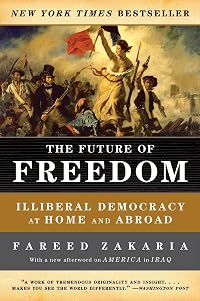
The Future of Freedom
by Fareed Zakaria
On This Page
Description
More democracy means more freedom. Or does it? American democracy is, in many people's minds, the model for the rest of the world. Fareed Zakaria points out that the American form of democracy is one of the least democratic in use today.Tags
Recommendations


Member Reviews
Zakaria builds an analytical approach to the viability of democracy as government elected by the majority of its people and often a constitutional liberalism codifying the rule of law, separation of powers, institutional check and balances, and most importantly individual rights around property, contracts, etc. This analysis suggests a sweet spot around GDP, a lack of a natural resource-based economy (full duplex integration with the global economy), and other basic elements such as a healthy middle class. You cannot have a true, liberal democracy without the rule of law. Examples of “illiberal” democracies are democratically elected autocrats as have happened in Egypt, Venezuela, etc.
This opus begins with a The History of Human show more Liberty from when first in Rome in created the rule of law. Actually, Zakaria finds Rome more important to the growth of democracy as know it than Greece. As the scholarly analysis of the lifespan of democracy and what are its fertile grounds proceeds, it becomes most thought provoking and surprising toward the end with a Too Much Democracy chapter.
Zakaria speaks to the general public discontent with the democratization of political process in the U.S. such as how the most democratic branch, Congress, is loathed, while non-democratic parts like the military and Supreme Court are. He speaks to how American (all?) democracy unchecked tends to commercialize and thus deplete the effectiveness of democracy leading to rampant referendum hijacking, constant fund-raising, and—most disconcerting—an absence of priority of public service by leading citizens. show less
This opus begins with a The History of Human show more Liberty from when first in Rome in created the rule of law. Actually, Zakaria finds Rome more important to the growth of democracy as know it than Greece. As the scholarly analysis of the lifespan of democracy and what are its fertile grounds proceeds, it becomes most thought provoking and surprising toward the end with a Too Much Democracy chapter.
Zakaria speaks to the general public discontent with the democratization of political process in the U.S. such as how the most democratic branch, Congress, is loathed, while non-democratic parts like the military and Supreme Court are. He speaks to how American (all?) democracy unchecked tends to commercialize and thus deplete the effectiveness of democracy leading to rampant referendum hijacking, constant fund-raising, and—most disconcerting—an absence of priority of public service by leading citizens. show less
This was book was just as good as "The Post-American World" by the same author, and even easier to understand. Here once again, Mr. Zakaria simplifies complex issues without sacrificing their essential components. Highlights include an excellent analysis of the Arab world: ""The Arab world is a political desert with no real political parties, no free press, and few pathways for dissent. As a result, the mosque became the place to discuss politics. As the only place that cannot be banned in Muslim societies, it is where all the hate and opposition towards the regimes collected and grew. The language of opposition became, in these lands, the language of religion. This combination of religion and politics has proven to be combustible." show more [from Chapter 4, "The Islamic Exception" (The Rise of Religion)]. Regarding the democratization of politics in the United States: "The more open a system becomes, the more easily it can be penetrated by money, lobbyists, and fanatics. What has changed in Washington is not that politicians have closed themselves off from the American people and are unwilling to hear their pleas. it is that they do scarcely anything but listen to the American people." (from Chapter 5, "Too Much of a Good Thing"). And finally, in reference to "the deregulation of democracy [having] gone too far": ".......... in poll after poll, when Americans are asked what public institutions they most respect, three bodies are always at the top of their list: the armed forces, the Federal Reserve System, and the Supreme Court. All three have one thing in common: they are insulated from public pressures and operate undemocratically." (from Conclusion: "The Way Out"). "The Future of Freedom" opens with a two-paragraph excerpt from "The Age of Fable or Stories of Gods and Heroes" by Thomas Bulfinch. This excerpt concerns Ulysses and his encounter with the Sirens. Although Mr. Zakaria "explains" this mythological metaphor in the final chapter of the book, this is my interpretation: that the USA has reached a dangerous crossroads at this time in history, and that careful and disciplined navigation will be necessary to help the country stay on course, renouncing the temptations resulting from the mixed blessings, and potentially dangerous loopholes, inherent in America's liberal democratic system. show less
Reason read: TIOLI #10 title with freedom
First off, this book is nonfiction, written by Fareed Zakaria (Indian/American) journalist, works for CNN and Washington Post. He is a political person and identifies as a centrist; Centrism is a political outlook or position involving acceptance or support of a balance of social equality and a degree of social hierarchy while opposing political changes that would result in a significant shift of society strongly to the left or the right. This book is a commentary of democracy and constitutionalism and the many forms of democracy. Illiberal Democracy restricts freedom of thought and behavior. The US was a constitutionalism country originally but that has been eroded over the years. This book show more covers all the problems with the US political system and how there really is no two party system. It is a system run by special interest and polls and how a lot of reform has actually caused the many losses to the original ideas that the country was founded on. The author also covers in depth all the countries of the world and the forms of government and what he considers the deciding factors of freedom. Easy money whether it is oil based or money given to countries by other countries does not promote movement toward freedom for the people. The book also covers religion; Christianity, secularism, Islam and its affect on government and governments effects on it.
I found it an interesting book but I can't say that I understood it. I do think there were gems but on the other hand, you can't pin any one thought down. The author does not like to take sides but rather provides information. I ended up feeling that there really is no hope of turning things around here in the US and voting really doesn't offer any leverage to influence change. Published in 2004 and still pretty much describes things as they continue to be. show less
First off, this book is nonfiction, written by Fareed Zakaria (Indian/American) journalist, works for CNN and Washington Post. He is a political person and identifies as a centrist; Centrism is a political outlook or position involving acceptance or support of a balance of social equality and a degree of social hierarchy while opposing political changes that would result in a significant shift of society strongly to the left or the right. This book is a commentary of democracy and constitutionalism and the many forms of democracy. Illiberal Democracy restricts freedom of thought and behavior. The US was a constitutionalism country originally but that has been eroded over the years. This book show more covers all the problems with the US political system and how there really is no two party system. It is a system run by special interest and polls and how a lot of reform has actually caused the many losses to the original ideas that the country was founded on. The author also covers in depth all the countries of the world and the forms of government and what he considers the deciding factors of freedom. Easy money whether it is oil based or money given to countries by other countries does not promote movement toward freedom for the people. The book also covers religion; Christianity, secularism, Islam and its affect on government and governments effects on it.
I found it an interesting book but I can't say that I understood it. I do think there were gems but on the other hand, you can't pin any one thought down. The author does not like to take sides but rather provides information. I ended up feeling that there really is no hope of turning things around here in the US and voting really doesn't offer any leverage to influence change. Published in 2004 and still pretty much describes things as they continue to be. show less
In this book, Mr. Zakaria differentiates between Liberal and Illiberal Democracies. The main idea is that taking free elections as the only aspect of democracy results in catastrophic results as in the case of Nazi Germany or Hamas in Gaza.
Instead, he says that liberal democracy, which implies individual rights, rule of law, separation of powers and free elections are essential requirements to have a successful state.
I found this book very interesting and the author's ideas clear and thought provoking. I think I'll look forward to reading more by Mr. Zakaria.
Instead, he says that liberal democracy, which implies individual rights, rule of law, separation of powers and free elections are essential requirements to have a successful state.
I found this book very interesting and the author's ideas clear and thought provoking. I think I'll look forward to reading more by Mr. Zakaria.
Zakaria is editor of Newsweek International and a frequent TV personality who has written a political science book called The Future of Freedom: Illiberal Democracy at Home and Abroad (©2003). The book has several things going in its favor. It has an index, notes and appears to try to bring in new published ideas into the arena of democratic political theory. It is not a strict expose of political theory in the classical sense and it is not a new voice making an original claim. It is a hybrid of both and that is one of the good things about the book. It keeps your attention, if only to see where he will go. But, he doesn’t go far.
The basic idea substantiating the book is that an economic middle class must exist and support a show more democracy lest it devolve into either tyranny or chaos. He does not delve into the chaos nor tyranny alternative too much other than to refer to Hitler or some Middle Eastern strongmen. He gives a short history of the Freedom starting with Constantine in Chapter 1, “the Christian Church is, in my view, the first important source of liberty in the West—and hence the world. It is highlights the central theme of this chapter, which is that liberty came to the West centuries before democracy. Liberty led to democracy and not the other way around”. Zakaria says that a strong middle class must allow itself to be taxed and therefore hold the upper class accountable to service the needs of all the populace. This is a simple idea (of societal legitimacy), which he supports with some recent historical examples.
Although he lives in New York City (jacket blurb), he presumes to know enough about California to say that it currently has the future of where American democracy may already become illiberal, meaning chaotic and illegitimate. He says that private money has replaced the traditional party system ‘of elders’ and inaugurated a state initiative process of referendums. He refers to state initiatives as ‘direct democracy,’ which they are definitely not. He says that Californians have emasculated their elected leaders by these initiatives but are shocked that they (state politicians) can do so little about the state’s problems (p. 195). What Zakaria hadn’t bothered to figure out is that the state is now run buy one party who themselves orchestrate new ballot initiatives to solidify their grasp of elected governance by imposing new debt on everyone. In the end, Zakaria resorts to duplicity to salvage his government of the elected, for the elected. He says that certain government positions have to be insulated from removal despite calls from the non-governmental population and other amateurs criticisms’. A few special people have to govern even if it displeases those governed because they see the long-term decisions necessary and not the short-term expedients. He calls this the “Less is More” democratic solution. This of course completely contradicts his main thesis about democracy, but is very Ivy League. I appreciated this touch very much. In classical political thought this is called the Noble Lie of Plato although Plato may have been proposing it as a failed idea. Zakaria proposes it as a virtue of advanced democracy. Even more advanced than Californians now are!
Zakaria says that Democracy in the West has taken centuries and that to push Asian or Middle Easterners too fast would be wrong and force them into illiberalism. Zakaria did not mention anything about the US military and its citizen soldiers. Our democracy is inextricably linked with these men and women. Zakaria’s presentation is great for politicians and aspiring politicians but weak on the reality of actual nation building along with the sacrifices necessary to produce it. Being taxed is not the greatest sacrifice one can make in a democratic nation. He assumes that the ‘power struggles’ which result in democracy as being internal and non-violent, basically political. Our country’s major interventions have been external and often times violent. One does not have to be a warmonger to understand US history and this historical aspect. Zakaria may be a naturalized US citizen, I don’t know.
Overall, this is not a very intellectually rigorous work. It need not be. It seems to be compare very well with other journalists and theorists who don’t have his breadth of ideas. This is a good resource if Zakaria ever taught a course and needed supplemental reading for the course syllabus. Except for Peter Jennings, all the people who wrote blurbs for the book jacket are favorably referred to in the book, hence the publishing value of a good name index. show less
The basic idea substantiating the book is that an economic middle class must exist and support a show more democracy lest it devolve into either tyranny or chaos. He does not delve into the chaos nor tyranny alternative too much other than to refer to Hitler or some Middle Eastern strongmen. He gives a short history of the Freedom starting with Constantine in Chapter 1, “the Christian Church is, in my view, the first important source of liberty in the West—and hence the world. It is highlights the central theme of this chapter, which is that liberty came to the West centuries before democracy. Liberty led to democracy and not the other way around”. Zakaria says that a strong middle class must allow itself to be taxed and therefore hold the upper class accountable to service the needs of all the populace. This is a simple idea (of societal legitimacy), which he supports with some recent historical examples.
Although he lives in New York City (jacket blurb), he presumes to know enough about California to say that it currently has the future of where American democracy may already become illiberal, meaning chaotic and illegitimate. He says that private money has replaced the traditional party system ‘of elders’ and inaugurated a state initiative process of referendums. He refers to state initiatives as ‘direct democracy,’ which they are definitely not. He says that Californians have emasculated their elected leaders by these initiatives but are shocked that they (state politicians) can do so little about the state’s problems (p. 195). What Zakaria hadn’t bothered to figure out is that the state is now run buy one party who themselves orchestrate new ballot initiatives to solidify their grasp of elected governance by imposing new debt on everyone. In the end, Zakaria resorts to duplicity to salvage his government of the elected, for the elected. He says that certain government positions have to be insulated from removal despite calls from the non-governmental population and other amateurs criticisms’. A few special people have to govern even if it displeases those governed because they see the long-term decisions necessary and not the short-term expedients. He calls this the “Less is More” democratic solution. This of course completely contradicts his main thesis about democracy, but is very Ivy League. I appreciated this touch very much. In classical political thought this is called the Noble Lie of Plato although Plato may have been proposing it as a failed idea. Zakaria proposes it as a virtue of advanced democracy. Even more advanced than Californians now are!
Zakaria says that Democracy in the West has taken centuries and that to push Asian or Middle Easterners too fast would be wrong and force them into illiberalism. Zakaria did not mention anything about the US military and its citizen soldiers. Our democracy is inextricably linked with these men and women. Zakaria’s presentation is great for politicians and aspiring politicians but weak on the reality of actual nation building along with the sacrifices necessary to produce it. Being taxed is not the greatest sacrifice one can make in a democratic nation. He assumes that the ‘power struggles’ which result in democracy as being internal and non-violent, basically political. Our country’s major interventions have been external and often times violent. One does not have to be a warmonger to understand US history and this historical aspect. Zakaria may be a naturalized US citizen, I don’t know.
Overall, this is not a very intellectually rigorous work. It need not be. It seems to be compare very well with other journalists and theorists who don’t have his breadth of ideas. This is a good resource if Zakaria ever taught a course and needed supplemental reading for the course syllabus. Except for Peter Jennings, all the people who wrote blurbs for the book jacket are favorably referred to in the book, hence the publishing value of a good name index. show less
Hind sight is much easier than foresight, so I tried to read beyond that and current political views, and enjoyed at least the first ½ to 2/3rds of the book very much. He makes a valiant and worthy effort in trying to bring to terms the unrelated terms of Freedom and Democracy, yet like so many falls back into the trap of proceeding on the assumption of one necessitating the other. He meets the other ultimate trap of assuming Democracy was designed to give us a nest of security, safety and be stability. When in fact it is just the opposite, our Republican Democracy was created to maintain our freedom, allow us to use our wings and to be a constantly changing order, to adapt to a constantly changing world, in fact to encourage it. One show more must remember Freedom is not free, it is a constant effort to find and maintain, stagnation is it’s greatest enemy.
I read another book by FZ; the name evades me, as I left it in my travels in China. I was enthralled by his insight, balance an analysis, this book is just more bias and opinionated with less insight.
I often revert to this sightless insight: Security is mostly superstition; it does not exist in nature. Life is either a daring adventure or nothing. – Helen Keller show less
I read another book by FZ; the name evades me, as I left it in my travels in China. I was enthralled by his insight, balance an analysis, this book is just more bias and opinionated with less insight.
I often revert to this sightless insight: Security is mostly superstition; it does not exist in nature. Life is either a daring adventure or nothing. – Helen Keller show less
very informative -- wish I had read the book when it first came out. am motivated to read his update. I found the last third of the book the most interesting when Zakaria goes into detail about how too much democracy might not necessarily be a good thing -- example = California, and how the state has put itself in difficult financial positions through voter decisions.
Good book.
Good book.
Members
- Recently Added By
Author Information

26+ Works 4,721 Members
Fareed Zakaria was born in Mumbai, India on January 20, 1964. He received a B.A. from Yale University and a Ph.D. in political science in 1993 from Harvard University. He was the managing editor of Foreign Affairs before becoming the editor of Newsweek International in 2000. He writes a weekly foreign affairs column in the publication and also has show more a weekly show on CNN called Fareed Zakaria GPS. Prior to that he worked as a news analyst from 2002 to 2007 on ABC's This Week with George Stephanopoulos and hosted the weekly show Foreign Exchange with Fareed Zakaria on PBS. He is the author of several books including The Future of Freedom, The Post-American World, and In Defense of a Liberal Education. (Bowker Author Biography) show less
Awards and Honors
Awards
Distinctions
Common Knowledge
- Canonical title
- The Future of Freedom
- Original publication date
- 2003
- Important places
- USA
Classifications
- Genres
- Politics and Government, Nonfiction, General Nonfiction, History, Philosophy
- DDC/MDS
- 321.8 — Society, government, & culture Political science Systems of governments and states Democratic government [formerly : Republic]
- LCC
- JC423 .Z35 — Political Science Political theory Political theory. The state. Theories of the state Forms of the state
- BISAC
Statistics
- Members
- 1,333
- Popularity
- 18,127
- Reviews
- 10
- Rating
- (3.88)
- Languages
- 11 — Czech, Dutch, English, Estonian, German, Italian, Polish, Portuguese, Russian, Spanish, Swedish
- Media
- Paper, Audiobook, Ebook
- ISBNs
- 33
- UPCs
- 1
- ASINs
- 12