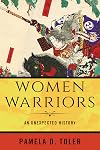
Women Warriors: An Unexpected History
by Pamela D. Toler
On This Page
Description
Who says women don’t go to war? From Vikings and African queens to cross-dressing military doctors and WWII Russian fighter pilots, these are the stories of women for whom battle was not a metaphor.The woman warrior is always cast as an anomaly—Joan of Arc, not GI Jane. But women, it turns out, have always gone to war. In this fascinating and lively world history, Pamela Toler not only introduces us to women who took up arms, she also shows why they did it and what happened when they show more stepped out of their traditional female roles to take on other identities.
These are the stories of women who fought because they wanted to, because they had to, or because they could. Among the warriors you’ll meet are:
* Tomyris, ruler of the Massagetae, who killed Cyrus the Great of Persia when he sought to invade her lands
* The West African ruler Amina of Hausa, who led her warriors in a campaign of territorial expansion for more than 30 years
* Boudica, who led the Celtic tribes of Britain into a massive rebellion against the Roman Empire to avenge the rapes of her daughters
* The Trung sisters, Trung Trac and Trung Nhi, who led an untrained army of 80,000 troops to drive the Chinese empire out of Vietnam
* The Joshigun, a group of 30 combat-trained Japanese women who fought against the forces of the Meiji emperor in the late 19th century
* Lakshmi Bai, Rani of Jhansi, who was regarded as the “bravest and best” military leader in the 1857 Indian Mutiny against British rule
* Maria Bochkareva, who commanded Russia’s first all-female battalion—the First Women’s Battalion of Death—during WWII
* Buffalo Calf Road Woman, the Cheyenne warrior who knocked General Custer off his horse at the Battle of Little Bighorn
* Juana Azurduy de Padilla, a mestiza warrior who fought in at least 16 major battles against colonizers of Latin America and who is a national hero in Bolivia and Argentina today
* And many more spanning from ancient times through the 20th century.
By considering the ways in which their presence has been erased from history, Toler reveals that women have always fought—not in spite of being women but because they are women. show less
Tags
Recommendations























Member Reviews
Asked about women in military combat most people will name Joan of Arc or perhaps the mythological Amazons. Some might recall the name Boadicea and a very few might even come up with Sen. Tammy Duckworth but the list would probably end there. Women who take part in any form of combat or military actions are considered exceptions or aberrations. When woman’s efforts are praised it is usually said that she fought like a man. Toler seeks to ameliorate that lack of knowledge with an account of numerous women who fought beside men (or sometimes led them). Her examples are taken from various eras and from all over the world. Rather than grouping the stories chronologically or geographically, Tober sorts them by type such as the Joan of Arc show more of ‘wherever’ or women who disguised themselves as men during wartime.
Women have taken part in battles since ancient times, sometimes out of necessity, sometimes willingly. Their stories are intriguing and many of them were unfamiliar to me. These stories were usually disbelieved or hidden (perhaps men didn’t want to share the glory). Isabella of Castile “developed an important innovation in military medicine: mobile field hospitals.” Sounds rather like MASH units. It was a woman, Buffalo Calf Road Woman, who knocked Gen. Custer off his horse at the battle of Little Bighorn. His death was attributed to the women on the battlefield but that would be too ignominious so we don’t hear about it.
In addition to the main stories there are short accounts found only in the footnotes, such as that of Pearl Witherington. During World War II, she parachuted into occupied France and led a network of saboteurs who severed German communications around Orleans. She was recommended for Britain’s Military Cross but only men can be given that honor for some reason. Instead she was offered an MBE, a civil honor, which she refused because “she had done nothing ‘civil’ in the war.”
Toler tries to throw in some humor: she points out an instance of mansplaining from March 1918 when William G. Shepherd tried to explain to a Russian woman soldier that because women have “potential motherhood” killing that kills the whole race. It begins to wear a bit thin though because she points out over and over how men denigrate or ignore women's contributions. (It's all too true but the stories speak for themselves.)
This is an easy to read, informative book rather than a dry, scholarly thesis. I have the impression that Toler uncovered so many of these amazing stories that she has enough material for a sequel. There are a few minor errors, e.g. a queen regent is not a queen regnant. There are both footnotes and end notes and the book is indexed. There are a few black and white drawings and photographs. show less
Women have taken part in battles since ancient times, sometimes out of necessity, sometimes willingly. Their stories are intriguing and many of them were unfamiliar to me. These stories were usually disbelieved or hidden (perhaps men didn’t want to share the glory). Isabella of Castile “developed an important innovation in military medicine: mobile field hospitals.” Sounds rather like MASH units. It was a woman, Buffalo Calf Road Woman, who knocked Gen. Custer off his horse at the battle of Little Bighorn. His death was attributed to the women on the battlefield but that would be too ignominious so we don’t hear about it.
In addition to the main stories there are short accounts found only in the footnotes, such as that of Pearl Witherington. During World War II, she parachuted into occupied France and led a network of saboteurs who severed German communications around Orleans. She was recommended for Britain’s Military Cross but only men can be given that honor for some reason. Instead she was offered an MBE, a civil honor, which she refused because “she had done nothing ‘civil’ in the war.”
Toler tries to throw in some humor: she points out an instance of mansplaining from March 1918 when William G. Shepherd tried to explain to a Russian woman soldier that because women have “potential motherhood” killing that kills the whole race. It begins to wear a bit thin though because she points out over and over how men denigrate or ignore women's contributions. (It's all too true but the stories speak for themselves.)
This is an easy to read, informative book rather than a dry, scholarly thesis. I have the impression that Toler uncovered so many of these amazing stories that she has enough material for a sequel. There are a few minor errors, e.g. a queen regent is not a queen regnant. There are both footnotes and end notes and the book is indexed. There are a few black and white drawings and photographs. show less
 This review was written for LibraryThing Early Reviewers.
Disclaimer: I won a copy via a giveaway on Librarything.
My brother reads quite a bit of John Keegan. I’m not entirely sure if he has read every book Keegan wrote, but it must be close. Every so often I think I should read Keegan, but then I read something and go, “yeah, he might be a brilliant dude, but he sounds like a bit of a dick”. Years ago, it was his comments during the case Irving brought against Deborah Lipstadt and Penguin books. Recently, it is the comments of his that Dr. Toler quotes in this excellent book about women warriors. Apparently, Keegan cannot conceive of women ever fighting.
Yes, it made me gnash my teeth too.
Dr Toler’s book is, in part, a rebuttal to those like Keegan or those, as Toler points out show more more than once, that presume one thing about warrior grave goods in a grave of a woman and make a totally different presumption about the use of weapons in a man’s grave.
But it is also an analysis of why women who fight got written out of history in some cases. So that bit about the Viking warrior that was really a woman, is in this book.
The women that Toler writes about come from across the world, except for Australia for some reason. The number of women mentioned by name is a vast, and Toler covers Asia, Africa, and South America as well as Europe. When she deals with North and South America, Toler includes Indigenous women. Therefore, we have a discussion about Molly Pitcher but also Nanye’hi (White Rose) who lead a Cherokee victory against the Creek. (Don’t worry Buffalo Calf road Woman is also here).
But the book isn’t just about women warriors, it is also about how cultures and society saw them. For instance, the motivation for a woman warrior in China, say, would be different than that of a woman of Europe. Japanese warrior women also composed poetry after fighting in sieges.
And the footnotes, Toler’s footnotes are a joy to read.
The book is divided, loosely, into type of warrior and type of popular warrior in history. So, there is a chapter on Joan of Arc and her sisters, but then on women in siege warfare. The book covers the ancient world tilt the end of the Second World War, and serves as a history to illustrate that women in warfare isn’t something new.
While famous women warriors make appearances, such as Queen Ninja, Joan of Arc and Mulan, Toler includes lesser known women such as Kenau Simonsdochet Hasslaer and Cathy Williams, the first African-American woman to join the Armed Forces. She disguised herself as a man and then they refused to give her a pension.
When dealing with woman of color who exist in a white society, Toler does not forget to include racism as a factor for the treatment of the women in terms of historical texts. This is particularly true when she is discussing Buffalo Calf Road Woman.
Toler presents an entertaining, informative read that cements women’s place on the battlefields of history. show less
My brother reads quite a bit of John Keegan. I’m not entirely sure if he has read every book Keegan wrote, but it must be close. Every so often I think I should read Keegan, but then I read something and go, “yeah, he might be a brilliant dude, but he sounds like a bit of a dick”. Years ago, it was his comments during the case Irving brought against Deborah Lipstadt and Penguin books. Recently, it is the comments of his that Dr. Toler quotes in this excellent book about women warriors. Apparently, Keegan cannot conceive of women ever fighting.
Yes, it made me gnash my teeth too.
Dr Toler’s book is, in part, a rebuttal to those like Keegan or those, as Toler points out show more more than once, that presume one thing about warrior grave goods in a grave of a woman and make a totally different presumption about the use of weapons in a man’s grave.
But it is also an analysis of why women who fight got written out of history in some cases. So that bit about the Viking warrior that was really a woman, is in this book.
The women that Toler writes about come from across the world, except for Australia for some reason. The number of women mentioned by name is a vast, and Toler covers Asia, Africa, and South America as well as Europe. When she deals with North and South America, Toler includes Indigenous women. Therefore, we have a discussion about Molly Pitcher but also Nanye’hi (White Rose) who lead a Cherokee victory against the Creek. (Don’t worry Buffalo Calf road Woman is also here).
But the book isn’t just about women warriors, it is also about how cultures and society saw them. For instance, the motivation for a woman warrior in China, say, would be different than that of a woman of Europe. Japanese warrior women also composed poetry after fighting in sieges.
And the footnotes, Toler’s footnotes are a joy to read.
The book is divided, loosely, into type of warrior and type of popular warrior in history. So, there is a chapter on Joan of Arc and her sisters, but then on women in siege warfare. The book covers the ancient world tilt the end of the Second World War, and serves as a history to illustrate that women in warfare isn’t something new.
While famous women warriors make appearances, such as Queen Ninja, Joan of Arc and Mulan, Toler includes lesser known women such as Kenau Simonsdochet Hasslaer and Cathy Williams, the first African-American woman to join the Armed Forces. She disguised herself as a man and then they refused to give her a pension.
When dealing with woman of color who exist in a white society, Toler does not forget to include racism as a factor for the treatment of the women in terms of historical texts. This is particularly true when she is discussing Buffalo Calf Road Woman.
Toler presents an entertaining, informative read that cements women’s place on the battlefields of history. show less
This review was written for LibraryThing Early Reviewers.Fascinating peek into the world of women as warriors. Global, covering millennia of human history. The author spent years gathering this information, with copious footnotes, notes, and bibliography. The oldest female warriors were no doubt nomadic women of the Eurasian steppes; we know this from the burial goods archaeologists have found in their kurgans, or burial mounds. This holds true for the Scythians and Sarmatians of a slightly later era. In ancient Greece, we have Telesilla of Argos who led women and fought off Spartans[!] in defense of their city. There are the two Artemisias: one fought as admiral of Persian fleet in Greco-Persian War and the other fought for her native city against Rhodes. In ancient Britain, Boudica led her show more people against the Roman army and nearly defeated them. In India, history nearly repeated itself where Rani Lakshmi Bai led the people of her princely state against the British in the Sepoy Mutiny of 1857. There are examples from Africa ands Asia. On the latter continent, Tomoe Gozen, a Samurai [the name pertains to a certain social class--of both sexes], fought in the 12th century Gempei War between two clans. She is pictured on the cover of the book. Warrior queens: Isabel of Castile against Granada and her daughter Catherine of Aragon. The latter is more famous for more than just Henry VIII's wife and her fate; she directed a war with Scotland as Henry's regent, while he was fighting on the Continent. Zenobia fought Romans, setting up her [short-lived] kingdom of Palmyra [in Present-day Syria]. Cleopatra commanded the Egyptian Navy in the battle between Marc Antony and Octavian. There are many women who disguised themselves as men and fought, their sex only being revealed when they were wounded: Nadezha Durova who fought for Russia against Napoleon, the many women who fought in disguise during the American Civil War. I'd say a novel I read recently:[Die Tatarin] about a Tatar girl who disguises herself and fights against Sweden in Peter I of Russia's time, isn't so far-fetched, then.
This was an enthralling and very readable set of information about women warriors throughout history; this is a book meant to be dipped into again and again.
Highly recommended. show less
This was an enthralling and very readable set of information about women warriors throughout history; this is a book meant to be dipped into again and again.
Highly recommended. show less
This review was written for LibraryThing Early Reviewers.Count me among the fans of "Women Warriors". As another reviewer states, this wide-ranging book goes beyond the typical profiles of fabulous females (which, given how long women have been left in the shadows, are important in and of themselves). Toler's history, however, also demands -- and delivers -- a critical look at when and why women have been relegated to the margins, how they actually took a greater role in military narratives than people realize, and how their contributions have been erased, minimized, explained away or turned into myth.
My one complaint is that I wish "Women Warriors" were longer, but that is purely my greed for more history and context. I know some reviewers object to the footnotes, most notably Toler's show more comments about bias; given the persistence of misogyny (as is clear from even a glance at Twitter), I personally feel like her criticisms bear repeating, and understanding. show less
My one complaint is that I wish "Women Warriors" were longer, but that is purely my greed for more history and context. I know some reviewers object to the footnotes, most notably Toler's show more comments about bias; given the persistence of misogyny (as is clear from even a glance at Twitter), I personally feel like her criticisms bear repeating, and understanding. show less
This review was written for LibraryThing Early Reviewers.Just as Women’s History Month closes for 2019, Women Warriors: An Unexpected History joins my research bookshelf with a handful of academically rigorous books. These books on “women doing unexpected things” include surveys of warrior queens, music composers, mathematicians and philosophers, as well as dozens of biographies of famous, accomplished women. I have several more popular history books on scandalous women, bad princesses, and overlooked scientists. The latter seem to dominate the marketplace. I enjoy their breezy modern take while introducing the reader to (mostly) forgotten women.
Needless to say, this was not an “unexpected history” for me—at lease in terms of the female historical figures. From the mythical Mulan show more to the female Dahomean King’s Guards (likely inspiration for the all femalel guards of the Black Panther movie), I was aware of most of Toler’s subjects. What was unexpected—and most welcome!—was the analysis and in-depth research. Unlike most authors of these survey books, Toler is an academic.
Thankfully she doesn’t write like one. Her prose is clear and readable.
Toler organizes her material into eight chapters with titles such as “Don’t Mess with Mama” and “Her Father’s Daughter.” In each chapter she surveys typical women warriors, from across time and cultures, who fit the title. She puts their decision to fight in the context of the times and explores the consequences of taking these dramatic actions. After every two survey chapters, a several-page “Checkpoint” covers a single subject in more detail. Substantial footnotes provide additional information and source references.
Toler concludes her book by asking the question: Are these warrior women “insignificant exceptions”? Most academics and historical military commanders felt so. Modern US military leaders used that to argue against allowing women in combat roles. They argued this at a time when Israeli women were drafted and served with their male counterparts. They argued this long after all female battalions fought in WWI and WWII. They argued this long after Soviet “Night Witches”—an all female bomber squadron (women pilots, navigators, and maintenance crews)—terrorized the Nazis on the Eastern front. Several ex-military women ran for US congress in 2018, highlighting their impressive service records, and many won. The bravery and accomplishments of modern women in combat around the world should forever lay that argument to rest.
Toler answers her own question: “Exceptions within the context of their time and place? Yes. Exceptions over the scope of human history? Not so much. Insignificant? Hell no!”
Highly recommended. Check out Author Pamela D. Toler talking about her book Women Warriors in the video below.
Note: I received a copy of this book from the publisher in exchange for an honest review. show less
Needless to say, this was not an “unexpected history” for me—at lease in terms of the female historical figures. From the mythical Mulan show more to the female Dahomean King’s Guards (likely inspiration for the all femalel guards of the Black Panther movie), I was aware of most of Toler’s subjects. What was unexpected—and most welcome!—was the analysis and in-depth research. Unlike most authors of these survey books, Toler is an academic.
Thankfully she doesn’t write like one. Her prose is clear and readable.
Toler organizes her material into eight chapters with titles such as “Don’t Mess with Mama” and “Her Father’s Daughter.” In each chapter she surveys typical women warriors, from across time and cultures, who fit the title. She puts their decision to fight in the context of the times and explores the consequences of taking these dramatic actions. After every two survey chapters, a several-page “Checkpoint” covers a single subject in more detail. Substantial footnotes provide additional information and source references.
Toler concludes her book by asking the question: Are these warrior women “insignificant exceptions”? Most academics and historical military commanders felt so. Modern US military leaders used that to argue against allowing women in combat roles. They argued this at a time when Israeli women were drafted and served with their male counterparts. They argued this long after all female battalions fought in WWI and WWII. They argued this long after Soviet “Night Witches”—an all female bomber squadron (women pilots, navigators, and maintenance crews)—terrorized the Nazis on the Eastern front. Several ex-military women ran for US congress in 2018, highlighting their impressive service records, and many won. The bravery and accomplishments of modern women in combat around the world should forever lay that argument to rest.
Toler answers her own question: “Exceptions within the context of their time and place? Yes. Exceptions over the scope of human history? Not so much. Insignificant? Hell no!”
Highly recommended. Check out Author Pamela D. Toler talking about her book Women Warriors in the video below.
Note: I received a copy of this book from the publisher in exchange for an honest review. show less
This review was written for LibraryThing Early Reviewers.Pamela Toler has written an extraordinary book about the role women have played across history as warriors, i.e., women who go to war for their clans, tribes, home, countries. She also discusses how these women have been written out of the history books by, for example, archaeologists who assumed that because a woman was buried with tradition weapons of war, those weapons must have belonged to a man, or historians who have reduced women warriors to, in some cases, a single sentence in a paragraph discussing other things or a footnote in the back of the book.
This book is very well written in an accessible way without ever becoming overly scholarly and thus off putting to the casual reader. It deserves a very large audience, but may not show more get what it deserves because of pre-conceived notions about the role of women in any society, which seldom includes the descriptor “warrior.” Even her footnotes are well-written and informative.
The author tells the stories of dozens of warriors across the ages starting with Tomyris, who in 530 BCE, led her troops into battle against Cyrus the Great of Persia and vanquished the Persians from the battlefield.
Toler ends descriptions of women warriors with the telling of the story of the excavation, in 1871, of a Viking warrior who was discovered in a “well-furnished” grave with a sword, spear, armor piercing arrows, a battle knife, two shields, and two horses. This warrior became known as the Birka man. In 2017, DNA analysis of the Birka man proved that he was a she. And despite the evidence to the contrary, male archaeologist and historians continued to defend the assumption that the body in the Viking grave was male.
This book should be required reading for any women’s history class. Every woman should want to read this book. It is enlightening not only about how many woman warriors there have been, but how often these women were kept from their rightful place in history books. show less
This book is very well written in an accessible way without ever becoming overly scholarly and thus off putting to the casual reader. It deserves a very large audience, but may not show more get what it deserves because of pre-conceived notions about the role of women in any society, which seldom includes the descriptor “warrior.” Even her footnotes are well-written and informative.
The author tells the stories of dozens of warriors across the ages starting with Tomyris, who in 530 BCE, led her troops into battle against Cyrus the Great of Persia and vanquished the Persians from the battlefield.
Toler ends descriptions of women warriors with the telling of the story of the excavation, in 1871, of a Viking warrior who was discovered in a “well-furnished” grave with a sword, spear, armor piercing arrows, a battle knife, two shields, and two horses. This warrior became known as the Birka man. In 2017, DNA analysis of the Birka man proved that he was a she. And despite the evidence to the contrary, male archaeologist and historians continued to defend the assumption that the body in the Viking grave was male.
This book should be required reading for any women’s history class. Every woman should want to read this book. It is enlightening not only about how many woman warriors there have been, but how often these women were kept from their rightful place in history books. show less
The phrase warrior women evokes many images, most with “boob” armor as a prominent feature however history tells a different story. Women Warriors: An Unexpected History by Pamela D. Toler covers millennia of historical records and new archaeological discoveries from Shang China to modern day examining the women who went into battle in numerous ways.
Toler covers not only the more famous warriors like Boudica, Joan of Arc, Lakshmi Bai, Hua Mulan, the Trung Sisters, and Tomoe Gozen among others but also spread her reach to lesser known historical figures of prominence as well as “every day” women. Toler brings to light many reasons why women went to war including adventure, defense of family and home, and surprising cultural as show more well. Also examined is how contemporary and modern-day historical accounts of these women use many of the same phrases like “she fought like a man” thus bring to the forefront the seemingly universal gender role that war is to many societies—though not all. Many of the women that Toler relates in her book, disguise themselves in men’s clothing and several continued using men’s clothing after their military service and one was “crossdressing” before she entered military service. Finally Toler covered the recent turn in archaeological findings that not all burials that contained weapons were men, but many women and the raging debate on if those women were actual warriors and if those weapons were ceremonial—though if men were buried with jewelry it showed they were rich.
The book’s text covered roughly 210 pages, but many of those pages having a considerable amount of footnotes that were both positive and negative in the overall quality of the book. Toler does focus on the famous few warriors, but spreads her eye to all parts of the globe and showed the diversity and commonality that all women warriors had. Her criticism of how women warriors were depicted over the millennia and across cultures showed many of the same trends with relatively few exceptions—China. However the book is far from perfect and while Toler packed a lot in 210 pages, she kept on repeating the same things over and over again including in her numerous footnotes. It was one thing to say something critically in a witty and sarcastically way once thus making an impression and making the reader aware to look for future instances of what Toler was criticizing, but to repeatedly make wisecracks over the same criticisms again and again just resulted in them losing their effect and become tiresome. Unfortunately the many repeated comments and footnotes makes one wonder if Toler had cut them out, if she could not have moved some of the interesting things she put in the footnotes because she “ran out of space” into the actual text if the book wouldn’t have come out better.
The overall Women Warriors: An Unexpected History is a nice primer and introduction to the many women who fought throughout history and the complex history surrounding them. While Pamela D. Toler does a wonderful job in bringing many women to the spotlight, her repeated phrases—including overdone wittiness—and almost overly expansive footnotes take away from the quality of the book. show less
Toler covers not only the more famous warriors like Boudica, Joan of Arc, Lakshmi Bai, Hua Mulan, the Trung Sisters, and Tomoe Gozen among others but also spread her reach to lesser known historical figures of prominence as well as “every day” women. Toler brings to light many reasons why women went to war including adventure, defense of family and home, and surprising cultural as show more well. Also examined is how contemporary and modern-day historical accounts of these women use many of the same phrases like “she fought like a man” thus bring to the forefront the seemingly universal gender role that war is to many societies—though not all. Many of the women that Toler relates in her book, disguise themselves in men’s clothing and several continued using men’s clothing after their military service and one was “crossdressing” before she entered military service. Finally Toler covered the recent turn in archaeological findings that not all burials that contained weapons were men, but many women and the raging debate on if those women were actual warriors and if those weapons were ceremonial—though if men were buried with jewelry it showed they were rich.
The book’s text covered roughly 210 pages, but many of those pages having a considerable amount of footnotes that were both positive and negative in the overall quality of the book. Toler does focus on the famous few warriors, but spreads her eye to all parts of the globe and showed the diversity and commonality that all women warriors had. Her criticism of how women warriors were depicted over the millennia and across cultures showed many of the same trends with relatively few exceptions—China. However the book is far from perfect and while Toler packed a lot in 210 pages, she kept on repeating the same things over and over again including in her numerous footnotes. It was one thing to say something critically in a witty and sarcastically way once thus making an impression and making the reader aware to look for future instances of what Toler was criticizing, but to repeatedly make wisecracks over the same criticisms again and again just resulted in them losing their effect and become tiresome. Unfortunately the many repeated comments and footnotes makes one wonder if Toler had cut them out, if she could not have moved some of the interesting things she put in the footnotes because she “ran out of space” into the actual text if the book wouldn’t have come out better.
The overall Women Warriors: An Unexpected History is a nice primer and introduction to the many women who fought throughout history and the complex history surrounding them. While Pamela D. Toler does a wonderful job in bringing many women to the spotlight, her repeated phrases—including overdone wittiness—and almost overly expansive footnotes take away from the quality of the book. show less
This review was written for LibraryThing Early Reviewers.Members
- Recently Added By
Lists

Feminism
167 works; 4 members
Author Information

10+ Works 483 Members
Pamela D. Toler goes beyond the familiar boundaries of American history to tell stories from other parts of the world, as well as history from the other side of the battlefield, the gender line, or the color bar. She is the author of The Heroines of Mercy Street: The Real Nurses of the Civil War, among other books. Her work has appeared in Aramco show more World, Calliope, History Channel Magazine, MHQ: The Quarterly Journal of Military History, and on Time.com. show less
Awards and Honors
Notable Lists
Common Knowledge
- People/Characters
- Boudica; Trưng Trắc; Trưng Nhị; Amina of Zazzau; Tomyris; Buffalo Calf Road Woman (show all 10); Lakshmi Bai; Maria Bochkareva; Juana Azurduy de Padilla; The Joshigun
- Important events
- Tomyris's Defeat of Cyrus (6th Century BCE); The Trung Sisters' Uprising (40&ndash | 43 CE); Boudica's Rebellion (60&ndash | 61 CE); Battle of Little Bighorn (1876); Indian Rebellion (1857); First Women's Battalion of Death (1917)
- Epigraph
- "I did not come to the front to give it
the once over with a cleaning rag in my hand."
Manolita, a partisana in the Spanish Civil War - First words
- Introduction
"Women Do
Not Fight"
When Antonia Fraser's Warrior Queens came out in 1988, I greeted it with delight.
Chapter One
Don't Mess
With Mama
In 1488, Italian noblewoman Caterina Sforza (1462-1509), known as the Tigress of Forli, was besieged in the city's main fortress, the Rocca di Ravaldino. Members of the rival Orsi... (show all) family had murdered her husband, Girolamo Riarlo, and held her children hostage. - Last words
- (Click to show. Warning: May contain spoilers.)Exceptions within the context of their time and place? Yes. Exceptions over the scope of human history? Not so much. Insignificant? Hell, no!
- Blurbers
- Letts, Elizabeth; Rioux, Anne Boyd; Mayor, Adrienne; Bowers, Paige
- Original language
- English
Classifications
- Genres
- History, Nonfiction, General Nonfiction, Sexuality and Gender Studies, Biography & Memoir
- DDC/MDS
- 355.0092 — Society, government, & culture Public administration & military science The Military - Land, Air & Sea / Warfare Biography And History Biography
- LCC
- UB416 .T65 — Military Science Military administration Military administration Minorities, women, etc. in armed forces
- BISAC
Statistics
- Members
- 181
- Popularity
- 181,033
- Reviews
- 21
- Rating
- (3.60)
- Languages
- English
- Media
- Paper, Audiobook, Ebook
- ISBNs
- 8
- ASINs
- 1