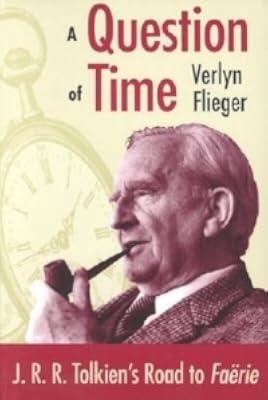
A Question of Time: J.R.R. Tolkien's Road to Faerie
by Verlyn Flieger
On This Page
Description
J.R.R. Tolkien's The Hobbit, The Lord of the Rings, and Silmarillion have long been recognized as among the most popular fiction of the twentieth century, and most critical analysis of Tolkien has centered on these novels. Granted access by the Tolkien estate and the Bodleian Library in Oxford to Tolkien's unpublished writings, Verlyn Flieger uses them here to shed new light on his better known works, revealing a new dimension of his fictive vision and giving added depth of meaning to his show more writing. Tolkien's concern with time--past and present, real and "faerie"--captures the wonder and peril of travel into other worlds, other times, other modes of consciousness. Reading his work, we "fall wide asleep" into a dream more real than ordinary waking experience, and emerge with a new perception of the waking world. Flieger explores Tolkien's use of dream as time-travel in his unfinished stories The Lost Road and The Notion Club Papers as well as in The Lord of the Rings and his shorter fiction and poetry. Analyzing Tolkien's treatment of time and time-travel, Flieger shows that he was not just a mythmaker and writer of escapist fantasy but a man whose relationship to his own century was troubled and critical. He achieved in his fiction a double perspective of time that enabled him to see in the mirror of the past the clouded reflection of the present. show lessTags
Recommendations










Member Reviews
Verlyn Flieger is one of the great Tolkien scholars, with a wealth of knowledge that has enriched many students of the maker of Middle-earth. But in this one case, I think Flieger has gone somewhat astray. I don't think Flieger understands Faërie.
This is not a rare thing. Faërie is the land of folklore -- but folklore has moved away from it. Our society as a whole dropped the medieval Romance -- until Tolkien himself successfully revived the genre. These days, we don't read The Franklin's Tale or Sir Orfeo; we read Agatha Christie or F. Scott Fitzgerald -- novels, not romances; stories of people, not motifs. Even the ballads show this trend -- the supernatural is key to "Thomas Rymer" or "Tam Lin," very old songs indeed, or even to a show more murder ballad like "The Twa Sisters" (where a murdered girl's corpse becomes a musical instrument that tells the tale of her murder). But newer ballads of murder just tell of "bloody knives" or poison, or if two lovers are separated, it's not because of a Woman of the Elves, it's because one of the lovers' mothers doesn't want X, who doesn't have any money, marrying her precious child!
Flieger looks at the effects of time, but I don't think you can understand time in Faërie unless you hear of Thomas the Rhymer being taken away by the Queen of Elfland, and returned after a long stay that takes almost no time. Or of Sir Orfeo watching Heurodis being captivated (in the true sense: taken captive) by the King of Faërie beneath a "ympe tree" where worlds cross, and riding in the King's hunt until Orfeo's music wins her release. Tolkien knew. Tolkien saw the barren lands left by the ancient plagues; he dreamed of the water sweeping all before it; he knew how thin was the line between our world and... that other world. (No, that other world does not really exist, but it lives in our hearts and our folktales.)
Of course I can't prove I'm right. Flieger knows more about Tolkien's life and works than I do. But where she sees allegory, or at least "applicability," I see the themes that went into so many folktales, because they speak to some ancient yearning in us -- a yearning that Tolkien so brilliantly captured. I can't help but think that this book is too modern a take on an ancient mystery. show less
This is not a rare thing. Faërie is the land of folklore -- but folklore has moved away from it. Our society as a whole dropped the medieval Romance -- until Tolkien himself successfully revived the genre. These days, we don't read The Franklin's Tale or Sir Orfeo; we read Agatha Christie or F. Scott Fitzgerald -- novels, not romances; stories of people, not motifs. Even the ballads show this trend -- the supernatural is key to "Thomas Rymer" or "Tam Lin," very old songs indeed, or even to a show more murder ballad like "The Twa Sisters" (where a murdered girl's corpse becomes a musical instrument that tells the tale of her murder). But newer ballads of murder just tell of "bloody knives" or poison, or if two lovers are separated, it's not because of a Woman of the Elves, it's because one of the lovers' mothers doesn't want X, who doesn't have any money, marrying her precious child!
Flieger looks at the effects of time, but I don't think you can understand time in Faërie unless you hear of Thomas the Rhymer being taken away by the Queen of Elfland, and returned after a long stay that takes almost no time. Or of Sir Orfeo watching Heurodis being captivated (in the true sense: taken captive) by the King of Faërie beneath a "ympe tree" where worlds cross, and riding in the King's hunt until Orfeo's music wins her release. Tolkien knew. Tolkien saw the barren lands left by the ancient plagues; he dreamed of the water sweeping all before it; he knew how thin was the line between our world and... that other world. (No, that other world does not really exist, but it lives in our hearts and our folktales.)
Of course I can't prove I'm right. Flieger knows more about Tolkien's life and works than I do. But where she sees allegory, or at least "applicability," I see the themes that went into so many folktales, because they speak to some ancient yearning in us -- a yearning that Tolkien so brilliantly captured. I can't help but think that this book is too modern a take on an ancient mystery. show less
http://nwhyte.livejournal.com/2540819.html
This is another of Flieger's lucid explorations of Tolkien's thought, this time looking at his interpretation of Time, as evidenced both by the time distortions experienced by visitors to the fairy realm (be it the Fellowship in Lothlórien or Smith when he leaves Wootton Major) and by the prophetic dreams revealed to many of his characters, Frodo most of all. This is all tied in very nicely with the received wisdom of time-travel between the wars - I must admit I tend to think of it in terms of Wells and Doctor Who, vessels voyaging through the timelines, but there is also the tradition of Dunne and Priestley, which Tolkien was much more comfortable with and which reached its peak in his show more unpublished The Notion Club Papers. This book, slim as it is, will be a lot more comprehensible if you've already absorbed the huge volumes of the History of Middle Earth. show less
This is another of Flieger's lucid explorations of Tolkien's thought, this time looking at his interpretation of Time, as evidenced both by the time distortions experienced by visitors to the fairy realm (be it the Fellowship in Lothlórien or Smith when he leaves Wootton Major) and by the prophetic dreams revealed to many of his characters, Frodo most of all. This is all tied in very nicely with the received wisdom of time-travel between the wars - I must admit I tend to think of it in terms of Wells and Doctor Who, vessels voyaging through the timelines, but there is also the tradition of Dunne and Priestley, which Tolkien was much more comfortable with and which reached its peak in his show more unpublished The Notion Club Papers. This book, slim as it is, will be a lot more comprehensible if you've already absorbed the huge volumes of the History of Middle Earth. show less
Ratings
Members
- Recently Added By
Author Information

31+ Works 1,617 Members
Verlyn Flieger's books on Tolkien include Splintered Light, A Question of Time, Interrupted Music, and Green Suns and Farie (all published by The Kent State University Press). With Carl Hostetter she edited Tolkien's Legendarium and with Douglas A. Anderson edited Tolkien's essay On Fairy-stories. With David Bratman and Michael D. C. Drout she show more edits the yearly journal Tolkien Studies. She has published two fantasy novels, Pig Tale and The Inn at Corbies' Caww; an Arthurian novella, "Avilion" in The Doom of Camelot; and two short stories, "Green Hill Country," in Seekers of Dreams, and "Igraine at Tintagel," in Amazing Graces. show less
Awards and Honors
Awards
Common Knowledge
- Original publication date
- 1997
- People/Characters
- J. R. R. Tolkien; Alboin Errol; James Barrie; Tom Bombadil; George du Maurier; J. W. Dunn (show all 13); Eriol; Frodo Baggins; Galadriel; Wilfrid Jeremy; C. S. Lewis; Arundel Lowdham; Christopher Tolkien
- Important places
- Faërie; Lothlórien; Númenor; The Shire
- Epigraph
- And see ye not yon bonny road
That winds about yon fernie brae?
That is the road to fair Elfland,
Where thou and I this nght maun gae.
--"Thomas Rymer"
... (show all)...certainly there was an Eden on this very unhappy earth. We all long for it, and we are constantly glimpsing it: our whole nature at its best and least corrupted, its gentlest and most humane, is still soaked with the sense of "exile."
--J. R. R. R. Tolkien
And as he were of faierie
He scheweth him tofore here yhe.
--John Gower, Confession Amantis - First words
- Introduction
J. R. R. Tolkien's academic career spanned a period of nearly forty years, from his first appointment in 1920 as Reader in English Language at Leeds University until his 1959 retirement from the positio... (show all)n of Merton Professor of English Language and Literature at Oxford. - Blurbers
- Hammond, Wayne G.
Classifications
- Genres
- Nonfiction, Literature Studies and Criticism, Fiction and Literature, Fantasy
- DDC/MDS
- 828.91209 — Literature & rhetoric English & Old English literatures English miscellaneous writings English miscellaneous writings 1900- English miscellaneous writings 1900-1999 English miscellaneous writings 1900-1945 Individual authors not limited to or chiefly identified with one specific form.
- LCC
- PR6039 .O32 .Z646 — Language and Literature English English Literature 1900-1960
- BISAC
Statistics
- Members
- 129
- Popularity
- 254,245
- Reviews
- 2
- Rating
- (4.15)
- Languages
- English
- Media
- Paper
- ISBNs
- 2