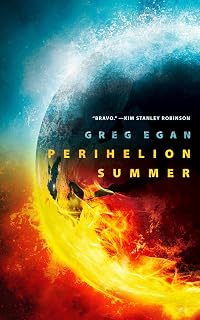
Perihelion Summer
by Greg Egan
On This Page
Description
Taraxippus is coming ; a black hole one-tenth the mass of the sun that will change the solar system forever. Matt and his friends board a mobile aquaculture rig, self-sustaining in food, power, and fresh water.Tags
Recommendations








Member Reviews
As calamity looms in Earth's near future, some people lay plans to escape death, but most do nothing, in denial about the danger. I'm not reviewing this morning's newspaper; Australian author Greg Egan's latest novel is both a thriller and a parable about climate change. Since it's in part a thriller, please note that I'm revealing a lot about the plot, behind the spoiler tag.
A primordial black hole, 1/10 the mass of the sun, is approaching the solar system. Astronomers have only an approximate trajectory at first, and can't say how close to Earth the body, which they've named "Taraxippus," will pass. Matt will ride out the visit in mid-ocean, on an innovative ship designed to be nearly self-sufficient, using aquaculture to provide a show more sustainable food source. He and his partners in the venture will be safe from any 50-meter tidal surges Taraxippus may cause. Most fellow Australians Matt talks to treat him as an eccentric - the danger seems remote to them.
And the deniers appear to win their bet; Taraxippus' maximum tides are indeed small. ButEarth's orbit has been changed, becoming more elliptical. Winters in the southern hemisphere will be much colder, bringing unaccustomed snow and ice.
And southern summers will be very much hotter.
Most of the book follows the efforts of Matt, his shipmates, and others, to flee as killing daytime heat and humidity mount. The rich, northern-hemisphere countries will take only a few refugees. Antarctica becomes the destination for thousands at sea. The fate of hundreds of millions left behind is indicated by Matt's expedition to Perth, Australia, searching for his sister and parents: he finds a dark, burnt-out city, passable only at night, with small crowds of people huddled in the shrinking number of air-conditioned buildings, awaiting the coming day's deadly rise in temperature. In this second round of disaster, denial is irrelevant - most people have nowhere to go.
Your standard technothriller writer might spend hundreds of pages on the horror of this mass dying. In this 200-page novella, Egan mostly leaves that to our imagination. Since this is Egan, the reader knows that he's worked out the astrodynamics of the black hole encounter and Earth's new orbit, as well as the clever mechanical scheme of the aquaculture ship. Egan also refuses a common thriller trope. While Matt is in Perth, the ship is hijacked by gun-toting men. Matt and his fellows work out a plan to kill the hijackers, boarding the vessel secretly - only to learn that their women shipmates have negotiated the hijackers' withdrawal, with no one harmed. The point is not excitement, but the rational human mind making the best of circumstances, on a planet where severe global warming has been advanced by centuries.
Would our minds be more concentrated by danger if the worst threat were immediate, not decades in the future? Egan is doubtful. But we, at least, facing climate change, have one advantage over his characters.
We can still do something. show less
A primordial black hole, 1/10 the mass of the sun, is approaching the solar system. Astronomers have only an approximate trajectory at first, and can't say how close to Earth the body, which they've named "Taraxippus," will pass. Matt will ride out the visit in mid-ocean, on an innovative ship designed to be nearly self-sufficient, using aquaculture to provide a show more sustainable food source. He and his partners in the venture will be safe from any 50-meter tidal surges Taraxippus may cause. Most fellow Australians Matt talks to treat him as an eccentric - the danger seems remote to them.
And the deniers appear to win their bet; Taraxippus' maximum tides are indeed small. But
And southern summers will be very much hotter.
Most of the book follows the efforts of Matt, his shipmates, and others, to flee as killing daytime heat and humidity mount. The rich, northern-hemisphere countries will take only a few refugees. Antarctica becomes the destination for thousands at sea. The fate of hundreds of millions left behind is indicated by Matt's expedition to Perth, Australia, searching for his sister and parents: he finds a dark, burnt-out city, passable only at night, with small crowds of people huddled in the shrinking number of air-conditioned buildings, awaiting the coming day's deadly rise in temperature. In this second round of disaster, denial is irrelevant - most people have nowhere to go.
Your standard technothriller writer might spend hundreds of pages on the horror of this mass dying. In this 200-page novella, Egan mostly leaves that to our imagination. Since this is Egan, the reader knows that he's worked out the astrodynamics of the black hole encounter and Earth's new orbit, as well as the clever mechanical scheme of the aquaculture ship. Egan also refuses a common thriller trope. While Matt is in Perth, the ship is hijacked by gun-toting men. Matt and his fellows work out a plan to kill the hijackers, boarding the vessel secretly - only to learn that their women shipmates have negotiated the hijackers' withdrawal, with no one harmed. The point is not excitement, but the rational human mind making the best of circumstances, on a planet where severe global warming has been advanced by centuries.
Would our minds be more concentrated by danger if the worst threat were immediate, not decades in the future? Egan is doubtful. But we, at least, facing climate change, have one advantage over his characters.
We can still do something. show less
Very nice novella. Explores global warming with an interesting twist—cosmic event changes Earth's orbital mechanics slightly, leading to huge changes. The framing lets Egan think about the necessity of urgent adaptation without the complex of blame and denial attending our fossil-fuel-driven reality. It's still super-hard! Mostly takes place at sea, with a small group who are figuring out how to make scalable, sustainable, subsistence sea-farming viable. What I found most overall impressive about this is how it emulates but subverts a lot of post-apocalyptic survival narratives—particularly one big twist when there was clearly a violent solution, and Egan takes a different path. He doesn't hit you over the head with it, but it's show more clear that he's aware of the dangers of ecofascism. I frequently compare Egan to Chiang, but there's a strong touch of KSR here, and I was also reminded of one of my favorite obscure climate books, John Calvin Batchelor's The People's Republic of Antarctica. show less
Egan, Greg. Perihelion Summer. Tor, 2019.
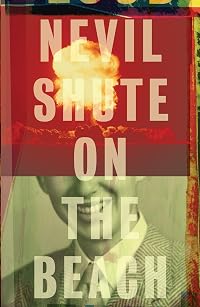
In Perihelion Summer Greg Egan gives us a climate change disaster that is neither our fault nor the fault of alien monsters. How about a pair of smallish black holes crossing the plane of the ecliptic close enough to disrupt the orbits of Earth and Moon? That’ll do it. Our hero, Matt, is planning to ride out the expected high tides and possible tidal waves in a large aquaculture rig. When the second black hole is discovered, the math suggests a much worse disaster, and Matt finds himself shepherding an international flotilla of refugees into the Antarctic where temperatures will be survivable. Don’t expect the survivalist fantasies of Mad Max or Water World, or even the grim hopelessness of show more On the Beach. Egan is a committed hard science fiction guy in the tradition of Arthur C. Clarke. For the most part, his characters act with rationality and humane motives. Even his villains can be persuaded with reasonable arguments based on self-interest. I hope he is right about human nature. show less
In Perihelion Summer Greg Egan gives us a climate change disaster that is neither our fault nor the fault of alien monsters. How about a pair of smallish black holes crossing the plane of the ecliptic close enough to disrupt the orbits of Earth and Moon? That’ll do it. Our hero, Matt, is planning to ride out the expected high tides and possible tidal waves in a large aquaculture rig. When the second black hole is discovered, the math suggests a much worse disaster, and Matt finds himself shepherding an international flotilla of refugees into the Antarctic where temperatures will be survivable. Don’t expect the survivalist fantasies of Mad Max or Water World, or even the grim hopelessness of show more On the Beach. Egan is a committed hard science fiction guy in the tradition of Arthur C. Clarke. For the most part, his characters act with rationality and humane motives. Even his villains can be persuaded with reasonable arguments based on self-interest. I hope he is right about human nature. show less
This is a short book in which climate change is greatly accelerated by Earth's near miss with two passing black holes, which adjusts the Earth's orbit so that summers become much hotter. It's an interesting concept that kept me reading; much of the story takes place on a floating fish farm that starts heading to Antarctica with a bunch of refugees once the global warming starts. However, I found all of the characters to be flat and very same-same, distinguished only by their nationalities, and the conflict outside of survival wasn't terribly exciting. The end was also very abrupt and felt like just putting off the inevitable extinction of the species. So this was just okay for me.
Perihelion Summer by Greg Egan is a standalone science fiction novella from Tor.com. The combination of author I like and imprint of consistently good novellas meant that I was definitely going to read this at some point. Happily I got an early copy, so I can share this review just before release.
The premise of this book is a fairly technical apocalypse, involving black holes. There are some maths and physics details near the start, but it’s not opaquely technical, in my opinion. Most of the story focuses on the characters dealing with the disaster and its aftermath and observing and interacting with others doing the same. There were a lot of thoughtful little bits included, which made the read more delightful. For example the show more headlines from various newspapers (which will be most appreciated by Australian and British readers, I think) and comments about Australian spying in Timor-Leste.
I found Matt’s relationship with his mother both interesting, in the difficulties it added to the book, and a bit incomprehensible, with regards to her attitude. I ended up thinking about her attitude a lot and I think it comes down to this: I can understand apocalypse-denial, but not once the apocalypse is actually happening. As a child of refugees, the idea of not leaving a doomed home to save yourself when you have the ability to just baffles me. I know the mother character’s feelings are reflecting real people’s attitudes but somehow it’s even worse when shown in such an extreme situation. Anyway, that part — Matt’s interactions with his family — gave me a lot of feelings, in the way that good books often do.
This was an excellent read and I couldn’t put it down, even though I had to sleep. I highly recommend it to fans of realistic (ish) apocalypse fiction and Greg Egan’s other books. It’s a brilliant combination of character dynamics and accessible science. I really must get around to reading more Greg Egan.
5 / 5 stars
You can read more of my reviews on my blog. show less
The premise of this book is a fairly technical apocalypse, involving black holes. There are some maths and physics details near the start, but it’s not opaquely technical, in my opinion. Most of the story focuses on the characters dealing with the disaster and its aftermath and observing and interacting with others doing the same. There were a lot of thoughtful little bits included, which made the read more delightful. For example the show more headlines from various newspapers (which will be most appreciated by Australian and British readers, I think) and comments about Australian spying in Timor-Leste.
I found Matt’s relationship with his mother both interesting, in the difficulties it added to the book, and a bit incomprehensible, with regards to her attitude. I ended up thinking about her attitude a lot and I think it comes down to this: I can understand apocalypse-denial, but not once the apocalypse is actually happening. As a child of refugees, the idea of not leaving a doomed home to save yourself when you have the ability to just baffles me. I know the mother character’s feelings are reflecting real people’s attitudes but somehow it’s even worse when shown in such an extreme situation. Anyway, that part — Matt’s interactions with his family — gave me a lot of feelings, in the way that good books often do.
This was an excellent read and I couldn’t put it down, even though I had to sleep. I highly recommend it to fans of realistic (ish) apocalypse fiction and Greg Egan’s other books. It’s a brilliant combination of character dynamics and accessible science. I really must get around to reading more Greg Egan.
5 / 5 stars
You can read more of my reviews on my blog. show less
Excellent concept, disappointingly rendered. Hard sci fi doesn't have to be this bland, Greg.
So what happens to the world when a pair of small black holes smashes through the solar system? Luckily they didn't hit anything (there's a lot of empty space in the solar system) but that doesn't mean they had no effect.
The blurb on the back cover sets the scene, so it shouldn't be a spoiler if I mention that the earth doesn't get destroyed but, since black holes are massive objects, the earth's orbit gets perturbed enough to have drastic climate consequences.
The hero of the story is Matt. He and his friends, had just finished building a floating self-sustaining habitat when news of the black holes was first announced. It's never really clear why they had done this but it's a good thing they did. Although the four of them can only show more persuade one of their family and friends to join them, the boat helps them escape the worst of the immediate changes.
The land based part of the story mainly takes place in Australia (where the author is from) which was interesting. I apparently don't know much about Australian geography but that's what Google maps is for.
I liked the story and the writing. The author doesn't give us any characters to really care about beyond Matt and he isn't real interesting. There are a lot of engineering problems to solve which was interesting (I'm an engineer so go figure). Virtually no relationships. It's almost completely unknown how Matt got together with the other 3 people (another guy and 2 women) to build the boat or what their relationship was. One of the woman is the only one who got someone to come along (an apparent boyfriend) and the other guy and woman are maybe having a relationship but Matt sure couldn't tell. This is why I only gave the story 3 stars. I enjoyed it but didn't love it.
Then there is the problem with the ending. The boat and the flotilla it collects have a destination in mind, but the story, which is about the virtual end of the world, just end. Perhaps Greg Egan plans a series which I'd read. I'd like to see a follow-up set maybe 10 years later. show less
The blurb on the back cover sets the scene, so it shouldn't be a spoiler if I mention that the earth doesn't get destroyed but, since black holes are massive objects, the earth's orbit gets perturbed enough to have drastic climate consequences.
The hero of the story is Matt. He and his friends, had just finished building a floating self-sustaining habitat when news of the black holes was first announced. It's never really clear why they had done this but it's a good thing they did. Although the four of them can only show more persuade one of their family and friends to join them, the boat helps them escape the worst of the immediate changes.
The land based part of the story mainly takes place in Australia (where the author is from) which was interesting. I apparently don't know much about Australian geography but that's what Google maps is for.
I liked the story and the writing. The author doesn't give us any characters to really care about beyond Matt and he isn't real interesting. There are a lot of engineering problems to solve which was interesting (I'm an engineer so go figure). Virtually no relationships. It's almost completely unknown how Matt got together with the other 3 people (another guy and 2 women) to build the boat or what their relationship was. One of the woman is the only one who got someone to come along (an apparent boyfriend) and the other guy and woman are maybe having a relationship but Matt sure couldn't tell. This is why I only gave the story 3 stars. I enjoyed it but didn't love it.
Then there is the problem with the ending. The boat and the flotilla it collects have a destination in mind, but the story, which is about the virtual end of the world, just end. Perhaps Greg Egan plans a series which I'd read. I'd like to see a follow-up set maybe 10 years later. show less
Members
- Recently Added By
Lists

Beginner's Guide to Climate Fiction
24 works; 7 members

Flyleaf Sci-Fi and Fantasy Book Club Selections
8 works; 2 members

Books Set in the Polar Regions
16 works; 6 members

Books With Time Words in the Title
160 works; 4 members

Books Read in 2022
5,226 works; 112 members

Ocean Setting
33 works; 5 members

Fiction Published in 2019
35 works; 1 member

Summer Books
82 works; 9 members
Author Information

129+ Works 13,941 Members
Some Editions
Common Knowledge
- Original publication date
- 2019-04-16
- Important places
- Perth, Western Australia, Australia; Antarctica
- First words
- Matt's parents threw a party for New Year's Eve, filling the house and garden with people and food, music and liquor.
- Last words
- (Click to show. Warning: May contain spoilers.)His mother took his head in her hands."Shh," she said. "It's all right. Everything's all right. I forgive you."
- Publisher's editor
- Strahan, Jonathan
- Blurbers
- Robinson, Kim Stanley
- Original language
- English AUS
Classifications
Statistics
- Members
- 165
- Popularity
- 198,950
- Reviews
- 16
- Rating
- (3.34)
- Languages
- English
- Media
- Paper, Ebook
- ISBNs
- 2
- ASINs
- 2