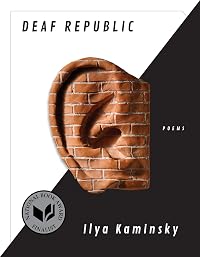
Deaf Republic
by Ilya Kaminsky
On This Page
Description
Deaf Republic opens in an occupied country in a time of political unrest. When soldiers breaking up a protest kill a deaf boy, Petya, the gunshot becomes the last thing the citizens hear--they all have gone deaf, and their dissent becomes coordinated by sign language. The story follows the private lives of townspeople encircled by public violence. At once a love story, an elegy, and an urgent plea, these poems confronts our time's vicious atrocities and our collective silence in the face of show more them. show lessTags
Recommendations












Member Reviews
from Eulogy
'You must speak not only of great devastation --
we heard that not from a philosopher
but from our neighbor, Alfonso --
his eyes closed, he climbed other people's porches and recited
to his child our National Anthem:
You must speak not only of great devastation --
when his child cried he
made her a newspaper hat and squeezed his silence
like two pleats of an accordion:
We must speak not only of great devastation --
and he played that accordion out of tune in a country
where the only musical instrument is the door.'
--IK
One of the most powerful collections I've read recently and 'Eulogy' is an example of how bleakness and a determination to hold onto hope both fit in the palm of the same hand. Kaminsky has written a modern parable that show more shows by the end, the work before us - fighting back but remembering that joy exists, the reason for fighting back. show less
'You must speak not only of great devastation --
we heard that not from a philosopher
but from our neighbor, Alfonso --
his eyes closed, he climbed other people's porches and recited
to his child our National Anthem:
You must speak not only of great devastation --
when his child cried he
made her a newspaper hat and squeezed his silence
like two pleats of an accordion:
We must speak not only of great devastation --
and he played that accordion out of tune in a country
where the only musical instrument is the door.'
--IK
One of the most powerful collections I've read recently and 'Eulogy' is an example of how bleakness and a determination to hold onto hope both fit in the palm of the same hand. Kaminsky has written a modern parable that show more shows by the end, the work before us - fighting back but remembering that joy exists, the reason for fighting back. show less
Ilya Kaminsky’s Deaf Republic is a visceral exploration of quieted dissent in the face of unspeakable brutality. In the besieged town of Vasenka, where military forces commit an inexcusable atrocity, silence is weaponized as the townspeople deafen themselves in retaliation for the murder of a deaf boy named Petya. Here, language is expertly wielded by means of wordlessness and the acts of war cease to be heard. Instead, the destruction is felt in the reverberations through the earth and through one another:
It has begun: I see the blue canary of my country
pick breadcrumbs from each citizen’s eyes—
pick breadcrumbs from my neighbors’ hair—
the snow leaves the earth and falls straight up as it
should—
to have a country, so show more important—
to run into walls, into streetlights, into loved ones, as
one should—
The blue canary of my country
runs into walls, into streetlights, into loved ones—
The blue canary of my country
watches their legs as they run and fall.
The citizens become like puppets in a theatrical production, standing discreetly on the “stage” of their country, speaking with hands, touch, and an abundance of feeling—a language that their tormentors do not understand. Sensing abandonment by the world and God, the townspeople take matters into their own hands, finding their fire “from a match [God] never lit”. In the epicenter of the collection, expectant newlyweds Sonya and Alfonso attempt to reconcile the lives they led before the war with their new normal, eventually becoming casualties as they join the opposition:
He who loves roofs, tonight and tonight, making love to
her and to her forgetting, let them borrow the light
from the blind.
There will be evidence, there will be evidence.
While helicopters bomb the streets, whatever they will
open, will open.
What is silence? Something of the sky in us.
A town now torn, the events that unfold in Vasenka stand as a microcosm for not only America’s involvement in wars abroad but also the paranoia and polarization caused by its militarized police force. It is in these hushed acts of violence where “the nakedness of a whole nation” is held in the mouths of its discarded. Dehumanized, alienated, and stripped bare by “a peaceful country”, the collection comes full circle as an indirect admonishment for the lack of concern:
Today
I have to screw on the expression of a person
though I am at most an animal
and the animal I am spirals
from the funeral to his kitchen, shouts: I have come,
God, I have come running to you—
in snow-drifted streets, I stand like a flagpole
without a flag.
Deaf Republic delivers a captivating and timeless yet urgently necessary message on the power small rebellions have in a country that oftentimes chooses willful (and prideful) ignorance over ethical self-reflection. Through Kaminsky’s haunting verse, silence reveals itself to be tripartite: the silence of the devoted, the silence of the departed, and the silence of the defiant whose actions speak louder than words. show less
It has begun: I see the blue canary of my country
pick breadcrumbs from each citizen’s eyes—
pick breadcrumbs from my neighbors’ hair—
the snow leaves the earth and falls straight up as it
should—
to have a country, so show more important—
to run into walls, into streetlights, into loved ones, as
one should—
The blue canary of my country
runs into walls, into streetlights, into loved ones—
The blue canary of my country
watches their legs as they run and fall.
The citizens become like puppets in a theatrical production, standing discreetly on the “stage” of their country, speaking with hands, touch, and an abundance of feeling—a language that their tormentors do not understand. Sensing abandonment by the world and God, the townspeople take matters into their own hands, finding their fire “from a match [God] never lit”. In the epicenter of the collection, expectant newlyweds Sonya and Alfonso attempt to reconcile the lives they led before the war with their new normal, eventually becoming casualties as they join the opposition:
He who loves roofs, tonight and tonight, making love to
her and to her forgetting, let them borrow the light
from the blind.
There will be evidence, there will be evidence.
While helicopters bomb the streets, whatever they will
open, will open.
What is silence? Something of the sky in us.
A town now torn, the events that unfold in Vasenka stand as a microcosm for not only America’s involvement in wars abroad but also the paranoia and polarization caused by its militarized police force. It is in these hushed acts of violence where “the nakedness of a whole nation” is held in the mouths of its discarded. Dehumanized, alienated, and stripped bare by “a peaceful country”, the collection comes full circle as an indirect admonishment for the lack of concern:
Today
I have to screw on the expression of a person
though I am at most an animal
and the animal I am spirals
from the funeral to his kitchen, shouts: I have come,
God, I have come running to you—
in snow-drifted streets, I stand like a flagpole
without a flag.
Deaf Republic delivers a captivating and timeless yet urgently necessary message on the power small rebellions have in a country that oftentimes chooses willful (and prideful) ignorance over ethical self-reflection. Through Kaminsky’s haunting verse, silence reveals itself to be tripartite: the silence of the devoted, the silence of the departed, and the silence of the defiant whose actions speak louder than words. show less
Ilya Kaminsky, a Russian emigre, a native of Odessa, now a US citizen, has written a haunting yet charming collection of poetry entitled Deaf Republic.
A town is taken over by a foreign army. A deaf boy becomes an early victim and the town's people resist by developing a sign language to express their opposition to the brutality thrust upon them. A puppet show serves as a front for the resistance. The women of Vesenka, heroines, entice enemy soldiers, ensnaring them to their own demise.
Kaminsky juxtaposes the range of experience: from the safety of the American suburbs where citizens take out their phones to record police brutality, to the war-torn streets of Ukraine where activism takes on a more elusive and creative force.
The world has show more gone nuts and Kaminsky gives voice to hope. He listens, like a witness, to the horrors that need to be exposed. show less
A town is taken over by a foreign army. A deaf boy becomes an early victim and the town's people resist by developing a sign language to express their opposition to the brutality thrust upon them. A puppet show serves as a front for the resistance. The women of Vesenka, heroines, entice enemy soldiers, ensnaring them to their own demise.
Kaminsky juxtaposes the range of experience: from the safety of the American suburbs where citizens take out their phones to record police brutality, to the war-torn streets of Ukraine where activism takes on a more elusive and creative force.
The world has show more gone nuts and Kaminsky gives voice to hope. He listens, like a witness, to the horrors that need to be exposed. show less
Deaf Republic is a moving and deft portrait of a town in revolt, a family in peril, and the polyvalence of silence. There are parallels to current contexts in the US (the village is not only out there but in here) that are warranted and not too heavy handed. I was most moved by the way that Kaminsky draws out the relationship between the puppeteers--the tiny, jeweled fragments of their love and domestic life.
Finalist for the 2019 National Book Award for Poetry.
Powerful.
This book is an interconnected book of poetry--the poems tell a story of sorts. An unnamed occupied town, where, after a deaf boy is shot by a soldier, the residents pretend to be deaf. Where they use real and made-up signs to communicate with each other, and the puppet troupe uses puppets to communicate with the crowds and to show from which houses people have been taken. The soldiers shoot and kill, remove and vanish individuals. The puppet theatre manager uses her puppets to communicate to the crowds, while her girls kill soldiers, one by one.
This book is clearly a parable meant to represent goings on today, a the last poem, "In A Time of Peace" makes clear. If people show more watch phone videos of the police shooting a man following their directions, how peaceful is it, really? While the residents in the unnamed town pretend to be deaf, residents of the US don't pretend, they are deaf to the horrors in the world and within our own borders.
I am not strong on poetry, and while this book is excellent I really wish I had a group to discuss this with. show less
Powerful.
This book is an interconnected book of poetry--the poems tell a story of sorts. An unnamed occupied town, where, after a deaf boy is shot by a soldier, the residents pretend to be deaf. Where they use real and made-up signs to communicate with each other, and the puppet troupe uses puppets to communicate with the crowds and to show from which houses people have been taken. The soldiers shoot and kill, remove and vanish individuals. The puppet theatre manager uses her puppets to communicate to the crowds, while her girls kill soldiers, one by one.
This book is clearly a parable meant to represent goings on today, a the last poem, "In A Time of Peace" makes clear. If people show more watch phone videos of the police shooting a man following their directions, how peaceful is it, really? While the residents in the unnamed town pretend to be deaf, residents of the US don't pretend, they are deaf to the horrors in the world and within our own borders.
I am not strong on poetry, and while this book is excellent I really wish I had a group to discuss this with. show less
In an unnamed, occupied country, a young, deaf boy is shot to death during a protest and his community goes collectively deaf and creates their own sign language in act of opposition.
I’ve never read anything quite like this collection of poetry, and on first read, I didn’t know what to make of it. And I’m fairly certain I’ve not before had the urge to immediately re-read a collection upon finishing it the first time. I find it difficult to write a review …
Part poetry, part performance, part… It’s unusual, riveting, harrowing, immersive, perhaps ground-breaking. It’s artful, and there is something hauntingly immediate about it. Read it (support the poet and even buy it!), and then read it a few more times.
Read in late show more 2018, speechless about it until now.... show less
I’ve never read anything quite like this collection of poetry, and on first read, I didn’t know what to make of it. And I’m fairly certain I’ve not before had the urge to immediately re-read a collection upon finishing it the first time. I find it difficult to write a review …
Part poetry, part performance, part… It’s unusual, riveting, harrowing, immersive, perhaps ground-breaking. It’s artful, and there is something hauntingly immediate about it. Read it (support the poet and even buy it!), and then read it a few more times.
Read in late show more 2018, speechless about it until now.... show less
A beautifully put together collection of poems. Ilya Kaminsky's Deaf Republic reads more like a stage play than just a collection of poems. It is a story. It is a parable. As the title suggests Deaf Republic explores silence in all its forms and specifically its more focused on politics and war and the effects of war and politics on a population. The story follows a town where after soldiers in the course of duties of crowd control of a protest kill a deaf boy the killing shot turns the entire town deaf. Thus Deaf Republic.
The collection poetry story is often beautiful and confronts the times we live in. At times tiresome but mostly beautiful.
The collection poetry story is often beautiful and confronts the times we live in. At times tiresome but mostly beautiful.
Members
- Recently Added By
Lists

2020 Notable Books for Adults
26 works; 5 members

Translingualism
191 works; 4 members

"We" narration
49 works; 2 members

A Ukraine Reading List
121 works; 90 members

Book Riot Read Harder 2026
80 works; 1 member
Author Information

26+ Works 1,117 Members
Ilya Kaminsky was born in the former Soviet Union and is now an American citizen. He is the author of a previous poetry collection, Dancing in Odessa, and coeditor of The Ecco Anthology of International Poetry. He has received a Whiting Award, a Lannan Literary Fellowship, and a Guggenheim Fellowship, and was named a finalist for the Neustadt show more International Prize for Literature. His work has been translated into more than twenty languages. show less
Awards and Honors
Awards
Distinctions
Common Knowledge
- Canonical title
- Deaf Republic
- Original title
- Deaf Republic
- Original publication date
- 2019
- People/Characters
- Alfonso Barabinski; Sonya Barabinski; Anushka Barabinski; Petya; Momma Galya Armolinskaya
- Important places
- Vasenka
- Dedication
- In Memory of Ella and Viktor Kaminsky
For Katie Farris - First words
- We lived happily during the war.
- Last words
- (Click to show. Warning: May contain spoilers.)How bright is the sky (forgive me) how bright
- Original language
- English US
Classifications
Statistics
- Members
- 604
- Popularity
- 48,443
- Reviews
- 13
- Rating
- (4.40)
- Languages
- Dutch, English
- Media
- Paper, Audiobook, Ebook
- ISBNs
- 7
- ASINs
- 3