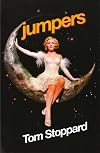
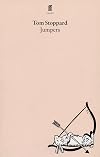
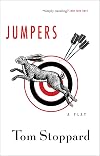
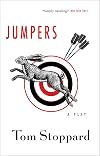
Jumpers
by Tom Stoppard
On This Page
Description
The Incredible Radical Liberal Jumpers are a team of acrobatic professors of philosophy, whose absurd gymnastic displays reflect a bewildering world where logic has confounded belief in moral absolutes. In this dark, exuberant comedy, Stoppard brilliantly parodies the philosophy lecture, the detective thriller, the comedy of manners and the Whitehall farce, to follow a philosopher's doomed flight to prove the existence of God in the face of an indifferent universe.Tags
Recommendations



















Member Reviews
In Jumpers, Tom Stoppard was humiliating the pompous civilization that overanalyzes, deconstructs, and builds ridiculous rules and structures instead of dealing with reality. The line "Aetheism is just a crutch for non believers to deal with the existence of God" caught it beautifully. By using the tool of Brits on the moon at several points, he said that if you take people out of the environment/context, they revert to selfish acts without benefit of cover. The pretense is gone. The astronaut at the trial didn't challenge anything; he just agreed and kept going. Similarly, Greystoke, a pure work of fiction, was the perfect embodiment of pompous manners and class structure, and was dismissed. The real wild man was the judge, a former show more caretaker, who had no qualifications, and ran the whole proceeding into the ground. As The Common Man (whose hobby was philosophy!), he told us how off course we really are. And despite all George Moore's philosophising and analyzing and caring, it was he who killed his hare, he who killed his tortoise, and of course he who killed his marriage, by refusing to defend it. He lost it all because his mind was focused on idiotic rationalizations. The vice chancellor (or chancellor of vice) was the "suit" in all this. When he spoke at the trial, he uttered total gibberish, and the crowd roared with approval. He was clearly what was wrong with everything, and of course, he was running it all. Meanwhile, The archbishop made sense and was disposed of, same for Greystoke, and for Bones. Meanwhile, George, whose night this was supposed to be, didn't get to utter a word. Then, at the end, the wife was sent to the moon, and was lifted above everyone else. And that's how it ended. She had a miserable time - unappreciated intellect, unsuccessful career, sham of a marriage - and all covered by her position in society...her husband, her relationship with the vice chancellor...Clearly, she needed to get out of it all and be herself, and the only place she could do that was on the old man-in-the-moon style moon of pre astronaut days. So there was actually method to the madness, and it was entertaining to boot. It was all very British humor which I really appreciated, and the similarities to the final episode of the Prisoner were too many to ignore. By the way, Jumpers are what shrinks call suicidals, and the fact they all wore yellow must have meant they refused to deal with reality, hiding behind their philosophy instead of dealing with it. I kept seeing Robbie Coltrane as George. He really would have made the play. And that reminds me: the female lead was first played by Diana Rigg. Imagine how different THAT would have been! I would have loved to have seen that. LOTS of food for thought in Jumpers. Loved it. show less
Witty, Intelligent, and Fun: As with so many of Stoppard's plays, this one seems to operate on multiple levels of reality. On the one hand we have a network of philosphers looking for the essence of morality, divinity, and community. On the other, a failed actress has comitted murder and is trying to escape the consequences of her actions while committing adultery at the same time. All of this takes place in a reality that is not our own, but isn't far from it. Stoppard treats these subjects as he treats most of the subjects of his plays: with humor, cleverness, and irony. Stoppard creates a philospher who is so wrapped up in preparing a speech on morality that he is completely unaware of the murder and infidelity that are so obviously show more happening within his own home. A police officer manages to overlook these same problems due to his obsession with the murderer's past career as an actress. Throughout the play these kind of juxtapositions take place as each character seeks to ignore the reality around him/her as he/she seeks desperately to create his/her own reality. Stopard presents all of this with his usual blend of wit and charm, making Jumpers another solid addition to his body of work. show less
This may be one of the weirdest things I've read from Stoppard. It is definitely absurdist, with larger than life characters and dead bodies being pretty much ignored by most of the characters. I do think the zaniness isn't quite as charming as in some of his other works, but it still manages to work. It would be very fun to see this staged.
Ratings
Members
- Recently Added By
Lists

My Play Collection
769 works; 3 members
Author Information

113+ Works 23,622 Members
When the National Theatre needed a last-minute substitute for a canceled production of As You Like It, Kenneth Tynan decided to stage Rosencrantz and Guildenstern Are Dead, a work by an unfamiliar author that had received discouraging notices from provincial critics at its Edinburgh Festival debut. Of course, the play, when it opened in April show more 1967, met with universal acclaim. In New York the next year, it was chosen best play by the Drama Critics Circle. In such an unlikely way, Tom Stoppard came to light. Born in Czechoslovakia, a country he left (for Singapore) when he was an infant, he began his literary career as a journalist in Bristol, where play reviewing led to playwriting. After Rosencrantz and Guildenstern, Stoppard's reputation suffered through the production of a number of minor works, whose intellectual preoccupations were shrugged off by reviewers: Enter a Free Man (1968; "an adolescent twinge of a play," N.Y. Times), The Real Inspector Hound (1968; "lightweight," N.Y. Times), and After Magritte. But in the 1970s, the initial enthusiasms aroused by Rosencrantz and Guildenstern were more than vindicated by the production of two full-length plays, Jumpers (1974) and the antiwar play Travesties (1975), whose immense verbal and theatrical inventiveness made them absolute successes on both sides of the Atlantic. Stoppard's method from the start has been to contrive explanations for highly unlikely encounters---of objects (the ironing board, old lady, and bowler hat of After Magritte), characters (Joyce, Lenin, and Tzara in Travesties), and even plays (Hamlet, Rosencrantz and Guildenstern, The Importance of Being Earnest, Travesties, and The Real Thing, 1982). In the 1970s, Tynan called for Stoppard---as a Czech and as an artist---to engage himself politically. But although political subjects have since found their way into pieces from Every Good Boy Deserves Favor (1977) to Squaring the Circle (1985), politics and art seem to have become just two more of the playwright's irreconcilables, which meet, but never join, in the logical frames of his comedy. The presence of political material---such as the Lenin sections that nearly ruin the second part of Travesties---has occasionally strained the structure of the plays. But in The Real Thing Stoppard is comfortable enough with the satire on art and activism to bring a third subject, love, into the mix. Stoppard has acknowledged his Eastern European heritage nonpolitically, in a series of adaptations of plays by Arthur Schnitzler (see Vol. 2), Johann Nestroy, and Ferenc Molnar. (Bowker Author Biography) Tom Stoppard is the author of many plays, including Rosencrantz and Guildenstern Are Dead, Jumpers, Travesties, and The Invention of Love. He lives in London. (Publisher Provided) show less
Awards and Honors
Awards
Work Relationships
Has as a supplement
Has as a student's study guide
Common Knowledge
Classifications
Statistics
- Members
- 680
- Popularity
- 42,271
- Reviews
- 4
- Rating
- (3.60)
- Languages
- English
- Media
- Paper, Ebook
- ISBNs
- 12
- ASINs
- 9