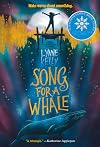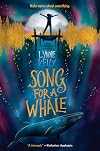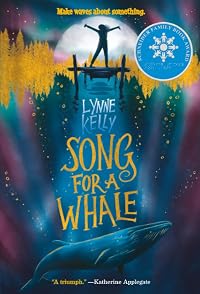
Song for a Whale
by Lynne Kelly 
On This Page
Description
Twelve-year-old Iris and her grandmother, both deaf, drive from Texas to Alaska armed with Iris's plan to help Blue-55, a whale unable to communicate with other whales.Tags
Recommendations








Member Reviews
Great book! I particularly loved Iris' relationships with her Deaf grandparents and her way of signing poems with her grandfather. Altogether, the relationships were really well written across the board -- from the clueless and harmful classmate Nina, to her brother and best friend, to her sometimes rocky but very realistic communication with her parents. I also love the cruise ship as getaway -- hard to imagine a more effective means of removing oneself from regular contact while presenting a very safe way to do it. Mad props to Grandma for her heist abilities and her wandering nature. I also really loved Iris' interactions with sound, and her keen appreciation of radio repair. I really hope, in the end, that she gets her Philco back. show more The focus on Blue 55 and his song was such a thoughtful and high impact emotional bridge -- but I love that Tristan calls Iris out on figuring out why she needs so badly to connect to this whale. The book shows some really beautiful growth over the course of the story, and Iris figuring out what she needs to continue that growth is an incredibly strong thread.
I appreciated that Lynne Kelly is totally transparent in her connections with the Deaf community in the Author's note, and also about the readers she hired to hold her story to account. show less
I appreciated that Lynne Kelly is totally transparent in her connections with the Deaf community in the Author's note, and also about the readers she hired to hold her story to account. show less
When Iris, who is Deaf, learns about a whale called Blue-55 whose song is different from every other whale, she has the idea to make a song for him, to show him someone hears him and is listening. Using her electronic expertise (her hobby is repairing and restoring old radios), and with help from her school's music teacher and student musicians, Iris creates and records a song at 55hz, then sends it to a scientist who is trying to tag Blue-55. But Iris doesn't leave it there: she wants to be in Alaska to see Blue-55 when he's tagged, and see him hear her song. Her parents don't understand why this is so important to her, but her grandma - also Deaf - does.
*Spoilers*
Grandma and Iris concoct a plan and take off for Alaska: they fly from show more Houston to San Francisco, then take a cruise ship (where Iris makes friends with another girl, Bennie, whose mom works on the ship, and where Grandma rediscovers the joy of karaoke). But Blue-55 changes course, and even if Iris and her grandma can make it to the other sanctuary, in Oregon, those scientists aren't interested in playing Iris' song for the whale. But Iris won't let any obstacles stop her: she's determined to make sure Blue-55 knows he's heard.
Nearly the whole story is from Iris' perspective, but there are a few short sections throughout from Blue-55's. Both characters are compelling; both Deaf and hearing readers will likely empathize with how Iris feels left out at her school, where she's the only Deaf student; at home, although her mom and brother Tristan use ASL fluently, her dad never learned it well, and that proves a barrier to communication.
Ultimately, their trip allows Grandma to emerge from her grief over Grandpa's death, and helps Iris advocate for herself to attend a different school, where there are many Deaf students, including her friend Wendell.
Signed language is in italics, in English rather than ASL gloss.
See also: Safe Harbor by Padma Venkatraman, Two Tribes by Emily Bowen Cohen, Where the Sky Lives by Margaret Dilloway, A Kind of Spark by Elle McNicoll
Quotes
Some people have the kind of confidence that lets them get away with being clueless. (6)
"He keeps singing this song, and everything in the ocean swims by him, as if he's not there. He thinks no one understands him. I want to let him know he's wrong about that." (75)
People who were desperate to communicate always found a way. (121)
Maybe he swam near those other whales but not really with them. Kind of like how I was at school. (176)
"...what you did with the song is called acoustic biology. People in that field study sounds that animals make when communicating." (Andi to Iris, 273) show less
*Spoilers*
Grandma and Iris concoct a plan and take off for Alaska: they fly from show more Houston to San Francisco, then take a cruise ship (where Iris makes friends with another girl, Bennie, whose mom works on the ship, and where Grandma rediscovers the joy of karaoke). But Blue-55 changes course, and even if Iris and her grandma can make it to the other sanctuary, in Oregon, those scientists aren't interested in playing Iris' song for the whale. But Iris won't let any obstacles stop her: she's determined to make sure Blue-55 knows he's heard.
Nearly the whole story is from Iris' perspective, but there are a few short sections throughout from Blue-55's. Both characters are compelling; both Deaf and hearing readers will likely empathize with how Iris feels left out at her school, where she's the only Deaf student; at home, although her mom and brother Tristan use ASL fluently, her dad never learned it well, and that proves a barrier to communication.
Ultimately, their trip allows Grandma to emerge from her grief over Grandpa's death, and helps Iris advocate for herself to attend a different school, where there are many Deaf students, including her friend Wendell.
Signed language is in italics, in English rather than ASL gloss.
See also: Safe Harbor by Padma Venkatraman, Two Tribes by Emily Bowen Cohen, Where the Sky Lives by Margaret Dilloway, A Kind of Spark by Elle McNicoll
Quotes
Some people have the kind of confidence that lets them get away with being clueless. (6)
"He keeps singing this song, and everything in the ocean swims by him, as if he's not there. He thinks no one understands him. I want to let him know he's wrong about that." (75)
People who were desperate to communicate always found a way. (121)
Maybe he swam near those other whales but not really with them. Kind of like how I was at school. (176)
"...what you did with the song is called acoustic biology. People in that field study sounds that animals make when communicating." (Andi to Iris, 273) show less
Iris is deaf and communicates with sign language. Her grandparents are also deaf and sign. Iris’ parents and brother are hearing, and sign with her although her father is less adept. Her best friend is Wendell, also deaf but who attends a deaf school. At her public school, Iris learns about Blue 55, a blue whale that sings at a higher hertz level than other whales. This makes communication between him and other whales difficult. He has no family and swims the ocean alone. Iris connects immediately with Blue 55’s loneliness and feels strongly about finding a way to communicate to him. After corresponding with a whale scientist and working with the music teacher at school, Iris creates a recording at Blue’s hertz level. Her dream is show more to travel to the whale sanctuary in Alaska and play her song when 55 swims by. Her grandmother, still grieving since Grandpa’s death, will be the key to getting Iris to Blue 55. Iris’ sense of determination and can-do spirit pace this solid story. Despite setbacks, she finds ways to overcome or work around them. The only thing that didn’t ring true to me was her diving into the ocean to meet Blue 55. A moment of magical realism?? show less
children's diverse middlegrade fiction (Iris and her grandparents are Deaf; author is a sign language interpreter).
tender-hearted story about a girl who has no one to talk to at school connecting with a lonely whale who doesn't belong to a pod either. The story maybe is a little bit too long, but Iris is such a sweet, interesting person, one doesn't much mind spending the extra time with her.
tender-hearted story about a girl who has no one to talk to at school connecting with a lonely whale who doesn't belong to a pod either. The story maybe is a little bit too long, but Iris is such a sweet, interesting person, one doesn't much mind spending the extra time with her.
This is about a whale, but it is more about the girl who is chasing the whale. Iris, being the only deaf girl in her school, feels like no one understands her. When she learns about a whale who seems to have the same problem, she immediately feels a kinship with him. The book follows her quest to let this whale know someone is listening to him. The quest was made harder because she speaks a different language than everyone else. The way she relates to the hearing world and how they relate to her was interesting to see. Expressions are different in sign language, her teacher was upset because a poem she wrote didn't rhyme but to her it did. So even though she had a translator communication was not always easy. I never thought of sign show more language that way before. I liked how Kelly used the whale's story to tell Iris's. You could feel Iris's frustration with not belonging and not being understood, even when those who loved her tried their best. It is a wonderful look at a girl learning how to make her own space in a world that doesn't seem to have a space for her. And the people that love her learning how to let her. show less
Fun, fascinating, inspiring, and important.
I liked all the details about deaf culture. The author has extensive notes explaining that not only has she 20 years in the business translating between 'hearing-impaired' and 'sign-language impaired' but she also interviewed people who are deaf while writing the book. The character of the father is, unfortunately, representative of too many parents who do not learn sign language to communicate with their children.
And it's important, because ASL and other languages for the deaf are not just transcriptions of the dominant language (such as English). Kelly makes it clear by showing us the 'handshape poems' that the deaf characters in the book create. Iris's father will never be able to appreciate show more that poetry, or even understand it.
Iris's talent, developed over years of hard work, for repairing radios is also interesting, and turns out to be the key to her quest to help the whale feel less lonely. And the whale feels real, as Kelly takes inspiration from a real whale and adds information from research to give Blue55 an identity.
Side characters, even the pickle-mouthed teacher and the know-it-all who actually knows nothing, are developed individuals, too. Grandma is absolutely wonderful, as is Wendell. The dilemma of the choice between a school for the deaf and a mainstream school is handled in concise but rich detail, too. There's just so much wonderfulness in this book... but it's still a concise and engaging read. Bravo!
"I wondered if she liked to put down a good book before turning to the last page, too."
Experience with the glaciers affects Iris's 'accent' as she softens the V-shaped sign into more of U now that she sees them irl.
A dish of half chocolate and half pistachio ice cream sounds amazing.
One minor complaint; Wendell's explanation of why stars twinkle and planets don't was frustratingly incomplete. Byju says "...stars twinkle as they are point sources and also due to atmospheric refraction. Planets won't twinkle as they are a group of point sources." Oh, and even more minor, the fifth gas giant planet is still a theory with insufficient agreement to be stated so definitely. (Kelly apparently didn't do quite as much research for this character, but that's ok imo honestly.) show less
I liked all the details about deaf culture. The author has extensive notes explaining that not only has she 20 years in the business translating between 'hearing-impaired' and 'sign-language impaired' but she also interviewed people who are deaf while writing the book. The character of the father is, unfortunately, representative of too many parents who do not learn sign language to communicate with their children.
And it's important, because ASL and other languages for the deaf are not just transcriptions of the dominant language (such as English). Kelly makes it clear by showing us the 'handshape poems' that the deaf characters in the book create. Iris's father will never be able to appreciate show more that poetry, or even understand it.
Iris's talent, developed over years of hard work, for repairing radios is also interesting, and turns out to be the key to her quest to help the whale feel less lonely. And the whale feels real, as Kelly takes inspiration from a real whale and adds information from research to give Blue55 an identity.
Side characters, even the pickle-mouthed teacher and the know-it-all who actually knows nothing, are developed individuals, too. Grandma is absolutely wonderful, as is Wendell. The dilemma of the choice between a school for the deaf and a mainstream school is handled in concise but rich detail, too. There's just so much wonderfulness in this book... but it's still a concise and engaging read. Bravo!
"I wondered if she liked to put down a good book before turning to the last page, too."
Experience with the glaciers affects Iris's 'accent' as she softens the V-shaped sign into more of U now that she sees them irl.
A dish of half chocolate and half pistachio ice cream sounds amazing.
One minor complaint; Wendell's explanation of why stars twinkle and planets don't was frustratingly incomplete. Byju says "...stars twinkle as they are point sources and also due to atmospheric refraction. Planets won't twinkle as they are a group of point sources." Oh, and even more minor, the fifth gas giant planet is still a theory with insufficient agreement to be stated so definitely. (Kelly apparently didn't do quite as much research for this character, but that's ok imo honestly.) show less
4-1/2 stars
In most ways I loved this book but I couldn’t quite give it 5 stars because of the point of view of the whale/other whales too. I couldn’t quite suspend disbelief and all the way through, once I hit page 76, I was eager to read the author’s notes at the end. While they were excellent, informative and interesting, I still couldn’t quite accept one aspect of the story, the fictional whale parts, even though I sort of adored that part of the story too. It’s just that the rest was such amazingly good realistic fiction and I found the unrealistic portions kind of jarring, however moving and fun.
The writing is lovely. The illustrations are lovely.
I loved the main character and story’s narrator, Iris. I also especially show more enjoyed her grandmother; I loved how she responded. What a hoot she was. This is a great granddaughter-grandmother relationship! I also enjoyed so many other characters too, including Bennie & Sura, Iris’s mother, father, and brother, Wendell and his family, and some of Iris’s teachers and classmates. The family and friend and school relationships were portrayed well.
This book has so much going for it. There is ample humor throughout and I thoroughly enjoyed it. But I felt sad a lot of the time I was reading it. The book is about communication and the lack of it, and about deep and cutting loneliness. I felt sad for the whale and then felt even sadder when I realized that Iris isn’t even as fluent in ASL and she could be, though I correctly knew what that was going. There are interesting inclusions about Deaf culture. There is a lot of suspense that was both entertaining and excruciating.
I love how Iris is skilled in electronics, radios and other devices too. I love the whales. I love the Alaska cruise portions – the only cruise I’ve taken as an adult was to Alaska in 1983 so it was fun to “be back there” with some common experiences.
I’m happy for Iris and I guess I’m supposed to feel happy for the whale too, but I felt only partial solace.
I did kind of love this book but it’s 4-1/2 not 5 stars for me, rounded down despite the author’s explanation. This would have probably been a favorite 5 star book for me at ages 9-12, and that’s the target audience for this book. I think what bothered me now might not have bothered me back then. The author’s notes at the end were wonderful and (in my opinion) needed inclusions. I’ve always loved whales and it pains me that I couldn’t quite accept portions of the story. As I read I wasn’t quite sure about how to take the whales’ voices, thoughts, feelings, and that kind of took me out of the story, just a bit. I couldn’t wait to read the author’s notes but I didn’t want spoilers so I waited until I’d finished the book. Perhaps I should have read everything in the back when I got to page 76 of the hardcover edition. I don’t think the story would have been spoiled for me but I didn’t know that. I wanted to know more about whales and how realistic/unrealistic things were, what was fantasy that either worked or not.
I did really, really like this book and I will definitely read other books by this author. show less
In most ways I loved this book but I couldn’t quite give it 5 stars because of the point of view of the whale/other whales too. I couldn’t quite suspend disbelief and all the way through, once I hit page 76, I was eager to read the author’s notes at the end. While they were excellent, informative and interesting, I still couldn’t quite accept one aspect of the story, the fictional whale parts, even though I sort of adored that part of the story too. It’s just that the rest was such amazingly good realistic fiction and I found the unrealistic portions kind of jarring, however moving and fun.
The writing is lovely. The illustrations are lovely.
I loved the main character and story’s narrator, Iris. I also especially show more enjoyed her grandmother; I loved how she responded. What a hoot she was. This is a great granddaughter-grandmother relationship! I also enjoyed so many other characters too, including Bennie & Sura, Iris’s mother, father, and brother, Wendell and his family, and some of Iris’s teachers and classmates. The family and friend and school relationships were portrayed well.
This book has so much going for it. There is ample humor throughout and I thoroughly enjoyed it. But I felt sad a lot of the time I was reading it. The book is about communication and the lack of it, and about deep and cutting loneliness. I felt sad for the whale and then felt even sadder when I realized that Iris isn’t even as fluent in ASL and she could be, though I correctly knew what that was going. There are interesting inclusions about Deaf culture. There is a lot of suspense that was both entertaining and excruciating.
I love how Iris is skilled in electronics, radios and other devices too. I love the whales. I love the Alaska cruise portions – the only cruise I’ve taken as an adult was to Alaska in 1983 so it was fun to “be back there” with some common experiences.
I’m happy for Iris and I guess I’m supposed to feel happy for the whale too, but I felt only partial solace.
I did kind of love this book but it’s 4-1/2 not 5 stars for me, rounded down despite the author’s explanation. This would have probably been a favorite 5 star book for me at ages 9-12, and that’s the target audience for this book. I think what bothered me now might not have bothered me back then. The author’s notes at the end were wonderful and (in my opinion) needed inclusions. I’ve always loved whales and it pains me that I couldn’t quite accept portions of the story. As I read I wasn’t quite sure about how to take the whales’ voices, thoughts, feelings, and that kind of took me out of the story, just a bit. I couldn’t wait to read the author’s notes but I didn’t want spoilers so I waited until I’d finished the book. Perhaps I should have read everything in the back when I got to page 76 of the hardcover edition. I don’t think the story would have been spoiled for me but I didn’t know that. I wanted to know more about whales and how realistic/unrealistic things were, what was fantasy that either worked or not.
I did really, really like this book and I will definitely read other books by this author. show less
Members
- Recently Added By
Lists

4th Grade Books
312 works; 5 members

READ IN 2021
239 works; 4 members
Author Information

3 Works 1,145 Members
Lynne Kelly is a LibraryThing Author, an author who lists their personal library on LibraryThing.
Awards and Honors
Awards
Distinctions
Notable Lists
Common Knowledge
- People/Characters
- Iris; Blue-55
- Dedication
- For everyone who's ever felt alone
- First words
- Until last summer I thought the only thing I had in common with that whale on the beach was a name.
- Quotations
- "You're like him [Grandpa] in that way - able to communicate with people you don't know. I'm always in my own head too much to know what to say to other people." (p. 159)
[Grandma to Iris]: "Thank you so much for going on the adventure with me. It was exactly what I needed. Even though Grandpa wasn't around to enjoy it, I feel like he's with me again. I think when I was that sad, there wasn't ... (show all)any room for him. Now there is." (p. 283) - Last words
- (Click to show. Warning: May contain spoilers.)I would too.
- Publisher's editor
- Sullivan, Kate
- Blurbers
- Applegate, Katherine; Simmonds, Millicent
Classifications
- Genres
- Kids, Tween, Fiction and Literature, Children's Books
- DDC/MDS
- 813.6 — Literature & rhetoric American literature in English American fiction in English 2000-
- LCC
- PZ7 .K29639 .S — Language and Literature Fiction and juvenile belles lettres Fiction and juvenile belles lettres Juvenile belles lettres
- BISAC
Statistics
- Members
- 985
- Popularity
- 26,698
- Reviews
- 33
- Rating
- (4.21)
- Languages
- English, French
- Media
- Paper, Audiobook, Ebook
- ISBNs
- 25
- ASINs
- 2