On This Page
Description
In 18th century Iceland, a man becomes a fugitive after being wrongly accused of murder.Tags
Recommendations





















Member Recommendations

Kolbkarlsson Also on the theme of colonial iceland, with oddball characters and a twisted sense of humour. It is a bleak as Iceland's bell, but a little more romantic and sentimental. The story is about one of iceland's great unknowns, Outsider artist and Vagabond Sölvi Helgasson.


Member Reviews
I was turned on to Halldór Laxness by references to his work in David Mitchell’s recent novel The Bone Clocks, and am glad for it. I’ll say at the outset that Adam Haslett could not have put in any better than he did in the introduction to this edition: “Am I really going to settle into a long novel about Iceland of all places? And did we mention the story takes place in the seventeenth century and revolves around forty years of intractable civil and criminal litigation? Headed for the exits yet? If so, I have some simple advice: stop. You’ve stumbled upon a beautiful and hilarious novel by a superb writer.”
The litigation he refers to is against Jón Hreggviðsson, one of the novel’s protagonists, who is accused of having show more murdered the Danish King’s hangman out on the moors one night after having been flogged by him. Hreggviðsson is a simple farmer at the head of a family of halfwits and lepers, but who is in possession of an ancient and very valuable book, sought after by Arnas Arnæus. In addition to being an avid book collector, Arnæus is an intermediary in between Denmark and Iceland, a local authority if you will, and also a suitor to Snæfríður Íslandssól, a beautiful, elfin woman who sizzles on every page with her wit and cool passion. She really made the novel for me, and as she has two other suitors, one a priest, and the other an incorrigible alcoholic, she’s in plenty of great scenes.
The novel takes place at a time when Iceland was under Denmark’s thumb, and “Iceland’s Bell” is its only national treasure remaining, hanging in a courthouse, and soon to be cut down. Stripped of heroes and its sovereignty, rapidly losing its copies of ancient eddas, Iceland seems to be in danger of losing its identity entirely.
This is a book filled with Denmark’s domination and cruel treatment of Iceland, and yet it leaves protest and condemnation as an unstated undercurrent. It’s a book with images of ruin that are memorable, and yet they are not presented with excessive pathos. Iceland’s honor may appear to be slipping away, but upon reflection it is evident in the characters that Laxness creates, flawed as they all are. They react to difficulty with stoicism and sarcasm, and there is real humor and life in this book. I only knocked my review score down to 4 stars because I thought the legal wranglings of Hreggviðsson’s case went through a few too many twists and turns and became less interesting. Definitely worth reading, and I’ll be looking for Independent People, the novel that earned him the Nobel Prize next.
Just this quote:
“There is only one moment in a man’s life that stays with him and will always stay with him throughout the march of time. Everything he does afterward, for good or for ill, he does in the reflected light of that moment, as he fights his lifelong battles – and there is nothing he can do to resist it. For certain, it is always one pair of eyes that reigns over such a moment, the eyes for which all poets are born, and yet their poet is never born, for upon the day that their true name is spoken the world will perish. What happened, what was said? At such a moment nothing happens, nothing is said. But suddenly they are down in a meadow by the river, and the estuary is flooded. Golden clouds shine behind her. The night breeze breathes through her fair hair. Traces of the day remain in the pale blush upon her rose-petal cheeks.” show less
The litigation he refers to is against Jón Hreggviðsson, one of the novel’s protagonists, who is accused of having show more murdered the Danish King’s hangman out on the moors one night after having been flogged by him. Hreggviðsson is a simple farmer at the head of a family of halfwits and lepers, but who is in possession of an ancient and very valuable book, sought after by Arnas Arnæus. In addition to being an avid book collector, Arnæus is an intermediary in between Denmark and Iceland, a local authority if you will, and also a suitor to Snæfríður Íslandssól, a beautiful, elfin woman who sizzles on every page with her wit and cool passion. She really made the novel for me, and as she has two other suitors, one a priest, and the other an incorrigible alcoholic, she’s in plenty of great scenes.
The novel takes place at a time when Iceland was under Denmark’s thumb, and “Iceland’s Bell” is its only national treasure remaining, hanging in a courthouse, and soon to be cut down. Stripped of heroes and its sovereignty, rapidly losing its copies of ancient eddas, Iceland seems to be in danger of losing its identity entirely.
This is a book filled with Denmark’s domination and cruel treatment of Iceland, and yet it leaves protest and condemnation as an unstated undercurrent. It’s a book with images of ruin that are memorable, and yet they are not presented with excessive pathos. Iceland’s honor may appear to be slipping away, but upon reflection it is evident in the characters that Laxness creates, flawed as they all are. They react to difficulty with stoicism and sarcasm, and there is real humor and life in this book. I only knocked my review score down to 4 stars because I thought the legal wranglings of Hreggviðsson’s case went through a few too many twists and turns and became less interesting. Definitely worth reading, and I’ll be looking for Independent People, the novel that earned him the Nobel Prize next.
Just this quote:
“There is only one moment in a man’s life that stays with him and will always stay with him throughout the march of time. Everything he does afterward, for good or for ill, he does in the reflected light of that moment, as he fights his lifelong battles – and there is nothing he can do to resist it. For certain, it is always one pair of eyes that reigns over such a moment, the eyes for which all poets are born, and yet their poet is never born, for upon the day that their true name is spoken the world will perish. What happened, what was said? At such a moment nothing happens, nothing is said. But suddenly they are down in a meadow by the river, and the estuary is flooded. Golden clouds shine behind her. The night breeze breathes through her fair hair. Traces of the day remain in the pale blush upon her rose-petal cheeks.” show less
This novel is set in 17th and 18th century Iceland and follows several interlocking stories. One is of Jon Hreggvidsson, a man accused of murdering the King's hangman. Through his saga we see the inaneness of the "courts" at the Althingi. His story reminded me in some ways of Don Quixote - there was a dark humor to his situation. His paths cross with Snaefridur, the most beautiful woman in Iceland, and Arnas Arnaeus, a wealthy collector of Icelandic manuscripts. Snaefridur and Arnas fall in love but Snaefridur is married to a drunkard who loses her dowry land and sometimes gets drunk and sells her to other men. Arnas, though he's infatuated with Snaefridur, seems to love his books more than anything and his quest to find original show more manuscripts monopolizes his life.
Among these storylines, Laxness weaves in a rich history of Iceland at the time, which was ruled by Denmark. The politics of this remote government and the hardships of living in Iceland are an essential part of the book.
Overall, I really liked this. It's certainly written impressively and thoroughly. I will admit that it was sometimes hard for me to follow the plot, though, and definitely took a lot of concentration. I would recommend this, but save it for a time when you can really focus and are ready for a bit of a challenge. show less
Among these storylines, Laxness weaves in a rich history of Iceland at the time, which was ruled by Denmark. The politics of this remote government and the hardships of living in Iceland are an essential part of the book.
Overall, I really liked this. It's certainly written impressively and thoroughly. I will admit that it was sometimes hard for me to follow the plot, though, and definitely took a lot of concentration. I would recommend this, but save it for a time when you can really focus and are ready for a bit of a challenge. show less
Glorious stuff: it's funny, it's moving, it's political, it's anthropological, it's a slap in the face to any straightforward nationalism, even of the post-colonial variety, while administering more slaps to the face of imperialism than I could possible count.
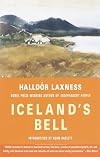
"If I could get away with a one-line introduction, I would: Halldór Laxness rules." Thankfully Adam Haslett extends his introduction to thirteen pages: it is well worth the price of admission to Iceland's Bell. Who is Adam Haslett? An acclaimed author, but more important to me, a devotee of Laxness--one who articulates with grace and style many of the reasons that I love Laxness so.
Haslett nails the characteristics of Laxness novels that make them so outstanding, he pinpoints the features of Iceland’s Bell that make it unique, and he delineates many of the qualities that make Laxness' writings so universal. Reading his introduction is enlightening. But we'll get back to Haslett in a bit--first, let's talk about the novel show more itself.
Iceland’s Bell was written a decade after Independent People. The plot is based on an historical event of the seventeenth century that resulted in forty years of litigation. The novel has a picaresque flavor, and offers something to please every reader. It is much more than an historical novel: it contains elements of intrigue, drama, pathos, love, vivid landscapes and varying scenes, and colorful characters with idiosyncratic personalities.
A major character is the marginal farmer, Jón Hreggviðsson. Jón steals cord (fishing line), is forced into labor, and is charged with killing the (Danish) King's Hangman. (It's unclear whether Jón actually killed him or not.) He is conscripted into the Danish army, and his fortunes rise and fall. He becomes embroiled in the middle of a love affair between Snæfríður, the most beautiful woman in Iceland, and Arnas Arnæs, a Royal Advisor modeled on the life of Árni Magnússon (the Icelandic book collector/scholar).
Snæfríður Iceland's Sun is the strongest, most compelling character in the book. Her fortunes also wax and wane, yet she is indomitable. She is willing to fight for her principles to the end, and the following speech conveys her determination and forthright nature, and reveals the Icelandic sense of identity:
"Excuse me for speaking up, excuse us for being a race of historians who forget nothing. But do not misunderstand me: I regret nothing that has happened, neither in words nor thoughts. It may be that the most victorious race is the one that is exterminated: I will not plead with words for mercy for Icelanders. We Icelanders are truly not too good to die. And life has meant nothing to us for a long time. But there is one thing that we can never lose while one man of this race, rich or poor, remains standing; and even in death this thing is never lost to us; that which is described in the old poem, and which we call fame: just so my father and my mother are not, though they are dust, called ignoble thieves."
This story moves from one incident, character, country, to another, and back again; from pain to humor, and back again; from the despicable yet delightfully sardonic Jón to the noble yet fatally stubborn Snæfríður. It's is typical Laxness Art.
And now, some quotes from Haslett:
"The bleakness is so total, and perhaps more importantly is delivered in prose so thoroughly nonchalant, that laughter is the only possible relief. ix ...we see the unflinching generosity Laxness has toward all his characters. "
And, the one I truly identify with:
"Reading my first Laxness novel is one of those experiences that I look back on with a kind of jealous fondness, loving the memory of it but wishing it hadn't ended."
This 2003 edition is the first English translation of Iceland’s Bell, and I hope more of Laxness’ books will become available in the near future. show less
Haslett nails the characteristics of Laxness novels that make them so outstanding, he pinpoints the features of Iceland’s Bell that make it unique, and he delineates many of the qualities that make Laxness' writings so universal. Reading his introduction is enlightening. But we'll get back to Haslett in a bit--first, let's talk about the novel show more itself.
Iceland’s Bell was written a decade after Independent People. The plot is based on an historical event of the seventeenth century that resulted in forty years of litigation. The novel has a picaresque flavor, and offers something to please every reader. It is much more than an historical novel: it contains elements of intrigue, drama, pathos, love, vivid landscapes and varying scenes, and colorful characters with idiosyncratic personalities.
A major character is the marginal farmer, Jón Hreggviðsson. Jón steals cord (fishing line), is forced into labor, and is charged with killing the (Danish) King's Hangman. (It's unclear whether Jón actually killed him or not.) He is conscripted into the Danish army, and his fortunes rise and fall. He becomes embroiled in the middle of a love affair between Snæfríður, the most beautiful woman in Iceland, and Arnas Arnæs, a Royal Advisor modeled on the life of Árni Magnússon (the Icelandic book collector/scholar).
Snæfríður Iceland's Sun is the strongest, most compelling character in the book. Her fortunes also wax and wane, yet she is indomitable. She is willing to fight for her principles to the end, and the following speech conveys her determination and forthright nature, and reveals the Icelandic sense of identity:
"Excuse me for speaking up, excuse us for being a race of historians who forget nothing. But do not misunderstand me: I regret nothing that has happened, neither in words nor thoughts. It may be that the most victorious race is the one that is exterminated: I will not plead with words for mercy for Icelanders. We Icelanders are truly not too good to die. And life has meant nothing to us for a long time. But there is one thing that we can never lose while one man of this race, rich or poor, remains standing; and even in death this thing is never lost to us; that which is described in the old poem, and which we call fame: just so my father and my mother are not, though they are dust, called ignoble thieves."
This story moves from one incident, character, country, to another, and back again; from pain to humor, and back again; from the despicable yet delightfully sardonic Jón to the noble yet fatally stubborn Snæfríður. It's is typical Laxness Art.
And now, some quotes from Haslett:
"The bleakness is so total, and perhaps more importantly is delivered in prose so thoroughly nonchalant, that laughter is the only possible relief. ix ...we see the unflinching generosity Laxness has toward all his characters. "
And, the one I truly identify with:
"Reading my first Laxness novel is one of those experiences that I look back on with a kind of jealous fondness, loving the memory of it but wishing it hadn't ended."
This 2003 edition is the first English translation of Iceland’s Bell, and I hope more of Laxness’ books will become available in the near future. show less
“Iceland’s Bell” is modeled on the traditional Icelandic sagas, and Jon Hrevggidsson, farmer and thief, is its unlikely hero. The story evolves in 17th Century Iceland, a land suffering from extreme poverty and corruption under the oppressive colonization of the Danes. After being sentenced for a lewd jest at the expense of the king, Hrevigdsson is persecuted for murder and saved from the gaols by the beautiful noblewoman Snaefridur, known as “Iceland’s Sun.” The willful Snaefridur however, has an ulterior motive for her act of generosity. She sends Hrevggidsson on a quest that will take him away from Iceland and his family, through international adventures as often hilarious as they are tragic, while he doggedly persists in show more trying to clear his name before the Danish judicial system.
“Iceland’s Bell” is written in a deceptively stark literary tone subtly brought to life with human touches. The saga-like plot enchantingly weaves together myth and history, star-crossed lovers and rogues, fables and wars, satire and tragedy. Through it all, the oppressed Icelanders’ devotion for their cold yet beautiful land shines forth, and the struggles of the colonized land are mirrored by the increasing resistance of strong-willed Snaefridur to the strictures placed upon her by class, custom, and tradition.
Besides being a subtle satire and captivating novel, Iceland’s Bell is, as well, an elegy to the resilience of the human spirit.
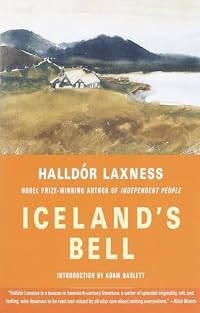
Iceland’s Bell” (Paperback)
Author: Haldor Laxness
Translator: Philip Roughton
Publisher: Vintage
ISBN: 1400034256 show less
“Iceland’s Bell” is written in a deceptively stark literary tone subtly brought to life with human touches. The saga-like plot enchantingly weaves together myth and history, star-crossed lovers and rogues, fables and wars, satire and tragedy. Through it all, the oppressed Icelanders’ devotion for their cold yet beautiful land shines forth, and the struggles of the colonized land are mirrored by the increasing resistance of strong-willed Snaefridur to the strictures placed upon her by class, custom, and tradition.
Besides being a subtle satire and captivating novel, Iceland’s Bell is, as well, an elegy to the resilience of the human spirit.
Iceland’s Bell” (Paperback)
Author: Haldor Laxness
Translator: Philip Roughton
Publisher: Vintage
ISBN: 1400034256 show less
Not one of the most widely read of Nobel literature laureates he is at least IMO the best of them all. To describe at least one of his better works (Independent people, Salka Valka, World Light, Iceland's bell) seems to me like a daunting task. The blurb on the back of the above book takes from a Daily Telegraph review describing it like: 'takes a Tolstoyan overview, he weaves in an Evelyn Waugh like humor; it is not possible to be unimpressed.' One thing I like about Laxness are his heroes (or main characters) are always flawed--the more villian like have some good characteristic traits--none of his characters (even minor ones) are wooden--they are all very human and Laxness is a compelling storyteller weaving in ancient history back show more into the current time of the story he tells. These are fun books to read but also full of an acute irony and sharply drawn social critique. Iceland's bell is set at the end of the 17th century but brings within its pages a wide variety of historical, religious, political observation and never presented in an ideological way but always with pathos and humor. Tolstoy is a good comparison in the one sense for sure but it's a Tolstoy with a wicked sense of humor. show less
I was captivated by this vivid picture of Iceland of the later medieval period, its common folks, fighting for mere survival, the local aristocrats often not doing much better, the grip of their colonial overlords and peculiar dealings of the medieval church.
Although I normally prefer more laconic sentences, I enjoyed well crafted Halldor's language, perhaps because it better suited the impossibly flowery, obscure and mannered way of talking used by the aristocracy and clergy of the day. I also prefer the faster pace of the story line but accepted the slower pace, perhaps because it emulated, in its speed, the movement of glaciers covering the Iceland's highlands.
My rating for the book is lower than my review would indicate, but show more that's because I never use high rating unless about 30% or more of the book conveys some knowledge that is useful or interesting to me even if the remainder is high-quality entertainment, which is, obviously, also important in any book. show less
Although I normally prefer more laconic sentences, I enjoyed well crafted Halldor's language, perhaps because it better suited the impossibly flowery, obscure and mannered way of talking used by the aristocracy and clergy of the day. I also prefer the faster pace of the story line but accepted the slower pace, perhaps because it emulated, in its speed, the movement of glaciers covering the Iceland's highlands.
My rating for the book is lower than my review would indicate, but show more that's because I never use high rating unless about 30% or more of the book conveys some knowledge that is useful or interesting to me even if the remainder is high-quality entertainment, which is, obviously, also important in any book. show less
Members
- Recently Added By
Lists


Author Information

When presenting the 1955 Nobel Prize to Laxness, the Swedish Academy of Letters cited "his vivid writing, which has renewed the Icelandic narrative art." Laxness has been by turns a Catholic convert, a socialist, and a target of the radical press, some of whom accused Laxness of a class ambivalence the Saturday Review summarized this way: "Though show more Laxness came to believe that the novelist's best material is to be found in the proletariat, his rejection of middle-class concerns was never complete, and the ambiguity of his attitude toward the conflict of cultural values accounts for the mixture of humor and pathos that is characteristic of all his novels." Independent People (1934--35) was a bestseller in this country; Paradise Reclaimed Reclaimed (1960), based in part on Laxness's own experiences in the United States, is a novel about a nineteenth-century Icelandic farmer and his travels and experiences, culminating in his conversion to the Mormon church. Laxness owes much to the tradition of the sagas and writes with understated restraint, concentrating almost entirely on external details, from which he extracts the utmost in absurdity. An Atlantic writer found that The Fish Can Sing (1957), the adventures of a young man in 1900 who wants to be a singer, "simmers with an ironic, disrespectful mirth which gives unexpected dimensions to the themes of lost innocence and the nature of art." (Bowker Author Biography) show less
Some Editions
Awards and Honors
Notable Lists
Series

Belongs to Publisher Series
Work Relationships
Common Knowledge
- Canonical title
- Iceland's Bell
- Original title
- Íslandsklukkan
- Alternate titles*
- IJslands klok
- Original publication date
- 1951 (German) (German)
- People/Characters
- Jón Hreggviðsson; Arnas Arnæus
- Important places
- Iceland; Denmark
- First words
- Es gab eine Zeit, heißt es in alten Büchern, da das isländische Volk nur ein gemeinsames Eigentum besaß, das einen gewissen Geldwert hatte. Das war eine Glocke.
There was a time, it says in books, that the Icelandic people had only one national treasure: a bell. - Last words
- (Click to show. Warning: May contain spoilers.)Und die Verbrecher standen neben den Felsen und sahen, wie der Bischof und seine Frau dahinritten; und die taubenetzten, schwarzmähnigen Pferde glänzten im Morgenlicht.
(Click to show. Warning: May contain spoilers.)And the criminals stood beneath the cliffs and watched the bishop and his lady ride by; and the dew-drenched, black-maned horses glistened in the dawn of the day. - Original language
- Icelandic
- Disambiguation notice*
- Ursprünglich erschienen in drei Teilen: Die Glocke Islands - Die lichte Maid - Feuer in Kopenhagen
*Some information comes from Common Knowledge in other languages. Click "Edit" for more information.
Classifications
- Genres
- Fiction and Literature, General Fiction, Historical Fiction
- DDC/MDS
- 839.6934 — Literature & rhetoric German & related literatures Other Germanic literatures Old Norse, Old Icelandic, Icelandic, Faroese literatures Modern West Scandinavian; Modern Icelandic Modern Icelandic fiction 1900-1999
- LCC
- PT7511 .L3 .I813 — Language and Literature German, Dutch and Scandinavian literatures Modern Icelandic literature Individual authors or works 19th-20th centuries
- BISAC
Statistics
- Members
- 745
- Popularity
- 37,554
- Reviews
- 14
- Rating
- (4.02)
- Languages
- 19 — Armenian, Czech, Danish, Dutch, English, Estonian, Finnish, French, German, Hungarian, Icelandic, Italian, Norwegian (Bokmål), Norwegian, Polish, Portuguese, Russian, Spanish, Swedish
- Media
- Paper, Ebook
- ISBNs
- 30
- ASINs
- 11