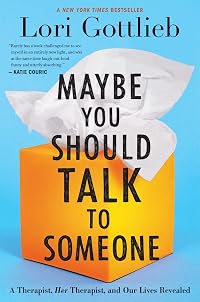
Maybe You Should Talk to Someone: A Therapist, HER Therapist, and Our Lives Revealed
by Lori Gottlieb
On This Page
Description
INSTANT NEW YORK TIMES BESTSELLER!Now being developed as a television series with Eva Longoria and ABC!
"Rarely have I read a book that challenged me to see myself in an entirely new light, and was at the same time laugh-out-loud funny and utterly absorbing."—Katie Couric
"This is a daring, delightful, and transformative book."—Arianna Huffington, Founder, Huffington Post and Founder & CEO, Thrive Global
"Wise, warm, smart, and funny. You must read this book."—Susan Cain, New York show more Times best-selling author of Quiet
From a New York Times best-selling author, psychotherapist, and national advice columnist, a hilarious, thought-provoking, and surprising new book that takes us behind the scenes of a therapist's world—where her patients are looking for answers (and so is she).
One day, Lori Gottlieb is a therapist who helps patients in her Los Angeles practice. The next, a crisis causes her world to come crashing down. Enter Wendell, the quirky but seasoned therapist in whose office she suddenly lands. With his balding head, cardigan, and khakis, he seems to have come straight from Therapist Central Casting. Yet he will turn out to be anything but.
As Gottlieb explores the inner chambers of her patients' lives — a self-absorbed Hollywood producer, a young newlywed diagnosed with a terminal illness, a senior citizen threatening to end her life on her birthday if nothing gets better, and a twenty-something who can't stop hooking up with the wrong guys — she finds that the questions they are struggling with are the very ones she is now bringing to Wendell.
With startling wisdom and humor, Gottlieb invites us into her world as both clinician and patient, examining the truths and fictions we tell ourselves and others as we teeter on the tightrope between love and desire, meaning and mortality, guilt and redemption, terror and courage, hope and change.
Maybe You Should Talk to Someone is revolutionary in its candor, offering a deeply personal yet universal tour of our hearts and minds and providing the rarest of gifts: a boldly revealing portrait of what it means to be human, and a disarmingly funny and illuminating account of our own mysterious lives and our power to transform them. show less
Tags
Recommendations

































Member Reviews
The best parts were when Gottlieb wrote about herself, her ex and the relationship with her therapist. She's like your super-smart girlfriend discussing her problems. Although, she's a little unrelatable because she has a successful writing career, and went to Yale and then Standford medical school for 2 years. Her years of feeling lost look nothing like mine! Gottlieb's book did make me reflect on my own negative thinking loops and the narratives we tell ourselves. Writing about her patients, or I am going to assume a mash-up of patients to better hide their identities, was trickier territory. Her patients' lives were far more "successful" than most, at least in outward appearance. These are patients who have time and money for a year show more or more of weekly therapy, and I am resentful about it. Most of us don't have that kind of access, but we still have the same tragedies only with subpar professional help or without any professional help at all. Patient problems were tidied up in the end, and the reality is some patients never get anywhere, stay the same, quit therapy, run out of money, and or need medication in addition to therapy to get unstuck. Life is so much messier and unresolved. show less
Lori Gottlieb is a Los Angeles-based psychotherapist who reveals her vulnerability in "Maybe You Should Talk to Someone." In her office, she is a skilled and empathetic listener who tries to support her clients while they work through their problems. Ironically, as the book opens, Lori's significant other, whom she calls Boyfriend, leaves her after they have been together for two years. He claims that he wants his freedom and has no interest in co-parenting Lori's eight-year-old son, Zach. Gottlieb feels betrayed, infuriated, and becomes so depressed that she frequently bursts into tears. Since she is having difficulty letting go of her fury and despair, she decides to visit a therapist herself.
In this rich, meaningful, and entertaining show more work of non-fiction, the author explains how talk therapy can be beneficial. Naysayers claim that it is impractical and expensive to visit a mental health practitioner for months or even years. Gottlieb asserts, however, that an individual who is fortunate enough to find the right therapist may acquire useful coping skills, achieve a measure of self-awareness, and find a path to joy and fulfillment. Gottlieb once said in an interview that "we’re so afraid of the truth that sometimes we even hide it from ourselves." One of a therapist's tasks is to help remove the blinkers from our eyes.
On one level, "Maybe You Should Talk to Someone" is an introduction to the art of psychotherapy. Gottlieb writes lucidly about therapeutic terminology, touches on the contributions of pioneers in the field, and provides insight into what can be accomplished if someone's treatment progresses well. The author has a marvelous sense of humor (much of it self-deprecating), and the case studies that she presents are intriguing. It is fascinating to observe Lori in session with John, a narcissistic, sarcastic, and obnoxious writer for a popular television series who believes that he is smarter and more competent than everyone else. Julie is a young woman who discovers shortly after her wedding that she may not have long to live. Rita, a gifted artist, has repeatedly failed at marriage and is estranged from her adult children. While Lori does her best to help her patients heal themselves, she also continues to visit her own therapist, whose guidance enables her to recognize why she has been obsessing so much about her ex-boyfriend. This is a candid, engrossing, and poignant book in which Lori Gottlieb suggests that psychotherapy can help us uncover the hidden truths about ourselves and pave the way for constructive change. show less
In this rich, meaningful, and entertaining show more work of non-fiction, the author explains how talk therapy can be beneficial. Naysayers claim that it is impractical and expensive to visit a mental health practitioner for months or even years. Gottlieb asserts, however, that an individual who is fortunate enough to find the right therapist may acquire useful coping skills, achieve a measure of self-awareness, and find a path to joy and fulfillment. Gottlieb once said in an interview that "we’re so afraid of the truth that sometimes we even hide it from ourselves." One of a therapist's tasks is to help remove the blinkers from our eyes.
On one level, "Maybe You Should Talk to Someone" is an introduction to the art of psychotherapy. Gottlieb writes lucidly about therapeutic terminology, touches on the contributions of pioneers in the field, and provides insight into what can be accomplished if someone's treatment progresses well. The author has a marvelous sense of humor (much of it self-deprecating), and the case studies that she presents are intriguing. It is fascinating to observe Lori in session with John, a narcissistic, sarcastic, and obnoxious writer for a popular television series who believes that he is smarter and more competent than everyone else. Julie is a young woman who discovers shortly after her wedding that she may not have long to live. Rita, a gifted artist, has repeatedly failed at marriage and is estranged from her adult children. While Lori does her best to help her patients heal themselves, she also continues to visit her own therapist, whose guidance enables her to recognize why she has been obsessing so much about her ex-boyfriend. This is a candid, engrossing, and poignant book in which Lori Gottlieb suggests that psychotherapy can help us uncover the hidden truths about ourselves and pave the way for constructive change. show less
Lori Gottlieb is a Los Angeles therapist who suddenly finds herself on the other side of the couch after a personal crisis, and she takes you into both rooms with uncommon candor. The premise is simple: her sessions with Wendell, her own therapist, braid together with the lives of four patients, each arriving with a problem they swear is the whole problem. It never is.
What makes this book work is character, not case study. John, the self-important Hollywood producer who insults everyone in reach, is rendered with enough specificity that his arrogance stops being a cartoon and starts reading like armor. Julie, newly married and facing terminal cancer, is written without the inspirational gloss that so often gets pasted onto sick women show more for other people’s comfort. Rita, approaching seventy and threatening to end her life if nothing changes, is heartbreaking because she is ordinary, and because the book refuses to treat loneliness as a quirky subplot. Charlotte, stuck in a loop of bad men and worse choices, is the one many readers will want to shake, which is exactly why she lands. These people feel real because Gottlieb lets them be contradictory, defensive, funny, and needy, sometimes in the same conversation.
The thematic current running underneath everything is about narrative, the private scripts we write to explain why we are stuck, and how invested we become in staying stuck when change threatens our identity. Gottlieb shows how therapy looks in practice, including the small evasions, the performative competence, the ways people try to hire a therapist to validate their version of events. She also shows the uncomfortable flip side: therapists are not immune to the same vanity and denial, and her own blind spots are on the page, unprotected.
Unputdownable.
The only weakness is that some insights arrive with a touch of polish, like a lesson landing exactly on cue, and a few passages circle familiar self-help language before moving on. It barely matters. When I was done, I wanted to call a friend and be braver with my own sentences. show less
What makes this book work is character, not case study. John, the self-important Hollywood producer who insults everyone in reach, is rendered with enough specificity that his arrogance stops being a cartoon and starts reading like armor. Julie, newly married and facing terminal cancer, is written without the inspirational gloss that so often gets pasted onto sick women show more for other people’s comfort. Rita, approaching seventy and threatening to end her life if nothing changes, is heartbreaking because she is ordinary, and because the book refuses to treat loneliness as a quirky subplot. Charlotte, stuck in a loop of bad men and worse choices, is the one many readers will want to shake, which is exactly why she lands. These people feel real because Gottlieb lets them be contradictory, defensive, funny, and needy, sometimes in the same conversation.
The thematic current running underneath everything is about narrative, the private scripts we write to explain why we are stuck, and how invested we become in staying stuck when change threatens our identity. Gottlieb shows how therapy looks in practice, including the small evasions, the performative competence, the ways people try to hire a therapist to validate their version of events. She also shows the uncomfortable flip side: therapists are not immune to the same vanity and denial, and her own blind spots are on the page, unprotected.
Unputdownable.
The only weakness is that some insights arrive with a touch of polish, like a lesson landing exactly on cue, and a few passages circle familiar self-help language before moving on. It barely matters. When I was done, I wanted to call a friend and be braver with my own sentences. show less
This book isn't what I thought it would be from its title: a book-length explanation of why anyone can benefit from talk therapy. While it is that, it's incidental: this is primarily an outstanding memoir by an excellent therapist who is remarkably open about her own life challenges and how she overcame them by entering therapy with a colleague. It's fascinating to see how she fell into the same defensive reactions as her own patients, even while being able to see and identify them for herself, and to watch her move from trepidation to trust just as her own patients must. As she repeatedly makes clear, it's not only the therapist's experience and skills, it's the relationship between patient and therapist that heals.
Just as one would show more want from one's own therapist, Lori Gottlieb is funny, warm, and brilliant without being either ostentatious or shy about it. Her (disguised) stories about the paths of her own patients through therapy, including the obnoxious writer of a hit TV comedy-drama and a newly married young woman with terminal cancer, keep the reader turning pages and are ultimately moving. The seven effusive blurbs on the back cover are all true. I didn't want to read anything else while I read this book. show less
Just as one would show more want from one's own therapist, Lori Gottlieb is funny, warm, and brilliant without being either ostentatious or shy about it. Her (disguised) stories about the paths of her own patients through therapy, including the obnoxious writer of a hit TV comedy-drama and a newly married young woman with terminal cancer, keep the reader turning pages and are ultimately moving. The seven effusive blurbs on the back cover are all true. I didn't want to read anything else while I read this book. show less
Recommended by my sil the child psychologist I found this book both irresistible, rich and wise. Want to know how it feels to be a therapist? How it feels to be a therapist who needs some therapy? Gottlieb leads us through the journey of four of her clients (fictionalized) as well as her own therapeutic journey after the unexpected end of a long-term relationship. The work starts with that as the issue, but moves deeper into issues of her own mortality and search for meaning. Gottlieb has the gift of citing and highlighting the work of various psychologists she admires and has found useful (like Carl Whittaker's, "the good enough parents theory". As someone who has benefitted from the help of therapists during transitional periods of my show more life, I loved this look behind the curtain.***** show less
Truly excellent book. Gottlieb weaves together her own life story with the lives of 4 of her patients in a way I haven't seen before: I have read quite a few books by counsellors and therapists at this point and while they all keep saying "I'm flawed too, I'm flawed too!" I've never seen one be brave enough to expose how she is just as batshit crazy as the rest of us and finds it just as difficult to see what's going on in her own life (and what she's really up to!).
Another way this is special is that it bravely tries to do two things at once: It's a personal memoir suitable as an introductory university textbook. I know that Yalom had to be convinced over and over again by his publishers that when he writes books about his cases he show more shouldn't explain why he says what he says, that he doesn't put in too much theory. Well, the publishers in this case took the risk that the public are interested in knowing what therapists know, and judging by the reviews it has paid off. show less
Another way this is special is that it bravely tries to do two things at once: It's a personal memoir suitable as an introductory university textbook. I know that Yalom had to be convinced over and over again by his publishers that when he writes books about his cases he show more shouldn't explain why he says what he says, that he doesn't put in too much theory. Well, the publishers in this case took the risk that the public are interested in knowing what therapists know, and judging by the reviews it has paid off. show less
Oof. This book. I did not expect to get as emotional as I did listening to this. Where do I even start?
I’m buying this book in print version so I can go through & annotate it. It’s. That. Good.
So many insights & aha moments for me. This was written as her story, but with her patients’ individual journeys as well & how they were interconnected. Gottlieb is a captivating writer and brutally honest when needed. I enjoyed the informative snippets about the science & psychology behind therapy techniques.
Another phenomenal story about the human condition and how to find the humanity in others. Absolutely loved it.
I’m buying this book in print version so I can go through & annotate it. It’s. That. Good.
So many insights & aha moments for me. This was written as her story, but with her patients’ individual journeys as well & how they were interconnected. Gottlieb is a captivating writer and brutally honest when needed. I enjoyed the informative snippets about the science & psychology behind therapy techniques.
Another phenomenal story about the human condition and how to find the humanity in others. Absolutely loved it.
Members
- Recently Added By
Lists

Top Five Books of 2020
982 works; 350 members

Phi Beta Kappa reading list
260 works; 8 members

Netflix and Reads
18 works; 2 members

Books to Read
95 works; 2 members

Men's healing resources
747 works; 1 member

Healing resources for women
587 works; 1 member

Psychology: Abuse, Grief, Self-Help
189 works; 1 member
Author Information

20+ Works 3,642 Members
Lori Gottlieb is the New York Times bestselling author of MAYBE YOU SHOULD TALK TO SOMEONE, which has sold over a million copies and is currently being adapted as a television series. In addition to her clinical therapy practice, she writes The Atlantic's weekly DEAR THERAPIST advice column and co-hosts the popular DEAR THERAPISTS podcast, show more produced by Katie Couric, where listeners can hear weekly sessions with guests. Recently, her viral TED Talk was one of the Top 10 Most Watched of the Year. Lori is a member of the Advisory Council for Bring Change to Mind, and she is a sought-after expert on mental health in media such as The Today Show, Good Morning America, CBS This Morning, CNN, and NPR's "Fresh Air." show less
Awards and Honors
Awards
Distinctions
Notable Lists
Common Knowledge
- Original publication date
- 2019
- Epigraph
- It is proposed that happiness be classified as a psychiatric disorder and be included in future editions of the major diagnostic manuals under the new name: major affective disorder, pleasant type. In a review of the relevant... (show all) literature it is shown that happiness is statistically abnormal, consists of a discrete cluster of symptoms, is associated with a range of cognitive abnormalities, and probably reflects the abnormal functioning of the central nervous system. One possible objection to this proposal remains—that happiness is not negatively valued. However, this objection is dismissed as scientifically irrelevant.
—RICHARD BENTALL,
JOURNAL OF MEDICAL ETHICS, 1992
The eminent Swiss psychiatrist Carl Jung said this:
“People will do anything, no matter how absurd,
to avoid facing their own souls.”
But he also said this:
“Who looks inside, awakes.” - First words
- CHART NOTE, JOHN:
Patient reports feeling “stressed out” and states that he is having difficulty sleeping and getting along with his wife. - Quotations
- Though we travel the world over to find the beautiful, we must carry it with us, or we find it not. - Ralph Waldo Emerson
- Blurbers
- Couric, Katie; Dickinson, Amy; Hepola, Sarah; Cain, Susan; Huffington, Arianna; Cahalan, Susannah (show all 10); Damour, Lisa; Yalom, Irvin; Jamison, Leslie; Jacobs, A.J.
- Disambiguation notice
- Do not combine the workbook or tool kit
Classifications
- Genres
- General Nonfiction, Biography & Memoir, Nonfiction
- DDC/MDS
- 616.89 — Applied science & technology Medicine & health Diseases, Allergies, Skin Conditions Nervous Disorders: Autism, Anorexia, OCD Mental disorders: bi-polar/schizophrenia
- LCC
- RC480.8 .G68 — Medicine Internal medicine Internal medicine Neurosciences. Biological psychiatry. Neuropsychiatry Psychiatry Therapeutics. Psychotherapy
- BISAC
Statistics
- Members
- 2,836
- Popularity
- 6,400
- Reviews
- 110
- Rating
- (4.22)
- Languages
- 9 — Chinese, Dutch, English, German, Hungarian, Serbian, Slovenian, Spanish, Portuguese (Portugal)
- Media
- Paper, Audiobook, Ebook
- ISBNs
- 31
- ASINs
- 11