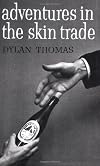
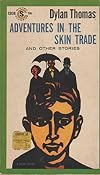
Adventures in the Skin Trade, and other stories
by Dylan Thomas
On This Page
Description
This collection of the poet Dylan Thomas's fiction--and what an extraordinary storyteller he was!--holds special interest because it ranges from the early stories such as "The School for Witches" and "The Burning Baby," with their powerful inheritance of Welsh mythology and wild imagination, to the chapters he completed before his death of the alas unfinished novelAdventures in the Skin Trade. Adventures is the story, written in a shrewd, sly, deadpan vein of picaresque comedy, of young show more Samuel Bennet, who runs away from his home in Wales to seek his fortune in London. show lessTags
Recommendations
















Member Reviews
The premise of Adventures in the Skin Trade struck me with a strong sense of déjà vu but I was unable to identify the any exact parallels to the frustratingly familiar plot.
A youth places himself in London with no clear ambitions other than cutting ties with his previous life. He becomes entangled with a caste of eccentric characters, and embarks on a series of episodic hijinks, as they drag him around London pubs and nightclubs in an increasing state of intoxication. The novel is truncated here, but presumably would have continued in this vein until the events somehow precipitate the protagonist’s coming-of-age moment, or unshackling from the restraints of his former life – symbolised, I predict, by the breaking of the empty show more bottle of Bass Ale that has been stuck on his finger since an early scene, rather than by his skin literally coming off, as was suggested by Thomas’s communication with Vernon Watkins.
The writing has momentum and comic energy, blending the familiar and absurd. At moments, Thomas’s rich imagery imbues everyday settings with mystical symbolism, recalling the tenor of some of his short stories, and in some scenes such as the furniture room, his version of London borders on the surreal. The characters, as much as we get of them, have the potential to be compelling. But unfortunately, in the novel’s incomplete state, the whole is less than the sum of its parts.
This book will be of interest to completionists and those who are curious about how Thomas may have been adapted his use of language to the medium of the novel. Readers are, however, unlikely to rank this fragment with his poems, Under Milkwood, or short stories, and it is really nothing more than an appendix to his core corpus of work. show less
A youth places himself in London with no clear ambitions other than cutting ties with his previous life. He becomes entangled with a caste of eccentric characters, and embarks on a series of episodic hijinks, as they drag him around London pubs and nightclubs in an increasing state of intoxication. The novel is truncated here, but presumably would have continued in this vein until the events somehow precipitate the protagonist’s coming-of-age moment, or unshackling from the restraints of his former life – symbolised, I predict, by the breaking of the empty show more bottle of Bass Ale that has been stuck on his finger since an early scene, rather than by his skin literally coming off, as was suggested by Thomas’s communication with Vernon Watkins.
The writing has momentum and comic energy, blending the familiar and absurd. At moments, Thomas’s rich imagery imbues everyday settings with mystical symbolism, recalling the tenor of some of his short stories, and in some scenes such as the furniture room, his version of London borders on the surreal. The characters, as much as we get of them, have the potential to be compelling. But unfortunately, in the novel’s incomplete state, the whole is less than the sum of its parts.
This book will be of interest to completionists and those who are curious about how Thomas may have been adapted his use of language to the medium of the novel. Readers are, however, unlikely to rank this fragment with his poems, Under Milkwood, or short stories, and it is really nothing more than an appendix to his core corpus of work. show less
As an avowed fan of [[Dlyan Thomas]]' poetry, it was a revelation to find this collection of short fiction. The title story was the opening to a novel Thomas intended to finish but never did. The other stories were all relatively short. Each and every one is filled to brimming with Thomas' characteristic lyric language, and richer for the writing regardless of the effectiveness of the narrative thread. Indeed, some of the stories suffer from the merging of a poet's mind into short form prose, meandering and mystical in opaque way. But, even in those stories, it's easy to get lost in the language.
Recommended!!!!
4 bones!!!!
Recommended!!!!
4 bones!!!!
I really wish Dylan Thomas had finished the title story to this collection, Adventures in the Skin Trade. It really shows him at his best, with elements of comedic inner dialogue (ala Joyce), absurdity (Kafka), adventurousness (Kerouac), and coming of age existentialism (Salinger), all flowing effortlessly. He started it before WWII and never got back to it afterwards, but it was enjoyable despite that.
Unfortunately in many of the other short stories here, he gets into too much religious allegory and apocalyptic visions, and his poetic, dream-like style is overdone, rendering his prose somewhat opaque.
4.5 stars to Adventures in the Skin Trade which starts the collection.
4.5 stars to The Followers which ends the collection, though I had show more read this before separately.
4 stars each to After the Fair and The True Story, which are the second and second to last stories.
Yikes on the other 17 stories, all generally 5-10 pages long.
Quotes; just this one on memory:
“Polly bent over Samuel’s hand and he saw down her dress. She knew that he was looking, but she did not start back or spread her hand across the neck of her dress; she raised her head and stared at his eyes. I shall always remember this, he said to himself. In 1933 a girl was pulling at a bottle on the little finger of my left hand while I looked down her dress. It will last longer than all my poems and troubles.
‘I can’t get it off,’ she said.
‘Take him up to the bathroom then and put some soap on it,’ said Mrs. Dacey, in her dry, neat voice. ‘And mind it’s only his bottle.’” show less
Unfortunately in many of the other short stories here, he gets into too much religious allegory and apocalyptic visions, and his poetic, dream-like style is overdone, rendering his prose somewhat opaque.
4.5 stars to Adventures in the Skin Trade which starts the collection.
4.5 stars to The Followers which ends the collection, though I had show more read this before separately.
4 stars each to After the Fair and The True Story, which are the second and second to last stories.
Yikes on the other 17 stories, all generally 5-10 pages long.
Quotes; just this one on memory:
“Polly bent over Samuel’s hand and he saw down her dress. She knew that he was looking, but she did not start back or spread her hand across the neck of her dress; she raised her head and stared at his eyes. I shall always remember this, he said to himself. In 1933 a girl was pulling at a bottle on the little finger of my left hand while I looked down her dress. It will last longer than all my poems and troubles.
‘I can’t get it off,’ she said.
‘Take him up to the bathroom then and put some soap on it,’ said Mrs. Dacey, in her dry, neat voice. ‘And mind it’s only his bottle.’” show less
Proof that great poets don't always make great writers.
Unfinished works are always going to be unsatisfying, this proves the rule and not by being an exception. It's an apparently autobiographical bildungsroman, but such a story is unsatisfactory without the final coming of age. As it stands it's a fairly standard tale about a small town boy coming to London and having his expectations shattered on the first night . Thomas does have the occasional sharp turn of phrase you'd expect and retains his poetic ability to find the comically bizarre in the mundane but there's not really enough there to sustain what's there as anything else but an interesting footnote to Thomas's poetry which, as the introduction in my version noted, he seemingly show more took far more care over than his prose. If this is semi-autobiographical it was a hell of a lot more fun to live than to read. show less
Unfinished works are always going to be unsatisfying, this proves the rule and not by being an exception. It's an apparently autobiographical bildungsroman, but such a story is unsatisfactory without the final coming of age. As it stands it's a fairly standard tale about a small town boy coming to London and having his expectations shattered on the first night . Thomas does have the occasional sharp turn of phrase you'd expect and retains his poetic ability to find the comically bizarre in the mundane but there's not really enough there to sustain what's there as anything else but an interesting footnote to Thomas's poetry which, as the introduction in my version noted, he seemingly show more took far more care over than his prose. If this is semi-autobiographical it was a hell of a lot more fun to live than to read. show less
Outrageous and bizarre, with strange characters and situations.
Hi*!! I again clicked onto this from another member, as I was browsing - since i did pivk up a vintage paperback copy of this interesting book at a thrift shop. I will try to post more later, plus an image of the cover. I have not read this yet.
Ratings
Members
- Recently Added By
Author Information

274+ Works 15,820 Members
The most important Welsh poet of the twentieth century, Thomas was born in Swansea, about which he remembered unkindly "the smug darkness of a provincial town." He attended Swansea Grammar School but received his real education in the extensive library of his father, a disappointed schoolteacher with higher ambitions. Refusing university study in show more favor of immediately becoming a professional writer, Thomas worked first in Swansea and then in London at a variety of literary jobs, which included journalism and, eventually, filmscripts and radio plays. In 1936 he began the satisfying but stormy marriage to the bohemian writer and dancer Caitlin MacNamara that would endure for the rest of his career. His life fell into a pattern of oscillation between work and dissipation in London and recovery and relaxation in a rural retreat, usually in Wales. Thomas worked in a documentary film unit during the war. Besides his poetry, he wrote plays and fiction. In the early 1950s, he gave three celebrated poetry-reading tours of the United States, during which his outrageous behavior vied with his superb reading ability for public attention. Aggravated by chronic alcoholism, his health collapsed during the last tour, and he died in a New York City hospital. In his poetry, Thomas embraced an exuberant romanticism in the encounter between self and world and a joyous riot in the lushness of language. His work falls into three periods---an early "womb-tomb" phase during which he produced a notebook, which he later mined for further poems, a middle one troubled by marriage and war, and a final acceptance of the human condition. The exuberant rhetoric of his work belies an equally strong devotion to artistry, what he once called "my craft or sullen art." His great "Fern Hill," for example, builds its imagery of the rejoicing innocence of childhood on a strict and demanding syllabic count. A recollection of boyhood holidays on the farm of his aunt and uncle, that poem places its emotion within an Edenic framework typical of Thomas's work. The impressive sonnet sequence "Altarwise by Owl-Light" (1936) combines the internal quest of romanticism with a more elaborate religious outlook in tracing the birth and spiritual autobiography of a poet. Almost at the end of his career he produced the moving elegy "Do Not Go Gentle into That Good Night" (1952), written during the final illness of his father. Despite his periods of doubt and dissipation, Thomas celebrated the fullness of life. As he wrote in a note to his Collected Poems (1952), "These poems, with all their crudities, doubts, and confusion, are written for the love of Man and in praise of God, and I'd be a damn fool if they weren't." (Bowker Author Biography) show less
Series
Belongs to Publisher Series
Reihe Hanser (71)
Common Knowledge
- Canonical title
- Adventures in the Skin Trade, and other stories
- Original publication date
- 1953
- Disambiguation notice
- Book
Classifications
Statistics
- Members
- 619
- Popularity
- 47,077
- Reviews
- 6
- Rating
- (3.53)
- Languages
- 6 — Dutch, English, German, Italian, Spanish, Swedish
- Media
- Paper, Audiobook, Ebook
- ISBNs
- 16
- ASINs
- 24