How to Hide an Empire: A History of the Greater United States
by Daniel Immerwahr
On This Page
Description
A pathbreaking history of the United States' overseas possessions and the true meaning of its empire We are familiar with maps that outline all fifty states. And we are also familiar with the idea that the United States is an "empire," exercising power around the world. But what about the actual territories-the islands, atolls, and archipelagos-this country has governed and inhabited? In How to Hide an Empire, Daniel Immerwahr tells the fascinating story of the United States outside the show more United States. In crackling, fast-paced prose, he reveals forgotten episodes that cast American history in a new light. We travel to the Guano Islands, where prospectors collected one of the nineteenth century's most valuable commodities, and the Philippines, site of the most destructive event on U.S. soil. In Puerto Rico, Immerwahr shows how U.S. doctors conducted grisly experiments they would never have conducted on the mainland and charts the emergence of independence fighters who would shoot up the U.S. Congress. In the years after World War II, Immerwahr notes, the United States moved away from colonialism. Instead, it put innovations in electronics, transportation, and culture to use, devising a new sort of influence that did not require the control of colonies. Rich with absorbing vignettes, full of surprises, and driven by an original conception of what empire and globalization mean today, How to Hide an Empire is a major and compulsively readable work of history. show lessTags
Recommendations







Member Reviews
The author begins this decidedly different approach to American history by pointing out that on December 7, 1941, Japanese planes attacked not just Pearl Harbor, but also the U.S. territories of the Philippines, Guam, Midway Island, and Wake Island. Yet Roosevelt chose to characterize the entire incident as an attack on Pearl Harbor. Immerwahr writes:
"Roosevelt no doubt noted that the Philippines and Guam, though technically part of the United States, seemed foreign to many. Hawaii, by contrast, was more plausibly ‘American.’ Though it was a territory rather than a state, it was closer to North America and significantly whiter than the others. …. Yet even when it came to Hawaii, Roosevelt felt a need to massage the point. Though show more the territory had a substantial white population, nearly three-quarters of its inhabitants were Asians or Pacific Islanders. . . . “
Thus, Roosevelt changed his announcement, and added that damage had been done to “American naval and military forces,” and “very many American lives” had been lost.
This history is illustrative of the main theme of this book, which emphasizes the deliberate invisibility of American territories outside of the mainland. Early on, the word “colonies” was determined to be anathema. “Territories” sounded better, if one had to discuss those places at all. Mostly, however, they were not and still are not discussed. Immerwahr observes, “One of the truly distinctive features of the United States’ empire is how persistently ignored it has been.”
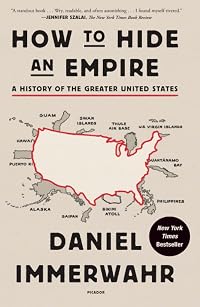
In fact, as Immerwahr avers, the “logo map” of the United States most often shows the mainland, and more recently, includes Alaska and Hawaii. But, Immerwahr asks, “When have you ever seen a map of the United States that had Puerto Rico on it? Or American Samoa, Guam, the U.S. Virgin Islands, the Northern Marianas, or any of the other smaller islands the United States has annexed over the years?”
The logo map, the author argues, is not only misleading geographically:
"It suggests that the United States is a politically uniform space: a union, voluntarily entered into, of states standing on equal footing with one another. But that’s not true, and it’s never been true. From the day the treaty securing independence from Britain was ratified, right up to the present, it’s been a collection of states and territories. It’s been a partitioned country, divided into two sections, with different laws applying in each.”
On the eve of World War II, nearly nineteen million people lived in American colonies, the great bulk of them in the Philippines. Although smaller than the British Empire, the United States empire was then the fifth largest in the world. Moreover, the racism that had pervaded the U.S. since slavery affected the territories as well, as the example of FDR’s reaction to the Japanese bombing illustrates so well. Colonial subjects were even called “niggers” to emphasize their “inferior” status, and were treated as badly as black citizens were in the mainland.
A report released during WWII noted that “Most people in this country [i.e., the U.S.], including educated people, know little or nothing about our overseas possessions.”
Of course, as we have found, even today many mainlanders do not realize Puerto Ricans are American citizens. A poll taken after Hurricane Maria found that only a slight majority of mainlanders, and only 37% of those under age 30, knew that fact. Even the current U.S. President seemed to be unaware of it. As one online article reported about his reaction to Hurricane Maria in 2017:
"The small Caribbean island is a United States territory (technically an “unincorporated territory”) and has been since 1898, after the U.S. claimed victory in the Spanish-American War. Puerto Ricans have American citizenship and are able to travel throughout the U.S. mainland as they please – and it’s under the jurisdiction of the current occupant of the Oval Office.
It appears that the president – who hails from New York, the state that contains the largest population of Puerto Ricans in the country – is either not entirely aware that Puerto Rico is not another country, or is refusing to acknowledge that it’s a part of the United States.”
Immerwahr, an associate professor of history at Northwestern University, sets out to show what U.S. history would look like if it acknowledged the Greater United States rather than just the logo map version. That history has had three stages, in his view. The first was westward expansion: “the creation in the 1830s of a massive all-Indian territory [is] arguably the United States’ first colony.” The second stage moved off the continent, when the U.S. started annexing new territory overseas. The third stage involved a retreat and a ceding back of territory. He explores the reason why at some length.
Although the United States prefers to see itself as a “republic,” the result of this self-deception has been costly for people in the colonies:
"The logo map has relegated them to the shadows, which are a dangerous place to live. At various times, the inhabitants of the U.S. Empire have been shot, shelled, starved, interned, dispossessed, tortured, and experimented on. What they haven’t been, by and large, is seen.”
Immerwahr attempts, quite successfully in my view, to remedy that omission. He spends a great deal of time recounting the injustices committed in the colonies, far from the eyes of mainlanders. He noted:
"The men sent to run the territories, unlike the trained administrators who oversaw European colonies, simply didn’t know much about the places to which they’d been assigned, and they cycled rapidly through their posts. Between Guam’s annexation in 1899 and World War II, it had nearly forty governors. FDR’s first governor of Puerto Rico, who served for six months, spoke no Spanish and left reporters with the distinct impression that he didn’t know where the island was. There was a period of several months when the territory of Alaska, which is half the physical size of India, didn’t have a single federal official in it.”
In the Philippines, in particular, he tells the story of how Daniel Burnham and others were sent to Manilla to transform it, but for the colonizers, not the natives.:
"Such were the joys of empire. The colonies [in the Philippines in this instance] were, for men like [Daniel] Burnham, playgrounds, places to carry out ideas without worrying about the counterforces that encumbered action at home. Mainlanders could confiscate land, redirect taxes, and waste workers’ lives to build paradises in the mountains.”
Other stories of Colonial behavior are even worse, and hard to stomach. In perhaps the most egregious example, the author reports that the U.S. Department of Defense admitted in 2002 to having conducted chemical and biological warfare experiments on unwitting citizens in territories including Puerto Rico and the Marshall Islands. The first tests were carried out by a mainland doctor, Cornelius P. Rhoads, whose cancer research in a Puerto Rican hospital in the 1930s reportedly included injecting unknowing patients with cancer cells. Incredibly, Rhoads went on to serve in 1940 as director of Memorial Hospital for Cancer Research in New York, and then starting in 1945 was the first director of Sloan-Kettering Institute, and the first director of the combined Memorial Sloan–Kettering Cancer Center. Thanks to his unethical contributions to cancer research, Rhoads was featured on the cover of the June 27, 1949 issue of “Time Magazine” under the title "Cancer Fighter.”
The second experiments, using biological and chemical weapons, were performed by the U.S. military in the 1960s and 1970s at various locations, including Puerto Rico, Alaska, Hawaii, Florida, Canada, and the Marshall Islands. The experiments were performed outdoors, meaning civilians might also have been exposed to harmful chemical and biological agents.
All of these behaviors were enabled by three interconnected forces: racism; the imprimatur of laws passed in its service; and the invisibility that still obtains regarding the annexed areas.
The legal basis for the treatment of the colonies was established with the “Insular Cases,” a series of opinions by the U.S. Supreme Court in 1901 about whether or not people in newly acquired U.S. territories were citizens. (The term "insular" signifies that the territories were islands administered by the War Department's Bureau of Insular Affairs.) In a number of related cases listed here, the Court held that full constitutional protection of rights did not automatically (or ex proprio vigore — i.e., of its own force) extend to all places under American control. This meant that inhabitants of unincorporated territories such as Puerto Rico—"even if they are U.S. citizens"—may lack some constitutional rights (e.g., the right to remain part of the United States in case of de-annexation).
Thus, the Insular Cases "authorized the colonial regime created by Congress, which allowed the United States to continue its administration—and exploitation—of the territories acquired from Spain after the Spanish-American War.” [See, Juan R. Torruella [First Circuit Judge], “Ruling America's Colonies: The ‘Insular Cases,’” Yale Law & Policy Review, Vol. 32, No. 1 (fall 2013), pp. 57-95, online here.]
Today, the categorizations and implications put forth by the Insular Cases still govern the United States' territories. The Harvard Law Review Blog writes, "Judge Torruella has become the most prominent critic of the Insular Cases, arguing forcefully that “the Insular Cases represent classic Plessy v. Ferguson legal doctrine and thought that should be totally eradicated from present-day constitutional reasoning.”
Currently, Immerwahr reports, there are about four million people living in U.S. territories, in Puerto Rico, Guam, American Samoa, the U.S. Virgin Islands, and the Northern Marianas. He observes, “they’re subject to the whims of Congress and the president, but they can’t vote for either.”
The author concludes the book with a discussion of “birtherism,” discussing how the racism that has always tinged attitudes toward territories and former territories still intrudes into American politics.
Evaluation: This history reflects a great deal of research and as a bonus is written in a very accessible way, interweaving anecdotes about colonial players with facts that are horrifying and little reported. The book, dedicated “To the Uncounted,” should be a part of every U.S. history program. show less
"Roosevelt no doubt noted that the Philippines and Guam, though technically part of the United States, seemed foreign to many. Hawaii, by contrast, was more plausibly ‘American.’ Though it was a territory rather than a state, it was closer to North America and significantly whiter than the others. …. Yet even when it came to Hawaii, Roosevelt felt a need to massage the point. Though show more the territory had a substantial white population, nearly three-quarters of its inhabitants were Asians or Pacific Islanders. . . . “
Thus, Roosevelt changed his announcement, and added that damage had been done to “American naval and military forces,” and “very many American lives” had been lost.
This history is illustrative of the main theme of this book, which emphasizes the deliberate invisibility of American territories outside of the mainland. Early on, the word “colonies” was determined to be anathema. “Territories” sounded better, if one had to discuss those places at all. Mostly, however, they were not and still are not discussed. Immerwahr observes, “One of the truly distinctive features of the United States’ empire is how persistently ignored it has been.”
In fact, as Immerwahr avers, the “logo map” of the United States most often shows the mainland, and more recently, includes Alaska and Hawaii. But, Immerwahr asks, “When have you ever seen a map of the United States that had Puerto Rico on it? Or American Samoa, Guam, the U.S. Virgin Islands, the Northern Marianas, or any of the other smaller islands the United States has annexed over the years?”
The logo map, the author argues, is not only misleading geographically:
"It suggests that the United States is a politically uniform space: a union, voluntarily entered into, of states standing on equal footing with one another. But that’s not true, and it’s never been true. From the day the treaty securing independence from Britain was ratified, right up to the present, it’s been a collection of states and territories. It’s been a partitioned country, divided into two sections, with different laws applying in each.”
On the eve of World War II, nearly nineteen million people lived in American colonies, the great bulk of them in the Philippines. Although smaller than the British Empire, the United States empire was then the fifth largest in the world. Moreover, the racism that had pervaded the U.S. since slavery affected the territories as well, as the example of FDR’s reaction to the Japanese bombing illustrates so well. Colonial subjects were even called “niggers” to emphasize their “inferior” status, and were treated as badly as black citizens were in the mainland.
A report released during WWII noted that “Most people in this country [i.e., the U.S.], including educated people, know little or nothing about our overseas possessions.”
Of course, as we have found, even today many mainlanders do not realize Puerto Ricans are American citizens. A poll taken after Hurricane Maria found that only a slight majority of mainlanders, and only 37% of those under age 30, knew that fact. Even the current U.S. President seemed to be unaware of it. As one online article reported about his reaction to Hurricane Maria in 2017:
"The small Caribbean island is a United States territory (technically an “unincorporated territory”) and has been since 1898, after the U.S. claimed victory in the Spanish-American War. Puerto Ricans have American citizenship and are able to travel throughout the U.S. mainland as they please – and it’s under the jurisdiction of the current occupant of the Oval Office.
It appears that the president – who hails from New York, the state that contains the largest population of Puerto Ricans in the country – is either not entirely aware that Puerto Rico is not another country, or is refusing to acknowledge that it’s a part of the United States.”
Immerwahr, an associate professor of history at Northwestern University, sets out to show what U.S. history would look like if it acknowledged the Greater United States rather than just the logo map version. That history has had three stages, in his view. The first was westward expansion: “the creation in the 1830s of a massive all-Indian territory [is] arguably the United States’ first colony.” The second stage moved off the continent, when the U.S. started annexing new territory overseas. The third stage involved a retreat and a ceding back of territory. He explores the reason why at some length.
Although the United States prefers to see itself as a “republic,” the result of this self-deception has been costly for people in the colonies:
"The logo map has relegated them to the shadows, which are a dangerous place to live. At various times, the inhabitants of the U.S. Empire have been shot, shelled, starved, interned, dispossessed, tortured, and experimented on. What they haven’t been, by and large, is seen.”
Immerwahr attempts, quite successfully in my view, to remedy that omission. He spends a great deal of time recounting the injustices committed in the colonies, far from the eyes of mainlanders. He noted:
"The men sent to run the territories, unlike the trained administrators who oversaw European colonies, simply didn’t know much about the places to which they’d been assigned, and they cycled rapidly through their posts. Between Guam’s annexation in 1899 and World War II, it had nearly forty governors. FDR’s first governor of Puerto Rico, who served for six months, spoke no Spanish and left reporters with the distinct impression that he didn’t know where the island was. There was a period of several months when the territory of Alaska, which is half the physical size of India, didn’t have a single federal official in it.”
In the Philippines, in particular, he tells the story of how Daniel Burnham and others were sent to Manilla to transform it, but for the colonizers, not the natives.:
"Such were the joys of empire. The colonies [in the Philippines in this instance] were, for men like [Daniel] Burnham, playgrounds, places to carry out ideas without worrying about the counterforces that encumbered action at home. Mainlanders could confiscate land, redirect taxes, and waste workers’ lives to build paradises in the mountains.”
Other stories of Colonial behavior are even worse, and hard to stomach. In perhaps the most egregious example, the author reports that the U.S. Department of Defense admitted in 2002 to having conducted chemical and biological warfare experiments on unwitting citizens in territories including Puerto Rico and the Marshall Islands. The first tests were carried out by a mainland doctor, Cornelius P. Rhoads, whose cancer research in a Puerto Rican hospital in the 1930s reportedly included injecting unknowing patients with cancer cells. Incredibly, Rhoads went on to serve in 1940 as director of Memorial Hospital for Cancer Research in New York, and then starting in 1945 was the first director of Sloan-Kettering Institute, and the first director of the combined Memorial Sloan–Kettering Cancer Center. Thanks to his unethical contributions to cancer research, Rhoads was featured on the cover of the June 27, 1949 issue of “Time Magazine” under the title "Cancer Fighter.”
The second experiments, using biological and chemical weapons, were performed by the U.S. military in the 1960s and 1970s at various locations, including Puerto Rico, Alaska, Hawaii, Florida, Canada, and the Marshall Islands. The experiments were performed outdoors, meaning civilians might also have been exposed to harmful chemical and biological agents.
All of these behaviors were enabled by three interconnected forces: racism; the imprimatur of laws passed in its service; and the invisibility that still obtains regarding the annexed areas.
The legal basis for the treatment of the colonies was established with the “Insular Cases,” a series of opinions by the U.S. Supreme Court in 1901 about whether or not people in newly acquired U.S. territories were citizens. (The term "insular" signifies that the territories were islands administered by the War Department's Bureau of Insular Affairs.) In a number of related cases listed here, the Court held that full constitutional protection of rights did not automatically (or ex proprio vigore — i.e., of its own force) extend to all places under American control. This meant that inhabitants of unincorporated territories such as Puerto Rico—"even if they are U.S. citizens"—may lack some constitutional rights (e.g., the right to remain part of the United States in case of de-annexation).
Thus, the Insular Cases "authorized the colonial regime created by Congress, which allowed the United States to continue its administration—and exploitation—of the territories acquired from Spain after the Spanish-American War.” [See, Juan R. Torruella [First Circuit Judge], “Ruling America's Colonies: The ‘Insular Cases,’” Yale Law & Policy Review, Vol. 32, No. 1 (fall 2013), pp. 57-95, online here.]
Today, the categorizations and implications put forth by the Insular Cases still govern the United States' territories. The Harvard Law Review Blog writes, "Judge Torruella has become the most prominent critic of the Insular Cases, arguing forcefully that “the Insular Cases represent classic Plessy v. Ferguson legal doctrine and thought that should be totally eradicated from present-day constitutional reasoning.”
Currently, Immerwahr reports, there are about four million people living in U.S. territories, in Puerto Rico, Guam, American Samoa, the U.S. Virgin Islands, and the Northern Marianas. He observes, “they’re subject to the whims of Congress and the president, but they can’t vote for either.”
The author concludes the book with a discussion of “birtherism,” discussing how the racism that has always tinged attitudes toward territories and former territories still intrudes into American politics.
Evaluation: This history reflects a great deal of research and as a bonus is written in a very accessible way, interweaving anecdotes about colonial players with facts that are horrifying and little reported. The book, dedicated “To the Uncounted,” should be a part of every U.S. history program. show less
The whole raison d’être of the USA is anticolonialism, you would assume — this is the country that came into existence as a result of its objection to being ruled by a foreign power and having that power’s troops stationed on its land. Most US citizens would tell you that this has always been what the US has been about. And yet, Americans have spent much of the last 250 years stationing their troops on other people’s lands and exercising rule over peoples who have little or no say in how they are ruled. Most notoriously they did this to indigenous people on the continent of North America, but along the way they also picked up dozens of Pacific or Caribbean islands of commercial or strategic interest, as well as a large piece of show more Mexico and big chunks of the former Spanish empire (especially the Philippines and Puerto Rico). Even after World War II made outright colonialism unfashionable, the US has continued to maintain bases around the world, many rented from foreign governments but others, like Guam, still very much run as overseas territories with only very limited self-government. Client states and former colonies are graciously allowed to run their own affairs, but always with the proviso that the US might choose to send in the marines and appoint a more favourable dictator, should things move in a direction deemed prejudicial to US commercial or strategic interests.
Immerwahr looks at the odd hypocrisy which allows Americans to denounce colonialism whilst remaining blissfully unaware of their country’s huge bootprint on the rest of the globe. The map of the US everyone carries in their heads is that of the 48 contiguous states, and if pushed few would remember to add anything other than Alaska and Hawai’i to that picture. The history of Puerto Rico is not taught in mainland schools, and a large proportion of Americans seem to be unaware that it is a US territory.
This is interesting, and maybe worth pursuing further, but Immerwahr then drifts off into a more general analysis of why acquiring colonies was important in the 19th century and how it came to be redundant after World War II, when technical developments in synthetic chemistry reduced the strategic importance of most colonial raw materials (especially rubber) whilst military-led industrial standardisation and the spread of English-as-a-second-language meant that political coercion was no longer necessary to create global export markets for US industry. This is all relatively familiar stuff, and doesn’t really seem necessary here, but it does let Immerwahr tell us (twice) about the importance In world history of his cousin-by-marriage Fritz Haber… show less
Immerwahr looks at the odd hypocrisy which allows Americans to denounce colonialism whilst remaining blissfully unaware of their country’s huge bootprint on the rest of the globe. The map of the US everyone carries in their heads is that of the 48 contiguous states, and if pushed few would remember to add anything other than Alaska and Hawai’i to that picture. The history of Puerto Rico is not taught in mainland schools, and a large proportion of Americans seem to be unaware that it is a US territory.
This is interesting, and maybe worth pursuing further, but Immerwahr then drifts off into a more general analysis of why acquiring colonies was important in the 19th century and how it came to be redundant after World War II, when technical developments in synthetic chemistry reduced the strategic importance of most colonial raw materials (especially rubber) whilst military-led industrial standardisation and the spread of English-as-a-second-language meant that political coercion was no longer necessary to create global export markets for US industry. This is all relatively familiar stuff, and doesn’t really seem necessary here, but it does let Immerwahr tell us (twice) about the importance In world history of his cousin-by-marriage Fritz Haber… show less
There is nothing else quite like this work in that the author starts with the continental "settler" empire of the 19th century, takes you through the "insular" empire that was created by the Spanish-American War, and brings you through the "empire of bases" that under-girded "globalism," and which may now be past its zenith; just in time to be reinvented in another format. I've been using the "e" word for awhile vis-a-vis the American experience, but what Immerwahr does particularly well is to illustrate the strains that empire created, when going hand in hand with the sheer hard work of holding together the "Lower 48" as a coherent polity, with out the added strains of going global and undeniably multi-ethnic. Perhaps the single most show more salient point in this book comes with the admission of Alaska and Hawaii to the Union, which marks the official ending of the concept of the "white-male Jacksonian republic" being a viable option, as that sort of racism was always a brake on official expansion. Besides that Immerwahr writes with humor and self-awareness, even when there is serious ugliness to confront, and about the only reason that I mark this book down a little bit is that he goes on a bit too long about how technology, international standards, and cultural "soft power" undermined the need for the sort of formal empire that required the subjugation and administration of large populations. Immerwahr also might have dealt with the notion of the creation of America's insular empire as a project of "reunion;" nothing like a "splendid little war" to bring a divided people together, at least in theory. show less
There are books that remind me of just how ignorant I am about the history (and current reality) of the country I live in. Books like this one. I delight in the education, even while I cringe at the harsh truths. This opens up a way to read U.S. history that would most decidedly not be Florida-approved, and it clarifies things that the powerful have worked to hide...thus, the title.
"Pointillist empire."
There's a point in the middle of the book where Immerwahr transitions from Puerto Rico and the Phillipines to capitalism abroad. It seems to wander until you realize how badly foreign bases and the soft power of commercial and cultural dominance has resulted in so many own-goals in American foreign policy. Where colonial powers held land and conceded to independence movements, the US model held to strategic military and economic hooks that ultimately kindled insurrection via insurgency. The resulting terrorism hence is a direct and inevitable outcome of America's particular method of exerting imperial control across the globe.
There's a point in the middle of the book where Immerwahr transitions from Puerto Rico and the Phillipines to capitalism abroad. It seems to wander until you realize how badly foreign bases and the soft power of commercial and cultural dominance has resulted in so many own-goals in American foreign policy. Where colonial powers held land and conceded to independence movements, the US model held to strategic military and economic hooks that ultimately kindled insurrection via insurgency. The resulting terrorism hence is a direct and inevitable outcome of America's particular method of exerting imperial control across the globe.
This is an amazing book, every chapter of which holds more than enough facts and insights to satisfy those whose political perspective doesn't conflict so strongly that they're driven away. I'm on Immerwahr's side—progressive, inclusive, skeptical of nationalism and empire-building—but I hate that strain on the left that considers an attitude of righteous bitterness the only acceptable one, and I was wearied by the eagerness to see the worst motive in every historical action and military decision. Nevertheless, I learned enough to make me recommend "How to Hide an Empire" to anyone with any interest in the history of the United States' actions on the global stage. Immerwahr's command of detail in support of his arguments, together show more with a superbly broad expertise that includes sociology, economics, military history and epidemiology, make for a breathtakingly interesting book that made me wonder how I could not have heard about this stuff. In particular, the chapters on the Phillipines make me want to buttonhole my friends and share what I've learned. (The information about how Puerto Rico—and Puerto Ricans—got where they are today is great, too.) Highly recommended. show less
Fascinating popular retelling of U.S. history as the history of a nation that was never just “united states” and was always—since the end of the Revolution—a nation with territories, which meant a nation with subjects as well as citizens. I enjoyed the writing: Phrases like “the cursed accordion of Poland, expanding and contracting,” show his wit (and sometimes got a bit precious, but I mostly enjoyed them).
Yes, we know that the U.S. was territorially expansionist, but (most) contiguous territories were treated very differently than noncontiguous territories, further revealing the centrality of race to U.S. history—until Hawai’i and Alaska were admitted, whites had successfully blocked statehood for any territory that show more might put nonwhites in power in the near term. (I would’ve appreciated a bit about the mainland territory in which I was born, whose majority-nonwhite residents still lack voting rights in Congress despite living around it.) Immerwahr’s argument has two main chunks, as I read it. The first is just educating mainlanders about how very much territory, and how very many people, the U.S. controlled and in many cases still controls without any intention of admitting to the polity, including in the Phillippines, Guam, and Puerto Rico. The “logo map” of the mainland (with Alaska and Hawai’i squished in along the side) that dominates mainstream thinking leads the public to misunderstand what “the United States” and its history really are. (As my husband points out, a significant number of Americans apparently don’t know that New Mexico is a state, any more than they care that DC can’t control its own destiny—being on the mainland isn’t enough to protect everyone from a racialized failure to know, though New Mexico at least has two senators.)
The second part of the book, which seems more scattershot but comes together in the end, is to explain why American imperialism didn’t usually come in the form of running colonies—what he refers to as globalization rather than colonization. Immerwahr adds considerations of technical changes as well as ideology (though he is also clear that the desire not to admit nonwhites to citizenship and the embarrassment of keeping them subjects and subjected played big roles). Specifically, technological innovations meant that owning tropical colonies became less important as a guarantor of important resources lacking on the U.S. mainland, such as rubber; standardization meant that the U.S. didn’t need to legally mandate production to its needs because the market would take care of that; likewise with the dominance of English and the U.S. entertainment industry. Technological change also united with resistance to imperialism to lead the U.S. to take a “pointillist” approach to territory: as long as it has hundreds of bases around the world, which it does, and as long as it can fly or sail to them, which it can, it doesn’t need more from the country around those bases. Indeed the U.S. often finds it convenient to put its bases in out-of-the-way places that are harder to notice and protest, though people (including Osama bin Laden) do anyway. show less
Yes, we know that the U.S. was territorially expansionist, but (most) contiguous territories were treated very differently than noncontiguous territories, further revealing the centrality of race to U.S. history—until Hawai’i and Alaska were admitted, whites had successfully blocked statehood for any territory that show more might put nonwhites in power in the near term. (I would’ve appreciated a bit about the mainland territory in which I was born, whose majority-nonwhite residents still lack voting rights in Congress despite living around it.) Immerwahr’s argument has two main chunks, as I read it. The first is just educating mainlanders about how very much territory, and how very many people, the U.S. controlled and in many cases still controls without any intention of admitting to the polity, including in the Phillippines, Guam, and Puerto Rico. The “logo map” of the mainland (with Alaska and Hawai’i squished in along the side) that dominates mainstream thinking leads the public to misunderstand what “the United States” and its history really are. (As my husband points out, a significant number of Americans apparently don’t know that New Mexico is a state, any more than they care that DC can’t control its own destiny—being on the mainland isn’t enough to protect everyone from a racialized failure to know, though New Mexico at least has two senators.)
The second part of the book, which seems more scattershot but comes together in the end, is to explain why American imperialism didn’t usually come in the form of running colonies—what he refers to as globalization rather than colonization. Immerwahr adds considerations of technical changes as well as ideology (though he is also clear that the desire not to admit nonwhites to citizenship and the embarrassment of keeping them subjects and subjected played big roles). Specifically, technological innovations meant that owning tropical colonies became less important as a guarantor of important resources lacking on the U.S. mainland, such as rubber; standardization meant that the U.S. didn’t need to legally mandate production to its needs because the market would take care of that; likewise with the dominance of English and the U.S. entertainment industry. Technological change also united with resistance to imperialism to lead the U.S. to take a “pointillist” approach to territory: as long as it has hundreds of bases around the world, which it does, and as long as it can fly or sail to them, which it can, it doesn’t need more from the country around those bases. Indeed the U.S. often finds it convenient to put its bases in out-of-the-way places that are harder to notice and protest, though people (including Osama bin Laden) do anyway. show less
Members
- Recently Added By
Lists

Top Five Books of 2020
982 works; 350 members

Evan's Reading List 2023
20 works; 1 member

Phi Beta Kappa reading list
260 works; 8 members

Evan's Wish List
86 works; 2 members

Five star books
1,767 works; 110 members

United States
35 works; 1 member
Author Information

3+ Works 1,851 Members
Daniel Immerwahr is Associate Professor of History at Northwestern University.
Some Editions
Awards and Honors
Awards
Distinctions
Common Knowledge
- Original publication date
- 2019
- Important places
- Guam; Hawai'i, USA; The Philippines; Puerto Rico
- Epigraph
- The only problem is
they don't think much
about us
in America.
--Alfredo Navarro Salanga, Manila - Dedication
- To the uncounted
- First words
- The thirteen colonies that would make up the United States declared independence from Britain in 1776.
- Quotations
- In 1935 the State Department announced that it was annexing Baker, Howland, and Jarvis Islands in the central Pacific. Two days later, it hastily rescinded the announcement. The United States didn't need to annex those island... (show all)s, officials clarified with embarrassment. Consultation of the records had revealed that it already owned them.
- Last words
- (Click to show. Warning: May contain spoilers.)The history of the United States is the history of empire.
- Original language
- English
- Canonical DDC/MDS
- 973
- Canonical LCC
- F965
Classifications
Statistics
- Members
- 1,815
- Popularity
- 12,012
- Reviews
- 34
- Rating
- (4.30)
- Languages
- English, German, Italian, Spanish
- Media
- Paper, Audiobook, Ebook
- ISBNs
- 15
- ASINs
- 5