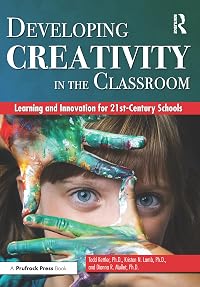
Developing Creativity in the Classroom
by Todd Kettler Ph.D
On This Page
Description
Developing Creativity in the Classroom applies the most current theory and research on creativity to support the design of teaching and learning. Creative thinking and problem solving are at the heart of learning and application as students prepare for innovation-driven careers. This text debunks myths about creativity and teaching and, instead, illustrates productive conceptions of creative thinking and innovation, including a constructivist learning approach in which creative thinking show more enhances and strengthens conceptual understanding of the curriculum. Through models of teaching that support creativity and problem solving, this book extends the idea of a creative pedagogy to the four core curriculum domains. Developing Creativity in the Classroom focuses on explanations and examples of how creative thinking and deep learning merge to support engaging learning environments, rising to the challenge of developing 21st-century competencies. show lessTags
Member Reviews
I was pleasantly surprised by this book. I've worked in education and educational technology for a very long time and as such I know that creativity is a very complex subject to study and make tangible. The authors did a good job of taking what we know academically and making it useful by educators. Having said that I would argue that this book's audience is administrator level staff of schools. So it would require further dissemination and refinement to be used directly in classrooms.
The book starts with a number of overview research and background information. The authors pleasantly skip the one 'formal' test we have for creativity as it only tests a limited and purely IQ-based form of creativity. That alone made me engaged in the show more rest of the content of the book. I also like that the information given here is presented in an open ended way. In other words, you can take from it what you want and if you don't agree or a like a certain aspect then you simply don't use it.
If I put my academic paper reviewer hat on I would say that the copious self-referencing is a bit suspect. Even if you're the sole expert in a field you base your work on others and you situate your thinking in terms of others' thinking. The result is that the references at the end are a bit meager. Then again the field of creativity research isn't all that massive. But it would have been prudent to branch out a bit and show various related research. show less
The book starts with a number of overview research and background information. The authors pleasantly skip the one 'formal' test we have for creativity as it only tests a limited and purely IQ-based form of creativity. That alone made me engaged in the show more rest of the content of the book. I also like that the information given here is presented in an open ended way. In other words, you can take from it what you want and if you don't agree or a like a certain aspect then you simply don't use it.
If I put my academic paper reviewer hat on I would say that the copious self-referencing is a bit suspect. Even if you're the sole expert in a field you base your work on others and you situate your thinking in terms of others' thinking. The result is that the references at the end are a bit meager. Then again the field of creativity research isn't all that massive. But it would have been prudent to branch out a bit and show various related research. show less
This book includes a great deal of findings from the latest research on what helps the development of creativity. In particular, the authors discuss the ways in which individuals living in the 21st century have different needs in terms of education, lamenting:
“Although policy makers, teachers, and researchers have acknowledged the value of 21st-century skills, 21st-century skills are not always implemented in classroom practice.”
By “21st-century skills” they mean the development of critical thinking, problem solving, collaboration, and multimedia communication. The business sector names “creativity” as the top skill sought be employers.
But most teachers, studies find, still emphasize traditional learning goals involving show more memorization and close-ended tasks. Teachers are way behind the curve; “facts” can be garnered from the internet; critical analysis and creativity cannot.
They point to companies like Google that radically changed the standard work model to foster innovation, fashioning a workplace that encourages employees to interact with one another: “The philosophy is very simple. Google’s success depends on innovation and collaboration.”
After this introduction stressing the need for creativity as an important part of the curriculum, the rest of the book is divided into four sections:
Part I: What Is Creativity?
Part II: Practicing a Creative Pedagogy
Part III: Creative Pedagogy in the Content Areas
Part IV: Systematic Development of Creativity
I found the sections on theory less helpful than the sections on tactics. A number of techniques are presented to help open up students to new ideas, such as brainstorming; “I Wonder “ and “What If” thinking; and visualization. The major emphasis however, is on establishing an environment in which imagination is celebrated rather than dismissed or scorned. Students must not be afraid to appear stupid or silly. The authors observe:
“Although this sounds simple, some research has found that [lack of support by teachers] occurs in many classrooms. Teachers often make dismissive responses to students’ unorthodox ideas, questions, or interpretations of literature to avoid interruption of their planned lessons.”
Inevitably, the reaction by students is that they thereafter “refrain from idea generation [or] asking insightful questions. . . . Instead, they learn to sit passively waiting for the teacher to tell them how to [think about what they are learning]”
In other words, as usual, it comes down to good teachers. Moreover, such teachers need the support of their administrations, because if schools have certain rigid goals about what should be taught and how it should be taught in order to meet testing outcomes, teachers too will have their ideas and initiative stifled.
Evaluation: This book presents good arguments for opening up the classroom, as well as suggestions for how to do it. I thought however that the academic, jargony style might alienate those who most need to be interested by it. Memoirs by great teachers, on the other hand, are quite entertaining and readable but often lack concrete suggestions. A way to combine the two approaches would be most welcome and more helpful, I would think. Nevertheless, the content is good, and deserves an audience. show less
“Although policy makers, teachers, and researchers have acknowledged the value of 21st-century skills, 21st-century skills are not always implemented in classroom practice.”
By “21st-century skills” they mean the development of critical thinking, problem solving, collaboration, and multimedia communication. The business sector names “creativity” as the top skill sought be employers.
But most teachers, studies find, still emphasize traditional learning goals involving show more memorization and close-ended tasks. Teachers are way behind the curve; “facts” can be garnered from the internet; critical analysis and creativity cannot.
They point to companies like Google that radically changed the standard work model to foster innovation, fashioning a workplace that encourages employees to interact with one another: “The philosophy is very simple. Google’s success depends on innovation and collaboration.”
After this introduction stressing the need for creativity as an important part of the curriculum, the rest of the book is divided into four sections:
Part I: What Is Creativity?
Part II: Practicing a Creative Pedagogy
Part III: Creative Pedagogy in the Content Areas
Part IV: Systematic Development of Creativity
I found the sections on theory less helpful than the sections on tactics. A number of techniques are presented to help open up students to new ideas, such as brainstorming; “I Wonder “ and “What If” thinking; and visualization. The major emphasis however, is on establishing an environment in which imagination is celebrated rather than dismissed or scorned. Students must not be afraid to appear stupid or silly. The authors observe:
“Although this sounds simple, some research has found that [lack of support by teachers] occurs in many classrooms. Teachers often make dismissive responses to students’ unorthodox ideas, questions, or interpretations of literature to avoid interruption of their planned lessons.”
Inevitably, the reaction by students is that they thereafter “refrain from idea generation [or] asking insightful questions. . . . Instead, they learn to sit passively waiting for the teacher to tell them how to [think about what they are learning]”
In other words, as usual, it comes down to good teachers. Moreover, such teachers need the support of their administrations, because if schools have certain rigid goals about what should be taught and how it should be taught in order to meet testing outcomes, teachers too will have their ideas and initiative stifled.
Evaluation: This book presents good arguments for opening up the classroom, as well as suggestions for how to do it. I thought however that the academic, jargony style might alienate those who most need to be interested by it. Memoirs by great teachers, on the other hand, are quite entertaining and readable but often lack concrete suggestions. A way to combine the two approaches would be most welcome and more helpful, I would think. Nevertheless, the content is good, and deserves an audience. show less
 This review was written for LibraryThing Early Reviewers.
Books that are serious about creativity make for serious reading, and this is no exception. Developing Creativity in the Classroom is an encyclopedic treatment of an important and timely topic.
The basic thesis of the book is that creative products are both new and useful, creativity can be taught, and “The goal of developing creativity in the classroom is to move beyond ornamental creativity toward cognitive conceptions of creativity.” This requires educators to develop lessons that integrate creative approaches throughout the assigned tasks. The book successfully develops and defends this thesis by drawing on various creativity models and providing practical advice and examples. Several examples pertain to the general problem of show more teaching creativity, and others are specific to disciplines of language arts, mathematics, science, and social studies.
The authors draw on several well-established creativity models to establish a recurring framework for designing, discussing, and assessing creative classrooms. Wallas’s four-stage model of creative thinking, published in 1926, is especially prominent. This model identifies phases of 1) preparation, 2) incubation, 3) illumination, and 4) verification as a general path toward creative production. Divergent thinking is assessed for fluency, flexibility, originality, and elaboration. The Torrance Incubation Model of Teaching encourages teachers to heighten anticipation, deepen expectation, and keep it going.
Various theories exploring sources of creativity examine the importance of a creative personality, creative processes, creative “press”—pressures creative people encounter, and creative products. Because a classroom combines all these elements, the text identifies characteristics that promote or inhibit creativity in several contexts. For example, the creative classroom environment includes the physical environment, availability of materials, exciting or engaging instruction, meaningful assignments, flexible use of time, positive teacher-student relationships. Models further illustrate each element. Available assessment instruments are surveyed.
Intellectual safety is highlighted as an important element of a creative classroom climate. Students are supported and encouraged to share new ideas. Time constraints are relaxed, mistakes are embraced as opportunities for learning, criticism is expected to be helpful, and students are taught how to collaborate constructively, advocate their own ideas, and provide constructive feedback.
The book identifies and corrects several myths and misconceptions teachers hold about creativity. Furthermore because “Teachers’ preference for noncreative students was consistent across all grade levels ... as well as across all disciplines” the book recommends several practical approaches to integrating creative thinking into classrooms. Because “creative thinking and innovation starts in the classroom”, creativity must be integrated into each lesson. Because creativity must be built in and not simply added on, many examples illustrate how to incorporate creativity into lessons.
“We need to abandon the metaphor of learning as consumption and instead conceive of learning as creation.” The classroom must become an environment for deep learning. “Creativity is arguably the opposite of reproduction.” In the creative classroom “teachers design learning tasks that require critical combinations of the old and the new.” One of many helpful tables provides descriptions of creative teaching.
Part III of the book provides specific, practical, and effective recommendations for creativity-based lessons in several content areas. For each content area creative abilities are discussed in terms of fluency, flexibility, originality, elaboration, imagination, intuition, extending boundaries, transformation, evaluation, sensitivity, and alternative perspectives. For example, many of these creative elements are exercised when students are asked “How are we like Scout, and how might we become like Atticus?” when reading To Kill a Mockingbird in Language Arts class.
This book can serve as a useful handbook for educators, parents, administrators, and Boards of Education. It is a well-written, complete, objective, and well researched book on an important topic. The authors are well-qualified to address this subject, and their careful scholarship is evident. The references section spans 36 pages. Bravo to their important contributions for Developing Creativity in the Classroom and for dispelling the myth that “creative work in schools is fluffy, just for fun, and occurs in isolation from the serious work of the curriculum.” show less
The basic thesis of the book is that creative products are both new and useful, creativity can be taught, and “The goal of developing creativity in the classroom is to move beyond ornamental creativity toward cognitive conceptions of creativity.” This requires educators to develop lessons that integrate creative approaches throughout the assigned tasks. The book successfully develops and defends this thesis by drawing on various creativity models and providing practical advice and examples. Several examples pertain to the general problem of show more teaching creativity, and others are specific to disciplines of language arts, mathematics, science, and social studies.
The authors draw on several well-established creativity models to establish a recurring framework for designing, discussing, and assessing creative classrooms. Wallas’s four-stage model of creative thinking, published in 1926, is especially prominent. This model identifies phases of 1) preparation, 2) incubation, 3) illumination, and 4) verification as a general path toward creative production. Divergent thinking is assessed for fluency, flexibility, originality, and elaboration. The Torrance Incubation Model of Teaching encourages teachers to heighten anticipation, deepen expectation, and keep it going.
Various theories exploring sources of creativity examine the importance of a creative personality, creative processes, creative “press”—pressures creative people encounter, and creative products. Because a classroom combines all these elements, the text identifies characteristics that promote or inhibit creativity in several contexts. For example, the creative classroom environment includes the physical environment, availability of materials, exciting or engaging instruction, meaningful assignments, flexible use of time, positive teacher-student relationships. Models further illustrate each element. Available assessment instruments are surveyed.
Intellectual safety is highlighted as an important element of a creative classroom climate. Students are supported and encouraged to share new ideas. Time constraints are relaxed, mistakes are embraced as opportunities for learning, criticism is expected to be helpful, and students are taught how to collaborate constructively, advocate their own ideas, and provide constructive feedback.
The book identifies and corrects several myths and misconceptions teachers hold about creativity. Furthermore because “Teachers’ preference for noncreative students was consistent across all grade levels ... as well as across all disciplines” the book recommends several practical approaches to integrating creative thinking into classrooms. Because “creative thinking and innovation starts in the classroom”, creativity must be integrated into each lesson. Because creativity must be built in and not simply added on, many examples illustrate how to incorporate creativity into lessons.
“We need to abandon the metaphor of learning as consumption and instead conceive of learning as creation.” The classroom must become an environment for deep learning. “Creativity is arguably the opposite of reproduction.” In the creative classroom “teachers design learning tasks that require critical combinations of the old and the new.” One of many helpful tables provides descriptions of creative teaching.
Part III of the book provides specific, practical, and effective recommendations for creativity-based lessons in several content areas. For each content area creative abilities are discussed in terms of fluency, flexibility, originality, elaboration, imagination, intuition, extending boundaries, transformation, evaluation, sensitivity, and alternative perspectives. For example, many of these creative elements are exercised when students are asked “How are we like Scout, and how might we become like Atticus?” when reading To Kill a Mockingbird in Language Arts class.
This book can serve as a useful handbook for educators, parents, administrators, and Boards of Education. It is a well-written, complete, objective, and well researched book on an important topic. The authors are well-qualified to address this subject, and their careful scholarship is evident. The references section spans 36 pages. Bravo to their important contributions for Developing Creativity in the Classroom and for dispelling the myth that “creative work in schools is fluffy, just for fun, and occurs in isolation from the serious work of the curriculum.” show less
This review was written for LibraryThing Early Reviewers.After reading the previous reviews for this book, I realize that there's nothing mind-shattering that I'm going to be able to provide others with that hasn't already been said. But here's my best go. (Please read the longer reviews of this book - they are outstanding!)
This book is unlike most that I typically read as a classroom teacher. I love professional development books, but I typically choose to read books that help me implement new ideas or techniques in the classroom, give me new ideas for lessons, or blend philosophy with practice. This book is honestly the best resource an educator could get their hands on if they wanted to know more about focusing on true creativity in the classroom. Unfortunately, it's so long and academic show more that most teachers will never pick it up. (I was given a free copy from Library Thing for my honest review - I'm very appreciative of them but this book was challenging & not one I would typically pick up!)
That being said, it would be outstanding if teachers could be taught the Cliff's Notes version of this book and given a copy of it so they could refer to the specifics within it when they need to. I will never need to buy another book on creativity in the classroom, because I have the ultimate guide right here with "Developing Creativity in the Classroom!" show less
This book is unlike most that I typically read as a classroom teacher. I love professional development books, but I typically choose to read books that help me implement new ideas or techniques in the classroom, give me new ideas for lessons, or blend philosophy with practice. This book is honestly the best resource an educator could get their hands on if they wanted to know more about focusing on true creativity in the classroom. Unfortunately, it's so long and academic show more that most teachers will never pick it up. (I was given a free copy from Library Thing for my honest review - I'm very appreciative of them but this book was challenging & not one I would typically pick up!)
That being said, it would be outstanding if teachers could be taught the Cliff's Notes version of this book and given a copy of it so they could refer to the specifics within it when they need to. I will never need to buy another book on creativity in the classroom, because I have the ultimate guide right here with "Developing Creativity in the Classroom!" show less
This review was written for LibraryThing Early Reviewers.First of all, this book was very much written for professionals in the field of education. The authors all hold Ph.D’s and they write very academically.
I’d recommend this book for its comprehensive look at creativity in the classroom -- at ways that teachers can encourage creative thinking, and reduce obstacles and setbacks.
The book begins by examining how creativity is measured and understood, and ways that teachers’ understanding of creativity diverges from that of researchers.
It also examines creativity in core subject or curriculum areas: Language Arts, Mathematics, Science, and Social Studies, and considers ways that teachers’ professional development can aid them to foster creativity.
One area of professional concern for me show more is that the authors seemed to discount the continued relevance and importance of school libraries. In their introduction, they seem to position school libraries as relics of the past, things that they remember from when they went to school, but which don’t necessarily continue to hold relevance for education today.
The authors believe that “physical” libraries are faltering, replaced by online constructs -- and I agree that libraries are subject to ongoing evolution. A post to The Digital Reader on Jan. 9, 2019, related that in 2018, libraries loaned-out more than 274 million digital resources through the OverDrive platform.
(https://the-digital-reader.com/2019/01/09/65-libraries-each-loaned-over-a-million-titles-last-year/)
But I want to emphasize the role of library staff in thoughtfully curating many online resources used by students in their studies. The platforms may change, but library staff-efforts continue to be vital and relevant.
I’d also like to observe that oftentimes, it’s the library that hosts a Makerspace -- which represents, for the authors, an opportunity for independent and personalized learning.
And finally, this book might be at-home on the “professional shelf” in a school library -- taking its place among books and other resources that support teachers and staff.
Disclaimer: I received a copy of this book through LibraryThing Early Reviewers. show less
I’d recommend this book for its comprehensive look at creativity in the classroom -- at ways that teachers can encourage creative thinking, and reduce obstacles and setbacks.
The book begins by examining how creativity is measured and understood, and ways that teachers’ understanding of creativity diverges from that of researchers.
It also examines creativity in core subject or curriculum areas: Language Arts, Mathematics, Science, and Social Studies, and considers ways that teachers’ professional development can aid them to foster creativity.
One area of professional concern for me show more is that the authors seemed to discount the continued relevance and importance of school libraries. In their introduction, they seem to position school libraries as relics of the past, things that they remember from when they went to school, but which don’t necessarily continue to hold relevance for education today.
The authors believe that “physical” libraries are faltering, replaced by online constructs -- and I agree that libraries are subject to ongoing evolution. A post to The Digital Reader on Jan. 9, 2019, related that in 2018, libraries loaned-out more than 274 million digital resources through the OverDrive platform.
(https://the-digital-reader.com/2019/01/09/65-libraries-each-loaned-over-a-million-titles-last-year/)
But I want to emphasize the role of library staff in thoughtfully curating many online resources used by students in their studies. The platforms may change, but library staff-efforts continue to be vital and relevant.
I’d also like to observe that oftentimes, it’s the library that hosts a Makerspace -- which represents, for the authors, an opportunity for independent and personalized learning.
And finally, this book might be at-home on the “professional shelf” in a school library -- taking its place among books and other resources that support teachers and staff.
Disclaimer: I received a copy of this book through LibraryThing Early Reviewers. show less
This review was written for LibraryThing Early Reviewers.This is a book to help get students to use creative thinking and innovative problem solving skills. One of the things that I really like about this book is there is a chapter for each of the core classes of language arts, math, science, and social studies.
This review was written for LibraryThing Early Reviewers.I won a copy of this book.
This was a pretty good book. Kettler uses research and theory to show concepts of creative thinking and how to apply them in the classroom. Science, Social Studies, Math, and Language all have areas where you can unleash your students' creativity.
This was a pretty good book. Kettler uses research and theory to show concepts of creative thinking and how to apply them in the classroom. Science, Social Studies, Math, and Language all have areas where you can unleash your students' creativity.
This review was written for LibraryThing Early Reviewers.Members
- Recently Added By
Lists

Creating Possibilities
10 works; 1 member
Author Information
1 Work 16 Members
Common Knowledge
- Canonical DDC/MDS
- 370.15/7
Classifications
- Genres
- Nonfiction, General Nonfiction
- DDC/MDS
- 370.15 — Society, government, & culture Education Education Theory of education; Meaning; Aim Psychology applied to education
- LCC
- LB1590.5 .K48 — Education Theory and practice of education Theory and practice of education Elementary or public school education
- BISAC
Statistics
- Members
- 16
- Popularity
- 1,519,172
- Reviews
- 8
- Rating
- (4.29)
- Languages
- English
- Media
- Paper, Ebook
- ISBNs
- 5