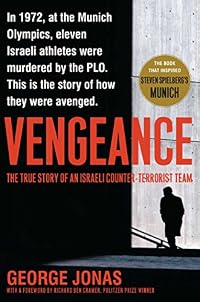
Vengeance: The True Story of an Israeli Counter-Terrorist Team
by George Jonas
On This Page
Description
Discloses the Israeli plan to assassinate the known terrorist leaders responsible for the Munich massacre of Israeli athletes and chronicles the story of the hit-squad's leader, a man morally destroyed by his mission.Tags
Recommendations





































Member Recommendations


Member Reviews
I think I owe Steven Spielberg a half-apology for bashing Munich two years ago. I still have objections toward his portrayal of the Mossad agents in the film. However, I was wrong when I accused him for disrespecting the Mossad (and the Israeli government, in that case), because they selected "Avner" (not a real name, obviously) who was an inexperienced junior field agent to lead a five-man team to avenge the deaths of eleven Israeli athletes massacred by the Black September terrorists during the Munich Olympics in 1972.
Apparently, that WAS the truth. Of course, Avner used to serve as a commando in one of Israelis’ many special forces, but being an intel proves to be much different than being a mere soldier.
This book is written using show more a first-hand account notably from Avner himself. The description provided on the team’s activities was a horrifying/mesmerizing/heart-wrenching/mind-boggling one. The author admitted that certain details were incapable of being verified and he had to alter some of them (esp. names) to protect his sources.
In my opinion, the author had done a great job as a biographer/researcher. He clearly separated his own opinion from other people’s. The prologue about the Munich massacre…OMG. It made me shuddered. I just can’t believe the Germans were so stupid – whilst they wanted to erase their bad image after more than 30 years anniversary of Nazi’s atrocities – they acted carelessly in dealing with the hostage situation. Thank goodness finally they came to their senses, admitted they did not have a special unit for counter-terrorism by then, so they asked Israel to help them establishing the GSG-9.
Anyway, the following chapters told about the journey of Avner’s team, mostly in European countries (Rome, Paris, Athens, etc) and also Beirut and Cyprus. His team consisted of five very different individuals: the ex-commando, youngest-of-the-lot Avner (team leader), the quiet, laid-back Hans (document forger), the eccentric Robert (bomb maker), the happy-go-lucky, practical Steve (driver, route strategist), and last but not least, the oldest, most experienced, calm, cautious Carl.
Avner was asked to do the assignment (i.e. assassinating 11 top terrorists responsible for the Munich massacre) by Golda Meir herself in her apartment. Well, who could refuse that great woman’s request? Not Avner of course. There's a catch. Mossad and the government would not acknowledge them and their operation.
Mossad was genious, gotta admit that. They used one team as a self-contained unit, supplied with nothing but a hit-list and funds, to make its own way in the Europe underground in exactly the same way as any other small terrorist cell. To their credit, the Mossad also strongly prohibited collateral damage. They’d rather have the team to tail a person for months rather than kill him at the spot but with a non-combatant also killed.
The narrations for each mission blew me away. Amazingly real and meticulous. The methods used were varied, from simple assassination using Berettas, or putting six tailor-made, localized bombs under the target’s bed. I was amused by the fact that Avner’s team “outsourced” some of the supporting works to a French privateer group called “Le Group” (not a real name again, I assume). Well, well, living underground is expensive and difficult. One always needs supports for safe houses, logistics, weapon materials, surveillance, etc.
Another interesting aspect in this book is the human-interest issue. Two years living underground, with rare visits to their families, would definitely take its toll on the team members, including Avner. He's a sabra (an Israeli who is born in Israel), but he never really felt home in Israel. This is where Spielberg was wrong. In Munich, Eric Bana played a more frustrated Avner (close to going loco, I daresay). This book, which was supposed to be Spielberg’s main source, told otherwise. Yes, Avner was having reasonable and not-baseless paranoia, but he neither regretted doing the mission, or whether it made any difference (which it did) nor completely blaming the Mossad’s ruthless and cynical actions for everything bad that happened.
In general, I think counter-terrorism will always be controversial. However, counter-terrorism could be classified as an act or war, and terrorism as a war crime. The maps of the world are drawn in blood. That's the sad fact. Le monde, c'est la f*cking guerre, no? show less
Apparently, that WAS the truth. Of course, Avner used to serve as a commando in one of Israelis’ many special forces, but being an intel proves to be much different than being a mere soldier.
This book is written using show more a first-hand account notably from Avner himself. The description provided on the team’s activities was a horrifying/mesmerizing/heart-wrenching/mind-boggling one. The author admitted that certain details were incapable of being verified and he had to alter some of them (esp. names) to protect his sources.
In my opinion, the author had done a great job as a biographer/researcher. He clearly separated his own opinion from other people’s. The prologue about the Munich massacre…OMG. It made me shuddered. I just can’t believe the Germans were so stupid – whilst they wanted to erase their bad image after more than 30 years anniversary of Nazi’s atrocities – they acted carelessly in dealing with the hostage situation. Thank goodness finally they came to their senses, admitted they did not have a special unit for counter-terrorism by then, so they asked Israel to help them establishing the GSG-9.
Anyway, the following chapters told about the journey of Avner’s team, mostly in European countries (Rome, Paris, Athens, etc) and also Beirut and Cyprus. His team consisted of five very different individuals: the ex-commando, youngest-of-the-lot Avner (team leader), the quiet, laid-back Hans (document forger), the eccentric Robert (bomb maker), the happy-go-lucky, practical Steve (driver, route strategist), and last but not least, the oldest, most experienced, calm, cautious Carl.
Avner was asked to do the assignment (i.e. assassinating 11 top terrorists responsible for the Munich massacre) by Golda Meir herself in her apartment. Well, who could refuse that great woman’s request? Not Avner of course. There's a catch. Mossad and the government would not acknowledge them and their operation.
Mossad was genious, gotta admit that. They used one team as a self-contained unit, supplied with nothing but a hit-list and funds, to make its own way in the Europe underground in exactly the same way as any other small terrorist cell. To their credit, the Mossad also strongly prohibited collateral damage. They’d rather have the team to tail a person for months rather than kill him at the spot but with a non-combatant also killed.
The narrations for each mission blew me away. Amazingly real and meticulous. The methods used were varied, from simple assassination using Berettas, or putting six tailor-made, localized bombs under the target’s bed. I was amused by the fact that Avner’s team “outsourced” some of the supporting works to a French privateer group called “Le Group” (not a real name again, I assume). Well, well, living underground is expensive and difficult. One always needs supports for safe houses, logistics, weapon materials, surveillance, etc.
Another interesting aspect in this book is the human-interest issue. Two years living underground, with rare visits to their families, would definitely take its toll on the team members, including Avner. He's a sabra (an Israeli who is born in Israel), but he never really felt home in Israel. This is where Spielberg was wrong. In Munich, Eric Bana played a more frustrated Avner (close to going loco, I daresay). This book, which was supposed to be Spielberg’s main source, told otherwise. Yes, Avner was having reasonable and not-baseless paranoia, but he neither regretted doing the mission, or whether it made any difference (which it did) nor completely blaming the Mossad’s ruthless and cynical actions for everything bad that happened.
In general, I think counter-terrorism will always be controversial. However, counter-terrorism could be classified as an act or war, and terrorism as a war crime. The maps of the world are drawn in blood. That's the sad fact. Le monde, c'est la f*cking guerre, no? show less
Sarà tutto vero?
Sarà tutto falso?
Diciamo che è vero un po' e non vero un po' u_u
In fondo se uno vuole informarsi su questa storia ci saranno altri libri, immagino... dei saggi più autorevoli, non come questo che è molto ma molto romanzato.
In ogni caso, chissenefrega della storia vera, è un ottima lettura, appassionante, intrigante e scorrevole. Anche se di parte >_>
Mi era piaciuto quando l'avevo letto per la prima volta anni fa e mi è piaciuto anche stavolta u_u
Sarà tutto falso?
Diciamo che è vero un po' e non vero un po' u_u
In fondo se uno vuole informarsi su questa storia ci saranno altri libri, immagino... dei saggi più autorevoli, non come questo che è molto ma molto romanzato.
In ogni caso, chissenefrega della storia vera, è un ottima lettura, appassionante, intrigante e scorrevole. Anche se di parte >_>
Mi era piaciuto quando l'avevo letto per la prima volta anni fa e mi è piaciuto anche stavolta u_u
The thrills, mystery, backstabbing reads like a Hollywood movie. Though the author makes clear of his position in this whole thing, the story does have an unbiased views (on certain matters at least). However, the purpose of this book is not about who's wrong or right. I feel it's more about one man's take on the whole issue of whether counter-terrorism, in whatever from, really works or not and whether it's worth it at all.
Quite easy to read considering that I don't know much about the Israel-Palestine fued and I don't read a lot of non-fictions.
Quite easy to read considering that I don't know much about the Israel-Palestine fued and I don't read a lot of non-fictions.
*Any political comments will be deleted. I don’t discuss political/religious/social issues on the Internet. So, don’t waste my time and yours. Want a political discussion? Head over to Twitter. Seriously, though.*
For us Greeks, the Olympic Games run in our blood. It is one more reason to be proud. All the citizens of the world associate the 15 days of peace and togetherness with strength, pride, honour. With images of the sacred ceremony of the Olympic Flame, the Olympic movement, the Flag of Peace with the circles of equality and solidarity.
But there are certain people who refuse to learn the meaning of peace, who refuse to respect anything that goes beyond their twisted notion of religion.
When I was ten, I watched a documentary show more dedicated to the events of the Munich Massacre that took place in the 1972 Olympics. Since that day, one of the strongest images I associate with the global celebration is a monster with a raised gun, standing on the balcony. A monster who didn’t even have the balls to uncover his face. One of the eight beasts that violated every sense of morality, peace and every basic principle that makes us human beings, causing the death of eleven Israeli athletes. It is the memory of a child beginning to understand that no, all is not well with the world. It is the memory of the Games that should have never continued but hey, let’s hear it for the show, right? Not to mention the incompetence (or unwillingness) of the German authorities. And my money is on the second option…
This book is a journey. The 2005 film by Steven Spielberg is a masterpiece. No written words, no movie can depict the horror, the violation, the flag of peace that was torn to pieces by the Black September monsters. But books and films are there for the younger generations.
Lest we forget…
‘’How can we possibly consider merely turning the other cheek to adversaries who are willing to commit crimes on the order of the Munich Massacre or 9/11 - or, for that matter, the Holocaust?’’
And that’s how simple it is... show less
For us Greeks, the Olympic Games run in our blood. It is one more reason to be proud. All the citizens of the world associate the 15 days of peace and togetherness with strength, pride, honour. With images of the sacred ceremony of the Olympic Flame, the Olympic movement, the Flag of Peace with the circles of equality and solidarity.
But there are certain people who refuse to learn the meaning of peace, who refuse to respect anything that goes beyond their twisted notion of religion.
When I was ten, I watched a documentary show more dedicated to the events of the Munich Massacre that took place in the 1972 Olympics. Since that day, one of the strongest images I associate with the global celebration is a monster with a raised gun, standing on the balcony. A monster who didn’t even have the balls to uncover his face. One of the eight beasts that violated every sense of morality, peace and every basic principle that makes us human beings, causing the death of eleven Israeli athletes. It is the memory of a child beginning to understand that no, all is not well with the world. It is the memory of the Games that should have never continued but hey, let’s hear it for the show, right? Not to mention the incompetence (or unwillingness) of the German authorities. And my money is on the second option…
This book is a journey. The 2005 film by Steven Spielberg is a masterpiece. No written words, no movie can depict the horror, the violation, the flag of peace that was torn to pieces by the Black September monsters. But books and films are there for the younger generations.
Lest we forget…
‘’How can we possibly consider merely turning the other cheek to adversaries who are willing to commit crimes on the order of the Munich Massacre or 9/11 - or, for that matter, the Holocaust?’’
And that’s how simple it is... show less
Possibly as near to the truth that one can get, life as a special agent is not necessarily glamourous, and men do not take up this occupation for money. Many young men may dream of being a special agent, few will ever become one, and fewer will in the end derive satisfaction or fulfillment from such an occupation. An informative read, an unpleasant subject.
The book is based on the account of ‘Avner’- allegedly the head of an independent Israeli anti-terrorist cell consisting of Mossad agents and working in western Europe in the seventies. The cell was formed to avenge the deaths of the 11 Israeli athletes murdered at the Munich Olympics in 1972. The agents were comissioned to kill 11 Palestinians allegedly responsible for ordering the Munich killings and planning other terrorist attacks.
Most of the book is devoted to quite detailed accounts of the workings of the cell: what methods were used, what weapons were used, who the informers were, contacts, organizers, and how the assassinations were carried out. I must admit I was slogging through it for a long time. In the end though what show more appeared was a fascinating picture of international terror, Israel and the intricate and deceptive ways of Mossad.
It also made me understand the background for the present Israeli invasion of Lebanon.
The book served as a basis for the movie Munich, and sparked a huge controversy over the veracity of the account. My gut feeling is that it is true.
The real name of ‘Avner’ is Juval Aviv:
http://www.foxnews.com/story/0,2933,92853,00.html
http://en.wikipedia.org/wiki/Yuval_Aviv show less
Most of the book is devoted to quite detailed accounts of the workings of the cell: what methods were used, what weapons were used, who the informers were, contacts, organizers, and how the assassinations were carried out. I must admit I was slogging through it for a long time. In the end though what show more appeared was a fascinating picture of international terror, Israel and the intricate and deceptive ways of Mossad.
It also made me understand the background for the present Israeli invasion of Lebanon.
The book served as a basis for the movie Munich, and sparked a huge controversy over the veracity of the account. My gut feeling is that it is true.
The real name of ‘Avner’ is Juval Aviv:
http://www.foxnews.com/story/0,2933,92853,00.html
http://en.wikipedia.org/wiki/Yuval_Aviv show less
A well written book that is by no means my favorite. I didn't enjoy is all that much simply because it took a long time to read. But this was written very well.
Members
- Recently Added By
Author Information

22 Works 727 Members
George Jonas was born on June 15, 1935 in Budapest, Hungary. Without formal education beyond secondary school, he worked in radio broadcasting in Budapest. He emigrated to Canada after the Soviet Union invaded Hungary in November 1956 to suppress a popular revolt. For more than three decades, he was affiliated with the Canadian Broadcasting show more Corporation. He wrote, produced, and edited dramas and documentary programs including The Scales of Justice. As a newspaper columnist, he worked at The Toronto Sun for 20 years before joining The National Post. He was the author of over 15 fiction and non-fiction books including Beethoven's Mask, Final Decree, A Passion Observed, Reflections on Islam, and By Persons Unknown: The Strange Death of Christine Demeter written with Barbara Amiel. His book, Vengeance: The True Story of an Israeli Counter-Terrorist Team, was adapted into a television movie entitled Sword of Gideon and a movie entitled Munich. His collections of poetry include The Absolute Smile and Selected Poems, 1967-2011. He also wrote the librettos for two one-act operas by Tibor Polgar. He died on January 10, 2016 at the age of 80. (Bowker Author Biography) show less
Work Relationships
Has the adaptation
Common Knowledge
- Original publication date
- 1984
- Important places*
- München, Beieren, Duitsland; Beieren, Duitsland
- Important events
- Black September attack during the Munich Olympics (1972)
- Related movies
- Sword of Gideon (1986 | IMDb); Munich (2005 | IMDb)
*Some information comes from Common Knowledge in other languages. Click "Edit" for more information.
Classifications
- Genres
- Nonfiction, History, General Nonfiction
- DDC/MDS
- 327.125694 — Society, Government, and Culture Political science International Relations: Spies Foreign policy and specific topics in international relations Espionage and subversion Asia
- LCC
- DS119.7 .J55 — History of Europe, Asia, Africa and Oceania Asia History of Asia Israel (Palestine). The Jews
- BISAC
Statistics
- Members
- 590
- Popularity
- 49,199
- Reviews
- 13
- Rating
- (3.86)
- Languages
- 11 — Chinese, Czech, Dutch, English, French, Hungarian, Italian, Norwegian (Bokmål), Portuguese, Russian, Spanish
- Media
- Paper, Ebook
- ISBNs
- 23
- ASINs
- 5