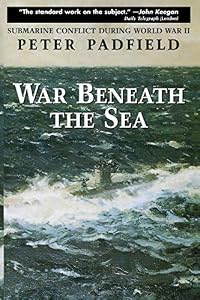
War Beneath the Sea: Submarine Conflict During World War II
by Peter Padfield
On This Page
Description
Sweeping from the frigid waters of the North Atlantic to the steaming South Pacific, this riveting chronicle of submarine warfare is the first to cover all the major submarine campaigns of the war, describing, in detail, the operations of the British, American, Japanese, Italian, and German submarine and anti-submarine forces. Beginning with a vivid re-creation of the sinking of the passenger liner Athenia by a German U-boat in September 1939, critically acclaimed military historian Peter show more Padfield's compelling narrative casts an unflinching eye on the devastating consequences of maritime warfare. The often harrowing encounters unfold with urgency and power, balanced by his keen sense of objectivity and perspective. Exploring the full spectrum of the submarine and anti-submarine warfare experience, this brilliantly detailed account pulls no punches. Facts and figures that stagger the imagination are revealed in starkly human terms, and disturbing questions abound. Padfield addresses the controversial issues raised with candor and insight, and the result is not only an impressive achievement but a milestone work in the history of the twentieth century. show lessTags
Recommendations
























Member Reviews
War Beneath the Sea is the comprehensive account of submarine conflict in the Second World War. Padfield covers all the major belligerents, going beyond the standard accounts of the Battle of the Atlantic and the 'clean sweep' patrols of Mush Morton in the Pacific to develop a systematic account of the submarines of Nazi Germany, the United States, Japan, Britain, and even Italy.
The submarine had made its significant debut as a weapon in the First World War, where unrestricted submarine warfare threatened the British empire and helped bring America into the war. The power of the submarine in commerce warfare was only systematically developed by the Nazis, and in particular Admiral Donitz, who combined high quality boats with a doctrine show more of aggressive surface night attacks. Nazi night optics were a cut above, and a clever binocular pedestal mount fed observations from the conning tower directly into the torpedo fire control center. By comparison, British boats were small and slow; their antisubmarine doctrine completely atrophied. American boats were the most impressive at the beginning of the war, with air conditioning for crew but were hindered by a cautious attack doctrine and the fatally flawed Mk 14 torpedo, with detonators that simply did not work. Japanese boats were large, but wedded to a doctrine of decisive fleet battle that reduce their flexibility.
As we all know, the Second World War started in 1939 with the invasion of Poland, and subsequent declaration of war by France and Britain against Nazi Germany. This was a problem for Donitz, since he had been promised that the war would start in 1942, when the U-boat building program would be completed and he'd have 300 U-boats. Instead he went to war with only a few dozen ready for action in the Atlantic. His forces ran wild in the First Happy Time against disorganized British defenses, but they lacked the numbers to be truly decisive.
The Battle of the Atlantic was one of the major campaigns of the war. Meanwhile, British submarines operating from Malta and Alexandria faced a miniature version of the shipping campaign against Axis transports to North Africa. The Maltese boats faced truly horrific conditions during the siege, but presented a perennial thorn in the Axis side.
Submarine actions depended on the courage and judgement of commanders, but it was also a technological war. It was in this area that the Allies succeeded, with development of centrimetric radar giving their submarines and escorts a major advantage. Convoy escort building, new weapons like the Hedgehog depth charge projector, and doctrine for pursuing U-boats tilted the submarine war towards the Allied side. The final days of both the Japanese and Nazi services were essentially suicide operations for little gain.
Padfield blends first-person accounts of actions with a synoptic view of the campaign. He has a generally positive view of the sailors who served, and isn't afraid to shy away from judgment of higher commanders. Donitz, though an avowed Nazi, understood the use of U-boats as a weapon. His failure to keep up with technological changes doomed his arm, and his men. On the allied side, their was a surprising lassitude at proper convoy tactics and aerial escorts. Britain forgot the lessons of the First World War, and the United States ignored what their Allies had learned months before, likely due to Earnest King's Anglophobia. The diversion of long range bombers and radars to the strategic bombing offensive, which delivered relatively few results early on, when as few as 100 planes could have tilted the balance in the Atlantic, is one area of folly. The obstinance of Pacific Command over the reliability of the Mk 14 is another area.
Having read quite a few of these naval histories, Padfield joins the top ranks of authors. show less
The submarine had made its significant debut as a weapon in the First World War, where unrestricted submarine warfare threatened the British empire and helped bring America into the war. The power of the submarine in commerce warfare was only systematically developed by the Nazis, and in particular Admiral Donitz, who combined high quality boats with a doctrine show more of aggressive surface night attacks. Nazi night optics were a cut above, and a clever binocular pedestal mount fed observations from the conning tower directly into the torpedo fire control center. By comparison, British boats were small and slow; their antisubmarine doctrine completely atrophied. American boats were the most impressive at the beginning of the war, with air conditioning for crew but were hindered by a cautious attack doctrine and the fatally flawed Mk 14 torpedo, with detonators that simply did not work. Japanese boats were large, but wedded to a doctrine of decisive fleet battle that reduce their flexibility.
As we all know, the Second World War started in 1939 with the invasion of Poland, and subsequent declaration of war by France and Britain against Nazi Germany. This was a problem for Donitz, since he had been promised that the war would start in 1942, when the U-boat building program would be completed and he'd have 300 U-boats. Instead he went to war with only a few dozen ready for action in the Atlantic. His forces ran wild in the First Happy Time against disorganized British defenses, but they lacked the numbers to be truly decisive.
The Battle of the Atlantic was one of the major campaigns of the war. Meanwhile, British submarines operating from Malta and Alexandria faced a miniature version of the shipping campaign against Axis transports to North Africa. The Maltese boats faced truly horrific conditions during the siege, but presented a perennial thorn in the Axis side.
Submarine actions depended on the courage and judgement of commanders, but it was also a technological war. It was in this area that the Allies succeeded, with development of centrimetric radar giving their submarines and escorts a major advantage. Convoy escort building, new weapons like the Hedgehog depth charge projector, and doctrine for pursuing U-boats tilted the submarine war towards the Allied side. The final days of both the Japanese and Nazi services were essentially suicide operations for little gain.
Padfield blends first-person accounts of actions with a synoptic view of the campaign. He has a generally positive view of the sailors who served, and isn't afraid to shy away from judgment of higher commanders. Donitz, though an avowed Nazi, understood the use of U-boats as a weapon. His failure to keep up with technological changes doomed his arm, and his men. On the allied side, their was a surprising lassitude at proper convoy tactics and aerial escorts. Britain forgot the lessons of the First World War, and the United States ignored what their Allies had learned months before, likely due to Earnest King's Anglophobia. The diversion of long range bombers and radars to the strategic bombing offensive, which delivered relatively few results early on, when as few as 100 planes could have tilted the balance in the Atlantic, is one area of folly. The obstinance of Pacific Command over the reliability of the Mk 14 is another area.
Having read quite a few of these naval histories, Padfield joins the top ranks of authors. show less
Not too long a book - at 652 pages of which 10% is references etc. which I didn't read. However, this is a dense book and chock full of detail but, I must add, not a hard read.
It covers the submarine campaigns of WWII and focuses on its main protagonists - certainly the Germans and understandably the most detail, the US mainly in the Pacific, the Brits mainly in the Med, the Indian/Pacific, and Norway, and less on the Japanese and the Italians. I wondered if I should read this book as the ground is well trod however, I am glad I did. Its scope is broad - the history and lead up to WWII, the equipment, the campaigns, strategies, the leaders, the men, and the action. relating to the latter - there was an awful lot of information on the show more actions - the patrols, the crews, and their victims and pursuers. A lot of attention was also paid to the political and military leadership that on all sides failed to realize the submarine potential and the military leaders who selfishly seeked to hinder the "silent services".
I am very glad I read this and 'twas worthwhile and I certainly expanded my knowledge on the underwater campaigns which are central to the outcome of WWII. show less
It covers the submarine campaigns of WWII and focuses on its main protagonists - certainly the Germans and understandably the most detail, the US mainly in the Pacific, the Brits mainly in the Med, the Indian/Pacific, and Norway, and less on the Japanese and the Italians. I wondered if I should read this book as the ground is well trod however, I am glad I did. Its scope is broad - the history and lead up to WWII, the equipment, the campaigns, strategies, the leaders, the men, and the action. relating to the latter - there was an awful lot of information on the show more actions - the patrols, the crews, and their victims and pursuers. A lot of attention was also paid to the political and military leadership that on all sides failed to realize the submarine potential and the military leaders who selfishly seeked to hinder the "silent services".
I am very glad I read this and 'twas worthwhile and I certainly expanded my knowledge on the underwater campaigns which are central to the outcome of WWII. show less
I entered the submarine service less than two decades after the last World War ended and served on two submarines from that conflict. As such, I was familiar with the role of the United States submarine service in the Pacific. However, I was totally ignorant of the escapades of our allies and the Axis powers in the Pacific as well as in the European theater. This book filled in those gaps. I found it a compelling read.
Really comprehensive text on submarine warfare during WWII. The is book covers all theaters of the submarine contribution and is a great book for historians who are interested in this period of submarine warfare.
Stands out for its broad coverage of both the Atlantic and Pacific theatres of war.
Ratings
Members
- Recently Added By
Author Information

27 Works 1,304 Members
Peter Padfield's trilogy includes Maritime Power and Maritime, Supremacy, both published by Overlook. He was born in British India and served as a navigating officer in P0 liners to India and Australia. After producing an acclaimed life of Admiral Karl Donitz, he wrote biographies of two other Nazi leaders. His work as a naval historian received show more the Mountbatten Maritime Prize. show less
Common Knowledge
- Original publication date
- 1998
- Important places
- Atlantic Ocean; North Atlantic Ocean; Pacific Ocean
- Important events
- World War II (1939 | 1945); Battle of the Atlantic (1939 | 1945); World War II, Pacific Theater (1941-12-07 | 1945-09-02)
Classifications
Statistics
- Members
- 198
- Popularity
- 164,753
- Reviews
- 5
- Rating
- (4.09)
- Languages
- English, German
- Media
- Paper, Audiobook, Ebook
- ISBNs
- 12
- ASINs
- 6