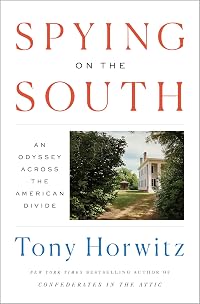
Spying on the South: An Odyssey Across the American Divide
by Tony Horwitz
On This Page
Description
"The author retraces Frederick Law Olmsted's journey across the American South in the 1850s, on the eve of the Civil War. Olmsted roamed eleven states and six thousand miles, and the New York Times published his dispatches about slavery and its defenders. More than 150 years later, Tony Horwitz followed Olmsted's route, and whenever possible his mode of transport--rail, riverboats, in the saddle--through Appalachia, down the Ohio and Mississippi, through Kentucky, Tennessee, Louisiana, and show more across Texas to the Rio Grande, discovering and reporting on vestiges of what Olmsted called the Cotton Kingdom"-- show lessTags
Recommendations










Member Reviews
“Olmsted’s initial faith in reasoned discourse had also waned. In the course of his travels, the South’s “leading men” had struck him as implacable: convinced of the superiority of their caste-bound society, intent on expanding it, and utterly contemptuous of the North. “They are a mischievous class—”
In the 1850s, on the eve of the Civil War, a young travel writer by the name of Frederick Law Olmsted, is sent by the fledgling New York Times, to travel extensively through the south, sending back disturbing dispatches of slavery and the fiery rhetoric that came along with it.
The late Tony Horwitz, (he died shortly after this book was published) decided to trace the exact route that Olmsted took, even attempting to use the show more same modes of transportation, whenever possible- train, riverboat, horseback. Similar in tone, to his wonderful book, Confederates in the Attic, Horwitz chats with many people along the way, getting a feel of the past and the distress of the modern south, where a lot of anger and discontent still fester. Horwitz has an easy style of writing and a great and sometimes biting sense of humor. I think this is the perfect swan song for him. show less
In the 1850s, on the eve of the Civil War, a young travel writer by the name of Frederick Law Olmsted, is sent by the fledgling New York Times, to travel extensively through the south, sending back disturbing dispatches of slavery and the fiery rhetoric that came along with it.
The late Tony Horwitz, (he died shortly after this book was published) decided to trace the exact route that Olmsted took, even attempting to use the show more same modes of transportation, whenever possible- train, riverboat, horseback. Similar in tone, to his wonderful book, Confederates in the Attic, Horwitz chats with many people along the way, getting a feel of the past and the distress of the modern south, where a lot of anger and discontent still fester. Horwitz has an easy style of writing and a great and sometimes biting sense of humor. I think this is the perfect swan song for him. show less
Tony Horwitz was a Pulitzer Prize winning author who made a name for himself by approaching history not as an academic but as a reporter. In Confederates in the Attic, for example, he participated in Civil War battle reenactments to learn just what drove the passionate appeal for this activity. Along the way, he delivered a good deal of history, providing background to flesh out his entertaining interviews.
In A Voyage Long and Strange: Rediscovering the New World, he again blended historical anecdotes from the past with impressions from the present. The latter were gained through a great deal of audacity and humor, as he attempted to retrace the footsteps of the earliest explorers in the New World.
For Spying on the South, Horwitz show more decided to follow in the path of Frederick Law Olmsted. Olmsted, who lived from 1822 to 1903, is mostly known today for his landscape designs, which included Central Park in Manhattan. As a young man, however, Olmsted worked as a reporter for the “New York Times.” On assignment, Olmsted travelled through the South from 1852 to 1857, sending back periodic dispatches to the newspaper about the lives and beliefs of Southerners. Olmsted was convinced - at first, anyway - that there had to be common ground between the two increasingly bellicose sides, if only he (and they) could discover what it was.
Olmsted’s articles were eventually collected into three volumes: A Journey in the Seaboard Slave States (1856), A Journey Through Texas (1857), and A Journey in the Back Country in the Winter of 1853-4 (1860). Horwitz, who was writing around the time of the 2016 election, wondered if the same sort of divisions were tearing apart the country as had characterized the pre-Civil War years. Thus, to get a better handle on what was happening in America, Horwitz used Omsted’s books as tour guides to plan his own trip, or, as he called it, “a ramble across America with long-dead Fred as my guide.”
Olmsted traveled for fourteen months, using steamboats, stagecoaches, horses, and mules, and Horwitz wanted to do the same. We follow Horwitz’s adventures on a coal towboat and on a mule, but also in the occasional rental car. Nevertheless, Horwitz gamely mimicked Olmsted’s trip whenever possible, even eating food that I must admit would never cross my lips. He bravely ventured into what was often hostile territory since he was a Northerner, regarded as one of the “elites” so despised by the many "Trumpers" he encountered. What he found during his own journey was similar to what Olmsted discovered: a vast fissure in the country. While the chasm between North and South was greatest in rural areas, there were still rather stark differences between the South and the North no matter where he ventured.
For a time Olmsted was accompanied by his brother John, and similarly, Horwitz was joined for a while by his Australian comedian friend Andrew Denton. Andrew’s observations were not only hilarious, but much less diplomatic than those of Horwitz.
Horwitz didn't always get into political discussions, but when they occurred, Horwitz despaired as much as Olmstead had done some 160 years earlier. Horwitz was shocked at hearing unapologetically racist views, and could relate to Olmsted’s “melancholy” over the same phenomenon.
Horwitz’s sojourn through Texas revealed to him quite distinctive regions but also commonalities no matter the region, setting it apart from other states. In particular, he observed widespread support for secessionist movements, or at least, secessionist sympathies - now called “Texit” after Brexit.
As Daniel Miller, president of the Texas Nationalist Movement explained about what attracted Texans to the idea of Texit:
“Texas is politically, culturally and economically distinct from the United States as a whole. Texans by and large believe in very limited government, a large measure of economic freedom, and absolute personal liberty.”
[It should be noted that a number of investigations, such as those compiled here, have established ties between Texas secession movements and Kremlin-funded actors in Russia. The interference is reported to be part of larger efforts to foment chaos in the United States and dissatisfaction with the government. At one point, the Russian-created Facebook page "Heart of Texas" had more followers than the official Texas Democrat and Texas Republican pages combined.]
By the end of Horwitz’s odyssey, he, like Olmsted, didn’t feel hopeful about the prospects for seeing any abatement to the polarization of the country. And it has only gotten worse since his book was written.
Discussion: Soon after I began listening to this on audio, the author died unexpectedly on May 27, 2019, at age 60. I felt bereft. I had thoroughly enjoyed “spending time with him” in his other books. But also, as I began this book, my immediate reaction was, “Gee, it’s a wonder he doesn’t have a heart attack from what he is eating on this trip.” Horwitz indeed died of cardiac arrest; I hope this excursion of his wasn’t the tipping point.
Evaluation: Horowitz was an adept raconteur whose observations remain valuable. He comes across as personable, curious, and willing to hear any and all sides of an issue, and in this way, gets almost everyone to open up to him. I always learn a great deal when reading his books, even while being hugely entertained. show less
In A Voyage Long and Strange: Rediscovering the New World, he again blended historical anecdotes from the past with impressions from the present. The latter were gained through a great deal of audacity and humor, as he attempted to retrace the footsteps of the earliest explorers in the New World.
For Spying on the South, Horwitz show more decided to follow in the path of Frederick Law Olmsted. Olmsted, who lived from 1822 to 1903, is mostly known today for his landscape designs, which included Central Park in Manhattan. As a young man, however, Olmsted worked as a reporter for the “New York Times.” On assignment, Olmsted travelled through the South from 1852 to 1857, sending back periodic dispatches to the newspaper about the lives and beliefs of Southerners. Olmsted was convinced - at first, anyway - that there had to be common ground between the two increasingly bellicose sides, if only he (and they) could discover what it was.
Olmsted’s articles were eventually collected into three volumes: A Journey in the Seaboard Slave States (1856), A Journey Through Texas (1857), and A Journey in the Back Country in the Winter of 1853-4 (1860). Horwitz, who was writing around the time of the 2016 election, wondered if the same sort of divisions were tearing apart the country as had characterized the pre-Civil War years. Thus, to get a better handle on what was happening in America, Horwitz used Omsted’s books as tour guides to plan his own trip, or, as he called it, “a ramble across America with long-dead Fred as my guide.”
Olmsted traveled for fourteen months, using steamboats, stagecoaches, horses, and mules, and Horwitz wanted to do the same. We follow Horwitz’s adventures on a coal towboat and on a mule, but also in the occasional rental car. Nevertheless, Horwitz gamely mimicked Olmsted’s trip whenever possible, even eating food that I must admit would never cross my lips. He bravely ventured into what was often hostile territory since he was a Northerner, regarded as one of the “elites” so despised by the many "Trumpers" he encountered. What he found during his own journey was similar to what Olmsted discovered: a vast fissure in the country. While the chasm between North and South was greatest in rural areas, there were still rather stark differences between the South and the North no matter where he ventured.
For a time Olmsted was accompanied by his brother John, and similarly, Horwitz was joined for a while by his Australian comedian friend Andrew Denton. Andrew’s observations were not only hilarious, but much less diplomatic than those of Horwitz.
Horwitz didn't always get into political discussions, but when they occurred, Horwitz despaired as much as Olmstead had done some 160 years earlier. Horwitz was shocked at hearing unapologetically racist views, and could relate to Olmsted’s “melancholy” over the same phenomenon.
Horwitz’s sojourn through Texas revealed to him quite distinctive regions but also commonalities no matter the region, setting it apart from other states. In particular, he observed widespread support for secessionist movements, or at least, secessionist sympathies - now called “Texit” after Brexit.
As Daniel Miller, president of the Texas Nationalist Movement explained about what attracted Texans to the idea of Texit:
“Texas is politically, culturally and economically distinct from the United States as a whole. Texans by and large believe in very limited government, a large measure of economic freedom, and absolute personal liberty.”
[It should be noted that a number of investigations, such as those compiled here, have established ties between Texas secession movements and Kremlin-funded actors in Russia. The interference is reported to be part of larger efforts to foment chaos in the United States and dissatisfaction with the government. At one point, the Russian-created Facebook page "Heart of Texas" had more followers than the official Texas Democrat and Texas Republican pages combined.]
By the end of Horwitz’s odyssey, he, like Olmsted, didn’t feel hopeful about the prospects for seeing any abatement to the polarization of the country. And it has only gotten worse since his book was written.
Discussion: Soon after I began listening to this on audio, the author died unexpectedly on May 27, 2019, at age 60. I felt bereft. I had thoroughly enjoyed “spending time with him” in his other books. But also, as I began this book, my immediate reaction was, “Gee, it’s a wonder he doesn’t have a heart attack from what he is eating on this trip.” Horwitz indeed died of cardiac arrest; I hope this excursion of his wasn’t the tipping point.
Evaluation: Horowitz was an adept raconteur whose observations remain valuable. He comes across as personable, curious, and willing to hear any and all sides of an issue, and in this way, gets almost everyone to open up to him. I always learn a great deal when reading his books, even while being hugely entertained. show less
In the 1850's, in his journalist days, Frederick Law Olmsted traveled through the slave-holding American South from Maryland to Texas looking for its soul, and hoping to "promote the mutual acquaintance of the North and South" during a very troubled era. His dispatches from the roads and rivers resulted in a trilogy of works which were later abridged into a single volume titled The Cotton Kingdom.
In the 21st century, while attempting to cull some books from his library, Tony Horwitz picked up his college copy of that volume, cracked the covers (as you do when culling), and got caught up by the idea of recreating Olmsted's journey in our own polarized time. Being an intrepid world traveler, journalist, war correspondent and historian show more himself, he did just that, and this book is the result.
Horwitz cadged a ride on a towboat moving coal barges along the Ohio River; traveled from St. Louis to New Orleans by steamboat (a rather different experience than the rowdy 19th century equivalent); met with remnants of the Old South aristocracy in Tennessee; drank in a lot of local bars in Louisiana and Texas; and took a mule-back expedition along the Rio Grande. He managed it all without getting into any serious trouble until the very end, when he inadvertently offended the mule and got a bit of an attitude adjustment handed to him.
He found a lot of what you would expect in the "unreconstructed south", and reports it as you would expect of a Yankee liberal... and that disturbed me through much of this book. Despite Horwitz's assertion that "Like Olmsted, I'd embarked on my journey believing--or at least hoping--that Americans on opposite sides of the national divide could listen to each other and air their differences in a rational and coolheaded fashion", I got the feeling that the author's own prejudices may have led him mainly to encounters that would reinforce them.
I nearly quit after the chapter titled "The Drift of Things in Ruby-Red America", which related his stay in the Republican stronghold of Crockett, Texas, where despite meeting some people he professed to like, he was left with a "bad taste in {his} mouth", and a very pessimistic feeling about "what is to become of us...this great country & this cursedly little people" (the latter being Olmsted's words). Pretty discouraging stuff, with nothing much to foster hope for coming out on the other side of the current mess. And yet...if I had given up at that point, I would have missed the chapter titled "And Absalom Rode Upon a Mule", which was really a hoot, and in which Horwitz got his come-uppance from both man and mule, restoring my faith in him as an objective observer. It has to be difficult to report your "story" when you're smack in the middle of it yourself; he could have cast himself in a better light and no one would have been the wiser. Neither the mule nor its unidentified handler are likely to read his account.
After a respite to recover from the effects of concussion and saddle sores in the comfort of a New England summer, Horwitz returned to Texas to finish his planned sojourn to the Rio Grande and into Mexico. Here he visited towns on either side of the border, where Americans crossed into Mexico to shop and Mexicans crossed into Texas daily to work; met with a representative of the long-unrecognized Kickapoo tribe; and attended Day of the Dead festivities as guests of a Mexican family.
Horwitz ends his book with a chapter about Olmsted's other iconic endeavor---New York's Central Park. And here he did find grounds for optimism. Touring the park with a former Commissioner of the city's Depatment of Parks and Recreation, he came away with the impression that this "deliberate, democratic experiment" (Olmsted again) worked, and continues to do so, offering an escape from the pressures of urban life to anyone and everyone. He observed an unforced, comfortable mingling of all sorts of strangers, including a Harlem sixth-grader and his little brother who, after Horwitz had given him a brief history of Olmsted's creation, advised him to "Tell Fred he did good". show less
In the 21st century, while attempting to cull some books from his library, Tony Horwitz picked up his college copy of that volume, cracked the covers (as you do when culling), and got caught up by the idea of recreating Olmsted's journey in our own polarized time. Being an intrepid world traveler, journalist, war correspondent and historian show more himself, he did just that, and this book is the result.
Horwitz cadged a ride on a towboat moving coal barges along the Ohio River; traveled from St. Louis to New Orleans by steamboat (a rather different experience than the rowdy 19th century equivalent); met with remnants of the Old South aristocracy in Tennessee; drank in a lot of local bars in Louisiana and Texas; and took a mule-back expedition along the Rio Grande. He managed it all without getting into any serious trouble until the very end, when he inadvertently offended the mule and got a bit of an attitude adjustment handed to him.
He found a lot of what you would expect in the "unreconstructed south", and reports it as you would expect of a Yankee liberal... and that disturbed me through much of this book. Despite Horwitz's assertion that "Like Olmsted, I'd embarked on my journey believing--or at least hoping--that Americans on opposite sides of the national divide could listen to each other and air their differences in a rational and coolheaded fashion", I got the feeling that the author's own prejudices may have led him mainly to encounters that would reinforce them.
I nearly quit after the chapter titled "The Drift of Things in Ruby-Red America", which related his stay in the Republican stronghold of Crockett, Texas, where despite meeting some people he professed to like, he was left with a "bad taste in {his} mouth", and a very pessimistic feeling about "what is to become of us...this great country & this cursedly little people" (the latter being Olmsted's words). Pretty discouraging stuff, with nothing much to foster hope for coming out on the other side of the current mess. And yet...if I had given up at that point, I would have missed the chapter titled "And Absalom Rode Upon a Mule", which was really a hoot, and in which Horwitz got his come-uppance from both man and mule, restoring my faith in him as an objective observer. It has to be difficult to report your "story" when you're smack in the middle of it yourself; he could have cast himself in a better light and no one would have been the wiser. Neither the mule nor its unidentified handler are likely to read his account.
After a respite to recover from the effects of concussion and saddle sores in the comfort of a New England summer, Horwitz returned to Texas to finish his planned sojourn to the Rio Grande and into Mexico. Here he visited towns on either side of the border, where Americans crossed into Mexico to shop and Mexicans crossed into Texas daily to work; met with a representative of the long-unrecognized Kickapoo tribe; and attended Day of the Dead festivities as guests of a Mexican family.
Horwitz ends his book with a chapter about Olmsted's other iconic endeavor---New York's Central Park. And here he did find grounds for optimism. Touring the park with a former Commissioner of the city's Depatment of Parks and Recreation, he came away with the impression that this "deliberate, democratic experiment" (Olmsted again) worked, and continues to do so, offering an escape from the pressures of urban life to anyone and everyone. He observed an unforced, comfortable mingling of all sorts of strangers, including a Harlem sixth-grader and his little brother who, after Horwitz had given him a brief history of Olmsted's creation, advised him to "Tell Fred he did good". show less
A few months ago when author Tony Horwitz died, I learned that he'd recently released this new book of his unique blend of history, travel, cultural exploration, and literary journalism. When I saw that his final work was based on following in the footsteps of one of my favorite historical figures, Frederick Law Olmsted, it seemed as if it was targeted at me.
Olmsted is best known for innovating the field of landscape architecture and designing some of America's most notable city parks and park systems, college campuses, hospital grounds, the 1893 World's Columbian Exposition Midway Plaisance, and the grounds of the US Capitol. Prior to his career in designing parks, Olmsted worked as a journalist, and much like Tony Horwitz, he show more traveled to places and wrote about his experiences. From 1852 to 1857, he traveled through the American South submitting his dispatches to the New York Times. In 1861, just before the outbreak of the American Civil War, his writings were compiled in the book Journeys and Explorations in the Cotton Kingdom, which remains a significant first-hand document of antebellum Southern society.
Olmsted was anti-slavery, a moderate position at the time compared with abolitionists who wanted to immediately free all enslaved people, and in some cases extend the full rights of citizenship to the freed African Americans. Anti-slavery advocates, which included Abraham Lincoln and other early Republicans, sought to prevent the expansion of slave-holding to new territories and carry out gradual manumission. Olmsted believed that practice of slavery was inefficient and had a deleterious effect not just on the enslaved people, but on the white society as well. A goal of his travels was to meet with Southerners, civilly exchange views, and convince them of the error of their ways. Olmsted would be disappointed, finding Southerners entrenched in their beliefs and uninterested in civil discourse on the matter of slavery.
Tracing Olmsted's route through the South in 2015-2016, against the background of the contentious presidential election leading to Donald Trump's victory, Tony Horwitz would also find a deeply divided America. Some of his encounters with Southerners who supported Trumpist ideology and believed in all manner of conspiracy theory are deeply disturbing. More disturbing still is that many of these same people treated Horwitz warmly and were happy to speak with him, as long as he hid his own political views.
The travelogue is interesting as Horwitz first journeys down the Ohio River through West Virginia on a ship towing a coal barge, offering insight into a tedious but dangerous job that some "country boys" have found as a source of income in an economically depressed region. His next river journey is on board a luxurious replica paddle wheeler with stops at historic plantations where the tour guides tend to ignore the enslaved people who made them possible.
In Louisiana, Horwitz is joined by a friend from Australia who is literally nearly killed by the artery-hardening Southern cuisine. They also enjoy the bizarre Mud Fest, where monster truck drivers come together to drink and drive their modified vehicles through a giant mud bog for a week. Continuing on his own across Texas, Horwitz tries and fails to debunk a conspiracy theory about a compound of Islamic extremists and participates in the Battle of the Alamo reenactment, oddly set against the background San Antonio's tourist trap attractions.
Perhaps one of the more interesting parts of the book is the Texas hill country where German immigrants settled before the war, and Olmsted found a community he thought could serve as an example of Free Soilers in the South. 150 years later, the German community persists - albeit in some cheezy ways - and Horwitz describes a part of Texas that doesn't fit my preconceived notions of the state. Horwitz travels by mule, a humbling experience, in the west of the Texas. He concludes his narrative along the border with Mexico where he interacts with both the border patrol and the mixed American and Mexican communities.
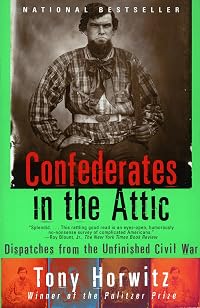
In many ways, Spying on the South is a sequel to Horwitz's best book Confederates in the Attic. It's also more somber and unsettling. 20 years ago one could chuckle at Confederate devotees as a dwindling number of hobbyists devoted to living in the past. Today that same energy has been channeled into a dangerous movement that has reached its political ascendancy. show less
Olmsted is best known for innovating the field of landscape architecture and designing some of America's most notable city parks and park systems, college campuses, hospital grounds, the 1893 World's Columbian Exposition Midway Plaisance, and the grounds of the US Capitol. Prior to his career in designing parks, Olmsted worked as a journalist, and much like Tony Horwitz, he show more traveled to places and wrote about his experiences. From 1852 to 1857, he traveled through the American South submitting his dispatches to the New York Times. In 1861, just before the outbreak of the American Civil War, his writings were compiled in the book Journeys and Explorations in the Cotton Kingdom, which remains a significant first-hand document of antebellum Southern society.
Olmsted was anti-slavery, a moderate position at the time compared with abolitionists who wanted to immediately free all enslaved people, and in some cases extend the full rights of citizenship to the freed African Americans. Anti-slavery advocates, which included Abraham Lincoln and other early Republicans, sought to prevent the expansion of slave-holding to new territories and carry out gradual manumission. Olmsted believed that practice of slavery was inefficient and had a deleterious effect not just on the enslaved people, but on the white society as well. A goal of his travels was to meet with Southerners, civilly exchange views, and convince them of the error of their ways. Olmsted would be disappointed, finding Southerners entrenched in their beliefs and uninterested in civil discourse on the matter of slavery.
Tracing Olmsted's route through the South in 2015-2016, against the background of the contentious presidential election leading to Donald Trump's victory, Tony Horwitz would also find a deeply divided America. Some of his encounters with Southerners who supported Trumpist ideology and believed in all manner of conspiracy theory are deeply disturbing. More disturbing still is that many of these same people treated Horwitz warmly and were happy to speak with him, as long as he hid his own political views.
The travelogue is interesting as Horwitz first journeys down the Ohio River through West Virginia on a ship towing a coal barge, offering insight into a tedious but dangerous job that some "country boys" have found as a source of income in an economically depressed region. His next river journey is on board a luxurious replica paddle wheeler with stops at historic plantations where the tour guides tend to ignore the enslaved people who made them possible.
In Louisiana, Horwitz is joined by a friend from Australia who is literally nearly killed by the artery-hardening Southern cuisine. They also enjoy the bizarre Mud Fest, where monster truck drivers come together to drink and drive their modified vehicles through a giant mud bog for a week. Continuing on his own across Texas, Horwitz tries and fails to debunk a conspiracy theory about a compound of Islamic extremists and participates in the Battle of the Alamo reenactment, oddly set against the background San Antonio's tourist trap attractions.
Perhaps one of the more interesting parts of the book is the Texas hill country where German immigrants settled before the war, and Olmsted found a community he thought could serve as an example of Free Soilers in the South. 150 years later, the German community persists - albeit in some cheezy ways - and Horwitz describes a part of Texas that doesn't fit my preconceived notions of the state. Horwitz travels by mule, a humbling experience, in the west of the Texas. He concludes his narrative along the border with Mexico where he interacts with both the border patrol and the mixed American and Mexican communities.
In many ways, Spying on the South is a sequel to Horwitz's best book Confederates in the Attic. It's also more somber and unsettling. 20 years ago one could chuckle at Confederate devotees as a dwindling number of hobbyists devoted to living in the past. Today that same energy has been channeled into a dangerous movement that has reached its political ascendancy. show less
If you knew nothing about Americans south of the Mason-Dixon Line and Tony Horwitz’ “Spying on the South: An Odyssey Across the American Divide” was your introduction to these peoples, you’d probably conclude that southerners revel in their ignorance, relish the most juvenile forms of entertainment, and stuff themselves with the worst food and beverages on the planet.
Was Horwitz really “spying on the South?”
Yup. But for whom was he spying and why?
Ostensibly, the narrative runs along two tracks:
1. Along the first track we are reading the history of Frederick Law Olmsted who as a young man made two lengthy trips to the South for this very purpose. He was writing for then new New York Daily Times about a decade or so before show more the Civil War tore the country apart. His dispatches were later collected into three books.
2. The second narrative is a satire of the first in which Horwitz follows the earlier journey using mostly modern travel methods to reenact Olmsted’s earlier journey. He later mounts a mule to reenact Olmsted’s journey, a segment in which it goes something like this: Mule 10, Horwitz 0.
The significance of Olmsted’s trek was that the landscapes and flora he found informed or perhaps inspired his later work as America’s first professional landscape architect. He designed New York’s Central Park, Montreal’s Mont Royal, and the capacious Biltmore estate in North Carolina among many others.
Olmsted was a virulent anti-slaver, a “free-soiler” in the parlance of the time. He graphically documented conditions on the plantations. To his credit, Horwitz fills out Olmstead’s observations and the local history after Olmsted went home.
For me the most interesting discussion was the history of freethinking German settlers to Texas. Mexico outlawed slavery before Texans declared their independence. For years land speculators and cotton growers had been flooding into the territory to expand the land under cultivation, as cotton was a tremendously profitable business at the time.
Texans later voted to join the United States as a slave state.
This didn’t sit well with the industrious Germans and Alsatians who legally immigrated to West Texas. But sympathies in the state were largely pro-slavery and though some fought a rearguard action during the Civil War to undermine the Confederate cause, most clammed up and kept their opinions to themselves.
Olmsted not only sympathized with the freethinkers, he promoted their cause once he returned to New York.
Horwitz obviously also sympathizes with the sympathizer and this is where the two stories cross. Because in America today all is not finished between the races. There is the matter of racial profiling. Gerrymandered voting districts. Voter ID cards. Belligerent immigration policy. Pandering to white supremacists. Racially-motivated shooting sprees.
Need I go on?
Horwitz sheds light on and helps correct the score where early Texans stood on the matter of personal freedoms and notes the layers of irony for today’s Texans who go on ad-nauseam about how little they want Washington to interfere with their personal freedoms. Ditto with Louisianans. And West Virginians.
My own readers will roll their eyes as I repeat my observation about how the very people who complain about their personal freedoms being jeopardized with attacks on the Second Amendment right to bear arms vote against anybody who believes women ought to have final say about processes in their own bodies.
Once the Civil War broke out Olmsted took a very active role in prosecuting the war for the Union. He was undoubtedly one of the unsung heroes behind the lines.
And his park designs inspire us to this day, making cities more liveable and encouraging better behaviour among its warring factions.
Tony, thank you for this entertaining look at America today.
RIP. show less
Was Horwitz really “spying on the South?”
Yup. But for whom was he spying and why?
Ostensibly, the narrative runs along two tracks:
1. Along the first track we are reading the history of Frederick Law Olmsted who as a young man made two lengthy trips to the South for this very purpose. He was writing for then new New York Daily Times about a decade or so before show more the Civil War tore the country apart. His dispatches were later collected into three books.
2. The second narrative is a satire of the first in which Horwitz follows the earlier journey using mostly modern travel methods to reenact Olmsted’s earlier journey. He later mounts a mule to reenact Olmsted’s journey, a segment in which it goes something like this: Mule 10, Horwitz 0.
The significance of Olmsted’s trek was that the landscapes and flora he found informed or perhaps inspired his later work as America’s first professional landscape architect. He designed New York’s Central Park, Montreal’s Mont Royal, and the capacious Biltmore estate in North Carolina among many others.
Olmsted was a virulent anti-slaver, a “free-soiler” in the parlance of the time. He graphically documented conditions on the plantations. To his credit, Horwitz fills out Olmstead’s observations and the local history after Olmsted went home.
For me the most interesting discussion was the history of freethinking German settlers to Texas. Mexico outlawed slavery before Texans declared their independence. For years land speculators and cotton growers had been flooding into the territory to expand the land under cultivation, as cotton was a tremendously profitable business at the time.
Texans later voted to join the United States as a slave state.
This didn’t sit well with the industrious Germans and Alsatians who legally immigrated to West Texas. But sympathies in the state were largely pro-slavery and though some fought a rearguard action during the Civil War to undermine the Confederate cause, most clammed up and kept their opinions to themselves.
Olmsted not only sympathized with the freethinkers, he promoted their cause once he returned to New York.
Horwitz obviously also sympathizes with the sympathizer and this is where the two stories cross. Because in America today all is not finished between the races. There is the matter of racial profiling. Gerrymandered voting districts. Voter ID cards. Belligerent immigration policy. Pandering to white supremacists. Racially-motivated shooting sprees.
Need I go on?
Horwitz sheds light on and helps correct the score where early Texans stood on the matter of personal freedoms and notes the layers of irony for today’s Texans who go on ad-nauseam about how little they want Washington to interfere with their personal freedoms. Ditto with Louisianans. And West Virginians.
My own readers will roll their eyes as I repeat my observation about how the very people who complain about their personal freedoms being jeopardized with attacks on the Second Amendment right to bear arms vote against anybody who believes women ought to have final say about processes in their own bodies.
Once the Civil War broke out Olmsted took a very active role in prosecuting the war for the Union. He was undoubtedly one of the unsung heroes behind the lines.
And his park designs inspire us to this day, making cities more liveable and encouraging better behaviour among its warring factions.
Tony, thank you for this entertaining look at America today.
RIP. show less
We have lost a great interpreter of the relationship between past and present. Sadly, Tony Horowitz died of a heart attack on Monday, May 27th, 2019 in Chevy Chase, MD. Your fans will miss your wit, insights, and your ability to interpret the stranger parts of America in a kind and humorous way.
Through his many books, Tony told fascinating stories that mixed humor with social criticism. Although this book was somewhat uneven in places (especially Louisiana), his trip down the Ohio was fascinating, while the trip down the Mississippi was somewhat less so. Nevertheless, Horowitz’s premise of following in the steps of Frederick Law Olmstead, whose pre-Civil War trip he retraces, is a fine idea. And it reminds us again of what a prolific show more and fine landscape architect Olmstead was. The beauty of this book is in the interweaving of Olmstead’s work and the legacy that he left for everyone who has the pleasure of exploring his love of nature.
The book also shares some similarities with Mark Twain’s Life on the Mississippi and Jonathan Raban’s Old Glory: An American Voyage. show less
Through his many books, Tony told fascinating stories that mixed humor with social criticism. Although this book was somewhat uneven in places (especially Louisiana), his trip down the Ohio was fascinating, while the trip down the Mississippi was somewhat less so. Nevertheless, Horowitz’s premise of following in the steps of Frederick Law Olmstead, whose pre-Civil War trip he retraces, is a fine idea. And it reminds us again of what a prolific show more and fine landscape architect Olmstead was. The beauty of this book is in the interweaving of Olmstead’s work and the legacy that he left for everyone who has the pleasure of exploring his love of nature.
The book also shares some similarities with Mark Twain’s Life on the Mississippi and Jonathan Raban’s Old Glory: An American Voyage. show less
In this half-travelogue-half-history, Horwitz explores the American South of 2016 and relates the antebellum impressions of Frederick Olmsted, as they follow the same routes through a region unlike their Northern experiences. I was unfamiliar with Olmsted, who later became the architect of NYC's Central Park, among other great landscapes, so it was intriguing to learn more about this fascinating historical figure, as well as about the pre-war Southerners he encountered in his travels. Horwitz also has his own (mis)adventures in the modern era, which I mostly found equally compelling. Like many contemporary nonfiction surveys purporting to explain the current political moment, there's a certain amount of overstatement in this part, but show more the book as a whole is definitely an intriguing and entertaining read! (This review is based on an e-galley received through Edelweiss.) show less
Members
- Recently Added By
Lists

Top Five Books of 2019
387 works; 111 members

Best Travel Writing - Non-Fiction
110 works; 6 members

BLM
210 works; 1 member

Bitter Southerner Summer Reading Roundup
198 works; 8 members

Books Read in 2020
4,379 works; 123 members

Books Read in 2021
5,361 works; 113 members
Author Information

11+ Works 9,923 Members
Anthony Lander Horwitz was born in Washington, D. C. on June 9, 1958. He received a bachelor's degree in history from Brown University and a master's degree from the Columbia University Graduate School of Journalism in 1983. After working as a union organizer in Mississippi, he became a newspaper reporter. He was an education reporter for The Fort show more Wayne News-Sentinel in Indiana from 1983 to 1984 and a general assignment reporter for The Sydney Morning Herald in Australia from 1985 to 1987. He joined The Wall Street Journal in 1990 as a foreign correspondent in Europe and the Middle East. He and his wife Geraldine Brooks won the Overseas Press Club's Hal Boyle Award in 1990 for their coverage of the Persian Gulf war. He returned to the United States in 1993 and was assigned to The Journal's Pittsburgh bureau. He won the 1995 Pulitzer Prize for national reporting for his accounts of working conditions in low-wage jobs. He later wrote for The New Yorker on the Middle East before becoming an author of nonfiction books. His first book, Confederates in the Attic: Dispatches from the Unfinished Civil War, was published in 1998. His other books included Blue Latitudes: Boldly Going Where Captain Cook Has Gone Before, A Voyage Long and Strange: Rediscovering the New World, Midnight Rising: John Brown and the Raid That Sparked the Civil War, and Spying on the South: An Odyssey Across the American Divide. He died on May 27, 2019 at the age of 60. (Bowker Author Biography) show less
Some Editions
Awards and Honors
Common Knowledge
- Original publication date
- 2019
- People/Characters
- Frederick Law Olmsted
- First words
- The only lodging in Grafton was a low-slung motel with a smashed door at the entrance.
- Last words
- (Click to show. Warning: May contain spoilers.)"Tell Fred he did good," Justin said, before leading his brother down a winding path and into the woods.
Classifications
- Genres
- Travel, General Nonfiction, Nonfiction, Biography & Memoir
- DDC/MDS
- 917.504 — History & geography Geography & travel Geography of and travel in North America Southeastern U.S. Travel
- LCC
- F213 .H768 — Local History of the United States, Canada and Latin America United States local history The South. South Atlantic States
- BISAC
Statistics
- Members
- 555
- Popularity
- 53,446
- Reviews
- 24
- Rating
- (3.94)
- Languages
- English, Korean
- Media
- Paper, Audiobook, Ebook
- ISBNs
- 8
- ASINs
- 2