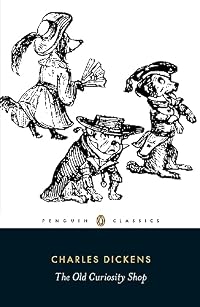
The Old Curiosity Shop
by Charles Dickens
On This Page
Description
Beautiful, honest Nell Trent lives with her devoted Grandfather in his Old Curiosity Shop, an enchanting shop of odds and ends. Desperate to make a better life for his Nell, Grandfather secretly gambles and gets deeply into debt with the unscrupulous Quilp. When what little money they have is lost in a game of cards, Quilp claims The Old Curiosity Shop as payment for the loansReleased in installments from 1840 to 1841, Charles Dicken's The Old Curiosity Shop caused such a sensation at the show more time that crowds of avid readers were waiting on the docks of New York to hear news of their heroine when the ship with the last episode approached the port.
. show less
Tags
Recommendations










Member Recommendations

Member Reviews
I promised myself that I would read at least 50 pages before giving up. I made it to 51, which covers the first six chapters. The first three are almost unreadable. They are narrated by a character who is intrigued by what he sees but refuses to ask any pertinent questions and is the kind of infuriating old timey character who can tell who is good and can be trusted and who is bad and will never be redeemed simply by glancing at their face. In these chapters, it is wall-to-wall waffle with almost no discernible plot. Then Dickens gets tired of this and decides to write the rest of the book in third person. I realise this change came about because the work was originally serialised, but couldn't he have rewritten it for when it was show more published in novel form? So the story greatly improves when it moves into third person; there's much less waffle and events and characters seem to wake up a little bit. However, we spend these three chapters in the company of Mr Quilp who is so ridiculously grotesque and evil that I really couldn't bear to read more about him. I hoped perhaps the book might end with Mrs Quilp murdering everyone. So, loath to continue with a 600-page story that started off as boring and then headed into unpleasant if I had no idea if my efforts would be rewarded, I took a quick peruse of Wikipedia. Turns out that the plot and characters seem to continue to suffer from 'Dickens changes his mind as he goes along serialisation' and damn, does it not have a satisfactory ending, so, um, pass. show less
Little Nell is generous, gentle, and has no one left in the world but her beloved grandfather. Alas, grandfather’s got a flaw: he’s fixated on the idea that if he just keeps wagering on card games, fate is sure to eventually deliver a jackpot large enough to secure his beloved granddaughter’s financial future. Manipulated into bankruptcy, he and Nell soon find themselves with only one recourse: to becoming wandering beggars.
From this point, the story takes off in several different directions. While one subplot tracks the fraught wanderings of Nell and her grandfather (a journey that includes memorable encounters with a nomadic Punch show and a travelling waxworks, but also episodes of desperation, desolation, and loss), another show more tracks the misadventures of Dick Swiveller, a dissolute student who turns out to possess a heart of gold; yet another, the illicit doings of smarmy barrister Sampson Brass and his loathsome sister Sally; yet another, the foul schemes of the physically and morally repulsive villain Daniel Quilp; yet another, the fate of Kit Nubbles, a kind and generous lad (in better days, the grandfather’s servant) who ends up in Quilp’s crosshairs; yet another, the activities of a certain “single gentleman” who, for reasons of his own, is intent upon hunting Nell and her grandfather down.
People critique Dickens for being “too wordy,” but feel like these are the same people who would probably critique Mozart for using “too many notes.” Dickens novels aren’t tools for the delivery of plot: they’re about illuminating the foibles of human nature, exposing the hypocrisies of society, and creating immersive experiences that deliver pathos, horror, outrage, laughter, hope, despair, wonder, fear, empathy, joy, and grief … and Old Curiosity Shop checks every box. By the time the novel was over I was emotionally exhausted, having raged over the perfidy of the gamblers intent on cheating the old man, been horrified by the villainy of Quilp, hooted at Dickens’ hyperbolic celebration of loathsome Sally’s beauty, ached over the plight of a generous furnace man stripped of hope by exploitative employers, celebrated the redemption of Dick and the Marchioness, ugly-cried at the death of characters I’d come to love, and laughed at the pony.
I get that this isn’t ranked by scholars as one of Dickens’ finest works, but where would one rank trifle in a hierarchy of desserts? It may not be fancy, but how can a combination of delicious ingredients not be delicious? While I haven’t read all of Dickens’ canon, I can say that Little Nell is a much more satisfying protagonist than Oliver Twist, Nell’s naive grandfather is wholly as affecting as Richard Summerson in Bleak House, the episode of the furnace man is as poignant as anything in Hard Times, and Dick Swiveller is Sidney Carton but with a happy ending. I look forward to rereading this again a decade from now, when I’ve forgotten just enough to feel like I’m discovering it anew. show less
From this point, the story takes off in several different directions. While one subplot tracks the fraught wanderings of Nell and her grandfather (a journey that includes memorable encounters with a nomadic Punch show and a travelling waxworks, but also episodes of desperation, desolation, and loss), another show more tracks the misadventures of Dick Swiveller, a dissolute student who turns out to possess a heart of gold; yet another, the illicit doings of smarmy barrister Sampson Brass and his loathsome sister Sally; yet another, the foul schemes of the physically and morally repulsive villain Daniel Quilp; yet another, the fate of Kit Nubbles, a kind and generous lad (in better days, the grandfather’s servant) who ends up in Quilp’s crosshairs; yet another, the activities of a certain “single gentleman” who, for reasons of his own, is intent upon hunting Nell and her grandfather down.
People critique Dickens for being “too wordy,” but feel like these are the same people who would probably critique Mozart for using “too many notes.” Dickens novels aren’t tools for the delivery of plot: they’re about illuminating the foibles of human nature, exposing the hypocrisies of society, and creating immersive experiences that deliver pathos, horror, outrage, laughter, hope, despair, wonder, fear, empathy, joy, and grief … and Old Curiosity Shop checks every box. By the time the novel was over I was emotionally exhausted, having raged over the perfidy of the gamblers intent on cheating the old man, been horrified by the villainy of Quilp, hooted at Dickens’ hyperbolic celebration of loathsome Sally’s beauty, ached over the plight of a generous furnace man stripped of hope by exploitative employers, celebrated the redemption of Dick and the Marchioness, ugly-cried at the death of characters I’d come to love, and laughed at the pony.
I get that this isn’t ranked by scholars as one of Dickens’ finest works, but where would one rank trifle in a hierarchy of desserts? It may not be fancy, but how can a combination of delicious ingredients not be delicious? While I haven’t read all of Dickens’ canon, I can say that Little Nell is a much more satisfying protagonist than Oliver Twist, Nell’s naive grandfather is wholly as affecting as Richard Summerson in Bleak House, the episode of the furnace man is as poignant as anything in Hard Times, and Dick Swiveller is Sidney Carton but with a happy ending. I look forward to rereading this again a decade from now, when I’ve forgotten just enough to feel like I’m discovering it anew. show less
This is a difficult book to love, but I do. Quilp is among the very worst of villains in Dickens’ novels, which says a lot because there are so many wicked people in his novels. One of the main characters, Little Nell, almost 14, must lead her grandfather with dementia out of London and into the wide world. She learns in the harshest of ways his horrible dark secret, which persists along with his dementia. The most heartbreaking scene I’ve read in any Dickens’ novel is her discovery and how she learns it. The reader cannot but love and adore Nell, but her story is tragic. I love the book for Kip, Nell’s little friend who had the biggest heart of any boy in any Dickens’ book I’ve read yet. Quilp puts Kip into the worst show more possible position in a manner that was impossible for Kip to defend himself, putting Kip’s and the lives of his mother and baby brother at unimaginable risk. While full of dastardly characters, the book is also full of kind, sometimes foolish, generous, and warm-hearted people. Take Richard Swiveler, quite an unusual character. Sometimes he has a dark aura being associated with Quilp for awhile, making him quite the enigma. But sure enough, he does what needs to be done. I think he’s one of Dickens’ more intriguing characters.
Was this the Harry Potter of its day? Some say so, and my set of 1940s Old Curiosity Shop dishes also support it—fans could collect the dishes in the 1940s, just as Potterverse fans can now. Quilp is Voldemort with his cohort young Tom Scott, with a charming cast of young teenagers against the world. A truly bittersweet story for the ages. show less
Was this the Harry Potter of its day? Some say so, and my set of 1940s Old Curiosity Shop dishes also support it—fans could collect the dishes in the 1940s, just as Potterverse fans can now. Quilp is Voldemort with his cohort young Tom Scott, with a charming cast of young teenagers against the world. A truly bittersweet story for the ages. show less
I think this Dickens novel is the one that's probably hardest for a modern day reader to appreciate. The Victorians adored the character of Little Nell and American readers were so eager to find out the ending that they 'were reported to storm the piers of New York City, shouting to arriving sailors (who might have already read the last instalment in the United Kingdom), "Is Little Nell alive?"' But it was difficult for me to appreciate the kind of sentimentality and pathos that distinguishes the character of Little Nell and I preferred the wonderfully grotesque character of Daniel Quilp who terrorises his wife, eats boiled eggs 'shell and all' and is the most lascivious of Dickens' villains (although this is 1840 so you only gets hints show more of this aspect).
"he ate hard eggs, shell and all, devoured gigantic prawns with the heads and tails on, chewed tobacco and water-cresses at the same time and with extraordinary greediness, drank boiling tea without winking, bit his fork and spoon till they bent again, and in short performed so many horrifying and uncommon acts that the women were nearly frightened out of their wits"
Given Dickens' comments (as reported by Claire Tomalin in her biography, Charles Dickens: A Life) that his bad characters portrayed the characteristics he found within himself, this portrayal of Quilp raised some interesting psychological questions in my mind about Dickens himself.
The introduction to my edition indicates that there are a lot of references to Bunyan's Pilgrim's Progress in the story which, again, a 19th century reader would have been very familiar with and I am not really familiar with at all. One character also frequently includes lines from popular songs in his dialogue and I can appreciate how this would have been very comic to a reader at the time but by the time I've had to look up the relevant footnote in the back of the book the joke has lost a little something in the translation as it were.
What I found most interesting about my reread of this book was the insight it gave into Dickens' feelings at the time of writing. A few years before Dickens started writing this novel, his beloved sister-in-law, Mary Hogarth, who had lived with him and his wife Catherine since their marriage, died suddenly at the age of 17. Dickens was absolutely distraught by her death and had to take a break from his publishing schedule for both The Pickwick Papers and Oliver Twist - this was the only time in his life when Dickens failed to get an instalment out on time. His grief for Mary's death seems far greater than we would consider reasonable given their relationship (and really there doesn't seem to be anything to suggest their relationship went beyond brother and sister in law); he wanted to be buried next to Mary and the published announcement called her 'the chief solace of his labours'. History is silent as to his wife's opinion of all this - from reading Tomalin's biography I almost get the impression that Catherine wasn't allowed to have opinions. Anyway, there's a bit of debate about this but it seems that when Dickens was writing The Old Curiosity Shop he may have had Mary in mind when he created the character of Little Nell and the idealisation of Little Nell as 'so young, so beautiful, so good' may well be linked to Dickens' idealisation of Mary Hogarth.
(SPOILERSAnd neither Little Nell or Mary ever got to grow up, marry and sully themselves by having sex within the sanctified bounds of marriage with their respective husbands. The more I read about women in Victorian literature, the more I realise how seriously messed up the Victorians were.) show less
"he ate hard eggs, shell and all, devoured gigantic prawns with the heads and tails on, chewed tobacco and water-cresses at the same time and with extraordinary greediness, drank boiling tea without winking, bit his fork and spoon till they bent again, and in short performed so many horrifying and uncommon acts that the women were nearly frightened out of their wits"
Given Dickens' comments (as reported by Claire Tomalin in her biography, Charles Dickens: A Life) that his bad characters portrayed the characteristics he found within himself, this portrayal of Quilp raised some interesting psychological questions in my mind about Dickens himself.
The introduction to my edition indicates that there are a lot of references to Bunyan's Pilgrim's Progress in the story which, again, a 19th century reader would have been very familiar with and I am not really familiar with at all. One character also frequently includes lines from popular songs in his dialogue and I can appreciate how this would have been very comic to a reader at the time but by the time I've had to look up the relevant footnote in the back of the book the joke has lost a little something in the translation as it were.
What I found most interesting about my reread of this book was the insight it gave into Dickens' feelings at the time of writing. A few years before Dickens started writing this novel, his beloved sister-in-law, Mary Hogarth, who had lived with him and his wife Catherine since their marriage, died suddenly at the age of 17. Dickens was absolutely distraught by her death and had to take a break from his publishing schedule for both The Pickwick Papers and Oliver Twist - this was the only time in his life when Dickens failed to get an instalment out on time. His grief for Mary's death seems far greater than we would consider reasonable given their relationship (and really there doesn't seem to be anything to suggest their relationship went beyond brother and sister in law); he wanted to be buried next to Mary and the published announcement called her 'the chief solace of his labours'. History is silent as to his wife's opinion of all this - from reading Tomalin's biography I almost get the impression that Catherine wasn't allowed to have opinions. Anyway, there's a bit of debate about this but it seems that when Dickens was writing The Old Curiosity Shop he may have had Mary in mind when he created the character of Little Nell and the idealisation of Little Nell as 'so young, so beautiful, so good' may well be linked to Dickens' idealisation of Mary Hogarth.
(SPOILERS
For as long as I'd heard of this book I expected the curiosity shop to be its central setting, and so it begins, but that is soon dispensed with and the story moves to explore a wider world where, as with every Dickens, it is the characters who are the curiosities. Where Trollope writes somewhat unpleasant people, Dickens writes truly black villains whom we're free to dislike without reserve, put opposite an innocent waif we can be equally unreserved in admiring. It's a shallow approach I'd expect to generate shallow results, yet Dickens makes them live on the page as well as any shades-of-grey characters might.
This novel is little Nell's, her name omitted from its title perhaps not to emphasize Dickens' so-soon return to the show more sympathetic orphan figure in the wake of Oliver. The key difference is that Nell has responsibility for her grandfather in addition to herself, a complication that demands self-sacrifice. The ending comes as if in answer to the charge that Oliver got off too lightly and unrealistically. I'll concede that it lags in the middle and too much of the novel is devoted to secondary characters. I'll even concede I like it least of the first four Dickens novels, as the sentimentality come thickest (the last couple of chapters are 100% sugar). I still like it better than much else. show less
This novel is little Nell's, her name omitted from its title perhaps not to emphasize Dickens' so-soon return to the show more sympathetic orphan figure in the wake of Oliver. The key difference is that Nell has responsibility for her grandfather in addition to herself, a complication that demands self-sacrifice. The ending comes as if in answer to the charge that Oliver got off too lightly and unrealistically. I'll concede that it lags in the middle and too much of the novel is devoted to secondary characters. I'll even concede I like it least of the first four Dickens novels, as the sentimentality come thickest (the last couple of chapters are 100% sugar). I still like it better than much else. show less
Written in 1840, when Dickens himself was less than 30 years old, [b:The Old Curiosity Shop|429024|The Old Curiosity Shop|Charles Dickens|https://i.gr-assets.com/images/S/compressed.photo.goodreads.com/books/1332523435l/429024._SY75_.jpg|5246858], while still a lovely read, introduces themes and writing that would become so much more mature and complex in Dickens’ later novels, [b:Little Dorrit|31250|Little Dorrit|Charles Dickens|https://i.gr-assets.com/images/S/compressed.photo.goodreads.com/books/1496619146l/31250._SY75_.jpg|80851] and [b:Dombey and Son|50827|Dombey and Son|Charles Dickens|https://i.gr-assets.com/images/S/compressed.photo.goodreads.com/books/1320513735l/50827._SY75_.jpg|4998726]. That this is one of his more show more sentimental efforts can be easily explained by knowing that Dickens was still grieving the premature loss of his young sister-in-law, Mary Hogarth, who died at the age of 17.
The death of Mary Hogarth was a blow that Dickens perhaps never recovered from. He was quite young himself, and Mary makes appearances in many of his novels, as angelic female characters, lost before their time. What the loss of one so young must undoubtedly trigger in anyone is a sense of their own mortality, an issue each of us grapples with daily.
That this was paramount in Dickens’ mind at the time of this writing seems to me to be evidenced in the following passage from the book:
The child admired and praised his work, and shortly afterwards departed; thinking, as she went, how strange it was, that this old man, drawing from his pursuits, and everything around him, one stern moral, never contemplated its application to himself; and, while he dwelt upon the uncertainty of human life, seemed both in word and deed to deem himself immortal. But her musings did not stop here, for she was wise enough to think that by a good and merciful adjustment this must be human nature, and that the old sexton, with his plans for next summer, was but a type of all mankind.
The story of Little Nell is the central one of The Old Curiosity Shop, but it runs parallel to a second story, which I think of as Kit’s story. While the two tales overlap in places, they seemed to me to be two distinct threads, with only a tenuous attachment. What they do have in common is the same villainous enemy seeking to do them harm, the dwarf, Quilp. Quilp is a villain of no subtlety. He is rotten from the brim to the dregs, and his inner character is reflected in his outer visage. He is the frightful thing a child hopes is not lingering under the bed or in the closets when the light goes out. He is, in fact, almost a caricature of evil, which, for me, lessens his impact. I tend to be more frightened by the evil that lies hidden beneath kinder words and countenances.
In the same vein, Nell is so good and so sweet that she becomes almost a symbol of childhood innocence and virtue, instead of a real little girl in a precarious position. While I was moved to tears over Florence Dombey and Amy Dorrit, I shed none for Nell. This told me that she affected me in a less personal way. Her Grandfather is, I believe, meant to elicit our sympathies, but like Mr. Dorrit, he never completely redeems himself for me. Without him, exactly as written, however, the extent of Nell’s love and devotion could never be portrayed.
The book has been compared to a fairytale, and it fits the description well. The child is in peril, the evil forces pursue her, particularly in the form of a Rumpelstiltskin-like Quilp, good forces collude to save her. But there is more depth than that to this tale. There are the actions of the Grandfather, which bring himself and Nell into the clutches of such evil and leave them exposed to a world where even the elements of nature can be cruel. There are sharp contrasts between the bucolic countryside and the industrialized city, where the fires burn day and night and threaten to suck everyone into a nightmare existence.
Kit’s story, I believe, saves the book from being maudlin or saccharin. He adds both humor and reality to the story and as it progresses, his story becomes the meat of the tale–the portion where you begin to see the inner workings of the characters, both good and bad. It is primarily in this story line that we see my favorite character from the book, Dick Swiveler and the marvelous Marchioness. What I like about Dick is that he grows over the course of the story. He swivels, if you will, from not seeing clearly, or perhaps even caring about others, to being one of the most insightful and caring characters penned. With him comes the Dickensian humor that brightens the bleakest of Dickens’ tales.
I thoroughly enjoyed this novel. It is an established fact that Dickens at his worst spreads a richer table than most authors at their best. If I were not comparing this to other Dickens novels, it would doubtless get a five-star rating. As it is, it is a smidgen below his best, so I give it four-stars and encourage everyone who hasn’t done so to read it. show less
The death of Mary Hogarth was a blow that Dickens perhaps never recovered from. He was quite young himself, and Mary makes appearances in many of his novels, as angelic female characters, lost before their time. What the loss of one so young must undoubtedly trigger in anyone is a sense of their own mortality, an issue each of us grapples with daily.
That this was paramount in Dickens’ mind at the time of this writing seems to me to be evidenced in the following passage from the book:
The child admired and praised his work, and shortly afterwards departed; thinking, as she went, how strange it was, that this old man, drawing from his pursuits, and everything around him, one stern moral, never contemplated its application to himself; and, while he dwelt upon the uncertainty of human life, seemed both in word and deed to deem himself immortal. But her musings did not stop here, for she was wise enough to think that by a good and merciful adjustment this must be human nature, and that the old sexton, with his plans for next summer, was but a type of all mankind.
The story of Little Nell is the central one of The Old Curiosity Shop, but it runs parallel to a second story, which I think of as Kit’s story. While the two tales overlap in places, they seemed to me to be two distinct threads, with only a tenuous attachment. What they do have in common is the same villainous enemy seeking to do them harm, the dwarf, Quilp. Quilp is a villain of no subtlety. He is rotten from the brim to the dregs, and his inner character is reflected in his outer visage. He is the frightful thing a child hopes is not lingering under the bed or in the closets when the light goes out. He is, in fact, almost a caricature of evil, which, for me, lessens his impact. I tend to be more frightened by the evil that lies hidden beneath kinder words and countenances.
In the same vein, Nell is so good and so sweet that she becomes almost a symbol of childhood innocence and virtue, instead of a real little girl in a precarious position. While I was moved to tears over Florence Dombey and Amy Dorrit, I shed none for Nell. This told me that she affected me in a less personal way. Her Grandfather is, I believe, meant to elicit our sympathies, but like Mr. Dorrit, he never completely redeems himself for me. Without him, exactly as written, however, the extent of Nell’s love and devotion could never be portrayed.
The book has been compared to a fairytale, and it fits the description well. The child is in peril, the evil forces pursue her, particularly in the form of a Rumpelstiltskin-like Quilp, good forces collude to save her. But there is more depth than that to this tale. There are the actions of the Grandfather, which bring himself and Nell into the clutches of such evil and leave them exposed to a world where even the elements of nature can be cruel. There are sharp contrasts between the bucolic countryside and the industrialized city, where the fires burn day and night and threaten to suck everyone into a nightmare existence.
Kit’s story, I believe, saves the book from being maudlin or saccharin. He adds both humor and reality to the story and as it progresses, his story becomes the meat of the tale–the portion where you begin to see the inner workings of the characters, both good and bad. It is primarily in this story line that we see my favorite character from the book, Dick Swiveler and the marvelous Marchioness. What I like about Dick is that he grows over the course of the story. He swivels, if you will, from not seeing clearly, or perhaps even caring about others, to being one of the most insightful and caring characters penned. With him comes the Dickensian humor that brightens the bleakest of Dickens’ tales.
I thoroughly enjoyed this novel. It is an established fact that Dickens at his worst spreads a richer table than most authors at their best. If I were not comparing this to other Dickens novels, it would doubtless get a five-star rating. As it is, it is a smidgen below his best, so I give it four-stars and encourage everyone who hasn’t done so to read it. show less
Charles Dickens' The Old Curiosity Shop explores the living conditions in Victorian London. On the one hand, there are the protagonists Nell and Kit, born into poor lower-class families and trying to make a living. On the other hand, there are the upper-class citizens and future employers of Nell and Kit. In between there is shady Quilp, not poor, but striving to become richer through various schemes. The plot starts in London before it unfolds in two separate plot lines, one still taking place in London and following Kit and the other following Nell and her grandfather on their journey away from London in search of a better life away from danger.
At the beginning, the reader learns that Nell's grandfather, owner of an old curiosity show more shop, cares for Nell because her parents are dead and she does not have anyone else anymore. With only the best intentions for Nell, her grandfather incurs a large amount of debt with Quilp who discovers that the old man has lost everything he borrowed gambling. Nell, on her part, is a modest young girl of fourteen years, who does not complain about her life although there would be ample reason to do so. Kit, Nell's only friend, lives under similar conditions. He lives in a small house with his mother and his two siblings and takes care of the family as best as he can doing odd jobs around the city after he is forced to leave his job at the old curiosity shop when Nell and her grandfather flee the city to live a life on the road as beggars. Nell's journey through the English countryside reminded me of Pilgrim's journey in John Bunyan's Pilgrim's Progress. With the goal of finding salvation both novel's protagonists set out and leave their home town, encountering several hardships along the way before they finally reach their destination. The characters they meet on the road are sometimes well-meaning, as in the case of Mrs Jarley, the owner of a traveling waxwork's show, who takes Nell and her grandfather in. Quite often, however, they are dangerous and try to lead the protagonists astray.
Two things about the novel strike me as particularly noteworthy. First, there is Dickens' characterization, which I find to be masterfully done. I found myself really caring for Nell and Kit and their fate. While this makes the novel a rather sad read, there have been certain places where I could not help but smile because I was so happy about positive episodes in the main characters' lives. Second, there is the fact that the novel was published as a weekly serial over the course of about two years. I am quite certain that the tension Dickens' created by having his readers wait another week for the next instalment of the novel must have left readers quite desperate. It was my experience when I read the novel that I would have been quite disappointed if I had had to put it down after certain chapters and wait for another week. This must have created a lot of talk about the novel in Victorian London, as many readers must have felt the same urge as I did to continue and read about the fate of poor little Nell.
To my mind the following quotation quite sums up the dilemma that presents itself to the two protagonists.
It is exactly this confinement to their place in society that serves as a metaphorical prison that is hard to escape for Nell and Kit. While Nell cares a lot about her grandfather, his gambling problem brings her many a sleepless and sorrowful night. And just when you feel that morning has dawned on Nell's life and she has finally found her place of safety and happiness, you are crushed by the cold fate Dickens has chosen for her.
I found this novel to be an outstanding example of good characterization and plotting. The ending made me sad and I think I would have wished for a more positive one, but it most certainly fit the overall tone of the novel. The Old Curiosity Shop is highly recommendable. 4 stars. show less
At the beginning, the reader learns that Nell's grandfather, owner of an old curiosity show more shop, cares for Nell because her parents are dead and she does not have anyone else anymore. With only the best intentions for Nell, her grandfather incurs a large amount of debt with Quilp who discovers that the old man has lost everything he borrowed gambling. Nell, on her part, is a modest young girl of fourteen years, who does not complain about her life although there would be ample reason to do so. Kit, Nell's only friend, lives under similar conditions. He lives in a small house with his mother and his two siblings and takes care of the family as best as he can doing odd jobs around the city after he is forced to leave his job at the old curiosity shop when Nell and her grandfather flee the city to live a life on the road as beggars. Nell's journey through the English countryside reminded me of Pilgrim's journey in John Bunyan's Pilgrim's Progress. With the goal of finding salvation both novel's protagonists set out and leave their home town, encountering several hardships along the way before they finally reach their destination. The characters they meet on the road are sometimes well-meaning, as in the case of Mrs Jarley, the owner of a traveling waxwork's show, who takes Nell and her grandfather in. Quite often, however, they are dangerous and try to lead the protagonists astray.
Two things about the novel strike me as particularly noteworthy. First, there is Dickens' characterization, which I find to be masterfully done. I found myself really caring for Nell and Kit and their fate. While this makes the novel a rather sad read, there have been certain places where I could not help but smile because I was so happy about positive episodes in the main characters' lives. Second, there is the fact that the novel was published as a weekly serial over the course of about two years. I am quite certain that the tension Dickens' created by having his readers wait another week for the next instalment of the novel must have left readers quite desperate. It was my experience when I read the novel that I would have been quite disappointed if I had had to put it down after certain chapters and wait for another week. This must have created a lot of talk about the novel in Victorian London, as many readers must have felt the same urge as I did to continue and read about the fate of poor little Nell.
To my mind the following quotation quite sums up the dilemma that presents itself to the two protagonists.
"It was a long night, which seemed as though it would have no end; but he had slept too, and dreamed - always of being at liberty, and roving about, now with one person and now with another, but ever with a vague dread of being recalled to prison; not that prison, but one which was in itself a dim idea, not of a place, but of a care and sorrow; of something oppressive and always present, and yet impossible to define. At last morning dawned, and there was the jail itself - cold, black, and dreary, and very real indeed." (p. 445)
It is exactly this confinement to their place in society that serves as a metaphorical prison that is hard to escape for Nell and Kit. While Nell cares a lot about her grandfather, his gambling problem brings her many a sleepless and sorrowful night. And just when you feel that morning has dawned on Nell's life and she has finally found her place of safety and happiness, you are crushed by the cold fate Dickens has chosen for her.
I found this novel to be an outstanding example of good characterization and plotting. The ending made me sad and I think I would have wished for a more positive one, but it most certainly fit the overall tone of the novel. The Old Curiosity Shop is highly recommendable. 4 stars. show less
Members
- Recently Added By
Lists

Favorite Dickens novels?
16 works; 27 members

Favourite 19th century fiction
257 works; 62 members

Unread books
1,063 works; 82 members

Folio Society
831 works; 53 members

Publisher's Weekly Bestsellers Prior to 1895 in Chronological Order
95 works; 6 members
Good, Smart, Clean Fiction
46 works; 4 members

Books Read in 2016
4,666 works; 197 members

Books I Own But Haven't Read
144 works; 2 members

SHOULD Read Books!
354 works; 9 members

KayStJ's to-read list
1,616 works; 11 members

al.vick-parents books
301 works; 1 member

Books Bought & Received as Gifts in 2014
81 works; 1 member

CCE 1000 Good Books List
1,033 works; 12 members

New Lifetime Reading Plan by Fadiman and Major
225 works; 5 members

Read
27 works; 1 member

Books read in 2025
49 works; 1 member

Charles Dickens books
17 works; 1 member
Author Information

Charles Dickens, perhaps the best British novelist of the Victorian era, was born in Portsmouth, Hampshire, England on February 7, 1812. His happy early childhood was interrupted when his father was sent to debtors' prison, and young Dickens had to go to work in a factory at age twelve. Later, he took jobs as an office boy and journalist before show more publishing essays and stories in the 1830s. His first novel, The Pickwick Papers, made him a famous and popular author at the age of twenty-five. Subsequent works were published serially in periodicals and cemented his reputation as a master of colorful characterization, and as a harsh critic of social evils and corrupt institutions. His many books include Oliver Twist, David Copperfield, Bleak House, Great Expectations, Little Dorrit, A Christmas Carol, and A Tale of Two Cities. Dickens married Catherine Hogarth in 1836, and the couple had nine children before separating in 1858 when he began a long affair with Ellen Ternan, a young actress. Despite the scandal, Dickens remained a public figure, appearing often to read his fiction. He died in 1870, leaving his final novel, The Mystery of Edwin Drood, unfinished. (Bowker Author Biography) show less
Some Editions
Awards and Honors
Series
Belongs to Publisher Series
Winkler Weltliteratur Dünndruckausgabe (Dickens 02)
Collins Classics (36)
Penguin English Library, 2012 series (2012-07)
Everyman's Library (173)
The World's Classics (270)
Work Relationships
Is contained in
Has the adaptation
Common Knowledge
- Canonical title
- The Old Curiosity Shop
- Original title
- The Old Curiosity Shop
- Original publication date
- 1840-1841
- People/Characters
- Nell Trent; Nell's Grandfather; Christopher 'Kit' Nubbles; Daniel Quilp; Richard 'Dick' Swiveller; The Marchioness (show all 9); Sampson Brass; Sally Brass; The single gentleman
- Important places
- London, England, UK; Shropshire, England, UK
- Related movies
- The Old Curiosity Shop (1934 | IMDb); The Old Curiosity Shop (1975 | IMDb); The Old Curiosity Shop (1979 | IMDb); The Old Curiosity Shop (1984 | IMDb); The Old Curiosity Shop (1995 | IMDb); The Old Curiosity Shop (2007 | IMDb)
- First words
- Although I am an old man, night is generally my time for walking.
- Last words
- (Click to show. Warning: May contain spoilers.)Such are the changes which a few years bring about, and so do things pass away, like a tale that is told!
- Original language
- English
- Canonical LCC
- PR4566
Classifications
Statistics
- Members
- 6,558
- Popularity
- 1,837
- Reviews
- 80
- Rating
- (3.69)
- Languages
- 14 — Arabic, Czech, Dutch, English, French, German, Greek, Italian, Norwegian (Bokmål), Polish, Portuguese, Spanish, Swedish, Turkish
- Media
- Paper, Audiobook, Ebook
- ISBNs
- 282
- UPCs
- 4
- ASINs
- 234