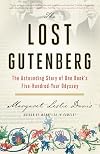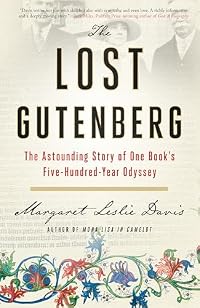
The Lost Gutenberg: The Astounding Story of One Book's Five-Hundred-Year Odyssey
by Margaret Leslie Davis
On This Page
Description
"The never-before-told story of one extremely rare copy of the Gutenberg Bible, and its impact on the lives of the fanatical few who were lucky enough to own it"--Tags
Recommendations



























Member Recommendations

Member Reviews
This is the fascinating story of one of the world’s most expensive print books…a first edition of the Gutenberg Bible (B45), and its journey from its creation to the present day. First of all, as several other reviewers have noted, the title “The LOST Gutenberg” is rather misleading, as the book has never been officially “lost,” and Davis’ story presents an unbroken “chain of custody” from the initial acquisition by a private collector (1836) down to the present day.
What’s most fascinating here are the stories of the collectors that obtain the Gutenberg. While the book itself may be the main character in the book, these individuals are certainly the most colorful. The book opens with the story of oil-fortune widow show more Estelle Doheny’s acquisition of the book in 1950. She is the only female and last private collector to own the volume. More importantly, she is one of the ONLY female book collectors of the era and, clearly, a figure Davis deeply admires.
Davis goes to great lengths to demonstrate that these various collectors were driven by wildly diverse motives and had very different relationships with B45. (Particularly the case with Sir Philip Beaumont Frere, the London solicitor who beats out Estelle Doheny’s bid at auction in 1947…and then promptly leaves the book locked up in the broker’s vault until he sells it.) The stories of these collectors are all stories of fortunes made and lost, symbolized by the book’s acquisition and sale. And perhaps that is the more important story here—the transition of the Gutenberg Bible from being a symbol of the enduring power of the printed word to being nothing more than a “status symbol” for the rich and famous, much like a RollsRoyce or a Rolex.
However, the story of B45 takes an unexpected turn after the death of Estelle Doheny when it voyages into the arcane world of the research university. The key figures in this phase of B45’s life are Professor Richard Schwab and nuclear physicist Tom Cahill. Using a cyclotron (a device designed to isolate plutonium for atom bombs), Schwab and Cahill discover fascinating details about the quality of the paper and ink that help illuminate Gutenberg’s printing process. Not only does their work illuminate the history of printing but it also opens up a new field of science-based study of antiquities.
Even then, B45 is not done making history. After being acquired by a Japanese publisher, a private university digitizes images of every leaf of the Bible so that it can be viewed online. Perhaps it is not too much to say that B45 ended its public life as a proto-type of the “e-book.” And it is wonderful to ponder that an artifact still exists that essentially bridges the evolution of print media to digital media.
Davis writes well. Her narrative is appropriately-paced. Her portrayals of the key figures (especially B45) is lively and engaging. Along the way, we learn the derivation of the idiom “fall guy,” an enlightening tidbit. There is a good bit of information here on the technical aspects of Gutenberg’s printing process and ancient books and manuscripts, but not so much as to overwhelm or discourage a general reader. Davis has done a noteworthy job of maintaining a light touch here. For those of us who love the printed word, Davis tells a fascinating and important story well worth the time. show less
What’s most fascinating here are the stories of the collectors that obtain the Gutenberg. While the book itself may be the main character in the book, these individuals are certainly the most colorful. The book opens with the story of oil-fortune widow show more Estelle Doheny’s acquisition of the book in 1950. She is the only female and last private collector to own the volume. More importantly, she is one of the ONLY female book collectors of the era and, clearly, a figure Davis deeply admires.
Davis goes to great lengths to demonstrate that these various collectors were driven by wildly diverse motives and had very different relationships with B45. (Particularly the case with Sir Philip Beaumont Frere, the London solicitor who beats out Estelle Doheny’s bid at auction in 1947…and then promptly leaves the book locked up in the broker’s vault until he sells it.) The stories of these collectors are all stories of fortunes made and lost, symbolized by the book’s acquisition and sale. And perhaps that is the more important story here—the transition of the Gutenberg Bible from being a symbol of the enduring power of the printed word to being nothing more than a “status symbol” for the rich and famous, much like a RollsRoyce or a Rolex.
However, the story of B45 takes an unexpected turn after the death of Estelle Doheny when it voyages into the arcane world of the research university. The key figures in this phase of B45’s life are Professor Richard Schwab and nuclear physicist Tom Cahill. Using a cyclotron (a device designed to isolate plutonium for atom bombs), Schwab and Cahill discover fascinating details about the quality of the paper and ink that help illuminate Gutenberg’s printing process. Not only does their work illuminate the history of printing but it also opens up a new field of science-based study of antiquities.
Even then, B45 is not done making history. After being acquired by a Japanese publisher, a private university digitizes images of every leaf of the Bible so that it can be viewed online. Perhaps it is not too much to say that B45 ended its public life as a proto-type of the “e-book.” And it is wonderful to ponder that an artifact still exists that essentially bridges the evolution of print media to digital media.
Davis writes well. Her narrative is appropriately-paced. Her portrayals of the key figures (especially B45) is lively and engaging. Along the way, we learn the derivation of the idiom “fall guy,” an enlightening tidbit. There is a good bit of information here on the technical aspects of Gutenberg’s printing process and ancient books and manuscripts, but not so much as to overwhelm or discourage a general reader. Davis has done a noteworthy job of maintaining a light touch here. For those of us who love the printed word, Davis tells a fascinating and important story well worth the time. show less
Though Margaret Leslie Davis's book is centered around a copy of the famous Gutenberg Bible (designated Number 45), it's really about the people who have sought, owned, and studied it over the course of two centuries. After a short description of the book's origins in the 15th century, she picks up the story with Archibald Acheson, 3rd Earl of Gosford, who purchases the book in 1836. While her reasons for starting with him go largely unmentioned (she does reference the book's previous owner, a Henry Perkins), the earl's purchase occurred at a time when the rare book market had emerged and copies of such books were increasingly prized by the growing group of collectors. As Davis notes, though, the Gutenberg was initially not as greatly show more valued as other works, with the earl acquiring his prize for a surprisingly modest sum.
That would change over the course of the 19th century, as the Gutenberg Bible became increasingly prized for its beauty, its rarity, and its historical significance. Davis charts this development through a succession of owners, from the earl through Lord William Tyssen-Amherst (who added the volume to his collection in 1884) to Charles William Dyson Perrins (a condiment manufacturer) before the book's eventual purchase by the wife of an American oil tycoon, Estelle Doheny, in 1950. As she traces the course of its ownership, she describes the motivations of each collector, their various views of the Bible, and their treatment of the book, all of which she makes engaging with a fine appreciation for engaging details. The increasing reverence in which the book is held is perhaps best embodied by Doheny, who upon her death donated it and the rest of her extensive collection to St. John's Seminary in Camarillo, California. This is where Davis tells what is perhaps the most tragic part of the book's tale, for upon the expiration of the restriction on Doheny's donation the Roman Catholic Church sold the Bible along with most of the other books and artwork she gifted them.
Today the Gutenberg Davis describes resides in a vault at Keio University in Japan, where it remains physically inaccessible to the public. Yet Davis ends the book on a surprisingly optimistic note, as she describes how, thanks to digitization efforts, anyone on the Internet today can read Number 45 for themselves, as digital scans of it are online at http://dcollections.lib.keio.ac.jp/en/gutenberg. Hopefully Davis's book will encourage more people to visit the site to see this historical treasure for themselves, especially given the winding journey it took to go from closeted collections to readability by the world. show less
That would change over the course of the 19th century, as the Gutenberg Bible became increasingly prized for its beauty, its rarity, and its historical significance. Davis charts this development through a succession of owners, from the earl through Lord William Tyssen-Amherst (who added the volume to his collection in 1884) to Charles William Dyson Perrins (a condiment manufacturer) before the book's eventual purchase by the wife of an American oil tycoon, Estelle Doheny, in 1950. As she traces the course of its ownership, she describes the motivations of each collector, their various views of the Bible, and their treatment of the book, all of which she makes engaging with a fine appreciation for engaging details. The increasing reverence in which the book is held is perhaps best embodied by Doheny, who upon her death donated it and the rest of her extensive collection to St. John's Seminary in Camarillo, California. This is where Davis tells what is perhaps the most tragic part of the book's tale, for upon the expiration of the restriction on Doheny's donation the Roman Catholic Church sold the Bible along with most of the other books and artwork she gifted them.
Today the Gutenberg Davis describes resides in a vault at Keio University in Japan, where it remains physically inaccessible to the public. Yet Davis ends the book on a surprisingly optimistic note, as she describes how, thanks to digitization efforts, anyone on the Internet today can read Number 45 for themselves, as digital scans of it are online at http://dcollections.lib.keio.ac.jp/en/gutenberg. Hopefully Davis's book will encourage more people to visit the site to see this historical treasure for themselves, especially given the winding journey it took to go from closeted collections to readability by the world. show less
It turns out the Gutenberg was not recognized as the earliest printed book until later in the 19th century, so copies of the bible were around but not given much attention by collectors. It was not even called Gutenberg but named after a French library where one existed, the Mazarin Bible. It slowly gained importance until it was eventually recognized as the ultimate book collecting prize in the 20th century. Since it is rare (48 copies survive out of about 180 printed) the last time one went up for sale in the 1980s was for 10s of millions. Most of them have ended up in institutions. The Gutenberg No. 45 probably had the most colorful history in terms of who owned it, staying in private hands until recently. This is a story of that show more book, but also the owners. All wealthy, obsessed, and tragic figures. In this age of inequality it's hard to be admiring of rich people buying books like this anymore, but there was a time when private collectors played an important role in preservation and some of those collectors are described in brief capsules. It was also the first Gutenberg to be bombarded with electrons to tease out each page's ink and paper qualities; and the first to be scanned and put on the Internet (in 1998). The story of how the Catholic Church in California sold off No. 45 in the 1980s to raise money in order to expand the private living quarters of the head priest is hilarious. What were they thinking? But then there are a few strange stories around No. 45. It would make for a better film similar to The Red Violin. show less
I greatly enjoyed reading this book. While the book touches on, at various points, the story surrounding the creation and printing of the various copies of the "Gutenberg Bible," the actual focus is on one particular copy, the copy that is known to scholars as "Number 45" from a catalogue of surviving copies made by one 19th century scholar. The author traces the history of the copy from the early 19th century to the present day. (The book's title is somewhat misleading, in that we aren't told anything about the copy's history prior to about 1825.) The two century odyssey -- and that's a good use of that word -- is quite fascinating, as we get a good look at the individuals that owned it. The widow of oil baron Edward Dohney gets the show more most coverage, possibly because her story is the best documented. And the end of her saga, after her death, is probably the most enraging, with the Archdiocese of Los Angeles fumbling it away. It is noteworthy how much bad luck and tragedy seems to attach to this copy. The author clearly had a good time writing this book, and it shows. For book-lovers, a highly enjoyable read. show less
I really enjoyed this book. And, yes, many of the reviews mention the fact that the title is somewhat misleading since there really wasn’t any “lost” Gutenberg bible. The bible that is the focus of Davis’ book is known as “45.” It is one of the estimated 180 bibles Gutenberg printed in the 15th century. This copy was owned by a handful of people including Estelle Doheny, widow of the oil tycoon Edward Doheny. In the late 1950s Estelle donated the Gutenberg and her entire collection of books, manuscripts, and other written and printed material to the St. John’s Seminary in the Catholic archdiocese of Lost Angeles. The archdioces decided in 1983 to sell the collection and did so for more than 39 million dollars. Estelle show more Doheny thought she had protected the collection by stipulating that nothing could be sold for at least 25 years after her death. The Cahtolic Church waited hardly a minute after that time to put everything on the auction block. They claimed it was to help shore up priestly vocations which had drastically slipped. The first thing they did with their windfall, however, was to remodel the archbishop’s residence. Number 45 ended up being purchased by a Japanese publisher that specializes in printing for schools. They locked the book away making it unavailable to anyone, but to their credit, they have twice had it digitzed, each time taking advantage of the current technology to provide the clearest images which can be viewed in their entirety at any time. Presumably, Gutenberg 45 will never be sold again, and will most likely never be seen again. The selling of Estelle Doheny’s collection including her Gutenberg ends Davis’ book and it ends on something of a dismal but not completely surprising note. The Catholic Church has often regarded financial gain over esthetic and historical significance, so selling the Gutenberg was something no once should have failed to see coming. My only negative comment on Davis’ book is her continual use of the present tense when referring to events of the past. This seems to be a popular trend in memoir writing, but it’s mildly annoying. show less
Maybe I should have read more descriptions before I picked this book up, because I found it to be really disappointing.
First of all, I have no idea why the title is "The Lost Gutenberg" because the book wasn't lost. In fact, this is a very detailed description of where this one particular copy of the Gutenberg Bible has been for the past 200 years.
The book basically comprises mini biographies of all of the book's owners over the years: who they were, how they gained their wealth, how they got into book collecting, how they acquired the Gutenberg, and what they did with it.
The book is a history, and for all but the final pages talks about things that happened in the past, and yet the ENTIRE BOOK IS IN THE PRESENT TENSE which I found show more incredibly distracting and annoying, especially when the author needed to talk about things that happened later than the thing she's currently discussing, so she had to use the future tense to talk about history. There is absolutely no reason for anything in this book to be in the present tense.
Ultimately, there was no larger narrative here: in the final pages when she talks about how the book has been used for research and what we have learned about Gutenberg and his process from it, she comes close to making a larger point about the importance of this book, but that point never justifies the entire narrative she has told. So in the end, this book is just a list of things that happened.... I hoped for there to be deeper thesis about the good and/or harm done by book collectors, or how the perceived value of books shifts based on other things in society, or the role of women in book curation, but Davis doesn't take the effort to develop these ideas into a thesis. show less
First of all, I have no idea why the title is "The Lost Gutenberg" because the book wasn't lost. In fact, this is a very detailed description of where this one particular copy of the Gutenberg Bible has been for the past 200 years.
The book basically comprises mini biographies of all of the book's owners over the years: who they were, how they gained their wealth, how they got into book collecting, how they acquired the Gutenberg, and what they did with it.
The book is a history, and for all but the final pages talks about things that happened in the past, and yet the ENTIRE BOOK IS IN THE PRESENT TENSE which I found show more incredibly distracting and annoying, especially when the author needed to talk about things that happened later than the thing she's currently discussing, so she had to use the future tense to talk about history. There is absolutely no reason for anything in this book to be in the present tense.
Ultimately, there was no larger narrative here: in the final pages when she talks about how the book has been used for research and what we have learned about Gutenberg and his process from it, she comes close to making a larger point about the importance of this book, but that point never justifies the entire narrative she has told. So in the end, this book is just a list of things that happened.... I hoped for there to be deeper thesis about the good and/or harm done by book collectors, or how the perceived value of books shifts based on other things in society, or the role of women in book curation, but Davis doesn't take the effort to develop these ideas into a thesis. show less
The subtitle is a tad hyperbolic. The narrative tells us nothing of the first several hundred years, but for the latter span the story is most interesting and well told.
Members
- Recently Added By
Lists

Books about Books
149 works; 24 members
Author Information

10 Works 613 Members
Margaret Leslie Davis is a graduate of Georgetown University and earned her master's in professional writing at the University of Southern California, where she is a fellow of the Los Angeles Institute for the Humanities. Her award-winning books have been featured on Good Morning America and in the London Sunday Times and Vanity Fair. She has show more appeared on C-SPAN Book TV and the History Channel's Modern Marvels as well as on Discovery Channel and AE's Biography. An experienced and sought-after public speaker, she has delivered addresses at many prestigious forums, including the New York Public Library, the White House Historical Association, and the National Gallery of Art. show less
Awards and Honors
Distinctions
Common Knowledge
- Original publication date
- 2019
- People/Characters
- William Amherst, 1st Earl Amherst; Thomas A. Cahill; Carrie Estelle Betzold Doheny; Edward L. Doheny; Charles William Dyson Perrins; Johannes Gutenberg (show all 11); Ernest U. Maggs; Lucille Valeria Miller; Bernard Quaritch; Abraham Simon Wolf Rosenbach; Richard N. Schwab
- Dedication
- For Catherine Chabot Davis
- First words
- The Gutenberg Bible is a masterpiece of world culture.
- Last words
- (Click to show. Warning: May contain spoilers.)The majestic leaves, including the signatures of the book's owners, can be viewed in splendid clarity at http://dcollections.lib.keio.ac.jp/en... (Epilogue)
Classifications
- Genres
- Nonfiction, History, General Nonfiction, Religion & Spirituality, Biography & Memoir
- DDC/MDS
- 093 — Computer science, information & general works Manuscripts & rare books (books about rare books) Incunabula
- LCC
- Z241 .B58 .D39 — Bibliography, Library Science and Information Resources Book industries and trade Incunabula. Block books
- BISAC
Statistics
- Members
- 309
- Popularity
- 102,953
- Reviews
- 12
- Rating
- (3.82)
- Languages
- English, Italian
- Media
- Paper, Audiobook, Ebook
- ISBNs
- 14
- ASINs
- 4