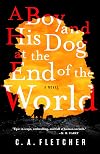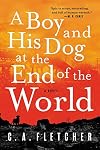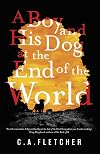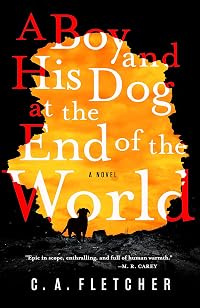
A Boy and His Dog at the End of the World
by C. A. Fletcher
On This Page
Description
The world used to be crowded before all the people went away, but Griz and his parents were never lonely on their remote island. They had each other and their dogs. Then the thief came. There may be no laws left, but if someone steals your dog, you can expect someone to come after you, because what's the point of love if you're not loyal.Tags
Recommendations












Member Reviews
I was absolutely consumed by C.A. Fletcher's new book, A Boy and His Dog at the End of the World. I literally couldn't put it down, and when I did, it was only because the tension was killing me and I had to walk away before I peeked ahead!
To honor the author's request..."It'd be a kindness to other readers - not to say this author - if the discoveries made as you follow Griz's journey into the ruins of our world remained a bit of a secret between us....", I'll be circumspect.
A event has taken most of the people from the Earth. But decades later there are still pockets of survivors that have made lives for themselves. Griz and his family are one of those, living on a remote Scottish island. (it really exists) But everything changes when show more a stranger arrives by water. And steals Griz's dog. And, for Griz, there is no choice - he's going to get his dog back.
"There may be no law left except what you make of it. But if you steal my dog, you can at least expect me to come after you. Because if we aren't loyal to the things we love, what's the point?"
Oh, what's not to love! What is Griz going to find outside of the parameters of his island? Who is still out there? What remnants of our civilization remain? Does he get his dog back? An author's imagining of a world after ours fascinates me every time. And Fletcher's vision of a future world is fantastic.
I love that Fletcher chose a young protagonist. This journey is a coming of age story for Griz. His determination and courage will endear him to readers. His thoughts and observations as he writes in his journal give this character even more depth. And food for thought for the reader.
The dog. Ahh, readers who are dog lovers (me included) are going to appreciate the canines in this tale. It's so easy to understand why Griz is determined to find his.
Fletcher is a dastardly master of foreshadowing and cliff hanger chapter endings. A sentence dropped into a paragraph that telegraphs a clue, an impending happening in Griz's quest. This is where I wanted to peek ahead so badly. (But don't!) Griz's journey is action-packed and will have the reader on the edge of their seat.
As Griz says - "I said I especially like the ones about apocalypses and dystopias because it's always interesting to see what the Before thought the After would be like."
A Boy and His Dog at the End of the World is going to a be a favorite read of mine for 2019. C.A. Fletcher - if you're listening - more please! show less
To honor the author's request..."It'd be a kindness to other readers - not to say this author - if the discoveries made as you follow Griz's journey into the ruins of our world remained a bit of a secret between us....", I'll be circumspect.
A event has taken most of the people from the Earth. But decades later there are still pockets of survivors that have made lives for themselves. Griz and his family are one of those, living on a remote Scottish island. (it really exists) But everything changes when show more a stranger arrives by water. And steals Griz's dog. And, for Griz, there is no choice - he's going to get his dog back.
"There may be no law left except what you make of it. But if you steal my dog, you can at least expect me to come after you. Because if we aren't loyal to the things we love, what's the point?"
Oh, what's not to love! What is Griz going to find outside of the parameters of his island? Who is still out there? What remnants of our civilization remain? Does he get his dog back? An author's imagining of a world after ours fascinates me every time. And Fletcher's vision of a future world is fantastic.
I love that Fletcher chose a young protagonist. This journey is a coming of age story for Griz. His determination and courage will endear him to readers. His thoughts and observations as he writes in his journal give this character even more depth. And food for thought for the reader.
The dog. Ahh, readers who are dog lovers (me included) are going to appreciate the canines in this tale. It's so easy to understand why Griz is determined to find his.
Fletcher is a dastardly master of foreshadowing and cliff hanger chapter endings. A sentence dropped into a paragraph that telegraphs a clue, an impending happening in Griz's quest. This is where I wanted to peek ahead so badly. (But don't!) Griz's journey is action-packed and will have the reader on the edge of their seat.
As Griz says - "I said I especially like the ones about apocalypses and dystopias because it's always interesting to see what the Before thought the After would be like."
A Boy and His Dog at the End of the World is going to a be a favorite read of mine for 2019. C.A. Fletcher - if you're listening - more please! show less
I received this novel from Orbit Books through NetGalley, in exchange for an honest review: my thanks to both of them for this opportunity.
Post apocalyptic worlds can come in a wide variety of flavors, most of them having in common the obliteration of the greater part of the human race: either by quirks of nature, pandemics, or climate changes, mankind finds itself vastly reduced in numbers and trying to survive in what is often a ravaged land – or a very unfriendly one. This novel, however, starts from a different kind of premise, that the dramatically dwindling population is the consequence of a devastating decrease in birth rate, one that results in the progressive, unavoidable emptying of the world, so that vegetation and fauna show more retake control of a landscape in which humans are more intruders than anything else.
A few enclaves survive, however, either small groups living together for support, or isolated family units: the latter is the case for Griz, the narrator of this story, whose family dwells on an island off the Scottish coast. It’s a harsh life, one made of hard work and constant struggle against the failure of ancient machinery cobbled together ingeniously from the remnants of the old world and made to function without the aid of electricity or propellants, both things having disappeared together with civilization as we know it.
Still, it’s not a bad life, despite its tragedies: Griz’s twin sister Joy died several years before falling from a cliff, and their distraught mother, searching for her child, fell badly and suffered a head injury that left her absent-minded and incapable of fending for herself. Griz’s father, older brother and sister are a tight-knit family unit, occasionally trading with the next-island neighbors, and surviving through sheep farming, some scavenging in the abandoned areas of the mainland (they call it “viking”, from Viking raiders or old) and whatever forms of agriculture the island climate allows. And of course there are their dogs, Jip and Jess – part of the family and Griz’s best friends and faithful companions.
Things change for the worse when a passing trader elopes with Jess: like humans, dogs have suffered in their reproductive abilities and female dogs have become quite rare in litters, so Brand – that’s the name of the trader – knows he will get a good price for Jess somewhere else. Incensed for the theft, and the awareness that the whole family has been deceived by Brand’s easy manners and tall tales, Griz jumps on one of the family’s boats and launches in pursuit of the thief, intending to retrieve the stolen dog at any cost.
What follows is of course an adventure in an unfamiliar and dangerous world, but it’s also a coming-of-age tale and a lesson about never losing sight of your humanity, no matter how harsh and unforgiving the situation becomes. And it’s a story about the bond between humans and dogs, as well, showing us that they are not just intelligent creatures who have stayed at our side since the dawn of time (Of all the animals that travelled the long road through the ages with us, dogs always walked closest), but also the kind of companions we can always rely on, their love and devotion coming straight from the heart and never filtered through self-interest or artifice.
As easy as it is to like Griz as a character, the moments in which this youngster truly shines happen in relation with Jip the dog: they are not merely friends and traveling companions, they look out for each other, care for each other’s well-being and share a bond that goes beyond the need for words, since they seem to understand one another through an unseen connection – not so much a connection of the mind, as one of the heart. As Griz tells the thief, in a heated exchange about the lack of laws following the fall of civilization: “…but if you steal my dog, you can at least expect me to come after you. If we’re not loyal to the things we love, what’s the point?”. Jip and Jess are family and as such they deserve the same kind of faithfulness and love as the rest of Griz’s parents and siblings – and in those simple words we can find the essence of this story and of Griz’s journey.
A side of this character that will not fail to endear it to us bookworms is the love of stories, the pleasure Griz takes in being drawn into them and letting the mind wander along the “what if…?” path that we all know so well: strangely enough, Griz’s main focus is on post-apocalyptic stories, which to me sounds like a tongue-in-cheek sort of joke and also as a curious parallel, since it’s a sub-genre I’ve always been interested on. For me, I think it’s a matter of superstition – sort of: as long as I can read about all the ways the world might end, I know it all remains firmly in the realm of fantasy; for Griz it’s a way to understand how the world truly ended: being born in the aftermath of it all means that any information has been filtered through second- and third-hand retellings and there is no certainty that things truly happened that way. Then there is the pure joy of losing oneself in stories – not just dystopian ones, of course: life on the island, with its definite boundaries and the need for constant hard work, does not leave much room for the mind to wander, and it’s only through books that Griz is able to move across a whole universe of possibilities.
And when the journey begins in earnest, when Griz is alone in the wide world beyond the borders of the tiny island, it’s the knowledge gleaned through books that helps in the difficult business of survival or that makes the sights and wonders more relatable, either thanks to scientific information or – again – to stories read in the past. And so the deep forests of the mainland (something that the islands lack) make Griz remember passages from The Hobbit or The Lord of the Rings; or the need to escape from confinement is fueled by recalling The Count of Montecristo, and so on.
Above all, this is a story about love, loyalty and steadfast determination, but it’s also a journey of discovery: of an unknown – and sometimes unknowable – world, but also of oneself and what it means to be human. You will find a wide range of feelings here: fear and delight, joy and terror, anger and compassion – this is the kind of book that will steal your heart, taking you on an emotional rollercoaster driven by a writing that at times becomes almost lyrical despite its deceiving simplicity. I found much more than I expected here, and I would not have missed it for the world. show less
Post apocalyptic worlds can come in a wide variety of flavors, most of them having in common the obliteration of the greater part of the human race: either by quirks of nature, pandemics, or climate changes, mankind finds itself vastly reduced in numbers and trying to survive in what is often a ravaged land – or a very unfriendly one. This novel, however, starts from a different kind of premise, that the dramatically dwindling population is the consequence of a devastating decrease in birth rate, one that results in the progressive, unavoidable emptying of the world, so that vegetation and fauna show more retake control of a landscape in which humans are more intruders than anything else.
A few enclaves survive, however, either small groups living together for support, or isolated family units: the latter is the case for Griz, the narrator of this story, whose family dwells on an island off the Scottish coast. It’s a harsh life, one made of hard work and constant struggle against the failure of ancient machinery cobbled together ingeniously from the remnants of the old world and made to function without the aid of electricity or propellants, both things having disappeared together with civilization as we know it.
Still, it’s not a bad life, despite its tragedies: Griz’s twin sister Joy died several years before falling from a cliff, and their distraught mother, searching for her child, fell badly and suffered a head injury that left her absent-minded and incapable of fending for herself. Griz’s father, older brother and sister are a tight-knit family unit, occasionally trading with the next-island neighbors, and surviving through sheep farming, some scavenging in the abandoned areas of the mainland (they call it “viking”, from Viking raiders or old) and whatever forms of agriculture the island climate allows. And of course there are their dogs, Jip and Jess – part of the family and Griz’s best friends and faithful companions.
Things change for the worse when a passing trader elopes with Jess: like humans, dogs have suffered in their reproductive abilities and female dogs have become quite rare in litters, so Brand – that’s the name of the trader – knows he will get a good price for Jess somewhere else. Incensed for the theft, and the awareness that the whole family has been deceived by Brand’s easy manners and tall tales, Griz jumps on one of the family’s boats and launches in pursuit of the thief, intending to retrieve the stolen dog at any cost.
What follows is of course an adventure in an unfamiliar and dangerous world, but it’s also a coming-of-age tale and a lesson about never losing sight of your humanity, no matter how harsh and unforgiving the situation becomes. And it’s a story about the bond between humans and dogs, as well, showing us that they are not just intelligent creatures who have stayed at our side since the dawn of time (Of all the animals that travelled the long road through the ages with us, dogs always walked closest), but also the kind of companions we can always rely on, their love and devotion coming straight from the heart and never filtered through self-interest or artifice.
As easy as it is to like Griz as a character, the moments in which this youngster truly shines happen in relation with Jip the dog: they are not merely friends and traveling companions, they look out for each other, care for each other’s well-being and share a bond that goes beyond the need for words, since they seem to understand one another through an unseen connection – not so much a connection of the mind, as one of the heart. As Griz tells the thief, in a heated exchange about the lack of laws following the fall of civilization: “…but if you steal my dog, you can at least expect me to come after you. If we’re not loyal to the things we love, what’s the point?”. Jip and Jess are family and as such they deserve the same kind of faithfulness and love as the rest of Griz’s parents and siblings – and in those simple words we can find the essence of this story and of Griz’s journey.
A side of this character that will not fail to endear it to us bookworms is the love of stories, the pleasure Griz takes in being drawn into them and letting the mind wander along the “what if…?” path that we all know so well: strangely enough, Griz’s main focus is on post-apocalyptic stories, which to me sounds like a tongue-in-cheek sort of joke and also as a curious parallel, since it’s a sub-genre I’ve always been interested on. For me, I think it’s a matter of superstition – sort of: as long as I can read about all the ways the world might end, I know it all remains firmly in the realm of fantasy; for Griz it’s a way to understand how the world truly ended: being born in the aftermath of it all means that any information has been filtered through second- and third-hand retellings and there is no certainty that things truly happened that way. Then there is the pure joy of losing oneself in stories – not just dystopian ones, of course: life on the island, with its definite boundaries and the need for constant hard work, does not leave much room for the mind to wander, and it’s only through books that Griz is able to move across a whole universe of possibilities.
And when the journey begins in earnest, when Griz is alone in the wide world beyond the borders of the tiny island, it’s the knowledge gleaned through books that helps in the difficult business of survival or that makes the sights and wonders more relatable, either thanks to scientific information or – again – to stories read in the past. And so the deep forests of the mainland (something that the islands lack) make Griz remember passages from The Hobbit or The Lord of the Rings; or the need to escape from confinement is fueled by recalling The Count of Montecristo, and so on.
Above all, this is a story about love, loyalty and steadfast determination, but it’s also a journey of discovery: of an unknown – and sometimes unknowable – world, but also of oneself and what it means to be human. You will find a wide range of feelings here: fear and delight, joy and terror, anger and compassion – this is the kind of book that will steal your heart, taking you on an emotional rollercoaster driven by a writing that at times becomes almost lyrical despite its deceiving simplicity. I found much more than I expected here, and I would not have missed it for the world. show less
Narrated by an honest yet naïve adolescent and set in a distant future in which mankind is facing extinction, this is a beautifully written piece of world building which balances depressing reality with a kind of stubborn hope. And dogs! It's a gentle rebuke of the way we live today (plastic everywhere) and a somewhat sardonic assurance that human foibles, as well as human strengths, will persist right until the very end. I especially liked the way Fletcher juxtaposed the tail-wagging consistency of his canine protagonist with the often fickle nature of the humans around him. If I have one criticism though it would be his overuse of foreshadowing of the "Little did I know what was to come next..." variety. Yes there are twists, show more especially that one-two punch at the end, but we really don't need a string of road signs advertising them. But given the novel's overall impact it's a very small bone to pick. Bibliophiles will appreciate the sly tributes to Tolkien, C. S. Lewis, and Harlan Ellison, among others. show less
I received a copy of this book from NetGalley and the publisher Orbit in exchange for an honest review.
This story grabbed me from the beginning and really never let go. The setup is pretty simple: Griz lives on an island (formerly known as Scotland) with his family and two dogs. One day, a stranger arrives to trade with them and ends up stealing Griz's dog. Griz sets off after the stranger to get his dog back and adventure ensues. The extra nuance here: most of the world's population is gone after an event called the Gelding where most people suddenly stopped being able to have children. Griz and his family survive by scavenging and trading with a few people on the mainland.
The story is told by Griz in the form of a journal as the show more adventure unfolds. I liked Griz's voice and sense of wonder as he saw many things for the first time (museum, amusement park) even though they started falling apart after "the end of the world." The descriptions of the countryside, the effects of several generations of neglect on structures and Griz' relationship with Jip, the other dog that makes the trip with him, were fantastic. The ending to this book was surprising and very clever. I really enjoyed it--great cover too! show less
This story grabbed me from the beginning and really never let go. The setup is pretty simple: Griz lives on an island (formerly known as Scotland) with his family and two dogs. One day, a stranger arrives to trade with them and ends up stealing Griz's dog. Griz sets off after the stranger to get his dog back and adventure ensues. The extra nuance here: most of the world's population is gone after an event called the Gelding where most people suddenly stopped being able to have children. Griz and his family survive by scavenging and trading with a few people on the mainland.
The story is told by Griz in the form of a journal as the show more adventure unfolds. I liked Griz's voice and sense of wonder as he saw many things for the first time (museum, amusement park) even though they started falling apart after "the end of the world." The descriptions of the countryside, the effects of several generations of neglect on structures and Griz' relationship with Jip, the other dog that makes the trip with him, were fantastic. The ending to this book was surprising and very clever. I really enjoyed it--great cover too! show less
“A man stole my dog. I went after him. Bad things happened. I can never go home.”
Thus opens A Boy and His Dog at the End of the World by C.A. Fletcher, one of the best post-apocalyptic books of the last decade at least. This book tells the story of Griz, who lives in a world with barely any people left. When a rare visitor comes to the island Griz lives on and leaves with his dog, Griz doesn’t think twice about taking off in pursuit.
“Dogs were with us from the very beginning and of all the animals that walked the long centuries beside us, they always walked the closest.
Griz is fiercely loyal to family, and dogs are family. Griz’s world is mostly empty of people and all the conveniences that modern society takes for granted. show more People get by on what they can do for themselves and what they can scavenge from the wreckage of the old world. Griz narrates his pursuit into a world that is only familiar from books. Survival in this world will take every bit of determination, luck and courage that Griz can muster.
Fletcher sets the mood with the very title and reinforces it from the opening line. The tension, excitement and worry crackles on every page. Seeing the world through Griz’s eyes shines a light on all the things that are important in our world as well as which things endure and which fade away.
Griz is a compelling narrator with a distinctive voice. The story is deeply moving and you’ll frequently find yourself reading it with your heart in your throat. Fletcher explores not only his depopulated world but what it means to be human.
Ultimately this is a story about the importance of connection, whether in a world crowded with people or a world nearly empty of them. This book has the potential to be a classic and a book that you will want to read, reread, and then read again. One of the finest examples the genre has to offer.
I was fortunate to be provided a copy of this book by the publisher.
“There may be no law left except what you make of it. But if you steal my dog, you can at least expect me to come after you. Because if we’re not loyal to the things we love, what’s the point?” show less
Thus opens A Boy and His Dog at the End of the World by C.A. Fletcher, one of the best post-apocalyptic books of the last decade at least. This book tells the story of Griz, who lives in a world with barely any people left. When a rare visitor comes to the island Griz lives on and leaves with his dog, Griz doesn’t think twice about taking off in pursuit.
“Dogs were with us from the very beginning and of all the animals that walked the long centuries beside us, they always walked the closest.
Griz is fiercely loyal to family, and dogs are family. Griz’s world is mostly empty of people and all the conveniences that modern society takes for granted. show more People get by on what they can do for themselves and what they can scavenge from the wreckage of the old world. Griz narrates his pursuit into a world that is only familiar from books. Survival in this world will take every bit of determination, luck and courage that Griz can muster.
Fletcher sets the mood with the very title and reinforces it from the opening line. The tension, excitement and worry crackles on every page. Seeing the world through Griz’s eyes shines a light on all the things that are important in our world as well as which things endure and which fade away.
Griz is a compelling narrator with a distinctive voice. The story is deeply moving and you’ll frequently find yourself reading it with your heart in your throat. Fletcher explores not only his depopulated world but what it means to be human.
Ultimately this is a story about the importance of connection, whether in a world crowded with people or a world nearly empty of them. This book has the potential to be a classic and a book that you will want to read, reread, and then read again. One of the finest examples the genre has to offer.
I was fortunate to be provided a copy of this book by the publisher.
“There may be no law left except what you make of it. But if you steal my dog, you can at least expect me to come after you. Because if we’re not loyal to the things we love, what’s the point?” show less
A Boy and His Dog at the End of the World is a proper end-of-the-world story, as it has everything you want in such stories. Plus, the entire story revolves around a boy’s attempt to get back his dog. That type of loyalty goes a long way towards overcoming any of the story’s pitfalls. Thankfully, there are few to none. C. A. Fletcher provides a history so that we can understand Griz’ world and why the sight of other people fills one with fear and not excitement. The world into which Griz ventures is harsh and dangerous but not without its beauty as well. Griz’ journey is exciting and refuses to follow any pattern, meaning it never becomes predictable or mundane. It is the type of story that engages your imagination while Griz’ show more struggles engage your sympathies. It is the type of book I had hoped more people would read because it is engrossing and provides a plethora of discussion topics. Have you read it? What did you think? show less
Griz's family lives on a little island in the Outer Hebrides, on a mostly depopulated Earth. Over a century before, something unknown, but referred to as the Gelding, caused the human reproduction rate to plummet to almost nothing. Griz's ancestors were among those who, as the population crashed, moved to remote areas where they wouldn't meet other people accidentally. The family consists of Griz, Griz's parents, and brother and sister Ferg and Bar. There was another sister, Joy, not much older than Griz, who is the youngest..Griz tells us the heartbreaking story of his sister Joy chasing a kite that got loose, and accidentally tumbling over the cliff.
Between the rocks and the powerful surf, she couldn't survive, and they could never show more recover her body.
One day, a ship with red sails arrives in their little harbor, carrying a man called Brand, who says he wants to trade. Brand, we soon learn, is a charmer, a storyteller, a liar, and a thief.
This is where our story really starts, and it's a story told entirely, with one small exception near the end, from Griz's viewpoint, in a notebook that he carries with him.
Brand adds color, fun, and a little news to the day, because strangers showing up is the only way to learn of what's happening away from their own island and their near neighbors, the Lewismen, on a nearby island. They all like Brand, and there is much talk about trading--but one of the things Brand wants to trade for is one of Griz's own two dogs, two small terriers called Jip and Jess. Brand wants Jess, because Jess is female, and dogs Gmuch as humans have dramatically collapsed in numbers. Griz says no. Everyone else says Jess is Griz's, and Griz won't give her up, ever.
Brand laughs it off.
Brand is invited to join them for dinner, and he brings his own contribution, something they've never had before, that he picked up in Spain--marmalade. They all eat and enjoy it, but Griz broke a tooth the day before, and the sweetness is too much for that broken tooth. Griz eats less than anyone else. Griz wakes up before everyone else, too--to find Brand is leaving, and all of Griz's family is sleeping very very deeply. He struggles to wake them, fearing they may not, and when his father is awake, they discover how much Brand has stolen, including all the fish they would have been both eating and trading in the coming weeks.
And Jess. Jip is still present, but Jess is gone. And Griz sees Brand's red sails just about to disappear over the horizon. Jip and Griz quickly set off in the sailboat Sweethope, Griz's own boat, following Brand.
What follows is a hard chase, with stops at places Griz never knew of, or had only read of in books gathered from "viking" abandoned towns and scattered abandoned buildings. There are several encounters with Brand, who proves to be in some ways cultured and educated, and who keeps insisting that Jess is his because he stole her, that he's not a monster, and that Griz, with no trace of beard at all, is obviously too young to be pursuing him, and needs to turn around and go home. He also tells Griz, repeatedly, that he's not a monster, a claim that Griz has good reason to doubt.
Griz continues the pursuit, and learns a great deal about the way the world has changed. Harrowing encounters included an encounter with wild pigs, that he wouldn't have survived except for the chance arrival of a French woman who says her name is "John Dark," or something that sounds like that. Griz does mention in passing, in the notebook he carries, that that's not what she really said, but what she really said was no more her real name than "John Dark," but it was a good name and what she chose to be called.
We see a depopulated England, and life (other than human) prevailing, and find both terrible and wonderful things, such as the Homely House. There are disturbing remnants of how people chose to face the end of their world, and some of the ways people are choosing to survive are disturbing too.
All along the way, there are secrets to be discovered, and secrets to be revealed. including Griz's own. Griz also finds a lot to think about, how dogs have been with humans from the beginning, and were betrayed by humans in the end. We learn about the Freemen, who apparently maintained underground, electronic brains--as long as possible, until the last people who knew how died. And now, at least some of the Freeman are spreading la peste, the plague, the actual plague.
I mentioned that Griz has a secret, but there's also another, major, secret, very important to Griz, that needs to be discovered.
This was a slow read for me, because it's a post-apocalyptic novel, of exactly the kind I don't enjoy nearly so much as when I was a teenager living through the Cold War. (Okay, yes, the Cold War may be back again, but I no longer want to focus on the aftermath of it going hot in some way when I'm reading for leisure.) But this one was recommended by a friend, whose judgment on this I trust, and the trust was not misplaced. Even though I took a few breaks, I kept returning to it, because, yes, it's worth it.
Also, all dogs encountered in the course of the book are alive and well at the end. Yes, that's something I require, to consider a book readable.
Recommended.
I bought this book. show less
Between the rocks and the powerful surf, she couldn't survive, and they could never show more recover her body.
One day, a ship with red sails arrives in their little harbor, carrying a man called Brand, who says he wants to trade. Brand, we soon learn, is a charmer, a storyteller, a liar, and a thief.
This is where our story really starts, and it's a story told entirely, with one small exception near the end, from Griz's viewpoint, in a notebook that he carries with him.
Brand adds color, fun, and a little news to the day, because strangers showing up is the only way to learn of what's happening away from their own island and their near neighbors, the Lewismen, on a nearby island. They all like Brand, and there is much talk about trading--but one of the things Brand wants to trade for is one of Griz's own two dogs, two small terriers called Jip and Jess. Brand wants Jess, because Jess is female, and dogs Gmuch as humans have dramatically collapsed in numbers. Griz says no. Everyone else says Jess is Griz's, and Griz won't give her up, ever.
Brand laughs it off.
Brand is invited to join them for dinner, and he brings his own contribution, something they've never had before, that he picked up in Spain--marmalade. They all eat and enjoy it, but Griz broke a tooth the day before, and the sweetness is too much for that broken tooth. Griz eats less than anyone else. Griz wakes up before everyone else, too--to find Brand is leaving, and all of Griz's family is sleeping very very deeply. He struggles to wake them, fearing they may not, and when his father is awake, they discover how much Brand has stolen, including all the fish they would have been both eating and trading in the coming weeks.
And Jess. Jip is still present, but Jess is gone. And Griz sees Brand's red sails just about to disappear over the horizon. Jip and Griz quickly set off in the sailboat Sweethope, Griz's own boat, following Brand.
What follows is a hard chase, with stops at places Griz never knew of, or had only read of in books gathered from "viking" abandoned towns and scattered abandoned buildings. There are several encounters with Brand, who proves to be in some ways cultured and educated, and who keeps insisting that Jess is his because he stole her, that he's not a monster, and that Griz, with no trace of beard at all, is obviously too young to be pursuing him, and needs to turn around and go home. He also tells Griz, repeatedly, that he's not a monster, a claim that Griz has good reason to doubt.
Griz continues the pursuit, and learns a great deal about the way the world has changed. Harrowing encounters included an encounter with wild pigs, that he wouldn't have survived except for the chance arrival of a French woman who says her name is "John Dark," or something that sounds like that. Griz does mention in passing, in the notebook he carries, that that's not what she really said, but what she really said was no more her real name than "John Dark," but it was a good name and what she chose to be called.
We see a depopulated England, and life (other than human) prevailing, and find both terrible and wonderful things, such as the Homely House. There are disturbing remnants of how people chose to face the end of their world, and some of the ways people are choosing to survive are disturbing too.
All along the way, there are secrets to be discovered, and secrets to be revealed. including Griz's own. Griz also finds a lot to think about, how dogs have been with humans from the beginning, and were betrayed by humans in the end. We learn about the Freemen, who apparently maintained underground, electronic brains--as long as possible, until the last people who knew how died. And now, at least some of the Freeman are spreading la peste, the plague, the actual plague.
I mentioned that Griz has a secret, but there's also another, major, secret, very important to Griz, that needs to be discovered.
This was a slow read for me, because it's a post-apocalyptic novel, of exactly the kind I don't enjoy nearly so much as when I was a teenager living through the Cold War. (Okay, yes, the Cold War may be back again, but I no longer want to focus on the aftermath of it going hot in some way when I'm reading for leisure.) But this one was recommended by a friend, whose judgment on this I trust, and the trust was not misplaced. Even though I took a few breaks, I kept returning to it, because, yes, it's worth it.
Also, all dogs encountered in the course of the book are alive and well at the end. Yes, that's something I require, to consider a book readable.
Recommended.
I bought this book. show less
Members
- Recently Added By
Lists

Kirkus Starred Fiction Reviews of Books Published in 2019
411 works; 12 members

Animals in the Title
498 works; 11 members

Top Five Books of 2024
795 works; 264 members

Post Apocalyptic Novels
41 works; 1 member

Favorite Science Fiction
456 works; 218 members
Talk Discussions
Past Discussions
A Boy and His Dog at the End of the World in Prose and Paws (August 2024)
Author Information

1 Work 959 Members
Some Editions
Awards and Honors
Work Relationships
Is a reply to
Common Knowledge
- Canonical title
- A Boy and His Dog at the End of the World
- Original title
- A Boy and His Dog at the End of the World
- Original publication date
- 2019
- Important places
- Mingulay, Western Isles, Scotland, UK
- Dedication
- For the midnight swimmers—and all past and present members of the Two O’clock Tea Club.
Especially Jack, Ari, Molly and Hannah.
May your beaches always have fires, dogs and laughter on them, whatever the weather. - First words
- Dogs were with us from the very beginning.
- Publisher's editor
- Hill, Jenni
Classifications
Statistics
- Members
- 841
- Popularity
- 32,609
- Reviews
- 54
- Rating
- (4.09)
- Languages
- English, Estonian, French, Spanish
- Media
- Paper, Audiobook, Ebook
- ISBNs
- 31
- ASINs
- 4