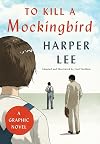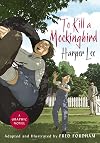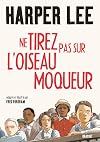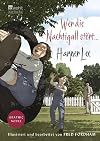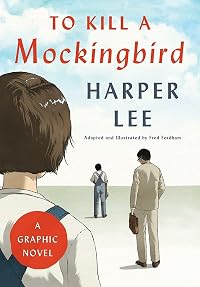
To Kill a Mockingbird: A Graphic Novel
by Fred Fordham (Author, Illustrator)
On This Page
Description
The explosion of racial hate in an Alabama town is viewed by a little girl whose father defends a black man accused of rape.Tags
Recommendations



Member Reviews
A faithful adaptation, for better or worse.
(Full disclosure: I received a free e-ARC for review through Edelweiss. Trigger warning for rape and racist violence.)
My feelings on this are conflicted and messy:
- How do you judge an adaptation of an existing work: on its own merits, or in its faithfulness to the source material? On the latter point, Fred Fordham's adaptation is a definite success. His graphic novel adaptation is loyal to both the plot and tone of Harper Lee's classic, and even plays on the nostalgia of the 1962 movie. Comic book Atticus is a dead ringer for Gregory Peck, and the Finch kids resemble their respective actors as well.
- My first experience with To Kill a Mockingbird was as a tween, well before I had to tools show more and knowledge to identify its more problematic aspects, chiefly the novel's inherent racism. Revisiting the story as an adult, in a different format, was...jarring. Some of the racism is plainly evident, e.g., is it ever okay for a white writer to use the n-word, even if historically accurate? And isn't it kind of gross for a story about Jim Crow racism and the lynching of a black man to center white voices? But there are so many layers to unpack, including liberal hero Atticus Finch's racism. (If he existed today, Atticus might be one of people pleading for "civility" from both sides. Yuck.) I found myself cringing as much as tearing up.
And that's kind of the crux of the matter, right? No doubt To Kill a Mockingbird: A Graphic Novel will evoke all sorts of nostalgia (coupled with an irrational desire to protect and defend a cherished piece of one's childhood), especially in white Americans; but don't let that prevent you from engaging with the book critically.
fwiw, I'd love to see a reimagining of Harper Lee's story told from Calpurnia or Helen Robinson's perspective.
http://www.easyvegan.info/img/to-kill-a-mockingbird-03.jpg
http://www.easyvegan.info/2019/01/08/to-kill-a-mockingbird-a-graphic-novel-by-fr... show less
(Full disclosure: I received a free e-ARC for review through Edelweiss. Trigger warning for rape and racist violence.)
My feelings on this are conflicted and messy:
- How do you judge an adaptation of an existing work: on its own merits, or in its faithfulness to the source material? On the latter point, Fred Fordham's adaptation is a definite success. His graphic novel adaptation is loyal to both the plot and tone of Harper Lee's classic, and even plays on the nostalgia of the 1962 movie. Comic book Atticus is a dead ringer for Gregory Peck, and the Finch kids resemble their respective actors as well.
- My first experience with To Kill a Mockingbird was as a tween, well before I had to tools show more and knowledge to identify its more problematic aspects, chiefly the novel's inherent racism. Revisiting the story as an adult, in a different format, was...jarring. Some of the racism is plainly evident, e.g., is it ever okay for a white writer to use the n-word, even if historically accurate? And isn't it kind of gross for a story about Jim Crow racism and the lynching of a black man to center white voices? But there are so many layers to unpack, including liberal hero Atticus Finch's racism. (If he existed today, Atticus might be one of people pleading for "civility" from both sides. Yuck.) I found myself cringing as much as tearing up.
And that's kind of the crux of the matter, right? No doubt To Kill a Mockingbird: A Graphic Novel will evoke all sorts of nostalgia (coupled with an irrational desire to protect and defend a cherished piece of one's childhood), especially in white Americans; but don't let that prevent you from engaging with the book critically.
fwiw, I'd love to see a reimagining of Harper Lee's story told from Calpurnia or Helen Robinson's perspective.
http://www.easyvegan.info/img/to-kill-a-mockingbird-03.jpg
http://www.easyvegan.info/2019/01/08/to-kill-a-mockingbird-a-graphic-novel-by-fr... show less
To Kill a Mockingbird is told through the eyes of Scout Finch, one of the most lovable and sharp-witted narrators I’ve ever met, and I’ve read a lot. She’s curious, no-nonsense.She’s growing up in a small Southern town in the 1930s, where things aren’t fair or simple, both things she seeks.
Scout spends her summers running wild with her brother Jem and their friend Dill, swapping wild stories and trying to catch a glimpse of Boo Radley - the mysterious neighbor no one ever sees. But her world starts to shift when her father, Atticus Finch, a quiet hero of a man, takes on the defense of Tom Robinson, a Black man falsely accused of beating and raping a white girl.
Through Scout’s honest, often funny, and sometimes show more heartbreaking perspective, we see a town wrestling with injustice, prejudice, and change. What makes the story so special is how Scout tries to make sense of it all with her usual spunk, stubbornness, and big heart. It’s a coming-of-age story that tackles big themes but never loses sight of its small-town charm—and at the center of it is Scout, asking the right questions and refusing to accept the world just as it is. show less
Scout spends her summers running wild with her brother Jem and their friend Dill, swapping wild stories and trying to catch a glimpse of Boo Radley - the mysterious neighbor no one ever sees. But her world starts to shift when her father, Atticus Finch, a quiet hero of a man, takes on the defense of Tom Robinson, a Black man falsely accused of beating and raping a white girl.
Through Scout’s honest, often funny, and sometimes show more heartbreaking perspective, we see a town wrestling with injustice, prejudice, and change. What makes the story so special is how Scout tries to make sense of it all with her usual spunk, stubbornness, and big heart. It’s a coming-of-age story that tackles big themes but never loses sight of its small-town charm—and at the center of it is Scout, asking the right questions and refusing to accept the world just as it is. show less
I wasn't sure if this should count towards my reading tally, but Harper Lee's beautiful writing is mostly intact, so I'll count the 'graphic novel' as just another edition of Mockingbird. I'm not above re-reading the original text over and over again, so why not! The completist in me finally won the battle (I'm not reading Go Set A Watchman, though).
Fred Fordham has illustrated my favourite novel beautifully, and I will admit to skipping ahead to see how he captured my favourite scenes - the fire at Miss Maudie's and Christmas at the Landing. Scout is endearing, all large eyes and overalls, and I love how the Finches all share the same features (naturally). Atticus isn't quite as dashing as Gregory Peck in the film, but hey ho. There show more are also one or two incredible full page illustrations, for the history of the Finches at the Landing, the fire, the children at the Radley house in the middle of the night, and Tom Robinson's death. The only persnickety detail I noted was that Fordham has Scout and Jem sharing a bedroom when they have separate but connecting rooms - I think the porch scenes confused him!
An absolutely gorgeous version of the classic story that every younger reader - and older obsessive fan! - should have on their shelves. show less
Fred Fordham has illustrated my favourite novel beautifully, and I will admit to skipping ahead to see how he captured my favourite scenes - the fire at Miss Maudie's and Christmas at the Landing. Scout is endearing, all large eyes and overalls, and I love how the Finches all share the same features (naturally). Atticus isn't quite as dashing as Gregory Peck in the film, but hey ho. There show more are also one or two incredible full page illustrations, for the history of the Finches at the Landing, the fire, the children at the Radley house in the middle of the night, and Tom Robinson's death. The only persnickety detail I noted was that Fordham has Scout and Jem sharing a bedroom when they have separate but connecting rooms - I think the porch scenes confused him!
An absolutely gorgeous version of the classic story that every younger reader - and older obsessive fan! - should have on their shelves. show less
The original story is well-maintained in this adaptation, all the most important moments are fully realized and the author stayed true to the characters (including leaving in that line where Atticus jokes that women aren’t allowed on juries because they’d ask too many questions, one of several hints in the novel that the man Scout idealized as a child would later appear more flawed in the eyes of an adult woman).
The characters facial features tended to be much more similar to one another than I would have preferred, and Boo and Dill looked so much alike in every respect that physically Dill basically just seemed like a shrunken version of Boo. I did find the illustrations impressive in other areas though, I thought the trial scenes show more were really well done and the backgrounds were wonderfully detailed and realistically lit, especially the nighttime panels.
I think of this graphic novel much the way I do the movie, it very much captures the spirit of the book, but you should absolutely still read the book. show less
The characters facial features tended to be much more similar to one another than I would have preferred, and Boo and Dill looked so much alike in every respect that physically Dill basically just seemed like a shrunken version of Boo. I did find the illustrations impressive in other areas though, I thought the trial scenes show more were really well done and the backgrounds were wonderfully detailed and realistically lit, especially the nighttime panels.
I think of this graphic novel much the way I do the movie, it very much captures the spirit of the book, but you should absolutely still read the book. show less
Drawing upon some of richest source material in American literature, Fred Fordham delivers a reverential adaptation. While the art can be a bit stiff and conservative, the story remains as powerful as ever in this new form. I gulped it down in one sitting.
I was both excited and apprehensive about reading this book, as the original text and the film are among my favorites. At first, I was not particularly taken with the illustrations, but that changed as the book continued. The scene with Burris Ewell and Miss Caroline was the first to change this. Within the pages, the illustrator was able to capture just how mean and nasty Burris is, giving the reader some foreshadowing of what is to come. Another very powerful moment was the verdict at Tom Robinson's trial. The looks on both Tom's and Scout's faces were perfect! So, if you're looking to revisit an old classic or to share it with a first-time reader, especially a reluctant reader, this book may just be the way to go. Just a warning--the show more book does still retain the use of the N-word, but it does a fantastic job of explaining why at the end of it in the "Note on the Language." show less
Well, it's one of my all-time favorite novels, and one of my all-time favorite films, so this graphic novel was right up my alley! It reads like the book, and looks like the movie! I very much enjoyed it, and as always, I get made as hell at the end of Tom's trial. But two words almost always get me calmed down again.
"Hey Boo."
"Hey Boo."
Members
- Recently Added By
Lists

Graphic Novels Adapted from Other Books
206 works; 1 member

Youth: Social Values
194 works; 1 member
Author Information

All Editions
Awards and Honors
Distinctions
Notable Lists
Work Relationships
Is an adaptation of
Classifications
- Genres
- Graphic Novels & Comics, Teen
- DDC/MDS
- 741.5 — Arts & recreation Drawing & decorative arts Drawing Comic books, graphic novels, fotonovelas, cartoons, caricatures, comic strips
- LCC
- PN6727 .F6777 .T6 — Language and Literature Literature (General) Literature (General) Collections of general literature Comic books, strips, etc.
- BISAC
Statistics
- Members
- 575
- Popularity
- 51,275
- Reviews
- 13
- Rating
- (4.18)
- Languages
- English, French, German, Portuguese
- Media
- Paper, Ebook
- ISBNs
- 9
- ASINs
- 1