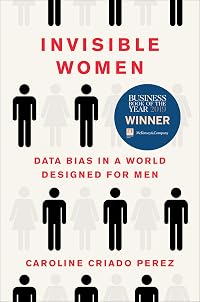
Invisible Women: Data Bias in a World Designed for Men
by Caroline Criado Perez
On This Page
Description
Data is fundamental to the modern world. From economic development, to healthcare, to education and public policy, we rely on numbers to allocate resources and make crucial decisions. But because so much data fails to take into account gender, because it treats men as the default and women as atypical, bias and discrimination are baked into our systems. And women pay tremendous costs for this bias in time, money, and often with their lives.Celebrated feminist advocate Caroline Criado Perez show more investigates the shocking root cause of gender inequality and research in Invisible Women, diving into women's lives at home, the workplace, the public square, the doctor's office, and more. Built on hundreds of studies in the US, the UK, and around the world, and written with energy, wit, and sparkling intelligence, this is a groundbreaking, unforgettable expose that will change the way you look at the world.
. show less
Tags
Recommendations





















Member Reviews
I listened to this as an audiobook and boy (or should that be girl), it made me angry and should make everyone angry. I was aware of some of it of course - I am female and a short female at that so I know all about bad design where I can't reach top shelves or the floor on couches or the endless queues for female toilets. But I'd never known or thought about some of the things talked about in this book such as poor urban design which forces women into dangerous situations, poor consideration of safety in transport, medical bias towards male testing only, lack of interest in fixing female health issues ( menopause anyone?). This is not mentioned in the book but I wonder if there is a reason medical scandals are often around obstetrics or show more dementia care where it mostly happens to women?
Now our world will operate on algorithms based on data biased towards men and it will become even harder to overcome. Made me very angry. show less
Now our world will operate on algorithms based on data biased towards men and it will become even harder to overcome. Made me very angry. show less
A brilliant exploration of the overwhelming data bias and/or gender data gap that exists in a wide range of fields where men are treated as the default and women as the outlier, even in cases where we know there are statistically significant differences between them. Criado Perez delves into a wide range of fields from social service provision, to the design of software, cars, and tools, to medical science, to politics where data is not being explored at a gender level, even when the limited data that exists indicates that women's experiences/needs are significantly different. Both informative and infuriating (particularly the section on medical science), the book is extremely well-cited and offers a plethora of evidence that the data show more we collect and then acting on that information, has the potential to massively change the lives of women around the globe. Highly recommended for all readers. show less
The world isn’t designed for women, and we don’t even know how bad it is because we haven’t collected information about it. For example, until very recently there was no crash testing of cars using dummies with a female weight/height profile, and it’s still very limited. “[W]hen a woman is involved in a car crash, she is 47% more likely to be seriously injured, and 71% more likely to be moderately injured, even when researchers control for factors such as height, weight, seat-belt usage, and crash intensity. She is also 17% more likely to die.” Because women are shorter, “[o]ur legs need to be closer to reach the pedals, and we need to sit more upright to see clearly over the dashboard,” but designers have defined this show more as the wrong position, making us “out of position” drivers. We “have less muscle on our necks and upper torso than men, which make us more vulnerable to whiplash (by up to three times), and car design has amplified this vulnerability. Swedish research has shown that modern seats are too firm to protect women against whiplash injuries: the seats throw women forward faster than men because the back of the seat doesn’t give way for women’s on average lighter bodies.”
Women’s work is ignored, which means that, for example, transportation planning doesn’t take into account the trips that women are more likely to make and anti-poverty programs move women into places where their networks are unavailable and childcare is suddenly both necessary and impossible to find. And male violence against women is ignored, so women’s safety concerns that limit use of public transportation and public space are dismissed as flaws in female behavior, even as we now know that women in India who have to use fields to urinate, instead of bathrooms, face a much greater risk of sexual assault and that women prefer security measures at bus stops (where we otherwise have to wait alone in the dark) to cameras on buses (which transportation designers are more willing to plan for). The disregard for women’s interests interacts—when we don’t count unpaid care work, we find that moderately long hours at paid work improves men’s health but threatens women’s health—because women are actually working a ton more. Everything could use some gender analysis: what counts as a deductible work expense generally conforms to “the kinds of things men will need to claim. Uniforms and tools are in; emergency day care is out.”
Among the rage-inducing stuff, I also learned that “countries with genderless languages (such as Hungarian and Finnish) are not the most equal. Instead, that honour belongs to a third group, countries with ‘natural gender languages’ …. because men go without saying, it matters when women literally can’t get said at all.” Relatedly, “gender neutral” tenure policies that give extra time on the tenure clock for having children advantage men, who use the extra time to write: one analysis of economics departments found that they resulted in a 22% decline in women’s chances of gaining tenure at their first job, and a 19% increase for men. Instead, Perez points to the example of giving father-specific paternity leave on a use it or lose it basis, which has apparently done some good in Sweden.
Then there’s bias against women: male biology students routinely underevaluate female peers while female students can tell who’s actually good; student evaluations are biased against female professors (and nonwhite professors)—that we know this very well and keep using evaluations as part of the standards for professors demonstrates that it’s not just lack of information that’s the problem, it’s that policymakers can’t stop thinking of women as problems to be solved, deviations from the norm. Women can’t get startup funding as easily as men; when professions gain importance (like computer programmers), decisionmakers kick women out of the field. In such circumstances, the myth of meritocracy can only perpetuate itself by collapsing the is/ought distinction—Perez cites an example of a finding that “frequenting a particular Japanese manga site is a ‘solid predictor of strong coding,’” which of course is much more about free time and culture than anything else.
And it’s not just money; women pay in illness and death for these failures to see. Construction jobs have safety limits on what can be lifted, but the research and regulation in nursing lags far behind. Miners’ diseases are heavily studied, but not the chemicals used in nail salons. The Army buys ‘different boot styles for hot and cold weather, mountain and desert warfare and the rain,’ but not for women. Medicine isn’t studied in women because women’s bodies are considered too complex and variable—but it sure as hell is prescribed to us, though our pain is undertreated. One result: “the second most common adverse drug reaction in women is that the drug simply doesn’t work, even though it clearly works in men.” And note what else that failure may mean: since women aren’t sufficiently studied in drug trials, we are likely losing out on drugs that would work for women but are ruled out because phase one trials are mostly done in men. And so on.
Poverty programs that fail to think about women fail. In Syria, for example, “while the introduction of mechanisation in farming did reduce demand for male labour, freeing men up to ‘pursue better-paying opportunities outside of agriculture’, it actually increased demand ‘for women’s labour-intensive tasks such as transplanting, weeding, harvesting and processing.’” Other interventions fail “in part because women are already overworked and don’t have time to spare for educational initiatives, no matter how beneficial they may end up being,” leading innovators to blame women for failing to be sensible. Other initiatives “exclude women by requiring a minimum land size, or that the person who attends the training is the head of a farming household, or the owner of the land that is farmed.” The story of improved stoves—which could help environmental impacts and women’s health—is particularly frustrating, because their designers for decades ignored the barriers to women’s uptake and blamed women for not changing, even though the new stoves disrupted multitasking and household relationships. show less
Women’s work is ignored, which means that, for example, transportation planning doesn’t take into account the trips that women are more likely to make and anti-poverty programs move women into places where their networks are unavailable and childcare is suddenly both necessary and impossible to find. And male violence against women is ignored, so women’s safety concerns that limit use of public transportation and public space are dismissed as flaws in female behavior, even as we now know that women in India who have to use fields to urinate, instead of bathrooms, face a much greater risk of sexual assault and that women prefer security measures at bus stops (where we otherwise have to wait alone in the dark) to cameras on buses (which transportation designers are more willing to plan for). The disregard for women’s interests interacts—when we don’t count unpaid care work, we find that moderately long hours at paid work improves men’s health but threatens women’s health—because women are actually working a ton more. Everything could use some gender analysis: what counts as a deductible work expense generally conforms to “the kinds of things men will need to claim. Uniforms and tools are in; emergency day care is out.”
Among the rage-inducing stuff, I also learned that “countries with genderless languages (such as Hungarian and Finnish) are not the most equal. Instead, that honour belongs to a third group, countries with ‘natural gender languages’ …. because men go without saying, it matters when women literally can’t get said at all.” Relatedly, “gender neutral” tenure policies that give extra time on the tenure clock for having children advantage men, who use the extra time to write: one analysis of economics departments found that they resulted in a 22% decline in women’s chances of gaining tenure at their first job, and a 19% increase for men. Instead, Perez points to the example of giving father-specific paternity leave on a use it or lose it basis, which has apparently done some good in Sweden.
Then there’s bias against women: male biology students routinely underevaluate female peers while female students can tell who’s actually good; student evaluations are biased against female professors (and nonwhite professors)—that we know this very well and keep using evaluations as part of the standards for professors demonstrates that it’s not just lack of information that’s the problem, it’s that policymakers can’t stop thinking of women as problems to be solved, deviations from the norm. Women can’t get startup funding as easily as men; when professions gain importance (like computer programmers), decisionmakers kick women out of the field. In such circumstances, the myth of meritocracy can only perpetuate itself by collapsing the is/ought distinction—Perez cites an example of a finding that “frequenting a particular Japanese manga site is a ‘solid predictor of strong coding,’” which of course is much more about free time and culture than anything else.
And it’s not just money; women pay in illness and death for these failures to see. Construction jobs have safety limits on what can be lifted, but the research and regulation in nursing lags far behind. Miners’ diseases are heavily studied, but not the chemicals used in nail salons. The Army buys ‘different boot styles for hot and cold weather, mountain and desert warfare and the rain,’ but not for women. Medicine isn’t studied in women because women’s bodies are considered too complex and variable—but it sure as hell is prescribed to us, though our pain is undertreated. One result: “the second most common adverse drug reaction in women is that the drug simply doesn’t work, even though it clearly works in men.” And note what else that failure may mean: since women aren’t sufficiently studied in drug trials, we are likely losing out on drugs that would work for women but are ruled out because phase one trials are mostly done in men. And so on.
Poverty programs that fail to think about women fail. In Syria, for example, “while the introduction of mechanisation in farming did reduce demand for male labour, freeing men up to ‘pursue better-paying opportunities outside of agriculture’, it actually increased demand ‘for women’s labour-intensive tasks such as transplanting, weeding, harvesting and processing.’” Other interventions fail “in part because women are already overworked and don’t have time to spare for educational initiatives, no matter how beneficial they may end up being,” leading innovators to blame women for failing to be sensible. Other initiatives “exclude women by requiring a minimum land size, or that the person who attends the training is the head of a farming household, or the owner of the land that is farmed.” The story of improved stoves—which could help environmental impacts and women’s health—is particularly frustrating, because their designers for decades ignored the barriers to women’s uptake and blamed women for not changing, even though the new stoves disrupted multitasking and household relationships. show less
If you only read one non fiction book in 2020, let it be this one.
This book brings forward the research, and the lack of it, for why, to paraphrase Henry Higgins, a woman cannot be more like a man. Caroline Criado Perez explains why “half the world’s population ... is seen as, well, niche”. It is well researched and referenced (the endnotes are a hefty 70 pages).
The book covers the differences in research and design around women’s physical differences, the impacts on women because of sexual violence and the impacts on our whole society due to the amount of unpaid work women do.
In a 1933 lecture, Freud said “Throughout history, people have knocked their heads against the riddle of femininity”. Well, if you would like to show more better understand why (and knowledge is power), this is the book for you.
If you say, “yes, but I’m not a woman and I’m not invisible”, then this is absolutely the book for you. If you are one of those who say women have been ridiculously banging on about this stuff for decades, read this and maybe you will be a fraction less stupid. show less
This book brings forward the research, and the lack of it, for why, to paraphrase Henry Higgins, a woman cannot be more like a man. Caroline Criado Perez explains why “half the world’s population ... is seen as, well, niche”. It is well researched and referenced (the endnotes are a hefty 70 pages).
The book covers the differences in research and design around women’s physical differences, the impacts on women because of sexual violence and the impacts on our whole society due to the amount of unpaid work women do.
In a 1933 lecture, Freud said “Throughout history, people have knocked their heads against the riddle of femininity”. Well, if you would like to show more better understand why (and knowledge is power), this is the book for you.
If you say, “yes, but I’m not a woman and I’m not invisible”, then this is absolutely the book for you. If you are one of those who say women have been ridiculously banging on about this stuff for decades, read this and maybe you will be a fraction less stupid. show less
Need to feel immense amounts of rage at the world? Read this book. No really—there were several times I had to put this book down & take a break because I had instigated fights with Noah. So much rage & anger & hurt.
I was already enraged after reading the quote at the very beginning of the book:
“Representation of the world, like the world itself, is the work of men; they describe it from their own point of view, which they confuse with the absolute truth.” -Simone de Beauvoir
The rest of the book spews data point after data point showcasing this bias. In daily life, in the workplace, in design, in the medical field, in politics, & in the event & aftermath of disaster. Men are seen as the default with women being “other” or show more straying from the norm. Not surprisingly, this causes a slew of issues—that then disproportionately affect women.
Not to mention all the invisible work, or unpaid labor, that falls to women. This doesn’t get counted in a country’s GDP, and influences the gender pay gap—predominantly because infrastructure does not set up working mothers for success. Often forcing working mothers to switch or part-time or quit their jobs altogether to focus on their care-taking unpaid labor. This is despite the research showing that more women in the workforce leads to significantly higher productivity & a higher GDP.
I could rant for days about the inequities against women shown in this book. Yet, there are still things missing. This book hardly touches the factors of race, sexual orientation, or gender identity (other than CIS-gender). Arguably, the data is scarce on those subsets when the majority of data is not sex-disaggregrated in the first place. But still—those populations exist and deserve to be recognized, represented, & studied in the data.
Another thing I found lacking in this book was any call to action. I was hopeful that after reading all the horrific statistics there would be a clear: “Okay, but here’s what we can do!” Much to my dismay, there was hardly any actionable advice given other than: “Listen to women.” This lack of advice could be simply because we’re not there yet. Some other countries (notably European, more specifically Austria & Scandinavian countries) have had success in lowering the gender pay gap, providing infrastructure that supports women, & policies that help ensure women are elected into positions of power. The US, not surprisingly, is far behind.
There is hope yet for future generations. Maybe. I’ll at least be raising Liam to see women not as objects, but as equals—just as deserving (if not more so) to be in positions of influence. I’ll do my best to instill in Josie the confidence of the average white man—the belief that she can do anything, that she has brilliance written into her bones, not despite her sex, but because of it. show less
I was already enraged after reading the quote at the very beginning of the book:
“Representation of the world, like the world itself, is the work of men; they describe it from their own point of view, which they confuse with the absolute truth.” -Simone de Beauvoir
The rest of the book spews data point after data point showcasing this bias. In daily life, in the workplace, in design, in the medical field, in politics, & in the event & aftermath of disaster. Men are seen as the default with women being “other” or show more straying from the norm. Not surprisingly, this causes a slew of issues—that then disproportionately affect women.
Not to mention all the invisible work, or unpaid labor, that falls to women. This doesn’t get counted in a country’s GDP, and influences the gender pay gap—predominantly because infrastructure does not set up working mothers for success. Often forcing working mothers to switch or part-time or quit their jobs altogether to focus on their care-taking unpaid labor. This is despite the research showing that more women in the workforce leads to significantly higher productivity & a higher GDP.
I could rant for days about the inequities against women shown in this book. Yet, there are still things missing. This book hardly touches the factors of race, sexual orientation, or gender identity (other than CIS-gender). Arguably, the data is scarce on those subsets when the majority of data is not sex-disaggregrated in the first place. But still—those populations exist and deserve to be recognized, represented, & studied in the data.
Another thing I found lacking in this book was any call to action. I was hopeful that after reading all the horrific statistics there would be a clear: “Okay, but here’s what we can do!” Much to my dismay, there was hardly any actionable advice given other than: “Listen to women.” This lack of advice could be simply because we’re not there yet. Some other countries (notably European, more specifically Austria & Scandinavian countries) have had success in lowering the gender pay gap, providing infrastructure that supports women, & policies that help ensure women are elected into positions of power. The US, not surprisingly, is far behind.
There is hope yet for future generations. Maybe. I’ll at least be raising Liam to see women not as objects, but as equals—just as deserving (if not more so) to be in positions of influence. I’ll do my best to instill in Josie the confidence of the average white man—the belief that she can do anything, that she has brilliance written into her bones, not despite her sex, but because of it. show less
Brilliant! I learnt so much from this book. I had to listen to it in small bursts because it's full of data&numbers and I needed time to process it all. Also because it made my blood boil, so I really could only listen to half an hour at a time anyway. There are so many ways in which the world has been designed for men, by men, due to their implicit gender bias, and this book goes through all of them. From seatbelts safety, to city structure, drug trials... It's appalling, really. Worth a read!
Oh, this book. Filled with important data pointing out the myriad ways that women have been neglected in building society around the world. And so depressing that it took me forever to read it.
Criado Perez is thorough. She explores not just the commonly known areas where women have been historically unplanned for, like medicine and the workplace, but also transportation, public toilets, the internet, refugee camps, and the list goes on and on. She ends with summing up her work into three themes that "define women's relationship with the world". One is the invisibility of the female body - neglecting to take into account the female body in medicine, technology, and architecture - and how it has led to injury, death, and a world where we show more just don't fit. Two is, ironically, the hyper-visibility of the female body. Male sexual violence against women and how we don't measure it and don't design spaces to account for it or limit it. And third, the unaccounted and unpaid care work of which women do more than their fair share. In our current world, "human" equals "male".
Her main solution to all of this is getting women in the position to be involved in decisions. To me, this seems undoubtedly correct, though I think part of that equation has to be getting men involved evenly in the unpaid care work at the same time. (Please, to all my male friends who are already there and doing their fair share, I see it and acknowledge it - my husband included!) I do love her last line:
"And so, to return to Freud's 'riddle of femininity', it turns out that the answer was staring us in the face all along. All 'people' needed to do was to ask women."
This is a book everyone should read, but fair warning that it isn't comfortable or easy reading. show less
Criado Perez is thorough. She explores not just the commonly known areas where women have been historically unplanned for, like medicine and the workplace, but also transportation, public toilets, the internet, refugee camps, and the list goes on and on. She ends with summing up her work into three themes that "define women's relationship with the world". One is the invisibility of the female body - neglecting to take into account the female body in medicine, technology, and architecture - and how it has led to injury, death, and a world where we show more just don't fit. Two is, ironically, the hyper-visibility of the female body. Male sexual violence against women and how we don't measure it and don't design spaces to account for it or limit it. And third, the unaccounted and unpaid care work of which women do more than their fair share. In our current world, "human" equals "male".
Her main solution to all of this is getting women in the position to be involved in decisions. To me, this seems undoubtedly correct, though I think part of that equation has to be getting men involved evenly in the unpaid care work at the same time. (Please, to all my male friends who are already there and doing their fair share, I see it and acknowledge it - my husband included!) I do love her last line:
"And so, to return to Freud's 'riddle of femininity', it turns out that the answer was staring us in the face all along. All 'people' needed to do was to ask women."
This is a book everyone should read, but fair warning that it isn't comfortable or easy reading. show less
Members
- Recently Added By
Lists

Best Feminist Literature
188 works; 26 members

Top Five Books of 2020
982 works; 348 members

Recommend the 20 best books you've read in the last five years
2,168 works; 601 members

Evan's Reading List 2023
20 works; 1 member

Lit Lattes Ep 005
12 works; 1 member

KayStJ's to-read list
1,616 works; 11 members

Club Read's Recommended Nonfiction Written by Women
618 works; 30 members

Top Five Books of 2025
954 works; 303 members

The War on Cars podcast
108 works; 1 member

Books That Changed Our Perspective
423 works; 168 members

GraceCollection TBR/To Buy List
106 works; 1 member

Books Read in 2022
5,166 works; 114 members

Books Read in 2023
5,547 works; 145 members

Wishlist
50 works; 1 member

2021 - List of books read
53 works; 1 member

Blackwell's Five Foot Bookshelf
72 works; 4 members

Books Read in 2020
4,379 works; 123 members

READ 2026
77 works; 1 member
Author Information

9 Works 3,745 Members
Awards and Honors
Awards
Distinctions
The Guardian Book of the Day (2019-02-28)
Series
Belongs to Publisher Series
btb (71887)
Work Relationships
Common Knowledge
- Canonical title*
- Onzichtbare vrouwen
- Original title
- Invisible Women: Exposing data bias in a world designed for men
- Original publication date
- 2019-03-07
- Epigraph
- Representation of the world, like the world itself, is the work of men; they describe it from their own point of view, which they confuse with the absolute truth.
Simone de Beauvoir - Dedication
- For the women who persist: keep on being bloody difficult
- First words
- Preface
Most of recorded human history is one big data gap.
Introduction: The default male
Seeing men as the human default is fundamental to the structure of human society.
Chapter 1.
Can snow-clearing be sexist?
It all started with a joke. - Quotations
- The truth is that around the world, women continue to be disadvantaged by a working culture that is based on the ideological belief that male needs are universal, (Ch3 - The Long Friday, p86 hardback edition)
- Last words
- (Click to show. Warning: May contain spoilers.)All 'people' needed to do was ask women.
- Blurbers
- Fine, Cordelia; Kennedy, Helena; Patterson, Christina; Reid, Melanie; Rippon, Gina; Rutherford, Adam (show all 8); Sturgeon, Nicola; Webb, Robert
- Original language
- English
- Canonical DDC/MDS
- 305.420721
- Canonical LCC
- HQ1237.C75
*Some information comes from Common Knowledge in other languages. Click "Edit" for more information.
Classifications
- Genres
- Sexuality and Gender Studies, Sociology, General Nonfiction, Nonfiction, Science & Nature
- DDC/MDS
- 305.420721 — Society, government, & culture Social sciences, sociology & anthropology Social group - Age, Gender, Ethnicity Women Social role and status of women Standard subdivisions
- LCC
- HQ1237 .C75 — Social sciences The family. Marriage, Women and Sexuality The Family. Marriage. Women Women. Feminism
- BISAC
Statistics
- Members
- 3,652
- Popularity
- 4,420
- Reviews
- 112
- Rating
- (4.24)
- Languages
- 14 — Czech, Danish, Dutch, English, Finnish, French, German, Italian, Polish, Portuguese, Serbian, Spanish, Swedish, Turkish
- Media
- Paper, Audiobook, Ebook
- ISBNs
- 41
- ASINs
- 12