On This Page
Description
Anthony Powell's universally acclaimed epic A Dance to the Music of Time offers a matchless panorama of twentieth-century London. Now, for the first time in decades, readers in the United States can read the books of Dance as they were originally published--as twelve individual novels--but with a twenty-first-century twist: they're available only as e-books.As the fourth book, At Lady Molly's (1957), opens, the heady pleasures of the 1920s have begun to give way to the austerity and worries show more of the 1930s. Even so, the whirl of London life continues: friends commit to causes and to spouses, confess adulteries, and fall victim to dissipation and disillusion. As Nick moves ever more comfortably in the worlds of art, culture, and society, Powell's palette broadens: old friends make appearances, but new ones take places on the stage as well--including Isobel Tolland, whom Nick knows at first sight he's destined to marry."Anthony Powell is the best living English novelist by far. His admirers are addicts, let us face it, held in thrall by a magician."--Chicago Tribune"A book which creates a world and explores it in depth, which ponders changing relationships and values, which creates brilliantly living and diverse characters and then watches them grow and change in their milieu. . . . Powell's world is as large and as complex as Proust's."--Elizabeth Janeway, New York Times"One of the most important works of fiction since the Second World War. . . . The novel looked, as it began, something like a comedy of manners; then, for a while, like a tragedy of manners; now like a vastly entertaining, deeply melancholy, yet somehow courageous statement about human experience."--Naomi Bliven, New Yorker"The most brilliant and penetrating novelist we have."--Kingsley Amis show lessTags
Recommendations













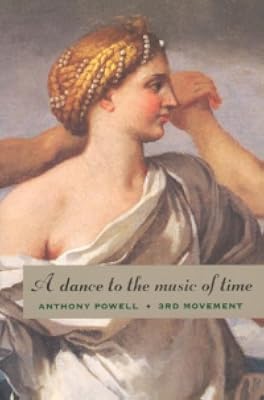








Member Recommendations


Member Reviews
It is well-worn wisdom that the second work in a trilogy, whether film or novel, often allows for some of the most beautiful moments, but also is rarely satisfying on its own, having to carry the plot from the first work while setting up the foundations for the last. There is, as far as I know, no such wisdom regarding the fourth work in a series of twelve, and so I find myself having to make assessments for myself. How thoroughly tiring! And while I settled on four stars, it's a fairly low four stars. As I've said before, Powell's magnum opus is clearly a "great work", but the whole is (by design) greater than the sum of its parts.
We're now in the mid-1930s. Nick Jenkins and his school chums must be around 30. Their lives have show more diverged almost completely: marriages, divorces, career changes, social circles, attitudes political and philosophical. Friends have become enemies, enemies friends. The Jenkins of A Question of Upbringing would no doubt be astonished by which friends he hasn't seen in years (Stringham) and which recur at parties and dinners (Widmerpool). His affair with Jean, hiding in the margins throughout much of The Acceptance World: A Novel, is over, and maturity is setting in.
Powell continues his mosaic-like structure, as Jenkins - reduced here to being a cipher again, after some development in the previous book - journeys through the world of the upper-middle and lower-upper classes. Where it's all going is somehow less important than the experience of taking the tour at all. As is his wont, Powell divides the book into chapters of various social engagements: an overnight stay with a rather bolshie aristocrat, a sort of drop-in dinner hosted by the gregarious Lady Molly, and returns to old haunts.
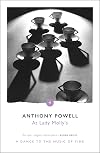
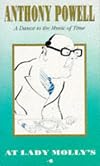
(Tangent: these Flamingo paperback editions, from the early 1980s, are gorgeous, aren't they? The artwork has been returned to by more recent editions, which I'm grateful of. So often classic editions are phased out in favour of more "artistic" renderings, as if literature now can't have an amusing side to it. I'm so glad to have obtained them.)
In truth, Powell's Dance is little more than cultural history, at this point. Much as I doubt that many people outside of Japan have an obsessive love of Noh theatre, I suspect not many people outside of the Anglo diaspora will gain much from this book - and even then! The social cues and miscues that drive the comedic sections of the novel require a fair bit of intuiting (or maybe it's just me: you might know a lot of people who regularly have to be reminded that their brother is no longer known by his old aristocratic-title-that-isn't-his-christian-name, and now goes by that more senior title he inherited). I could figure out that being "in the City" was a good thing, because that meant one worked in banking. But it took me longer to realise that being "in Mincing Lane" wasn't a snide euphemism for being queer, but rather an indication one worked in global trade. The dramatic sections of the novel, largely restricted to Jenkins' growing realisation of how much is lost as we age and change, are more resonant, as those things perhaps are more universal.
As I've commented before, it's unfair of people to call Powell "the English Proust". The two novelists could not be more different, even though they are the two most notable writers of multi-book literary series in which a young man blossoms artistically and personal amid a satirical class-structured social world. For one thing, Proust's greatest work must surely be the first volume of the Search whereas Powell's work only grows in stature as it moves forward. More importantly, though, attempts to adapt Proust rarely fail, precisely because the only character we can truly know in the French work is the unnamed narrator (not Marcel, as I highlight in my reviews, but that's a matter of opinion). The hundreds of Proustian characters are really only perceptions of personhood, attempts by the young man to understand others that inevitably fail because of the gulf between ourselves and those around us. Powell, although he causes plenty of challenges for those who would seek to adapt his works, gives us an everyman narrator who is primarily important as an entrée into the world of these other characters. They may evolve and change over the books, but when we see them, we are given a much more unvarnished, much less ethereal viewpoint.
So, At Lady Molly's. It's probably my favourite of the series thus far. I remain a little perplexed by the heavy focus on Widmerpool; an amusing character, but to me not as interesting as Peter, Charles, or Jean. He's that slightly silly type of priggish schoolboy whose morbidly funny attempts to understand the world make for good reading, but who nevertheless surprises as a centrepiece. Nevertheless, the combination of Powell's maturation as a writer and the fleshing-out of the characters after four novels, make this a welcome read. I would like to continue at a rate of one book a year, because the experience of only partially remembering a character is actually an asset here, replicating as it does Jenkins' own experience! But I feel that my patience may be wearing away with my desire to see things through.
(Tangent #2: As well as reading the novels, I have subsequently been listening to two separate recordings that have helped cement the narrative in my brain. First, Simon Vance's fantastic complete recording for Audible - what an achievement! And second, a now-obscure BBC radio adaptation from 1979-82, which I managed to find in occasionally patchy condition. Both worth seeking out!)
What lies ahead? The War, evidently. Characters here discuss their views on Nazism and imperialism in ways that feel thoroughly natural, reminding us of the multiplicity of views (and the limited capability of mass media) in the 1930s that allowed evil to progress so far on the continent. It appears marriage and perhaps children will be weighing more heavily in upcoming volumes. And, I hope, a little more on art and culture - subjects pivotal to the first three novels but which were sidelined here to allow for the near-complete focus on social interaction.
But I suppose that's how life works, right? People, hobbies, locations, attitudes, even our lives themselves - they exist at the whim of society and time, and that, I think, is Powell's message. show less
We're now in the mid-1930s. Nick Jenkins and his school chums must be around 30. Their lives have show more diverged almost completely: marriages, divorces, career changes, social circles, attitudes political and philosophical. Friends have become enemies, enemies friends. The Jenkins of A Question of Upbringing would no doubt be astonished by which friends he hasn't seen in years (Stringham) and which recur at parties and dinners (Widmerpool). His affair with Jean, hiding in the margins throughout much of The Acceptance World: A Novel, is over, and maturity is setting in.
Powell continues his mosaic-like structure, as Jenkins - reduced here to being a cipher again, after some development in the previous book - journeys through the world of the upper-middle and lower-upper classes. Where it's all going is somehow less important than the experience of taking the tour at all. As is his wont, Powell divides the book into chapters of various social engagements: an overnight stay with a rather bolshie aristocrat, a sort of drop-in dinner hosted by the gregarious Lady Molly, and returns to old haunts.
(Tangent: these Flamingo paperback editions, from the early 1980s, are gorgeous, aren't they? The artwork has been returned to by more recent editions, which I'm grateful of. So often classic editions are phased out in favour of more "artistic" renderings, as if literature now can't have an amusing side to it. I'm so glad to have obtained them.)
In truth, Powell's Dance is little more than cultural history, at this point. Much as I doubt that many people outside of Japan have an obsessive love of Noh theatre, I suspect not many people outside of the Anglo diaspora will gain much from this book - and even then! The social cues and miscues that drive the comedic sections of the novel require a fair bit of intuiting (or maybe it's just me: you might know a lot of people who regularly have to be reminded that their brother is no longer known by his old aristocratic-title-that-isn't-his-christian-name, and now goes by that more senior title he inherited). I could figure out that being "in the City" was a good thing, because that meant one worked in banking. But it took me longer to realise that being "in Mincing Lane" wasn't a snide euphemism for being queer, but rather an indication one worked in global trade. The dramatic sections of the novel, largely restricted to Jenkins' growing realisation of how much is lost as we age and change, are more resonant, as those things perhaps are more universal.
As I've commented before, it's unfair of people to call Powell "the English Proust". The two novelists could not be more different, even though they are the two most notable writers of multi-book literary series in which a young man blossoms artistically and personal amid a satirical class-structured social world. For one thing, Proust's greatest work must surely be the first volume of the Search whereas Powell's work only grows in stature as it moves forward. More importantly, though, attempts to adapt Proust rarely fail, precisely because the only character we can truly know in the French work is the unnamed narrator (not Marcel, as I highlight in my reviews, but that's a matter of opinion). The hundreds of Proustian characters are really only perceptions of personhood, attempts by the young man to understand others that inevitably fail because of the gulf between ourselves and those around us. Powell, although he causes plenty of challenges for those who would seek to adapt his works, gives us an everyman narrator who is primarily important as an entrée into the world of these other characters. They may evolve and change over the books, but when we see them, we are given a much more unvarnished, much less ethereal viewpoint.
So, At Lady Molly's. It's probably my favourite of the series thus far. I remain a little perplexed by the heavy focus on Widmerpool; an amusing character, but to me not as interesting as Peter, Charles, or Jean. He's that slightly silly type of priggish schoolboy whose morbidly funny attempts to understand the world make for good reading, but who nevertheless surprises as a centrepiece. Nevertheless, the combination of Powell's maturation as a writer and the fleshing-out of the characters after four novels, make this a welcome read. I would like to continue at a rate of one book a year, because the experience of only partially remembering a character is actually an asset here, replicating as it does Jenkins' own experience! But I feel that my patience may be wearing away with my desire to see things through.
(Tangent #2: As well as reading the novels, I have subsequently been listening to two separate recordings that have helped cement the narrative in my brain. First, Simon Vance's fantastic complete recording for Audible - what an achievement! And second, a now-obscure BBC radio adaptation from 1979-82, which I managed to find in occasionally patchy condition. Both worth seeking out!)
What lies ahead? The War, evidently. Characters here discuss their views on Nazism and imperialism in ways that feel thoroughly natural, reminding us of the multiplicity of views (and the limited capability of mass media) in the 1930s that allowed evil to progress so far on the continent. It appears marriage and perhaps children will be weighing more heavily in upcoming volumes. And, I hope, a little more on art and culture - subjects pivotal to the first three novels but which were sidelined here to allow for the near-complete focus on social interaction.
But I suppose that's how life works, right? People, hobbies, locations, attitudes, even our lives themselves - they exist at the whim of society and time, and that, I think, is Powell's message. show less
This feels different in tone to some of the earlier books. In it we meet both an eccentric, socialist member of the aristocracy and his sister, who Nick claims he'll marry. It seems to mark a bit of a turning point and while we have the parties and the goings on of the upper class, we also hear, for the first time, rumblings of war and the sense that in a few books time we'll loose several of these characters. Meeting Isabel also shifts the tone, it seems to settle Nick down a bit, makes him feel a bit more grounded. Feels a lot like we're entering a different phase and that there are storm clouds ahead - we wonder how they will weather them.
And so the saga continues. This felt more like a series of chapters in the larger story than necessarily its own book, but no complaints. Again, part of the charm is that not much happens, but just enough that i really want to know what happens next! I think what i like best is that i always feel i can relate to the narrator, Nick Jenkins, in his role as observer in a slightly crazy world full of even crazier people. As a relatively non-judgmental observer, we are definitely getting the feeling of the times. Looking forward to the next....oh......and i just found out there was a miniseries produced of this 12-volume epic....that is also something to look forward to!
I really enjoyed this one. I found it quite funny and there are plenty of well-drawn characters. The characteristic blend of humour and poignancy is still there.
Perhaps the most forgettable, for me, of the four volumes so far.Having nearly completed two more memorable volumes since finishing this one off, I had to go back to the web to remind myself of exactly what took place.
Marriage is in the air for a few key characters and Nick reflects on that quite a bit. There’s also a fairly dramatic dissolution of a marriage as well.
Overall however, this is more about discussions between characters than events that occur. There are long stretches of conversation over dinner which involve art, literature and politics to a lesser extent.
This is definitely an essential novel in the series, but it’s not a stand out episode by any means.
Marriage is in the air for a few key characters and Nick reflects on that quite a bit. There’s also a fairly dramatic dissolution of a marriage as well.
Overall however, this is more about discussions between characters than events that occur. There are long stretches of conversation over dinner which involve art, literature and politics to a lesser extent.
This is definitely an essential novel in the series, but it’s not a stand out episode by any means.
I enjoy how Widmerpool is kind of essential character in this, as he is in most of the books, but he doesn't really have that many lines in the book! It's kind of more about him than him. I don't know what can you say? These books are incredible.
The fourth book in a Dance to the Music of Time. Jenkins gets engaged, Widmerpool gets disengaged, much marital manoeuvring takes place. This book brings into focus the Tollands and Sleafords, rambling families living rambling lives, while other characters come drifting in and out of view from previous close ups. At Lady Molly's ends with a wonderful juxtaposition of the Jungian analysis of 80 year old General Conyers, equerry and unexpected polymath, with the unsinkability of the 'intuitive extravert' Widmerpool. A stately comedy.
Members
- Recently Added By
Lists

Time Magazine's "All-Time 100"
113 works; 15 members

1,001 BYMRBYD Concensus
723 works; 27 members
Talk Discussions
Past Discussions
A Dance to the Music of Time GR 2013 - April: At Lady Molly's in 75 Books Challenge for 2013 (May 2013)
Author Information

61+ Works 13,440 Members
Anthony Powell was born on December 21, 1905 in Westminster, England and was educated at Eton College and Balliol College, Oxford. In 1926 he became an editor at Duckworth & Co. and later moved on to be a scriptwriter for Warner Brothers. By 1937 he was a regular contributor to The Spectator and the Daily Telegraph. From 1953-1959 Powell was the show more Literary Editor of Punch. His first book, The Barnard Letter, was published in 1928 and his first novel, Afternoon Men, was published in 1931. In 1951 Powell published A Question of Upbringing, which was the first of the 12-novel sequence A Dance to the Music of Time. In 1975 he published Hearing Secret Harmonies, which was the last novel of the sequence. Powell wrote Infants of the Spring, which is part of To Keep the Ball Rolling, his memoirs. He also published The Fisher King in 1986. Anthony Powell died peacefully at his home, The Chantry, aged 94 on March 28, 2000. (Bowker Author Biography) show less
Some Editions
Awards and Honors
Awards
Series

Work Relationships
Is contained in
Has as a reference guide/companion
Common Knowledge
- Canonical title
- At Lady Molly's
- Original title
- At Lady Molly's
- Original publication date
- 1957
- People/Characters
- Nicholas Jenkins; General Conyers; Mildred Blaides; Lady Molly Jeavons; Kenneth Widmerpool
- First words
- We had known General |Conyers immemorially not because my father had ever served under him but through some long-forgotten connexion with my mother's parents.
- Last words
- (Click to show. Warning: May contain spoilers.)"I have thought about the subject a good deal, and you are always welcome to my views."
- Original language*
- Engels
*Some information comes from Common Knowledge in other languages. Click "Edit" for more information.
Classifications
Statistics
- Members
- 573
- Popularity
- 51,410
- Reviews
- 14
- Rating
- (3.81)
- Languages
- 6 — Dutch, English, Finnish, French, German, Italian
- Media
- Paper, Ebook
- ISBNs
- 21
- ASINs
- 25