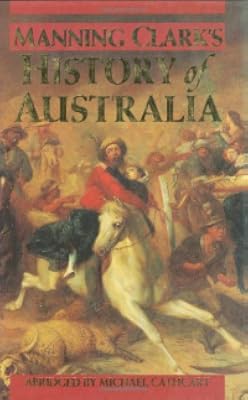
A History of Australia, complete and unabridged, Vol. 1-6
by Manning Clark
A History of Australia (Complete)
On This Page
Description
Written with young readers in mind, this lively, lucid account of Australia and its people begins with the geographic shaping of the continent millions of years ago and continues to the present day. Here is the fascinating story of a land inhabited sincethe Ice Ages by Aboriginal tribes, a land which remained undiscovered by the rest of the world until the birth of the industrial age, when European settlement reshaped it in political and social terms. Original sources are used to highlight show more episodes that will especially appeal to young readers: we hear the voices of Aborigines bewildered by the advent of the Europeans, and of those who made the perilous journey across the world in sailing ships ... We share the weariness of explorers trudging towards a far horizon, and the elation of a lucky gold-digger ... We storm the heights at Gallipoli alongside the Anzacs, and realise what it must have been like to go hungry during the Great Depression, or to fight in the Jungles of New Guinea ... This history, a distinguished collaboration between Manning Clark and Meredith Hooper is lavishly decorated throughout in colour and black-and-white by Susanne Ferrier, whose illustrations perfectly complement the text and give the book an extra, vivid dimension of sheer visual enjoyment. History of Australia is a book to be shared, appreciated and enjoyed by all those eager to discover the story of this great new country. show lessTags
Recommendations















Member Reviews
I care a lot for Clark's six-volume History, which I'm reading seriously and completely for the first time since I was young. Clark is the original wordy, mothball-smelling professor, with so much knowledge and so many thoughts bursting out that he is not afraid of any tangent, or of potentially boring the passer-by. His style is distinctive, and not for everyone, and even then he's not especially interested in worrying about the reader wants so much as in what he thinks they need. And I love him for it.
Here, Clark explores the first fifty years after Captain Cook stumbled across Australia, with a worthy prologue examining other passing exchanges between Europeans and the Great Southern Continent, and thoughts on why the landmass had show more not previously been conquered by the warring Asian and Muslim nations and groups who had fought on the other side of the Torres Strait.
Clark's history is often angry, astounded even by the utterly cruel treatment of convicts, the Indigenous, and those who dared to be different or to advocate for equality rather than aristocracy. (Within mere years of Europeans colonising a small part of Australia, there is a growing self-declared nobility who want to make sure few others have access to what they have.) Conservatives live to point out areas where Clark becomes more of a novelist than an historian, or where he lets his own bugbears get the better of him. But that is part of why I enjoy Clark. He is pinning history to a narrative to create an understanding of how we got to where we were in 1788, and from there to the present day. Clark's history should by no means be taken as the definitive source text on Australia, but then neither should Geoffrey Blainey's admired History which - for all its merits - seeks to excuse earlier behaviour on the grounds that "people back then thought a certain way", while Clark seeks to explain it... and also perhaps ask the thornier question: if there were people (including women and Indigenous Australians) who thought a different way, can we fully excuse those who didn't listen? (The same question touches us when we talk about the early Anglo-Americans and their slave ownership, or for that matter modern Australians who argue harsh penalties for refugees fleeing war and terror. If others are making vocal cases in support of these dispossessed groups, how much can we excuse the ignorance of those who make the opposite case? How will history judge them?)
Clark has three great strengths. First, his extensive research. The historian was known for his in-depth analysis of source texts of Australia's first century under European rule, and here he has immaculately combed the archives to present a more well-rounded picture of the early Australia than most novelists or pop historians can hope to offer. Second, his sharp, bitter irony. Clark prefers not to use quotation marks, instead to immerse us in the ways of thinking of his protagonists. This can occasionally be confronting to the casual reader I'm sure (to hear descriptions of "savages" and the like, not to mention those dastardly Catholics!) but creates a world in which, as we come to understand why early settlers - especially white Protestant men - acted the way they did, we also grasp how their world, like any world, was a mostly closed system of thought, indoctrinating a way of thinking that most could not escape from no matter what evidence was presented. (We are all like that, whether redneck or hipster, and let's not forget it.) Clark's conservative enemies like to seize upon this irony as bias, but it should be noted that the historian treats everyone with the same barbed brush. No-one escapes his ravenlike abilities of observation and dissection.
And, thirdly, Manning Clark's strength is in his description. This book, with its appendices of populations and landholders, positively reeks of late 18th century Australia. One comes away with a deep appreciation of what life was like in the Colony of New South Wales between 1788 and 1830, the people, the determination, the bustle, the smell, the fervour, the plotting, and the uncertainties, cultural and otherwise.
A vital history of a young country that is still discovering what our future is supposed to be, and how we can reckon with a past that threatens to overwhelm our present. show less
Here, Clark explores the first fifty years after Captain Cook stumbled across Australia, with a worthy prologue examining other passing exchanges between Europeans and the Great Southern Continent, and thoughts on why the landmass had show more not previously been conquered by the warring Asian and Muslim nations and groups who had fought on the other side of the Torres Strait.
Clark's history is often angry, astounded even by the utterly cruel treatment of convicts, the Indigenous, and those who dared to be different or to advocate for equality rather than aristocracy. (Within mere years of Europeans colonising a small part of Australia, there is a growing self-declared nobility who want to make sure few others have access to what they have.) Conservatives live to point out areas where Clark becomes more of a novelist than an historian, or where he lets his own bugbears get the better of him. But that is part of why I enjoy Clark. He is pinning history to a narrative to create an understanding of how we got to where we were in 1788, and from there to the present day. Clark's history should by no means be taken as the definitive source text on Australia, but then neither should Geoffrey Blainey's admired History which - for all its merits - seeks to excuse earlier behaviour on the grounds that "people back then thought a certain way", while Clark seeks to explain it... and also perhaps ask the thornier question: if there were people (including women and Indigenous Australians) who thought a different way, can we fully excuse those who didn't listen? (The same question touches us when we talk about the early Anglo-Americans and their slave ownership, or for that matter modern Australians who argue harsh penalties for refugees fleeing war and terror. If others are making vocal cases in support of these dispossessed groups, how much can we excuse the ignorance of those who make the opposite case? How will history judge them?)
Clark has three great strengths. First, his extensive research. The historian was known for his in-depth analysis of source texts of Australia's first century under European rule, and here he has immaculately combed the archives to present a more well-rounded picture of the early Australia than most novelists or pop historians can hope to offer. Second, his sharp, bitter irony. Clark prefers not to use quotation marks, instead to immerse us in the ways of thinking of his protagonists. This can occasionally be confronting to the casual reader I'm sure (to hear descriptions of "savages" and the like, not to mention those dastardly Catholics!) but creates a world in which, as we come to understand why early settlers - especially white Protestant men - acted the way they did, we also grasp how their world, like any world, was a mostly closed system of thought, indoctrinating a way of thinking that most could not escape from no matter what evidence was presented. (We are all like that, whether redneck or hipster, and let's not forget it.) Clark's conservative enemies like to seize upon this irony as bias, but it should be noted that the historian treats everyone with the same barbed brush. No-one escapes his ravenlike abilities of observation and dissection.
And, thirdly, Manning Clark's strength is in his description. This book, with its appendices of populations and landholders, positively reeks of late 18th century Australia. One comes away with a deep appreciation of what life was like in the Colony of New South Wales between 1788 and 1830, the people, the determination, the bustle, the smell, the fervour, the plotting, and the uncertainties, cultural and otherwise.
A vital history of a young country that is still discovering what our future is supposed to be, and how we can reckon with a past that threatens to overwhelm our present. show less
A delicate 4 stars.
Manning Clark's mammoth history of Australia charts the country from 1770 to 1935, from the arrival of the first tall ships to the slow descent into War that would force Australia into the modern era. One must, however, take Clark on his terms if one is to enjoy him at all. In the style of the "New Journalism", his is a literary, rhetorical, deeply partisan exploration of the past, lovingly researched but fiercely angry about a history of hypocrisy, oppression, and small-mindedness.
Volume V provides Clark with rich meat to feed upon. 1888, the year of Australia's centenary, is also the period in which nascent feminist and Labor (sic) movements begin to make themselves known. It is an era in which the first generation show more of Australian-born writers and artists attempt (often in vain) to make native forms of art. The 1890s is a period of dizzying politics as states and political parties fight for or against federation of the states, which finally takes place in 1901. With the death of Queen Victoria, the invention of the motorcar and the cinema, and new labour laws, life in Australia begins to change and diversify. And the excesses of the first years of the 20th century are to reach their peak with the horrors of the First World War, and the disastrous Gallipoli campaign.
Clark was well aware of the flaws of the "Great Man" view of history, but perhaps because of the subject matter, this volume is more focused on those at the top than ever before. This is a little frustrating, but Clark is especially insightful in his reflections on political matters. The hatred between Christian sects, which dominated the 19th century in Australia, is now replaced by a shared sense of racial fear. Interesting to hear from all of our early Prime Ministers, the "Founding Fathers" if you must, pure, undying support of the White Australia policy. The absurdity of Australia's participation in the Boer War campaign is given broad coverage, and Clark reserves his greatest censure for the Australian-born British sympathisers, who saw themselves as members of the Empire first, and citizens of the Great Southern Continent second.
But of course, what politicians endorse are (typically) only the deeply-held beliefs of the populace at large. Underpinning Australian culture in this era is a powerful cultural debate over whether the country's differences to the motherland are its strengths or its weaknesses. That sense of isolation bolsters the fear of the non-white, the concern about an invasion, whether militarily or by population growth, from those on the Asian and African continents. An eerie version of our current era, like a funhouse mirror, in which the Australians are keenly nationalistic about all the wrong things, while feeling viscerally uncomfortable about all the positive things their nation has to offer.
Clark was born in 1915 (he makes discreet reference to his pregnant mother in the closing chapters), but for most of us in 2020 those years seem so very distant. Yet they really are not. My great-grandparents were all teenagers when Clark was born, their values and beliefs shaped irrevocably their era, and these same values were those passed down to my grandparents, whose generation still looms large over our cultural values and shape our policies.
A reader of Australian history who only looks to Manning Clark would be a fool; a reader who seeks to understand it without him is surely lost. show less
Manning Clark's mammoth history of Australia charts the country from 1770 to 1935, from the arrival of the first tall ships to the slow descent into War that would force Australia into the modern era. One must, however, take Clark on his terms if one is to enjoy him at all. In the style of the "New Journalism", his is a literary, rhetorical, deeply partisan exploration of the past, lovingly researched but fiercely angry about a history of hypocrisy, oppression, and small-mindedness.
Volume V provides Clark with rich meat to feed upon. 1888, the year of Australia's centenary, is also the period in which nascent feminist and Labor (sic) movements begin to make themselves known. It is an era in which the first generation show more of Australian-born writers and artists attempt (often in vain) to make native forms of art. The 1890s is a period of dizzying politics as states and political parties fight for or against federation of the states, which finally takes place in 1901. With the death of Queen Victoria, the invention of the motorcar and the cinema, and new labour laws, life in Australia begins to change and diversify. And the excesses of the first years of the 20th century are to reach their peak with the horrors of the First World War, and the disastrous Gallipoli campaign.
Clark was well aware of the flaws of the "Great Man" view of history, but perhaps because of the subject matter, this volume is more focused on those at the top than ever before. This is a little frustrating, but Clark is especially insightful in his reflections on political matters. The hatred between Christian sects, which dominated the 19th century in Australia, is now replaced by a shared sense of racial fear. Interesting to hear from all of our early Prime Ministers, the "Founding Fathers" if you must, pure, undying support of the White Australia policy. The absurdity of Australia's participation in the Boer War campaign is given broad coverage, and Clark reserves his greatest censure for the Australian-born British sympathisers, who saw themselves as members of the Empire first, and citizens of the Great Southern Continent second.
But of course, what politicians endorse are (typically) only the deeply-held beliefs of the populace at large. Underpinning Australian culture in this era is a powerful cultural debate over whether the country's differences to the motherland are its strengths or its weaknesses. That sense of isolation bolsters the fear of the non-white, the concern about an invasion, whether militarily or by population growth, from those on the Asian and African continents. An eerie version of our current era, like a funhouse mirror, in which the Australians are keenly nationalistic about all the wrong things, while feeling viscerally uncomfortable about all the positive things their nation has to offer.
Clark was born in 1915 (he makes discreet reference to his pregnant mother in the closing chapters), but for most of us in 2020 those years seem so very distant. Yet they really are not. My great-grandparents were all teenagers when Clark was born, their values and beliefs shaped irrevocably their era, and these same values were those passed down to my grandparents, whose generation still looms large over our cultural values and shape our policies.
A reader of Australian history who only looks to Manning Clark would be a fool; a reader who seeks to understand it without him is surely lost. show less
See my review of Volume I. A favourite - a wordy, impassioned, wonderfully argumentative history. The second volume covers the histories of New South Wales and Van Diemen's Land from the start of the 1820s to the country's fiftieth anniversary in 1838, with a strong focus on the battles taking place: Protestant vs Catholic; white vs black; wealthy vs poor; free vs convict; and always, always, always old vs new... even when the "old" are still first generation immigrants themselves!
Some things never change.
Some things never change.
Ratings
Members
- Recently Added By
Lists

Works Cited in The Life and Death of Democracy by John Keane
278 works; 1 member
Author Information

43+ Works 1,569 Members
Awards and Honors
Notable Lists
Series

Work Relationships
Contains
Is abridged in
Has as a commentary on the text
Common Knowledge
- Canonical title
- A History of Australia, complete and unabridged, Vol. 1-6
- Important places
- Australia
- Original language
- English
- Disambiguation notice
- DO NOT combine the part with the whole. Vol. 1 is not the same thing as Vol. 2 which is not the same as Vol. 3, Vol. 4, Vol. 5, Vol. 6, abridged edition, or complete Vol. 1-6.
Classifications
Statistics
- Members
- 145
- Popularity
- 225,624
- Reviews
- 3
- Rating
- (3.50)
- Languages
- English, German
- Media
- Paper
- ISBNs
- 7