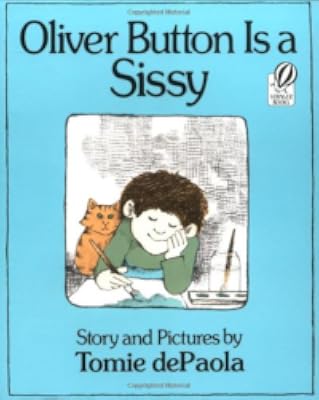
Oliver Button Is a Sissy
by Tomie dePaola
On This Page
Description
His classmates' taunts don't stop Oliver Button from doing what he likes best.Tags
Recommendations
Member Reviews
I really enjoyed this book for many reasons. I like how it went against stereotypes of boys and showed that not all boys have to do manly things. I enjoyed the main character, Oliver, and how he did not let other peoples nagging him change the way he was. He was called a sissy over and over again but he never changed; he continued to go to dance school every week and practiced and practiced. I also enjoyed the plot because a lot of the time when kids are bullied, they try to form to how society wants them to become, but Oliver never let all the bullying get to him. Also, when he did not win his dance recital, he still knew he was a star because he did something not a lot of boys could of done. I think the message of this book was that show more no matter what gender you are, do not ever quit something just because people don’t agree with it. Stick with you passion and what makes you happy and you will feel great about yourself. show less
Oliver Button gets labeled a sissy in this picture book from author/illustrator Tomie dePaola because he enjoys activities—jumping rope by himself, reading books and drawing pictures, playing with paper dolls and dressing up in costumes—considered less-than-masculine by his peers, and even his father. When he declares that he likes to dance, his parents give him lessons, and soon he's tapping up a storm. This leads to further name-calling, until the town talent show demonstrates what an amazing dancer Oliver is...
Originally published in 1979, and then republished in a new edition in 2017, Oliver Button Is a Sissy was a ground-breaking picture book, similar to Charlotte Zolotow and William Pène du Bois's 1972 William's Doll, that show more challenged assumptions about gender and play in young children, depicting young boys who enjoyed activities outside those traditionally assigned to children of their sex. Given that dePaola was artistically inclined from a young age, it's tempting to believe there is a large dose of autobiography here. In any case, I found the story engaging, and the artwork appealing in that trademark dePaola way. Recommended to those seeking children's books which encourage acceptance of a wide range of play activities for all children, regardless of gender or sex. show less
Originally published in 1979, and then republished in a new edition in 2017, Oliver Button Is a Sissy was a ground-breaking picture book, similar to Charlotte Zolotow and William Pène du Bois's 1972 William's Doll, that show more challenged assumptions about gender and play in young children, depicting young boys who enjoyed activities outside those traditionally assigned to children of their sex. Given that dePaola was artistically inclined from a young age, it's tempting to believe there is a large dose of autobiography here. In any case, I found the story engaging, and the artwork appealing in that trademark dePaola way. Recommended to those seeking children's books which encourage acceptance of a wide range of play activities for all children, regardless of gender or sex. show less
This was one of my favorite read alouds when I taught first and second grade. I'd even consider reading or recommending it to older children. The main theme is accepting someone for who and what they are, and not pigeonholing people into gender stereotypes. There is also bullying in the story. We meet Oliver Button, a young boy who loves to dance, paint and do other atypical boy things. But dancing is for girls, everyone tells him. Oliver gets picked on, but it does not deter him from showing off his skills at the school talent show. He finally gains acceptance and the story ends happily. I truly believe that most predudice and bias emanates from lack of education. The sooner that young children learn that boys can dance and girls can show more play football or any other boy-typical sport, the better off society will be. This is a sweet and uplifting story that can spur many good classroom discussions about acceptance and the aforementioned topics. show less
I like this book because it shows how misleading stereotypes can be. It is the story of a young boy who likes to dance. Throughout the story, perspectives begin to change and people begin to realize that boys can do things girls can do and vice verse. I like that it teaches kids that they can be anything they want to be.
I would probably use this book for 1-2 grades.
I would probably use this book for 1-2 grades.
I liked reading to book because of the changing perspectives throughout the story and the message that the story sends. First, I liked how the father’s perspective changes throughout the course of the story. For example, the story begins with Oliver Button’s father calling him a “sissy” like everyone else, but slowly his father begins to accept his dancing and by the end of the story his father fully embraces his dancing. Secondly, I like that Oliver Button loses the talent show which shows children that it is not always about winning and you will not win at everything in life. The main message of this story is that it is not always about winning everything sometimes it is just enough to accepted and loved by your family.
I put this on my LGBTQ shelf even though the boy isn't necessarily gay. He's just into dancing, so the other boys call him a sissy (and his dad isn't too thrilled with his choice of hobbies, either). The story is a kind of roller coaster of sad and happy (kids are jerks: boo! his mom is awesome: yea!), but the message is simple--just do what you love and hope that people get over it.
The thing i found most interesting about this book, is the fact that it was written in the 70's. The issue of accepting people for who they are is not a new concept, I just thought it was interesting that someone was interested enough to challenge gender roles in the 70's. The great thing about this book is character development. Oliver stays true to himself throughout the whole book. His peers and his father are the characters that change. Oliver likes to play with paper dolls, draw, and read. His peers at school make fun of him by writing :"Oliver Button is a sissy" all over the school hallways. This does not discourage Oliver though. His father does not really support him either, but relents and lets him take dance classes. Oliver show more practices dance and even preforms in the talent show. Although he does not win, when he returns to school, his peers have crossed out the word "sissy" and replaced it with "star"! Even Oliver's father is proud of him. I think this is a great lesson for children, and adults honestly, to learn. Accept people for who they are, weather it be your friend, your sibling, or your child. show less
Members
- Recently Added By
Lists

Written and Illustrated By
805 works; 1 member
Author Information

243+ Works 98,789 Members
Tomie dePaola was born in Meriden, Connecticut on September 15, 1934. He received a B.F.A. from Pratt Institute in 1956, a M.F.A. from California College of Arts and Crafts in 1969, and a doctoral equivalency from Lone Mountain College in 1970. He has written and/or illustrated more than 270 books including 26 Fairmount Avenue, Strega Nona, Meet show more the Barkers, Nana Upstairs and Nana Downstairs, and Oliver Button Is a Sissy. He has received numerous awards for his work including the Caldecott Honor Award, the Newbery Honor Award and the New Hampshire Governor's Arts Award of Living Treasure. His murals and paintings can be seen in many churches and monasteries throughout New England. He has designed greeting cards, magazine and record album covers, and theater sets. His work is shown in galleries and museums. Tomie dePaola died on March 30, 2020 because of complications he had from surgery after a fall. (Bowker Author Biography) show less
Awards and Honors
Awards
Common Knowledge
- Canonical title
- Oliver Button Is a Sissy
- Original title
- Oliver Button Is a Sissy
- Original publication date
- 1979
- People/Characters
- Oliver Button
- Dedication
- To Flossie
- First words
- Oliver Button was called a sissy.
- Last words
- (Click to show. Warning: May contain spoilers.)Then he noticed the school wall.
- Original language
- English
Classifications
Statistics
- Members
- 1,122
- Popularity
- 22,655
- Reviews
- 25
- Rating
- (4.06)
- Languages
- Catalan, English, Portuguese, Spanish
- Media
- Paper, Ebook
- ISBNs
- 23
- ASINs
- 7