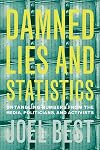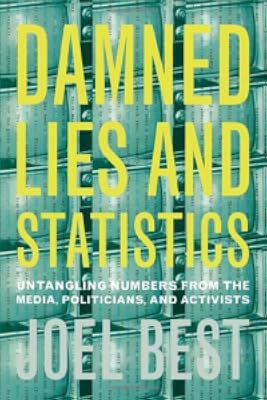
Damned Lies and Statistics: Untangling Numbers from the Media, Politicians, and Activists
by Joel Best
On This Page
Description
Here, by popular demand, is the updated edition to Joel Best's classic guide to understanding how numbers can confuse us. In his new afterword, Best uses examples from recent policy debates to reflect on the challenges to improving statistical literacy. Since its publication ten years ago, Damned Lies and Statistics has emerged as the go-to handbook for spotting bad statistics and learning to think critically about these influential numbers.Tags
Recommendations





Member Recommendations
PuddinTame Daniel J. Levitan particularly recommended this book in his own.
Member Reviews
Statistics are constructed not discovered. It is people that create statistics, consequently statistics are coloured by the worldview of the constructor. There is no such thing as a neutral statistic. This book provides ample evidence that statistics are the products of social activity. Joel Best, a professor of sociology and criminal justice, has produced a readable and informative book. He draws upon statistics from many walks of life to illustrate his points.
Those who create statistics want to prove something. Best, shows how by asking key questions we can help expose these underlying perspectives:
Who created the statistic?
Why was this statistic created?
How was the statistic created?
Best deals with key issues such as the source of show more bad statistics: bad guesses, descriptive definitions, confusing questions and biased samples; mutant statistics: the ways in which good statistics can be mangled, misused and misunderstood; and the problems of statistical comparison. It requires no background in maths or statistics. It will help readers be more critical in their acceptance of statistical data. show less
Those who create statistics want to prove something. Best, shows how by asking key questions we can help expose these underlying perspectives:
Who created the statistic?
Why was this statistic created?
How was the statistic created?
Best deals with key issues such as the source of show more bad statistics: bad guesses, descriptive definitions, confusing questions and biased samples; mutant statistics: the ways in which good statistics can be mangled, misused and misunderstood; and the problems of statistical comparison. It requires no background in maths or statistics. It will help readers be more critical in their acceptance of statistical data. show less
This is a book about the social context surrounding the creation and dissemination of social statistics. It is in no way a book about the mathematical discipline of statistics, which is generally applied in textbooks to widgets, not people. Interestingly, the word statistics is derived from the word state, "statists" were people who collected and analyzed data about the state. Eventually, we get statisticians who may collect and analyze data about just about anything.
The book discusses the motivations behind the creation of statistics in a fairly un-judgmental way, avoiding laying too much stress on the cynical presentation of statistics for the purpose of propaganda.
The book discusses some approaches to statistics that one can take; show more the first question to ask is "Is that even possible?" It discusses the many things that influence the collection of data. "Organizational practices" are a big factor; if more and more doctors diagnose a child as autistic does that mean that autism is on the rise or just that diagnoses are on the rise?
The statement "suicide is the second leading cause of death among adolescents" is easily satisfied by making the leading cause of death be "not-suicide", so long as at least one adolescent does commit suicide. Not such a useful statistic that one.
Tactics in statistics construction are broadening or narrowing the definition, talking about the "dark figure" (the unreported instances), asking a series of possibly leading questions and yet summarizing all the answers into a single "yes" or "no" response and biased sampling.
Errors in statistics dissemination are transformation of the meaning of a statistic and doing misguided computations, often using possibly wildly incorrect values as inputs. The author calls these sorts of errors mutant statistics.
Comparisons of different values may very well be meaningless when they end up comparing apples and oranges by using different measures, using the same measure at different times, using different definitions, failing to account for differing organizational practices, comparing different populations, and so forth.
In his last chapter but one the author describes several instances of arguments around and about statistics and the construction of different statistics by the opposing parties in the argument to support their side.
A well written, thoughtful book. My new best answer to the quotation of a statistic by anyone will simply be that I need to discover the origin and methodology of the statistic before I can make any comment; unless, of course, the statistic is utterly crazy, like the one with which the author begins the book. Then, I can just cut to the chase. show less
The book discusses the motivations behind the creation of statistics in a fairly un-judgmental way, avoiding laying too much stress on the cynical presentation of statistics for the purpose of propaganda.
The book discusses some approaches to statistics that one can take; show more the first question to ask is "Is that even possible?" It discusses the many things that influence the collection of data. "Organizational practices" are a big factor; if more and more doctors diagnose a child as autistic does that mean that autism is on the rise or just that diagnoses are on the rise?
The statement "suicide is the second leading cause of death among adolescents" is easily satisfied by making the leading cause of death be "not-suicide", so long as at least one adolescent does commit suicide. Not such a useful statistic that one.
Tactics in statistics construction are broadening or narrowing the definition, talking about the "dark figure" (the unreported instances), asking a series of possibly leading questions and yet summarizing all the answers into a single "yes" or "no" response and biased sampling.
Errors in statistics dissemination are transformation of the meaning of a statistic and doing misguided computations, often using possibly wildly incorrect values as inputs. The author calls these sorts of errors mutant statistics.
Comparisons of different values may very well be meaningless when they end up comparing apples and oranges by using different measures, using the same measure at different times, using different definitions, failing to account for differing organizational practices, comparing different populations, and so forth.
In his last chapter but one the author describes several instances of arguments around and about statistics and the construction of different statistics by the opposing parties in the argument to support their side.
A well written, thoughtful book. My new best answer to the quotation of a statistic by anyone will simply be that I need to discover the origin and methodology of the statistic before I can make any comment; unless, of course, the statistic is utterly crazy, like the one with which the author begins the book. Then, I can just cut to the chase. show less
Statistics are constructed not discovered. It is people that create statistics, consequently statistics are coloured by the worldview of the constructor. There is no such thing as a neutral statistic. This book provides ample evidence that statistics are the products of social activity. Joel Best, a professor of sociology and criminal justice, has produced a readable and informative book. He draws upon statistics from many walks of life to illustrate his points.
Those who create statistics want to prove something. Best, shows how by asking key questions we can help expose these underlying perspectives:
Who created the statistic?
Why was this statistic created?
How was the statistic created?
Best deals with key issues such as the source of show more bad statistics: bad guesses, descriptive definitions, confusing questions and biased samples; mutant statistics: the ways in which good statistics can be mangled, misused and misunderstood; and the problems of statistical comparison. It requires no background in maths or statistics. It will help readers be more critical in their acceptance of statistical data. show less
Those who create statistics want to prove something. Best, shows how by asking key questions we can help expose these underlying perspectives:
Who created the statistic?
Why was this statistic created?
How was the statistic created?
Best deals with key issues such as the source of show more bad statistics: bad guesses, descriptive definitions, confusing questions and biased samples; mutant statistics: the ways in which good statistics can be mangled, misused and misunderstood; and the problems of statistical comparison. It requires no background in maths or statistics. It will help readers be more critical in their acceptance of statistical data. show less
Short and not very deep book about when to be skeptical of statistics. I think the message could have been given even more briefly: often, statistics are unreliable because of problems of data collection and definition of terms, whether in surveys or in other ways. Because of innumeracy and natural tendencies to accept claims that correspond to our own preexisting inclinations, we too rarely question statistics—even ones that are unbelievable if you think about them for a second, like “over a hundred thousand women die from anorexia in the US each year,” which conflates suffering and dying. Best advocates that we ask ourselves how a particular statistic was created and with what reasons when judging its reliability, because show more neither total cynicism nor total credulity is justified. Maybe a book I’d give a kid in high school. show less
This is a good companion to the classic How to Lie with Statistics, delving into statistical methodologies and how numbers can be distorted, conflated, cherrypicked, confused, and put through "number laundering" by innumerates. Best does a good job of looking over real-world issues and provides clear examples.
This was required reading in a social sciences research class I took in graduate school, but it is not graduate level material. This is a popular science book to explain concepts that are confusing for those who have never studied statistics. Researchers are advised to use an actual statistics textbook to learn how to perform statistical analysis.
Offers advice on how to understand social statistics and how to recognize bad statistics that are sometimes put out by the media, or special interest groups; and presents analyses of a selection of bad statistics.
Members
- Recently Added By
Author Information
26+ Works 941 Members
Joel Best is Professor of Sociology and Criminal Justice at the University of Delaware. He is the author of the best-selling Damned Lies and Statistics, Stat-Spotting, and American Nightmares.
Awards and Honors
Common Knowledge
- Original publication date
- 2001
- Dedication
- For Kathe Lowney
- First words
- The dissertation prospectus began by quoting a statistic--a "grabber" meant to capture the reader's attention.
- Last words
- (Click to show. Warning: May contain spoilers.)When we fail to think critically, the statistics we hear might just as well be magical.
- Blurbers
- Holstein, James; Ben-Yehuda, Nachman; Imber, Jonathan B.; Adler, Patricia; Reuter, Peter
Classifications
- Genres
- Sociology, Nonfiction, General Nonfiction, Politics and Government, Science & Nature
- DDC/MDS
- 303.38 — Society, government, & culture Social sciences, sociology & anthropology Social processes Coordination and control Public opinion
- LCC
- HM535 .B47 — Social sciences Sociology (General) Sociology Theory. Method. Relations to other subjects
- BISAC
Statistics
- Members
- 409
- Popularity
- 76,061
- Reviews
- 7
- Rating
- (3.86)
- Languages
- English
- Media
- Paper, Ebook
- ISBNs
- 9
- ASINs
- 4