On This Page
Description
In 221 B.C. the First Emperor of Qin unified what would become the heart of a Chinese empire whose major features would endure for two millennia. In the first of a six-volume series on the history of imperial China, Lewis highlights the key challenges facing the court officials and scholars who set about governing an empire of such scale and diversity.Tags
Recommendations







Member Reviews
I have never felt so much the dirty, smelly Westerner that I am as while I was reading the opening chapters of this book. While my ancestors were eating chestnuts, probably raw, and fighting a rear-guard action against the unwanted, unnecessary innovation of 'fire', people in China were creating the totalitarian state. That sounds bad, but consider the intellectual leap necessary to organize hundreds of thousands, if not millions, of people into a unified polity. Remarkable stuff.
Those opening chapters really are doozies: on the one hand, structured around themes (geography, military, politics), on the other, giving you just enough information that you'll have an elevator speech about the Qin and Han (Warring states period ends, Qin show more create something like the first empire; it falls apart after the death of the first emperor; the Han win out among the following chaos; they separate themselves from the more horrifying aspects of Qin methods, while taking over enough to keep the empire unified).
And then, like the Chinese empire after the death of the first Qin emperor, the book falls apart. The thematic chapters are no doubt very nice for students looking specifically for information about, e.g., the topography of Chinese market towns. They are not very useful for understanding why things happened when they happened. By intentionally avoiding narrative, Lewis makes it almost impossible to judge the importance of the facts he provides to the reader. Thank heavens for the chronology at the end of the book.
Lewis does a good job avoiding some fashionable nonsense ("Eastern Imperialism is just a projection of Western prejudice"), but swallows a lot of it whole. I can't be the only reader upset that e.g., the Yellow Turban movement, which *Lewis* says was a major cause of the Han dynasty's ultimate fall, gets about two paragraphs of text--whereas merchants get two pages, and a bunch of nonsense theory about how they were subverting the imperial center by selling gooseberries or whatever. Welcome to contemporary academia: actual revolutions or rebellions are ignored; the soi disant subversion of everyday life is always *this close* to instaurating utopia.
Anyway, given how little up to date writing there is on ancient China, you have no option but to read this book, or remain mostly ignorant. And so I'll probably keep reading the series. But this was a real missed opportunity to do the job well. show less
Those opening chapters really are doozies: on the one hand, structured around themes (geography, military, politics), on the other, giving you just enough information that you'll have an elevator speech about the Qin and Han (Warring states period ends, Qin show more create something like the first empire; it falls apart after the death of the first emperor; the Han win out among the following chaos; they separate themselves from the more horrifying aspects of Qin methods, while taking over enough to keep the empire unified).
And then, like the Chinese empire after the death of the first Qin emperor, the book falls apart. The thematic chapters are no doubt very nice for students looking specifically for information about, e.g., the topography of Chinese market towns. They are not very useful for understanding why things happened when they happened. By intentionally avoiding narrative, Lewis makes it almost impossible to judge the importance of the facts he provides to the reader. Thank heavens for the chronology at the end of the book.
Lewis does a good job avoiding some fashionable nonsense ("Eastern Imperialism is just a projection of Western prejudice"), but swallows a lot of it whole. I can't be the only reader upset that e.g., the Yellow Turban movement, which *Lewis* says was a major cause of the Han dynasty's ultimate fall, gets about two paragraphs of text--whereas merchants get two pages, and a bunch of nonsense theory about how they were subverting the imperial center by selling gooseberries or whatever. Welcome to contemporary academia: actual revolutions or rebellions are ignored; the soi disant subversion of everyday life is always *this close* to instaurating utopia.
Anyway, given how little up to date writing there is on ancient China, you have no option but to read this book, or remain mostly ignorant. And so I'll probably keep reading the series. But this was a real missed opportunity to do the job well. show less
So, while it's true that this is kind of a dry monograph, that's almost a virtue, as the author gives you the schematics of how the Qin dynasty differed from the Zhou and the Warring States that preceded them, and how their successors, the Han, compared and contrasted with them. In the last case the answer is not as much as Han propaganda would suggest! The real problem with the Qin is that having created a social machine for total war, the first historic emperor really didn't know how to make peace. While much of this will probably not be news to serious scholars of Chinese history, there was a lot of clarification for me, and I expect to be reading further books in this series.
This is smart but austere survey of the first two dynasties of China, dating from 221 BC to 220 AD. The Qin and Han Dynasties arose from the bedlam of the Warring States, a sort of perpetual civil war which most accounts portray as a military stalemate with mass peasant misery occurring underfoot over a couple hundred years. Nothing novel there, just more of it. This all changed with the Qin who rose from that region to unite the central portion of the mainland which was understood to be somewhat nominal China at the time. This enterprise despite being short-lived, it lasted 15 years, fomented some interesting ideas about political philosophy, an idea called legalsim after the fact. The notion is that humans are mean and lazy and the show more state should restrict their impulses and channel them towards positive outlets, outlets like agriculture and war. This notion caught on, which is really impressive, given that it is 200 BC. There were egalitarian measures along the way about land distribution but these are shot down by the GOP, I mean the wealthy families whose members in government always lean against these propositions. The author is in his spare accounts of these matters, appears to be Foucauldian. He ruminates on the use of space in urban areas and palaces, especially how the Han Emperors preferred to be "hidden or invisible".
Kinship is very saucy in this context. Land inheritance isn't as significant as government appointments in terms of advancement or ambition. One has to grease the wheels somehow. There is a reign of serial gifts which isn't exclusively corruption as it has metaphysical dividends with the ones' ancestors and related vague purgatorial bullshit. The role of women is likewise dorsal and volatile. Mothers, stepmothers and daughters murk about and skew the more conservative patriarchal dynamics. The anecdotes about such made me appreciate my knowledge of Asian action cinema, such has come in handy, finally.
This is an adequate point of departure, though lacking too juicy a bibliography for me personally. I am moving on. show less
Kinship is very saucy in this context. Land inheritance isn't as significant as government appointments in terms of advancement or ambition. One has to grease the wheels somehow. There is a reign of serial gifts which isn't exclusively corruption as it has metaphysical dividends with the ones' ancestors and related vague purgatorial bullshit. The role of women is likewise dorsal and volatile. Mothers, stepmothers and daughters murk about and skew the more conservative patriarchal dynamics. The anecdotes about such made me appreciate my knowledge of Asian action cinema, such has come in handy, finally.
This is an adequate point of departure, though lacking too juicy a bibliography for me personally. I am moving on. show less
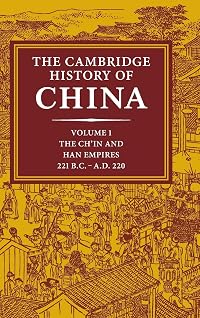
Harvard University Press is to be lauded for starting a reasonably priced competitor series to the Cambridge History of China which at USD 160 targets libraries not individual readers. The first installment written by Stanford's Mark Edward Lewis presents the Qin and Han Empires. In ten easy to read chapters he offers a glimpse into Ancient China. Each chapter is self-contained and develops a theme. This strength is also the major flaw of this work.
First, the omission. Instead of competing with the Cambridge series, Lewis cedes the floor regarding the political history. He devotes a scant 15 pages to present a basic overview of a thousand year period. The beginning of the Eastern Han dynasty (202-87 BC) gets all of four paragraphs. The show more fall of the Han dynasty is wrapped up in the conclusion (sic!). Otherwise, Lewis directs readers to the Cambridge book which is self-defeating. A sound chapter on the political history is a must for such an undertaking. The absence of economic data is also puzzling. Comparing and placing Qin and Han China with other concurrent civilizations would have been interesting (the literature exists).
Secondly, the organization of the individual themes is unclear. He starts well with a funnel (1 Geography, 2 State, 3 Empire, 4 Cities, 5 Rural society) but then chapter 6 The Outer world interrupts the link between chapter 5 and chapter 7 Kinship. A better place for chapter 6 would be after chapter 2 or 3. Chapter 8 to 10 deal with religion, literature and law respectively. A hasty conclusion tries to include the many undiscussed topics (such as the demographic decline and shift, sadly presented without numbers).
Thirdly, the maps need reworking. The chosen graphic style makes it difficult to grasp the meaning of the maps. A better use of hierarchies and timescales could provide major improvements (O, Tufte!).
Overall, I have a mixed feeling about the book. It is a beautifully bound book at a suitable price written by a noted expert who develops interesting themes. If the series continues in this vein, it will, however, not displace the Cambridge series. show less
First, the omission. Instead of competing with the Cambridge series, Lewis cedes the floor regarding the political history. He devotes a scant 15 pages to present a basic overview of a thousand year period. The beginning of the Eastern Han dynasty (202-87 BC) gets all of four paragraphs. The show more fall of the Han dynasty is wrapped up in the conclusion (sic!). Otherwise, Lewis directs readers to the Cambridge book which is self-defeating. A sound chapter on the political history is a must for such an undertaking. The absence of economic data is also puzzling. Comparing and placing Qin and Han China with other concurrent civilizations would have been interesting (the literature exists).
Secondly, the organization of the individual themes is unclear. He starts well with a funnel (1 Geography, 2 State, 3 Empire, 4 Cities, 5 Rural society) but then chapter 6 The Outer world interrupts the link between chapter 5 and chapter 7 Kinship. A better place for chapter 6 would be after chapter 2 or 3. Chapter 8 to 10 deal with religion, literature and law respectively. A hasty conclusion tries to include the many undiscussed topics (such as the demographic decline and shift, sadly presented without numbers).
Thirdly, the maps need reworking. The chosen graphic style makes it difficult to grasp the meaning of the maps. A better use of hierarchies and timescales could provide major improvements (O, Tufte!).
Overall, I have a mixed feeling about the book. It is a beautifully bound book at a suitable price written by a noted expert who develops interesting themes. If the series continues in this vein, it will, however, not displace the Cambridge series. show less
Like all this series, it has an overview of political history, but more on social history and in this case, religious/philosophical history. Very interesting on the development of Chinese religious traditions before the impact of Buddhism. Also interesting on Eastern Han evacuating much of the western frontier and settling it with foreign (in this case nomad) peoples --who were expected to fight for the Han empire, but were alienated by mistreatment by local officials, very like the Goths in the Roman Empire.
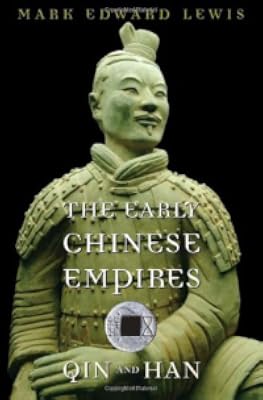
"The Early Chinese Empires: Qin and Han" by Mark Edward Lewis. Pub. 2007, 251 pp.
This is the first volume in the six-volume History of Imperial China series published by Harvard University Press; it covers the period from 221 BCE to 220 CE.
Unfortunately, unlike the series as a whole, this book is not laid out chronologically. Between a short introduction and conclusion, the ten chapters are set out thematically: one on geography, one on literature, one rural life, et cetera. This would be useful if you're looking only for information on, say, the military organization of Han era China. But it made it difficult for me to follow the overall progression of Chinese history. A particular person (with a hard to remember Chinese name) would be show more mentioned in different contexts in chapters on state organization, military reform, and religious views, making it hard to have a coherent picture of what was going on. This and the lack of summaries putting matters in a larger context made it hard for me to get as much out of the book as I'd hoped.
The included maps are almost useless, a problem again exacerbated by my unfamiliarity with Chinese regions and place names. They were often so zoomed in (without locator maps) that I couldn't tell where in China a place was and included no geographic features beyond (mostly unlabeled) rivers. Places are often mentioned in the text without being shown on the accompanying map and vice versa. Additionally, pictures the editor included did not strike me as particularly helpful or enlightening.
The book does have good information, however, and I enjoyed seeing how China was evolving compared with Europe at this time (when the Roman Empire was at its height). I found the chapters on family and kinship and on law very interesting. They remind one that the past, no less than China, is a foreign country; they do things differently there.
3/5, but not recommended as an introduction to Chinese history. For that you're better off with "All Under Heaven: A Complete History of China" by Rayne Kruger, a solid but not spectacular book. show less
This is the first volume in the six-volume History of Imperial China series published by Harvard University Press; it covers the period from 221 BCE to 220 CE.
Unfortunately, unlike the series as a whole, this book is not laid out chronologically. Between a short introduction and conclusion, the ten chapters are set out thematically: one on geography, one on literature, one rural life, et cetera. This would be useful if you're looking only for information on, say, the military organization of Han era China. But it made it difficult for me to follow the overall progression of Chinese history. A particular person (with a hard to remember Chinese name) would be show more mentioned in different contexts in chapters on state organization, military reform, and religious views, making it hard to have a coherent picture of what was going on. This and the lack of summaries putting matters in a larger context made it hard for me to get as much out of the book as I'd hoped.
The included maps are almost useless, a problem again exacerbated by my unfamiliarity with Chinese regions and place names. They were often so zoomed in (without locator maps) that I couldn't tell where in China a place was and included no geographic features beyond (mostly unlabeled) rivers. Places are often mentioned in the text without being shown on the accompanying map and vice versa. Additionally, pictures the editor included did not strike me as particularly helpful or enlightening.
The book does have good information, however, and I enjoyed seeing how China was evolving compared with Europe at this time (when the Roman Empire was at its height). I found the chapters on family and kinship and on law very interesting. They remind one that the past, no less than China, is a foreign country; they do things differently there.
3/5, but not recommended as an introduction to Chinese history. For that you're better off with "All Under Heaven: A Complete History of China" by Rayne Kruger, a solid but not spectacular book. show less
This is a good overview of Chinese history in the earliest dynasties. The author takes a broad approach by shifting the emphasis away from political events and onto cities, religion, law, literature etc. It's quite difficult to find good books in English on this period in chinese history. The contrast to the literature on the Roman empire is remarkable. Much remains to be written about the Qin and Han empires but for now this book works well as a general introduction.
Members
- Recently Added By
Lists

r/History Recommended Reading List
603 works; 12 members

r/AskHistorians' Recommended Books
1,068 works; 19 members

In Our Time books
4,934 works; 2 members
Author Information
9+ Works 693 Members
Mark Edward Lewis is Kwoh-Ting Li Professor in Chinese Culture, Stanford University. He is the author of The Early Chinese Empires and China's Cosmopolitan Empire (both from Harvard).
All Editions
Awards and Honors
Awards
Series

Common Knowledge
- Canonical title
- The Early Chinese Empires: Qin and Han
- Important places
- China
- Important events
- Qin Dynasty (221 BCE | 207 BCE); Han Dynasty (206 BCE | 220 CE)
Classifications
Statistics
- Members
- 285
- Popularity
- 113,276
- Reviews
- 11
- Rating
- (3.56)
- Languages
- Chinese, English
- Media
- Paper, Ebook
- ISBNs
- 4
- ASINs
- 1