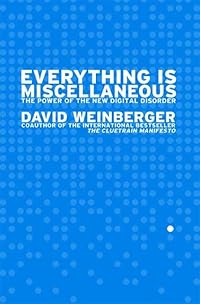
Everything Is Miscellaneous: The Power of the New Digital Disorder
by David Weinberger 
On This Page
Description
Philosopher Weinberger shows how the digital revolution is radically changing the way we make sense of our lives. Human beings constantly collect, label, and organize data--but today, the shift from the physical to the digital is mixing, burning, and ripping our lives apart. In the past, everything had its one place--the physical world demanded it--but now everything has its places: multiple categories, multiple shelves. Everything is suddenly miscellaneous. Weinberger charts the new show more principles of digital order that are remaking business, education, politics, science, and culture. He examines how Rand McNally decides what information not to include in a physical map (and why Google Earth is winning that battle), how Staples stores emulate online shopping to increase sales, why your children's teachers will stop having them memorize facts, and how the shift to digital music stands as the model for the future.--From publisher description. From A to Z, Everything Is Miscellaneous will completely reshape the way you think - and what you know - about the world. Includes information on alphabetical order, Amaxon.com, animals, Aristotle, authority, Bettmann Archive, blogs (weblogs), books, broadcasting, British Broadcasting Corporation (BBC), business, card catalog, categories and categorization, clusters, companies, Colon Classification, conversation, Melvil Dewey, Dewey Decimal Classification system, Encyclopaedia Britannica, encyclopedia, essentialism, experts, faceted classification system, first order of order, Flickr.com, Google, Great Books of the Western World, ancient Greeks, health and medical information, identifiers, index, inventory tracking, knowledge, labels, leaf and leaves, libraries, Library of Congress, links, Carolus Linnaeus, lumping and splitting, maps and mapping, marketing, meaning, metadata, multiple listing services (MLS), names of people, neutrality or neutral point of view, New York Public Library, Online Computer Library Center (OCLC), order and organization, people, physical space, everything having place, Plato, race, S.R. Ranganathan, Eleanor Rosch, Joshua Schacter, science, second order of order, simplicity, social constructivism, social knowledge, social networks, sorting, species, standardization, tags, taxonomies, third order of roder, topical categorization, tree, Uniform Product Code (UPC), users, Jimmy Wales, web, Wikipedia, etc. show lessTags
Recommendations

Member Recommendations

Member Reviews
The central thesis of Everything Is Miscellaneous is one with which I completely agree: digital information environments allow us to organize, access, and interact with information in new and previously undreamt ways. It allows us to transcend the limitations of physical storage and communication media, to free information to be everywhere and anywhere all at the same time.
It allows information to be whatever we need, whenever we need it. There exists more potential now to add more value, not just to information itself, but to the ways we access and interact with it. Mr. Weinberger offers us a powerful and compelling vision for our digital information world.
These three quotes perfectly sum up what this book is about:
From p. 212: “The show more difference in the digital order is the difference between the annoying interactions you have on a product support line... and the conversations you have with real people. ... The potential for connections from the trivial to the urgent is characteristic of the new miscellany. We are busily creating as many of these meaningful connections as we can.”
From p. 40: “How we organize our world reflects not only the world but also our interests, our passions, our needs, our dreams.”
From p. 45: “Now we know that not everything has its place. Everything has its places.”
As I was reading this book, I kept stopping to write down reactions that I had to various passages and arguments that he makes. I have seven type-written pages of reactions to this work - some enthusiastic agreement, and some incredulous “what is he thinking?!?” criticisms. It’s rare that a book can generate such passionate involvement from me. I value those that do. As exciting as I find many of Mr. Weinberger’s ideas, and as infuriating as I find some of his reasoning, I appreciate how this work challenges my thinking and requires me to question my assumptions.
This book is important. If there’s only one thing you take from this review, let it be that.
That being said – some of the examples Mr. Weinberger uses to back up his arguments are so off-base that I find myself questioning whether he really knows what he’s talking about. Too often, in order to try and make his point he oversimplifies things too much. But any vision for how we should interact with information must answer to nuanced reality. This book seriously lacks nuance.
One example: He consistently discusses the difference between the organization of information and the organization of access as though these must intrinsically be in conflict. Nothing in my experience working in a public library suggests that this is the case. But he needs it to be black & white in order to argue his point, so he overstates the reality of it.
In my opinion, the biggest failing of this work is that Mr. Weinberger seriously misappraises the state of information literacy in our society. More accurately – he doesn’t appraise it at all. Like most well-educated, well-read, literate people, he assumes that information seekers will exercise discernment and analytical thinking when they interact with information.
Working in a public library, I can categorically state that he’s wrong about this. The information literacy of the average information seeker has not kept pace with the expansion of our information environments.
This, then, speaks to the one aspect of his argument that I absolutely cannot agree with – his vilification of expertise.
He presents experts as dictators – people who jealously control access and capriciously decree what information people are allowed to have. If this is truly how he sees experts, then he’s correct to crusade against them.
But that’s not what experts are - it's certainly not what they should be. Not at all. Far from being dictators and judges, experts are teachers and guides.
Consider the role of expertise in light of the two basic acts of information interaction:
1) Searching for information: Mr. Weinberger takes it as given that people know how to search for information effectively. But many people don’t. When people don’t know how to search effectively, our rich and expansive world of digital information becomes overwhelming – a roiling, chaotic mess. Experts teach people how to find what they need within this tsunami of data.
On p. 132, he states: “[W]ith the miscellaneous, it’s all available to us, unfiltered.” And that’s a wonderful thing... but it also means that specific bits of information are harder to find. It becomes the old saw – looking for needle in a haystack. Experts can act as the information seeker’s metal detector.
2) Evaluating information: Once an information search returns results, he assumes that the information seeker will know what to do with them. It’s continually a shock to me how little skill many people demonstrate in the task of evaluating information – how credulous and uncritical people are. Many people don’t know how to recognize good, substantiated information from hearsay, rumor, conjecture; reliable information from the many shades of salesmanship.
Mr. Weinberger assumes that people will be actively engaged in their participation with information. But all too often, I see people looking for quick and easy answers, wanting most of all not to have to think too much about it. It’s continually shocking to me how many people overlook the best results in favor of the convenience of the first results.
Not only do many people lack the necessary skills to discern quality information from dreck, many people don’t understand why that should matter. In Chapter 6, he talks about the ready availability of medical information online. He’s correct that we should be active participants in our care, pro-active information seekers, and recognize that the medical industry isn’t as unbiased in its recommendations as it should be.
But I also shudder at the thought of someone listening to a crackpot on a blog instead of a qualified medical expert. Consider the potential for tremendous harm when someone doesn’t know to be critical of the information they find.
Experts teach people how to be discerning information seekers.
Experts: not dictators, but guides; not judges, but cheerleaders; not pedants, but teachers. We need experts teach people necessary information literacy skills. Given the current state of information literacy in our society, we need experts now more than ever.
Any attempt to address the realities of our digital information age must include a frank discussion of information literacy – and Mr. Weinberger never once mentions it in this book. To me, this is a serious failing.
And this is what kind of drives me crazy about Everything Is Miscellaneous – on the one hand, I agree completely that digital information environments are wonderful and exciting in their potential. I love that I get to spend my career exploring them.
But on the other hand, there are too many examples and arguments in this book that I disagree with for me to ever get completely onboard with it. Digital information environments offer mind-boggling potential for us to reassess and revamp our informational world – but we must ask essential critical questions about whether some of these proposed changes are actually good for us. Whether or not I ultimately agree with Mr. Weinberger’s vision, I don’t see him asking some of these essential questions. He takes it too much for granted that this is all to the good.
What I'd like to see next is an examination of how Mr. Weinberger’s ideas integrate with our current knowledge of neuroscience. No matter how digital our information becomes, no matter how far our access and interaction environments are removed from the constraints of the physical world, there’s one aspect of the information environment that remains resolutely, irrefutably physical – the wiring of our brains. Brains filled with neurons and axons and signal pathways which evolved over millennia to handle the physical world.
We need a better understanding of how our physical brains apprehend and process information when it’s organized according to schema that have no referents to the physical world. This is a gap in our understanding that must be filled. show less
It allows information to be whatever we need, whenever we need it. There exists more potential now to add more value, not just to information itself, but to the ways we access and interact with it. Mr. Weinberger offers us a powerful and compelling vision for our digital information world.
These three quotes perfectly sum up what this book is about:
From p. 212: “The show more difference in the digital order is the difference between the annoying interactions you have on a product support line... and the conversations you have with real people. ... The potential for connections from the trivial to the urgent is characteristic of the new miscellany. We are busily creating as many of these meaningful connections as we can.”
From p. 40: “How we organize our world reflects not only the world but also our interests, our passions, our needs, our dreams.”
From p. 45: “Now we know that not everything has its place. Everything has its places.”
As I was reading this book, I kept stopping to write down reactions that I had to various passages and arguments that he makes. I have seven type-written pages of reactions to this work - some enthusiastic agreement, and some incredulous “what is he thinking?!?” criticisms. It’s rare that a book can generate such passionate involvement from me. I value those that do. As exciting as I find many of Mr. Weinberger’s ideas, and as infuriating as I find some of his reasoning, I appreciate how this work challenges my thinking and requires me to question my assumptions.
This book is important. If there’s only one thing you take from this review, let it be that.
That being said – some of the examples Mr. Weinberger uses to back up his arguments are so off-base that I find myself questioning whether he really knows what he’s talking about. Too often, in order to try and make his point he oversimplifies things too much. But any vision for how we should interact with information must answer to nuanced reality. This book seriously lacks nuance.
One example: He consistently discusses the difference between the organization of information and the organization of access as though these must intrinsically be in conflict. Nothing in my experience working in a public library suggests that this is the case. But he needs it to be black & white in order to argue his point, so he overstates the reality of it.
In my opinion, the biggest failing of this work is that Mr. Weinberger seriously misappraises the state of information literacy in our society. More accurately – he doesn’t appraise it at all. Like most well-educated, well-read, literate people, he assumes that information seekers will exercise discernment and analytical thinking when they interact with information.
Working in a public library, I can categorically state that he’s wrong about this. The information literacy of the average information seeker has not kept pace with the expansion of our information environments.
This, then, speaks to the one aspect of his argument that I absolutely cannot agree with – his vilification of expertise.
He presents experts as dictators – people who jealously control access and capriciously decree what information people are allowed to have. If this is truly how he sees experts, then he’s correct to crusade against them.
But that’s not what experts are - it's certainly not what they should be. Not at all. Far from being dictators and judges, experts are teachers and guides.
Consider the role of expertise in light of the two basic acts of information interaction:
1) Searching for information: Mr. Weinberger takes it as given that people know how to search for information effectively. But many people don’t. When people don’t know how to search effectively, our rich and expansive world of digital information becomes overwhelming – a roiling, chaotic mess. Experts teach people how to find what they need within this tsunami of data.
On p. 132, he states: “[W]ith the miscellaneous, it’s all available to us, unfiltered.” And that’s a wonderful thing... but it also means that specific bits of information are harder to find. It becomes the old saw – looking for needle in a haystack. Experts can act as the information seeker’s metal detector.
2) Evaluating information: Once an information search returns results, he assumes that the information seeker will know what to do with them. It’s continually a shock to me how little skill many people demonstrate in the task of evaluating information – how credulous and uncritical people are. Many people don’t know how to recognize good, substantiated information from hearsay, rumor, conjecture; reliable information from the many shades of salesmanship.
Mr. Weinberger assumes that people will be actively engaged in their participation with information. But all too often, I see people looking for quick and easy answers, wanting most of all not to have to think too much about it. It’s continually shocking to me how many people overlook the best results in favor of the convenience of the first results.
Not only do many people lack the necessary skills to discern quality information from dreck, many people don’t understand why that should matter. In Chapter 6, he talks about the ready availability of medical information online. He’s correct that we should be active participants in our care, pro-active information seekers, and recognize that the medical industry isn’t as unbiased in its recommendations as it should be.
But I also shudder at the thought of someone listening to a crackpot on a blog instead of a qualified medical expert. Consider the potential for tremendous harm when someone doesn’t know to be critical of the information they find.
Experts teach people how to be discerning information seekers.
Experts: not dictators, but guides; not judges, but cheerleaders; not pedants, but teachers. We need experts teach people necessary information literacy skills. Given the current state of information literacy in our society, we need experts now more than ever.
Any attempt to address the realities of our digital information age must include a frank discussion of information literacy – and Mr. Weinberger never once mentions it in this book. To me, this is a serious failing.
And this is what kind of drives me crazy about Everything Is Miscellaneous – on the one hand, I agree completely that digital information environments are wonderful and exciting in their potential. I love that I get to spend my career exploring them.
But on the other hand, there are too many examples and arguments in this book that I disagree with for me to ever get completely onboard with it. Digital information environments offer mind-boggling potential for us to reassess and revamp our informational world – but we must ask essential critical questions about whether some of these proposed changes are actually good for us. Whether or not I ultimately agree with Mr. Weinberger’s vision, I don’t see him asking some of these essential questions. He takes it too much for granted that this is all to the good.
What I'd like to see next is an examination of how Mr. Weinberger’s ideas integrate with our current knowledge of neuroscience. No matter how digital our information becomes, no matter how far our access and interaction environments are removed from the constraints of the physical world, there’s one aspect of the information environment that remains resolutely, irrefutably physical – the wiring of our brains. Brains filled with neurons and axons and signal pathways which evolved over millennia to handle the physical world.
We need a better understanding of how our physical brains apprehend and process information when it’s organized according to schema that have no referents to the physical world. This is a gap in our understanding that must be filled. show less
Fascinating. I've been using tagging more and more - here on LibraryThing, in Evernote, etc - but I hadn't really thought about the underlying meanings. Weinberger did, and lays them out nicely - first-order arranging actual things (books on a shelf), second-order arranging references (card catalog), third-order tags which are not arranged, just randomly scattered about - but can be organized immediately into whatever order the individual wants at the moment (all the books by X about Y, all the books tagged SF (for the various possible meanings of SF)...). One interesting facet is that he was writing in 2007, and forecast some things ten years ahead...to now. He got most of them wrong, of course (There won't be much editing left to do show more on Wikipedia, just polishing...), but it's a fascinating look at how he saw things. show less
Weinberger proposes that the possibilities for ordering information in the digital and networked world can completely change the way we approach knowledge and learning. To make his point, he nicely summarizes organizational schemes of the past including the alphabet, good old Mevil Dewey, Linnaeus, Ranganathan (woo!), the card catalog, Encyclopaedia Britannica, and many more. His overviews are fun to read, well-researched, and deep enough to make his point without getting sidetracked. He then contrasts these traditional methods of organization with the Web 2.0 variety, leaning heavily on Flickr and Wikipedia as examples of tagging and social creation of content. In the end, he points us in the direction of a world filled with show more user-generated content and context where the interconnections are as important as the information itself, and where creativity and knowledge are found in the spaces between my ideas and your ideas.
This is all pretty heady stuff, but Weinberger is a very readable philosopher who gives his readers plenty of concrete examples to latch onto. Occasionally I found myself getting a little huffy (why, oh why, does he constantly use the card catalog as his illustration of how libraries organize things and never mention the OPAC? Why no mention of brick and mortor libraries that are incorporating Web 2.0 into their cataloging and public access? Why are libraries implicitly lumped in with "the man" who is keeping information out of the hands of the masses? How would he handle providing access to collections that are both physical and digital?). But once I calmed down a little, most of my qualms ended up being addressed elsewhere in the book, or could easily be dismissed by the fact that Weinberger isn't writing a book about libraries or archives, there is just a lot of overlap in what we are trying to accomplish.
This is a great book to read if you are a librarian, a library-wanna-be, an archivist, a techie, a scholar, a Flickr user, a philosopher, or just some jerk who likes to find things on the Internet.
[full review here: http://spacebeer.blogspot.com/2008/05/everything-is-miscellaneous-2007.html ] show less
This is all pretty heady stuff, but Weinberger is a very readable philosopher who gives his readers plenty of concrete examples to latch onto. Occasionally I found myself getting a little huffy (why, oh why, does he constantly use the card catalog as his illustration of how libraries organize things and never mention the OPAC? Why no mention of brick and mortor libraries that are incorporating Web 2.0 into their cataloging and public access? Why are libraries implicitly lumped in with "the man" who is keeping information out of the hands of the masses? How would he handle providing access to collections that are both physical and digital?). But once I calmed down a little, most of my qualms ended up being addressed elsewhere in the book, or could easily be dismissed by the fact that Weinberger isn't writing a book about libraries or archives, there is just a lot of overlap in what we are trying to accomplish.
This is a great book to read if you are a librarian, a library-wanna-be, an archivist, a techie, a scholar, a Flickr user, a philosopher, or just some jerk who likes to find things on the Internet.
[full review here: http://spacebeer.blogspot.com/2008/05/everything-is-miscellaneous-2007.html ] show less
Published in 2007, Everything is Miscellaneous by David Weinberger introduces us to the changes digital technology has brought to information organization and retrieval. Sounds geeky, right? Not at all. Weinberger uses the very understandable example of a photo archive to explain how storing, cataloging, and finding a particular photo has gone from an expensive, laborious process accessible to very few people, to an inexpensive, easy, real-time activity open to anyone.
Web 2.0 technology liberates us from dealing solely with atoms (”real” things) and opens new possibilities using bits (information about the things). A real object can only exist in one place, so it must be precisely placed if we hope to find it again. Data about an show more object gives us a bit more freedom to make the object retrievable through several different routes. With data (and metadata**) built on web 2.0 platforms like Flickr and LibraryThing, cumbersome cataloging and organization schemes — and those precise placement requirements of the past — can be pushed aside. Everything is miscellaneous now. Everything can be sorted, rearranged, tagged, toyed with, shared, mashed, and discovered all over again. Weinberger’s book is filled with examples and stories that illustrate our new tools and the radically new perspectives they engender. Digital technology makes them possible; the volume and pace of which new information is created makes them necessary; and the value of their collaborative results make it preferable.
This excerpt was part of a 3-book review. Find more of my reviews at Mostly NF. show less
Web 2.0 technology liberates us from dealing solely with atoms (”real” things) and opens new possibilities using bits (information about the things). A real object can only exist in one place, so it must be precisely placed if we hope to find it again. Data about an show more object gives us a bit more freedom to make the object retrievable through several different routes. With data (and metadata**) built on web 2.0 platforms like Flickr and LibraryThing, cumbersome cataloging and organization schemes — and those precise placement requirements of the past — can be pushed aside. Everything is miscellaneous now. Everything can be sorted, rearranged, tagged, toyed with, shared, mashed, and discovered all over again. Weinberger’s book is filled with examples and stories that illustrate our new tools and the radically new perspectives they engender. Digital technology makes them possible; the volume and pace of which new information is created makes them necessary; and the value of their collaborative results make it preferable.
This excerpt was part of a 3-book review. Find more of my reviews at Mostly NF. show less
This book was an interesting look at how the digitisation of information reduces the need for formal classification skills, because we classify things in the way that makes sense to us in the moment. Information is moving away from a tree structure and toward a graph structure. This book was pretty good, but the authors tributes to miscellany at the end were a bit...corny.
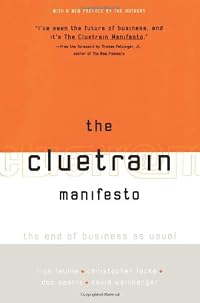
The author is an interesting man: he's a marketing consultant with a Ph.D. in philosophy who works at the Harvard Law School and advised Howard Dean's brief run for president. His book *The Cluetrain Manifesto* was memorably influential in 2001. He writes engagingly, informally, and clearly. Unfortunately, this book consists of ten chapters all saying the same thing: that we have moved past the age of classifying information in hierarchies and one-to-one relationships, and moved into the world of tagging and metadata. That's it. Each chapter simply explores this simple message from a slightly different angle.
Frankly, and with no arrogance meant, I knew this already, and find most of its implications obvious. (News flashes: the Dewey show more Decimal System is out of date [chapter 3]. Wikis, especially Wikipedia, are effective repositories of knowledge [chapter 7]. Classifying things too restrictively is counterproductive [chapter 9].) So I did not find the book a "mind-opener" (BuzzMachine.com), it did not make a "profound contribution" to my understanding of "the impact of the digital revolution" (BBC Global News), and despite what Esther Dyson says, I will indeed look at a humble bookshelf or store shelf the same way again.
Some of this is not the author's fault as much as it is the passage of time: it's 2015, and the book was written in 2007. Still, enough had happened by 2007 to make Scott Rosenberg of Salon.com's comment that the book shows "the benefits of moving from paper to bits" seem strangely out of time.
For those who haven't yet got the message, this could be a useful book. For example, I want to send this passage to the leaders of the heavily siloed organization that signs my paychecks: "Thinking that people's skills are defined by the department they're in wastes their talent. (It also means that companies frequently start corporate blogs with the least interesting people—the marketers—as their initial bloggers.) [A business] should scribble over the lines of division with lines of connection. Every line that's drawn ought to be systematically smudged....Everything belongs in more than one place, at least a little bit." show less
Frankly, and with no arrogance meant, I knew this already, and find most of its implications obvious. (News flashes: the Dewey show more Decimal System is out of date [chapter 3]. Wikis, especially Wikipedia, are effective repositories of knowledge [chapter 7]. Classifying things too restrictively is counterproductive [chapter 9].) So I did not find the book a "mind-opener" (BuzzMachine.com), it did not make a "profound contribution" to my understanding of "the impact of the digital revolution" (BBC Global News), and despite what Esther Dyson says, I will indeed look at a humble bookshelf or store shelf the same way again.
Some of this is not the author's fault as much as it is the passage of time: it's 2015, and the book was written in 2007. Still, enough had happened by 2007 to make Scott Rosenberg of Salon.com's comment that the book shows "the benefits of moving from paper to bits" seem strangely out of time.
For those who haven't yet got the message, this could be a useful book. For example, I want to send this passage to the leaders of the heavily siloed organization that signs my paychecks: "Thinking that people's skills are defined by the department they're in wastes their talent. (It also means that companies frequently start corporate blogs with the least interesting people—the marketers—as their initial bloggers.) [A business] should scribble over the lines of division with lines of connection. Every line that's drawn ought to be systematically smudged....Everything belongs in more than one place, at least a little bit." show less
Okay - prepare yourself for a rave. To say I loved this book is an understatement. I couldn't get enough of it. You simply must read it. I flagged just about every page with a yellow sticky until it got embarrassing. If you are wondering what all the fuss is about when it comes to digital or social media or the power of the world wide web, this is the book to inspire you. Weinberger tells a good story, lots in fact. He pulls everything together seamlessly and, it seems, effortlessly. He is my new personal hero. As you can tell he has reduced me to a blithering devotee. Oooh...and he's a Librarything author....off to check out his collection of miscellanea.....
Members
- Recently Added By
Published Reviews
ThingScore 25
"Anyone who has ever seen a computer program will know how much work is involved in creating the modules and functions through which the ordering is accomplished and this is the real big story: not that 'everything is miscellaneous', which is a pretty trite observation, but that disorder can be managed by software."
added by private library
Lists

Books referenced in David Weinberger's Too Big to Know
65 works; 2 members

Books That Changed Our Perspective
423 works; 168 members

Books We Discovered On LibraryThing
530 works; 130 members
Author Information

13+ Works 4,587 Members
David Weinberger is the publisher of JOHO (Journal of the Hyperlinked Organization, He is a commentator on National Public Radio's All Things Considered and a columnist for Darwin Magazine, KMWorld and Intranet Design Magazine
David Weinberger is a LibraryThing Author, an author who lists their personal library on LibraryThing.
Common Knowledge
- Original publication date
- 2007
- People/Characters
- Melvil Dewey; Clay Shirky; S. R. Ranganathan; Carolus Linnaeus; Eleanor Rosch; Aristotle (show all 8); Mortimer J. Adler; Jimmy Wales
- Dedication
- To the librarians
- First words
- "Absolutely Not."
- Publisher's editor
- Dennis, Robin
- Blurbers
- Anderson, Chris; Johnson, Steven; Sambrook, Richard; Wales, Jimmy; Dyson, Esther
Classifications
- Genres
- Technology, Nonfiction, General Nonfiction, Business, Philosophy
- DDC/MDS
- 300 — Society, government, & culture Social sciences, sociology & anthropology Social sciences
- LCC
- HD30.2 .W4516 — Social sciences Industries. Land use. Labor Industries. Land use. Labor Management. Industrial management
- BISAC
Statistics
- Members
- 2,250
- Popularity
- 8,880
- Reviews
- 62
- Rating
- (3.84)
- Languages
- 7 — Chinese, English, French, German, Italian, Japanese, Portuguese
- Media
- Paper, Ebook
- ISBNs
- 10
- ASINs
- 14