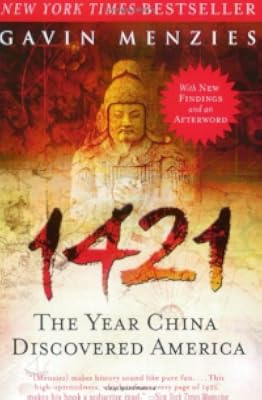
1421: The Year China Discovered America
by Gavin Menzies
On This Page
Description
On March 8, 1421, the largest fleet the world had ever seen set sail from China. Its mission was "to proceed all the way to the ends of the earth to collect tribute from the barbarians beyond the seas" and unite the whole world in Confucian harmony. When it returned in October 1423, the emperor had fallen, leaving China in political and economic chaos. The great ships were left to rot at their moorings and the records of their journeys were destroyed. Lost in China's long, self-imposed show more isolation that followed was the knowledge that Chinese ships had reached America seventy years before Columbus and had circumnavigated the globe a century before Magellan. Also concealed was how the Chinese colonized America before the Europeans and transplanted in America and other countries the principal economic crops that have fed and clothed the world. Unveiling incontrovertible evidence of these astonishing voyages, 1421 rewrites our understanding of history. Our knowledge of world exploration as it has been commonly accepted for centuries must now be reconceived due to this landmark work of historical investigation. show lessTags
Recommendations



















Member Recommendations
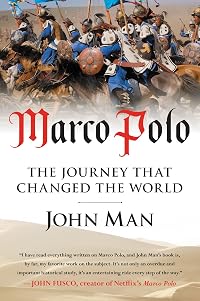
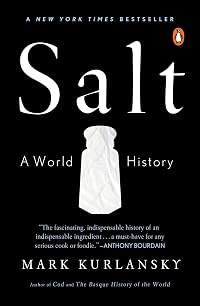
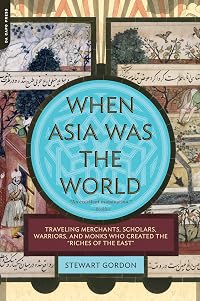
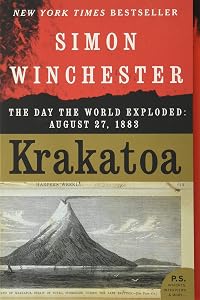
eromsted For a more realistic historical assessment of Zheng He, The Treasure Fleet and Chinese navigation and trade in general.
50

Member Reviews
The teaching of history is, as von Clausewitz said of war, the extension of politics by other means. Different nations teach their own history from their own viewpoint. Even if that history extends beyond their own borders, the story usually reflects the role of each country in the development of the world. So works of trans-national history are comparatively unusual, and even more rarely do they look beyond narrow national viewpoints.
So a book that claims that Chinese treasure fleets explored the world's oceans, circumnavigated the globe 100 years before Magellan and made landfall in the Americas some 75 years before Columbus is bound to ruffle some feathers. Menzies' 1421 does just that. His thesis is that the extravagance of the show more early Ming emperors, which culminated in the building of the Forbidden City, the completion of the Great Wall, and the commissioning of a massive trading fleet, numbering hundreds of ships, caused a subsequent emperor to retrench the nation's activity, to purge the archives of all records and to retreat into isolationism, leaving Portuguese explorers tantalising clues and charts showing distant lands which they then went out and "discovered".
Given that China had trade links all over South-East Asia, the coast of India and down the east coast of Africa, this seems plausible. The big problem is the lack of firm evidence. And also given that (in Menzies' account) all the main Chinese records were destroyed, this leaves him to pick up scraps from a range of other sources, piecing a story together from fragments. But this is always going to lead to confirmation bias; any evidence will be assessed for how it fits into the grand narrative, rather than looking at the evidence in isolation. Menzies lists a large number of academic institutions that helped him in his researches; what they thought of the outcome is another matter.
The style of the writing does not help. Menzies initially started writing a world travelogue, of which the central idea behind 1421 was just one part. This came to the attention of an enterprising publisher who saw the possibilities in a book based on the account of the treasure fleets. Menzies re-wrote that segment of the book with the aid of a ghost writer; but he admitted that he himself was no writer. He uses some of the usual tropes of the pseudo-science writer - "this proves that the Chinese must have...", "the only possible conclusion is that..." and so on. Even if his evidence were sound, the book presents subtle (and sometimes not-so-subtle) suggestions that it is not, simply because of the style. Interestingly, he twice cites Erich von Däniken, though not as any sort of reliable source, but rather as the only other person to think such-and-such a piece of evidence is significant, "and that can't be true!".
Of course, if his thesis is true, then all we will have are fragments which need to be pieced together. But this runs the risk of the whole being more than the sum of its parts. China has an extensive history; it was the world's first superpower. But if this claim was viable, would it not be the Chinese who would be making it?
Menzies died in 2020. He published further books making more fantastical claims about the role of China in medieval European history; and set up a website asking members of the public to add to the body of his evidence. This has been replaced by a very slick site for a "1421 Foundation" which has picked up this particular ball and is running with it. This is a shame, because it all now smacks of commercialisation and sensation; certainly, any serious historian or archaeologist coming to the field of medieval Chinese naval history might well be put off by all the trappings. And that would be a shame; in a world where narrow national interests are being exploited for political gain, any trans-national or global perspective is helpful in trying to give a sense of balance. But without better evidence, this book and its successors are not helping. show less
So a book that claims that Chinese treasure fleets explored the world's oceans, circumnavigated the globe 100 years before Magellan and made landfall in the Americas some 75 years before Columbus is bound to ruffle some feathers. Menzies' 1421 does just that. His thesis is that the extravagance of the show more early Ming emperors, which culminated in the building of the Forbidden City, the completion of the Great Wall, and the commissioning of a massive trading fleet, numbering hundreds of ships, caused a subsequent emperor to retrench the nation's activity, to purge the archives of all records and to retreat into isolationism, leaving Portuguese explorers tantalising clues and charts showing distant lands which they then went out and "discovered".
Given that China had trade links all over South-East Asia, the coast of India and down the east coast of Africa, this seems plausible. The big problem is the lack of firm evidence. And also given that (in Menzies' account) all the main Chinese records were destroyed, this leaves him to pick up scraps from a range of other sources, piecing a story together from fragments. But this is always going to lead to confirmation bias; any evidence will be assessed for how it fits into the grand narrative, rather than looking at the evidence in isolation. Menzies lists a large number of academic institutions that helped him in his researches; what they thought of the outcome is another matter.
The style of the writing does not help. Menzies initially started writing a world travelogue, of which the central idea behind 1421 was just one part. This came to the attention of an enterprising publisher who saw the possibilities in a book based on the account of the treasure fleets. Menzies re-wrote that segment of the book with the aid of a ghost writer; but he admitted that he himself was no writer. He uses some of the usual tropes of the pseudo-science writer - "this proves that the Chinese must have...", "the only possible conclusion is that..." and so on. Even if his evidence were sound, the book presents subtle (and sometimes not-so-subtle) suggestions that it is not, simply because of the style. Interestingly, he twice cites Erich von Däniken, though not as any sort of reliable source, but rather as the only other person to think such-and-such a piece of evidence is significant, "and that can't be true!".
Of course, if his thesis is true, then all we will have are fragments which need to be pieced together. But this runs the risk of the whole being more than the sum of its parts. China has an extensive history; it was the world's first superpower. But if this claim was viable, would it not be the Chinese who would be making it?
Menzies died in 2020. He published further books making more fantastical claims about the role of China in medieval European history; and set up a website asking members of the public to add to the body of his evidence. This has been replaced by a very slick site for a "1421 Foundation" which has picked up this particular ball and is running with it. This is a shame, because it all now smacks of commercialisation and sensation; certainly, any serious historian or archaeologist coming to the field of medieval Chinese naval history might well be put off by all the trappings. And that would be a shame; in a world where narrow national interests are being exploited for political gain, any trans-national or global perspective is helpful in trying to give a sense of balance. But without better evidence, this book and its successors are not helping. show less
You might have that certain relative in your family who is affable enough, but has some really weird ideas that he loves to go on about. For the sake of this review, let's call him "Uncle Gavin." Uncle Gavin is harmless, and charms your friends, but he has one pet topic that you try to steer him away from. Before you know it, he's started asking your friends who they think discovered the world and after a short time, the friend's nods and smiles go from sincerely interested to polite to barely hanging on, and they're looking around desperately for someone to rescue them from this conversation.
Uncle Gavin wrote this book. His premise sounds interesting, and perhaps sane, if far-fetched: he claims that the Chinese sailed essentially the show more entire world in 1421-23 and made maps of such voyages that were later used to guide the Portuguese and Spanish explorers who "discovered" America and other parts of the world. Why this has been a hidden fact for so long: the Chinese burned nearly every record of the voyages, stopped exploration, and basically forgot about the whole thing over the centuries. Why Uncle Gavin is the only person to have figured this out: he used to captain submarines and therefore knows how ocean currents work and can read a nautical chart. I'll let that sink in for a moment.
In any case, I was willing to go along with him at first, but it became apparent pretty quickly that things were spiraling out of control. I rarely make notes on audio books, but I found myself frantically scribbling things down when I was listening to this one. Things like:
"Just because Verrazzano compared some lighter-skinned Indians and their manner of dress to the "Eastern" style doesn't mean that they are descended from his [Menzies'] imaginary pregnant concubines that were put ashore from his imaginary overcrowded voyages."
I was going to list more, but as I look at that one, I think it sums up everything. Look, it's an interesting idea that the Chinese could have sent an enormous fleet out to see what there was out there, and that they could have drawn up a map of everything, and then decided to close their borders and give up on the outside world, and that the maps could have ended up in the hands of the European explorers, and that those explorers could have found knick-knacks that were Chinese and people who might have been descended from Chinese people who ended up there long-term one way or another. But if you're going to tell me, Uncle Gavin, that the Chinese took out 40 or 50 ships which were wrecked in various places and stayed and lived there, you're going to have to come up with some physical evidence. Wrecked ships off India, or eastern Africa, or Australia simply do not prove that Chinese people built the Bimini Road in the Caribbean to get their ships on land for repairs or had a settlement on Greenland (I am not kidding. I wish I were kidding.).
If this were half as long and half as crazy, it might be worth a perusal. As it is, run from this book. Read Foucault's Pendulum, which features the same sort of wild connect-the-dots game and also has going for it that it is fiction.
PS - It turns out that Menzies has also published 1434: The Year a Magnificent Chinese Fleet Sailed to Italy and Ignited the Renaissance. I imagine that he is now deep into the writing of 1468: The Year China Traveled to the Moon and Discovered Life and 1498: The Year China Invented Synthetic Life and Created the Spice Girls. show less
Uncle Gavin wrote this book. His premise sounds interesting, and perhaps sane, if far-fetched: he claims that the Chinese sailed essentially the show more entire world in 1421-23 and made maps of such voyages that were later used to guide the Portuguese and Spanish explorers who "discovered" America and other parts of the world. Why this has been a hidden fact for so long: the Chinese burned nearly every record of the voyages, stopped exploration, and basically forgot about the whole thing over the centuries. Why Uncle Gavin is the only person to have figured this out: he used to captain submarines and therefore knows how ocean currents work and can read a nautical chart. I'll let that sink in for a moment.
In any case, I was willing to go along with him at first, but it became apparent pretty quickly that things were spiraling out of control. I rarely make notes on audio books, but I found myself frantically scribbling things down when I was listening to this one. Things like:
"Just because Verrazzano compared some lighter-skinned Indians and their manner of dress to the "Eastern" style doesn't mean that they are descended from his [Menzies'] imaginary pregnant concubines that were put ashore from his imaginary overcrowded voyages."
I was going to list more, but as I look at that one, I think it sums up everything. Look, it's an interesting idea that the Chinese could have sent an enormous fleet out to see what there was out there, and that they could have drawn up a map of everything, and then decided to close their borders and give up on the outside world, and that the maps could have ended up in the hands of the European explorers, and that those explorers could have found knick-knacks that were Chinese and people who might have been descended from Chinese people who ended up there long-term one way or another. But if you're going to tell me, Uncle Gavin, that the Chinese took out 40 or 50 ships which were wrecked in various places and stayed and lived there, you're going to have to come up with some physical evidence. Wrecked ships off India, or eastern Africa, or Australia simply do not prove that Chinese people built the Bimini Road in the Caribbean to get their ships on land for repairs or had a settlement on Greenland (I am not kidding. I wish I were kidding.).
If this were half as long and half as crazy, it might be worth a perusal. As it is, run from this book. Read Foucault's Pendulum, which features the same sort of wild connect-the-dots game and also has going for it that it is fiction.
PS - It turns out that Menzies has also published 1434: The Year a Magnificent Chinese Fleet Sailed to Italy and Ignited the Renaissance. I imagine that he is now deep into the writing of 1468: The Year China Traveled to the Moon and Discovered Life and 1498: The Year China Invented Synthetic Life and Created the Spice Girls. show less
This is book is so horridly bad. Now maybe the Chinese went farther than they are recorded to have gone, maybe they accidentally washed up on the shores of the Americas. But this book is not the answer. Menzies mistranslated the size of Zheng He's fleet. One of Zheng He's admirals was back in China when he was supposed to be discovering the world. Menzies overestimates the speed of the fleets. The weird things Menzies comes up with: comfort women on the ships, sprout growing on the ships, etc. The funniest is the weird, unsubstantiated way they were supposed to come up with longitude. Menzies misuses Australian legends and information. Menzies messes up maps. Really, the portolan Antillia and Satanzes looks nothing like the Caribbean. show more Menzies misinterprets Dieppe maps. Menzies has no clue how to interpret DNA. Menzies has no clue what the Newport Tower was (hint, a windmill from the 1600s).
In the end, this book is just poppycock. All you need to know about Gavin Menzies you can find by watching National Geographic's documentary 1421: The Year China Discovered America (which you can find online). It presents his theory and then demolishes it completely. Watch especially at the end when the interviewer confronts Menzies on his misinterpretations, quoting the actual documents Menzies uses as proof and showing they in fact contradict Menzies. His face is priceless. That's all you need to know about Gavin Menzies and his theories. show less
In the end, this book is just poppycock. All you need to know about Gavin Menzies you can find by watching National Geographic's documentary 1421: The Year China Discovered America (which you can find online). It presents his theory and then demolishes it completely. Watch especially at the end when the interviewer confronts Menzies on his misinterpretations, quoting the actual documents Menzies uses as proof and showing they in fact contradict Menzies. His face is priceless. That's all you need to know about Gavin Menzies and his theories. show less
It's rare that I would waste space blasting a book. Life is short and time is a scarce resource. I'd rather just drop a book unworthy of finishing and move on to a new one. This time, though, I think 1421 merits further explanation because of the sensational success it has experienced worldwide.
Simply put, 1421 is junk history posing as "real history." Gavin Menzies has spun a fantastical and interesting tale out of the very real events surrounding the massive Chinese treasure fleets of 1421. His thesis--that the Chinese discovered the New World in the 1420s, mapped it, and that it was their maps that European explorers used when sailing for the New World (including, he argues, Columbus).
Built by a Ming emperor to gather in tribute show more from the ends of the Earth, the fleet was one of the last acts of imperial hubris. Shortly after it set sail, the emperor died. His son, in replacing his father's policies, had the fleets destroyed upon their return, along with records gathered during the voyage. Starting with that sparse introduction, Menzies proceeds to gather bits and pieces of evidence stretching from China itself to the Indian subcontinent, from the Congo to Patagonia and beyond, and levies the evidence to tell a tale of the massive Chinese fleet charting the New World the greater part of a century before Columbus set sail in 1492.
It is an extremely interesting and, if it were true, a ground breaking discovery and thesis. Perhaps it is true. But likely, it is not.
As I started reading it, the first question that came to mind for me was this: in the almost six centuries since these events happened, why has no one else suggested that the Chinese arrived first? Menzies explanation is that historians generally lack the skill set necessary to uncover the truth, a skill set that he has as a former captain in the British Navy. Unlike most historians, Menzies argues, he can read a chart, understand what he's looking at, and glean from these 15th century charts things that no historian would otherwise notice.
Yeah. It's a little bit of a stretch. I would be surprised to find that no historian has ever had the skill set to learn maritime charts and understand how to read them (heck, Theodore Roosevelt when only an undergraduate student at Harvard, researched and wrote a book of naval strategy -- "The Naval War of 1812"--that became a classic and a text book used by both the US and British navies for decades after it was published). That being said, I gave Menzies the benefit of the doubt. I've long been intrigued with China and its history, and I think I wanted to believe that history as we have been taught might not be true. How interesting would it be for America to have been discovered by the Chinese?
As I read, though, red flags continued to pop up. Out of only sparse details, Menzies would assert "conclusive proof" that his theories were finding relevance. Finally, over two hundred pages in, I decided to check into what critical review might have said about his methods and evidence. I reasoned that if Menzies is correct, or even has a good theory, then the academic community would support his findings with further research. I went to the internet.
Critical acclaim was anything but what I found. In addition to finding entire sites dedicated to debunking Menzies myths, I also found that historical lectures had been given explaining and demonstrating that what Menzies proposed was just that--a proposal. Be it even true, the evidence was not there, not was the reasoning clearly logical.
For example:
--Menzies claims that Chinese anchors have been found off of the coast of California, but fails to document them.
--1421 says that Chinese DNA is found in North America natives, but fails to account for the influx of Chinese immigrants in the 17th century.
--Menzies finds what he claims are chickens unique to Asia living in Peru, but fails to note that Peru exported millions of tons of silver to China and brought back silk and porcelain (and presumably other things, like, for example, chickens) throughout the heyday of the Spanish during the 16th through 17th centuries.
And that's just to start.
Historian Kirstin A. Seaver says, in disecting claims about the Chinese in Vinland:
"The study of history is likely to reward anyone willing to undertake it in a quest for better understanding of who they are, how they became what they are, and what they might hope to become. The manufacture of a history that never existed rewards only those who make money by deceiving the public."
If 1421 is true, Menzies has not found the evidence to support it. If it is false, it's junk and a waste of time to read. Further, it perpetuates a falsehood that makes the acquisition of real history--real, boring, dry and factual history--that much harder to grasp. show less
Simply put, 1421 is junk history posing as "real history." Gavin Menzies has spun a fantastical and interesting tale out of the very real events surrounding the massive Chinese treasure fleets of 1421. His thesis--that the Chinese discovered the New World in the 1420s, mapped it, and that it was their maps that European explorers used when sailing for the New World (including, he argues, Columbus).
Built by a Ming emperor to gather in tribute show more from the ends of the Earth, the fleet was one of the last acts of imperial hubris. Shortly after it set sail, the emperor died. His son, in replacing his father's policies, had the fleets destroyed upon their return, along with records gathered during the voyage. Starting with that sparse introduction, Menzies proceeds to gather bits and pieces of evidence stretching from China itself to the Indian subcontinent, from the Congo to Patagonia and beyond, and levies the evidence to tell a tale of the massive Chinese fleet charting the New World the greater part of a century before Columbus set sail in 1492.
It is an extremely interesting and, if it were true, a ground breaking discovery and thesis. Perhaps it is true. But likely, it is not.
As I started reading it, the first question that came to mind for me was this: in the almost six centuries since these events happened, why has no one else suggested that the Chinese arrived first? Menzies explanation is that historians generally lack the skill set necessary to uncover the truth, a skill set that he has as a former captain in the British Navy. Unlike most historians, Menzies argues, he can read a chart, understand what he's looking at, and glean from these 15th century charts things that no historian would otherwise notice.
Yeah. It's a little bit of a stretch. I would be surprised to find that no historian has ever had the skill set to learn maritime charts and understand how to read them (heck, Theodore Roosevelt when only an undergraduate student at Harvard, researched and wrote a book of naval strategy -- "The Naval War of 1812"--that became a classic and a text book used by both the US and British navies for decades after it was published). That being said, I gave Menzies the benefit of the doubt. I've long been intrigued with China and its history, and I think I wanted to believe that history as we have been taught might not be true. How interesting would it be for America to have been discovered by the Chinese?
As I read, though, red flags continued to pop up. Out of only sparse details, Menzies would assert "conclusive proof" that his theories were finding relevance. Finally, over two hundred pages in, I decided to check into what critical review might have said about his methods and evidence. I reasoned that if Menzies is correct, or even has a good theory, then the academic community would support his findings with further research. I went to the internet.
Critical acclaim was anything but what I found. In addition to finding entire sites dedicated to debunking Menzies myths, I also found that historical lectures had been given explaining and demonstrating that what Menzies proposed was just that--a proposal. Be it even true, the evidence was not there, not was the reasoning clearly logical.
For example:
--Menzies claims that Chinese anchors have been found off of the coast of California, but fails to document them.
--1421 says that Chinese DNA is found in North America natives, but fails to account for the influx of Chinese immigrants in the 17th century.
--Menzies finds what he claims are chickens unique to Asia living in Peru, but fails to note that Peru exported millions of tons of silver to China and brought back silk and porcelain (and presumably other things, like, for example, chickens) throughout the heyday of the Spanish during the 16th through 17th centuries.
And that's just to start.
Historian Kirstin A. Seaver says, in disecting claims about the Chinese in Vinland:
"The study of history is likely to reward anyone willing to undertake it in a quest for better understanding of who they are, how they became what they are, and what they might hope to become. The manufacture of a history that never existed rewards only those who make money by deceiving the public."
If 1421 is true, Menzies has not found the evidence to support it. If it is false, it's junk and a waste of time to read. Further, it perpetuates a falsehood that makes the acquisition of real history--real, boring, dry and factual history--that much harder to grasp. show less
(Reprinted from the Chicago Center for Literature and Photography [cclapcenter.com]. I am the original author of this review, as well as the owner of CCLaP; it is not being reprinted here illegally.)
We Westerners are of course familiar with the historical period known as the Renaissance; taking place between the 1300s and 1600s, it's the period when Europeans finally crawled out of their Dark-Age hole, rediscovered such ancient Greek concepts as science and philosophy, and started doing such things for the first time as sailing to the far corners of the planet. But did you know that China as well went through its own brief Renaissance at the same time, actually sailing around the planet on a regular basis a full 50 years before the show more Europeans started doing so, and that it was the maps and tips these Chinese gave to the Europeans that allowed the great figures from the "Age of Discovery" to make their voyages in the first place? Well, okay, so not everyone completely agrees with this theory; but it's the surprisingly strong one being espoused in the books 1421: The Year China Discovered America and 1434: The Year a Magnificent Chinese Fleet Sailed to Italy and Ignited the Renaissance, both of them by a retired British naval commander named Gavin Menzies, a hobbyist scholar who just happened to start stumbling across more and more evidence during his studies to support the theory mentioned above. See, the whole thing is problematic, because the Chinese actually went through a major period of isolationism right after this brief period of world-traveling, specifically as a overreaction to Ghengis Khan and his Mongol Hoard, which had actually held and ruled China all the way up to the beginning of the 1400s, or in other words the beginning of the Ming Dynasty in that country.
According to well-known history, the Chinese were so set on turning inwards at this point, they actually destroyed most of their own records regarding their globetrotting sea voyages from this period, just so no one else would be tempted to make such trips again; according to Menzies, he has slowly been putting the pieces back together through shreds of evidence in other countries, stone markers and rescued scrolls and the like, revealing that the Ming Dynasty's own period of global seafaring was actually much larger than any of us have ever realized, a systematic series of successes that would've virtually guaranteed China's eventual world domination, if they had simply stuck with it instead of embarking on a four-hundred-year period of profound isolationism like they actually did. It's certainly an intriguing theory, and Menzies does a pretty credible job backing it up; these are giant thick books we're talking about (over a thousand pages altogether), just chock-full of evidence both direct and circumstantial. Combine this, then, with Menzies' tech-savvy prose concerning the problems of map-drawing and chart-creating in that period, which is why certain documents from that period need to be widened or narrowed in Photoshop before they'll actually line up with real coastlines; it's just one of the dozens of little issues and problems with all this old evidence, he argues, that prevented it from being all added together by anyone else before now. (See, one of the things Menzies did while in the navy was actually sail the ancient Chinese routes talked about in these books; he therefore has an expert's understanding on what these routes must've been like for the original Chinese sailors, and can thus explain the inconsistencies in the maps and charts they left behind.)
These were great reads, books that really crank the gears of the mind into action (why, just the descriptions of a glittering, wealthy Southeast Asia in the 1400s is worth the cover price alone); I'll warn you, though, that these are denser books than the usual airport and beach reads, not exactly academic in complexity but definitely stories you need to pay careful attention to while reading. That said, they both get a big recommendation from me, especially for the growing amount of people in the western half of the world who are becoming more and more curious these days about the mysterious history of the eastern half.
Out of 10: 9.3 show less
We Westerners are of course familiar with the historical period known as the Renaissance; taking place between the 1300s and 1600s, it's the period when Europeans finally crawled out of their Dark-Age hole, rediscovered such ancient Greek concepts as science and philosophy, and started doing such things for the first time as sailing to the far corners of the planet. But did you know that China as well went through its own brief Renaissance at the same time, actually sailing around the planet on a regular basis a full 50 years before the show more Europeans started doing so, and that it was the maps and tips these Chinese gave to the Europeans that allowed the great figures from the "Age of Discovery" to make their voyages in the first place? Well, okay, so not everyone completely agrees with this theory; but it's the surprisingly strong one being espoused in the books 1421: The Year China Discovered America and 1434: The Year a Magnificent Chinese Fleet Sailed to Italy and Ignited the Renaissance, both of them by a retired British naval commander named Gavin Menzies, a hobbyist scholar who just happened to start stumbling across more and more evidence during his studies to support the theory mentioned above. See, the whole thing is problematic, because the Chinese actually went through a major period of isolationism right after this brief period of world-traveling, specifically as a overreaction to Ghengis Khan and his Mongol Hoard, which had actually held and ruled China all the way up to the beginning of the 1400s, or in other words the beginning of the Ming Dynasty in that country.
According to well-known history, the Chinese were so set on turning inwards at this point, they actually destroyed most of their own records regarding their globetrotting sea voyages from this period, just so no one else would be tempted to make such trips again; according to Menzies, he has slowly been putting the pieces back together through shreds of evidence in other countries, stone markers and rescued scrolls and the like, revealing that the Ming Dynasty's own period of global seafaring was actually much larger than any of us have ever realized, a systematic series of successes that would've virtually guaranteed China's eventual world domination, if they had simply stuck with it instead of embarking on a four-hundred-year period of profound isolationism like they actually did. It's certainly an intriguing theory, and Menzies does a pretty credible job backing it up; these are giant thick books we're talking about (over a thousand pages altogether), just chock-full of evidence both direct and circumstantial. Combine this, then, with Menzies' tech-savvy prose concerning the problems of map-drawing and chart-creating in that period, which is why certain documents from that period need to be widened or narrowed in Photoshop before they'll actually line up with real coastlines; it's just one of the dozens of little issues and problems with all this old evidence, he argues, that prevented it from being all added together by anyone else before now. (See, one of the things Menzies did while in the navy was actually sail the ancient Chinese routes talked about in these books; he therefore has an expert's understanding on what these routes must've been like for the original Chinese sailors, and can thus explain the inconsistencies in the maps and charts they left behind.)
These were great reads, books that really crank the gears of the mind into action (why, just the descriptions of a glittering, wealthy Southeast Asia in the 1400s is worth the cover price alone); I'll warn you, though, that these are denser books than the usual airport and beach reads, not exactly academic in complexity but definitely stories you need to pay careful attention to while reading. That said, they both get a big recommendation from me, especially for the growing amount of people in the western half of the world who are becoming more and more curious these days about the mysterious history of the eastern half.
Out of 10: 9.3 show less
A beautifully written and fascinating tale of the Chinese expeditions to all the oceans of the globe during the early 15th century. The author says that the Chinese not only sent out huge armadas all over the world, but on the sixth expedition during 1421-3, which is the one dealt with here, they split up into four armadas that criss-crossed all three oceans, and touched Antarctica, circumnavigated Greenland, mapped the Siberian coast, and so on. They also naturally left numerous shipwrecks all along the sea coasts of all continents, and also groups of stranded seamen and concubines who added their genes, languages, and cultural accomplishments to local populations. All these achievements are said to predate the travels of the European show more explorers like Magellan, Diaz, Columbus, and others. Ironically, the Chinese had spent so much on these maritime adventures and on their massive construction projects at home (their palaces and the Great Wall), that the successor emperors sharply cut back on their maritime activities, destroyed all the maps and documents, and retired their admirals and their dockyards, and entered on two centuries of isolation and xenophobia. Thus the author's theory rests more on circumstantial evidence and conjecture than on material facts. Naturally these ideas have attracted their share of criticism and scepticism, although there is obviously some ground to question the Western narrative of European priority in discovery and exploration. For South Asians, especially tantalising is the connection with the great ports of South India like Calicut, which was reportedly a mustering point for many of these armadas. All in all, an absorbing tale of fascinating episode of the world's history. show less
The book sounded interesting when it first came out, but on reading it's full of dubious claims. The author seems very full of himself and acts as though he knows more than historians who have studied these topics for many years. See detailed review by Dan Gibson at https://www.researchgate.net/publication/321708429_Book_Review_1421_The_Year_Chi... which notes that "I believe that Menzies has done what many others before him have done. That is: assume that they are researching the very first cross-Atlantic voyages, thus not taking into account that others may have been there before." and "The proofs given by Menzies only bring us to the conclusion that the Americas had been visited before the Portuguese arrived. This is no surprise, show more since it seems that the ancient Egyptian pharaohs possessed items and plants that were native only to the Americas. Obviously some people had been crossing the seas for many centuries. But was it the Chinese? Menzies fails to prove this."
Some issues I had with this book:
1) Menzies makes a big deal about the Fra Mauro map and quotes an appended note that says "Around the year 1420, a ship or junk [coming] from India ... was driven beyond Cap d Diab [Cape of Good Hope] and through the Isole Verde ... towards the west and south-west for 40 days, found nothing but sea and sky. ... They made their return to the said Cap de Diab in 70 days." He uses this as evidence for his argument that a Chinese fleet sailed to South America. But his theory has them sailing up the west coast of Africa and across the Atlantic, then south down the coast of South America, and then near the Antarctic and on to Australia. He completely ignores the text on the map he uses for evidence that says they found nothing but sea and sky and returned in 70 days.
2) He describes a second Chinese fleet going up the east coast of North America, then part of that fleet continuing on to Greenland, and maybe on to the North Pole. Then he claims in only a couple of paragraphs that they came home around Siberia and through the Bering Strait. In most of the rest of the book he uses long arguments to make his case, but there's very little in support of this wild claim.
3) He spends one whole chapter writing about his claim that the Chinese had discovered the secret to longitude and describing how they did it. He claims the existence of certain maps prove the Chinese had figured out how to calculate longitude, but there's no evidence to support his claim that one of the treasure fleets had actually carried out the measurements at this time.
Overall, there are just too many problems with this book to be believable. show less
Some issues I had with this book:
1) Menzies makes a big deal about the Fra Mauro map and quotes an appended note that says "Around the year 1420, a ship or junk [coming] from India ... was driven beyond Cap d Diab [Cape of Good Hope] and through the Isole Verde ... towards the west and south-west for 40 days, found nothing but sea and sky. ... They made their return to the said Cap de Diab in 70 days." He uses this as evidence for his argument that a Chinese fleet sailed to South America. But his theory has them sailing up the west coast of Africa and across the Atlantic, then south down the coast of South America, and then near the Antarctic and on to Australia. He completely ignores the text on the map he uses for evidence that says they found nothing but sea and sky and returned in 70 days.
2) He describes a second Chinese fleet going up the east coast of North America, then part of that fleet continuing on to Greenland, and maybe on to the North Pole. Then he claims in only a couple of paragraphs that they came home around Siberia and through the Bering Strait. In most of the rest of the book he uses long arguments to make his case, but there's very little in support of this wild claim.
3) He spends one whole chapter writing about his claim that the Chinese had discovered the secret to longitude and describing how they did it. He claims the existence of certain maps prove the Chinese had figured out how to calculate longitude, but there's no evidence to support his claim that one of the treasure fleets had actually carried out the measurements at this time.
Overall, there are just too many problems with this book to be believable. show less
Members
- Recently Added By
Lists

Non-fiction that you shouldn't waste your time on
45 works; 15 members

Carole's List
445 works; 13 members

What A Year: Books titled with a particular year
147 works; 2 members
Author Information

4+ Works 4,809 Members
Gavin Menzies is the bestselling author of 1421: The Year China Discovered America; 1434: The Year a Magnificent Chinese Fleet Sailed to Italy and Ignited the Renaissance; and The Lost Empire of Atlantis: History's Greatest Mystery Revealed. He served in the Royal Navy between 1953 and 1970. His knowledge of seafaring and navigation sparked his show more interest in the epic voyages of Chinese admiral Zheng He. Menzies lives in London. show less
Awards and Honors
Distinctions
Common Knowledge
- Canonical title
- 1421: The Year China Discovered America
- Alternate titles
- 1421: China Discovered America
- Original publication date
- 2002-01-01
- People/Characters
- Zheng He
- Important places
- China
- Dedication
- This book is dedicated to my beloved wife Marcella, who has travelled with me on the journeys related in this book and through life.
- First words
- On 2 February 1421, China dwarfed every nation on earth.
- Last words
- (Click to show. Warning: May contain spoilers.)Those who followed them, no matter how great their achievements, were sailing in their wake.
(Click to show. Warning: May contain spoilers.)Postscript: It is you, not historians or academics, who have rewritten history.
Classifications
- Genres
- History, General Nonfiction, Nonfiction, Travel
- DDC/MDS
- 910.951 — History & geography Geography & travel modified standard subdivisions of Geography and travel Explorers & Travelers Discovery and exploration by Asia China and adjacent areas
- LCC
- G322 .M455 — Geography, Anthropology and Recreation Geography (General) History of discoveries, explorations, and travel
- BISAC
Statistics
- Members
- 3,607
- Popularity
- 4,524
- Reviews
- 97
- Rating
- (3.25)
- Languages
- 14 — Chinese, Danish, Dutch, English, Finnish, French, German, Hungarian, Italian, Korean, Polish, Portuguese, Romanian, Spanish
- Media
- Paper, Audiobook, Ebook
- ISBNs
- 48
- ASINs
- 20