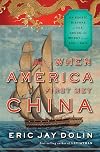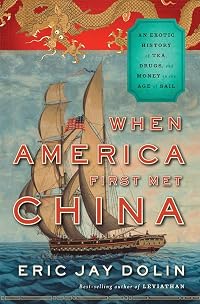
When America First Met China: An Exotic History of Tea, Drugs, and Money in the Age of Sail
by Eric Jay Dolin
On This Page
Description
Ancient China collides with newfangled America in this epic tale of opium smugglers, sea pirates, and dueling clipper ships.Tags
Recommendations

































Member Recommendations

by anonymous user
Member Reviews
This is a very readable account of early US ventures to China. It focuses on the American adaptability and entrepreneurial spirit. It is definitely aimed at a popular audience, with lots of anecdotes that are very interesting but only tangentially related, but it is well-researched and informative even for someone who knows a fair bit about the subject.
The book is broken into several parts. In the first, he looks at the first ventures to China, which were largely successful but almost never went to plan. Dolin discusses the difficulties in finding goods the Chinese wanted, eventually settling on sea otter pelts and sandalwood. The quest for each shows American ingenuity, greed and lack of long-term planning, as both otters and show more sandalwood were harvested to near extinction.
Then the book moves into the opium trade, where the US played a distant second to Britain but was still a substantial player. US merchants rode British coattails throughout the opium wars, but without US government approval. The US got all of the concessions the British got because the Chinese hoped that rivalry between then would help control them. US officials tacitly colluded with the British (again without DC approval) in trade and the Second Opium War.
Dolin finishes the book with a fairly brief discussion of Chinese moving to the western hemisphere. He talks about the coolie trade, which replaced the African slave trade to provide labor in Latin America. US ships were heavily involved in this trade, most of which were from the north at a time when abolitionism was growing increasingly vocal. He pulls no punches for how the coolies were treated and the fact that the trade was illegal in China (and the US after 1862). He also discusses immigrants to the US, including for the gold rush, railroad labor and women forced into prostitution. This section feels more like an add on, but is still interesting.
He discusses missionaries to only a limited degree, usually in relation to trade. He doesn't ignore them, but is clearly most interested in commerce and sailing. The amount of time he put into explaining development in sailing technology and organization demonstrates how important the "Age of Sail" is to him.
Overall, this book was fun and informative. Specialists may not like it because it wanders, but if they are teaching, it provides some excellent anecdotes to share with students. show less
The book is broken into several parts. In the first, he looks at the first ventures to China, which were largely successful but almost never went to plan. Dolin discusses the difficulties in finding goods the Chinese wanted, eventually settling on sea otter pelts and sandalwood. The quest for each shows American ingenuity, greed and lack of long-term planning, as both otters and show more sandalwood were harvested to near extinction.
Then the book moves into the opium trade, where the US played a distant second to Britain but was still a substantial player. US merchants rode British coattails throughout the opium wars, but without US government approval. The US got all of the concessions the British got because the Chinese hoped that rivalry between then would help control them. US officials tacitly colluded with the British (again without DC approval) in trade and the Second Opium War.
Dolin finishes the book with a fairly brief discussion of Chinese moving to the western hemisphere. He talks about the coolie trade, which replaced the African slave trade to provide labor in Latin America. US ships were heavily involved in this trade, most of which were from the north at a time when abolitionism was growing increasingly vocal. He pulls no punches for how the coolies were treated and the fact that the trade was illegal in China (and the US after 1862). He also discusses immigrants to the US, including for the gold rush, railroad labor and women forced into prostitution. This section feels more like an add on, but is still interesting.
He discusses missionaries to only a limited degree, usually in relation to trade. He doesn't ignore them, but is clearly most interested in commerce and sailing. The amount of time he put into explaining development in sailing technology and organization demonstrates how important the "Age of Sail" is to him.
Overall, this book was fun and informative. Specialists may not like it because it wanders, but if they are teaching, it provides some excellent anecdotes to share with students. show less
Dolin's book is well researched and details the development of American and Chinese relations from the time just after America's founding until the later parts of the 1800s. As most the interaction between the two nations was centered around trade Dolin is very thorough described the trade systems and practices that were used in during the period. By providing this information if provides great context on how events described in the given anecdotes effect one another as changes developed in economic and governmental standards. I would say the most interesting section of the book are the emergence of America as a world trading entity, The Opium War (ironically chronicling a great deal of history of British interacting with China as well show more as American), and details on the development of shipping in the 1800s. While many might find the subject of 18th-19th century trading drab Dolin's writing style results in the book being not too difficult to understand for those with no pre-existing knowledge of the subject, with a length not daunting for unseasoned readers. The makes the book very consumable and appropriate for those looking for "light reading" Overall, very informative and worth a read. show less
An easy, enjoyable read. Desccribes well the Canton hong system and is also very interesting on the history of clipper ships. Interestinly demonstrates that the US had a trade deficit with China even in the early days.
This book did not live up to its intriguing title. While there were interesting stories sprinkled throughout, mostly it felt like a chore to read.
Not the best writing -- his style isn't nearly as good as, say, 1491 Charles C Mann for example -- but I learned a lot.
Ratings
Members
- Recently Added By
Published Reviews
added by doomjesse
Author Information

16 Works 2,597 Members
Eric Jay Dolin is the best-selling author of Leviathan and Black Flags, Blue Waters, among other books. He and his family live in Marblehead, Massachusetts.
Awards and Honors
Common Knowledge
Classifications
Statistics
- Members
- 225
- Popularity
- 145,233
- Reviews
- 5
- Rating
- (3.80)
- Languages
- English
- Media
- Paper, Ebook
- ISBNs
- 3
- ASINs
- 3