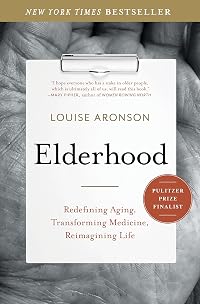
Elderhood: Redefining Aging, Transforming Medicine, Reimagining Life
by Louise Aronson
On This Page
Description
"[P]hysician and [...] author Louise Aronson's Elderhood is a [...] look at a vital but often disparaged stage of life. For more than 5,000 years, "old" has been defined as beginning between the ages of 60 and 70. That means most people alive today will spend more years in elderhood than in childhood, and many will be elders for 40 years or more. Yet at the very moment that humans are living longer than ever before, we've made old age into a disease, a condition to be dreaded, denigrated, show more neglected, and denied. [...] Harvard-trained geriatrician Louise Aronson uses stories from her quarter century of caring for patients, and draws from history, science, literature, popular culture, and her own life to weave a vision of old age that's neither nightmare nor utopian fantasy -- a vision full of joy, wonder, frustration, outrage, and hope about aging, medicine, and humanity itself. Elderhood is for anyone who is, in the author's own words, "an aging, i.e., still-breathing human being."" -- show lessTags
Recommendations









Member Reviews
I first heard about this book while I listened to an episode of Fresh Air with Terry Gross on my local National Public Radio station last year. Dr Aronson is a geriatrician on the faculty of the School of Medicine at the University of California, San Francisco, and because I was fascinated with her comments and insights about the care of elderly patients during the interview I purchased this book shortly afterward.
Louise Aronson was a nontraditional medical student, as she majored in history in an undergraduate college that did not require its students to take maths or sciences. She volunteered in a camp for South East Asian refugees, and observing doctors who worked in the camp was influential in her desire to become a physician. She show more trained in internal medicine, and her love of older people led her to specialize in geriatric medicine.
'Elderhood' is a multifaceted reexamination of old age, from the vantage points of not only medicine and science, but also history, anthropology, literature and popular culture. Aronson uses vignettes of patients who have come under her care, and her own elderly parents, to effectively demonstrate the substandard care that many older people receive in the U.S. health care system, and the medical and non-medical interventions that can help them lead better and more productive lives. She also explores the failings of modern medicine and the larger society as a whole in their treatment of the elderly. She notes that medical schools in the U.S. provide very little education about the field of geriatrics to their students, and due to the emphasis on curative over caring medicine, technological and pharmaceutical interventions over patiently listening to the stories of the elderly, subspecialty care over holistic approaches, and the disparity in pay between generalists and specialists, geriatrics is viewed as a far lesser field of medicine by medical faculty, residents, and students alike. As a result there is a severe shortage of geriatricians practicing in the United States, which is a major barrier in ensuring that most older people receive adequate medical care.
She makes a strong case for dividing older people into groups, based on their age (early, middle and advanced old age), similar to the distinctions between infants, toddlers, young children, tweens and adolescents in pediatrics. There is a huge difference between a healthy working 60 year old, a retired 75 year old with chronic but manageable health conditions living independently, and a 90 year old suffering from advanced dementia who is wheelchair bound and living in a nursing home. And, not all elderly people of similar ages are the same. We all know people in their 60s who could run circles around us, and at the same time others of the same age who will likely die soon. Serious illnesses like cancer can quickly transform an active and healthy septugenerian into a markedly aged person, and many of us have watched as a seemingly invincible older parent, relative or close friend transforms into a frail elderly adult in seemingly the blink of an eye.
Aronson describes the barriers she has faced from her immediate supervisors and the UCSF administration in trying to provide care to her patients, and that combined with her growing physical problems led to a severe case of burnout. Her frustrations with UCSF's electronic medical record system and with administrative bureaucracy match those that nearly all physicians face at some point in their careers, but she successfully overcame them and designed a workplace that was both personally fulfilling and beneficial to her elderly patients.
'Elderhood' is a refreshing, insightful and holistic analysis of the elderly from different disciplines, both within and outside of medicine, and is an excellent addition to written work about this increasingly more important population in Western societies. I was personally somewhat disappointed, though, as I unfairly expected 'Elderhood' to focus primarily on the medical aspects of the care of the elderly, and assist me in caring for my octogenarian parents. The different topics covered in this book made it seem somewhat disjointed, and her repeated insistences that elderly people need to be respected and treated differently by the medical community in particular and society at large was overkill. Despite my criticisms I highly recommend this book to medical professionals, and to those who are or soon will care for elderly parents or relatives, or enter elderhood themselves. show less
Louise Aronson was a nontraditional medical student, as she majored in history in an undergraduate college that did not require its students to take maths or sciences. She volunteered in a camp for South East Asian refugees, and observing doctors who worked in the camp was influential in her desire to become a physician. She show more trained in internal medicine, and her love of older people led her to specialize in geriatric medicine.
'Elderhood' is a multifaceted reexamination of old age, from the vantage points of not only medicine and science, but also history, anthropology, literature and popular culture. Aronson uses vignettes of patients who have come under her care, and her own elderly parents, to effectively demonstrate the substandard care that many older people receive in the U.S. health care system, and the medical and non-medical interventions that can help them lead better and more productive lives. She also explores the failings of modern medicine and the larger society as a whole in their treatment of the elderly. She notes that medical schools in the U.S. provide very little education about the field of geriatrics to their students, and due to the emphasis on curative over caring medicine, technological and pharmaceutical interventions over patiently listening to the stories of the elderly, subspecialty care over holistic approaches, and the disparity in pay between generalists and specialists, geriatrics is viewed as a far lesser field of medicine by medical faculty, residents, and students alike. As a result there is a severe shortage of geriatricians practicing in the United States, which is a major barrier in ensuring that most older people receive adequate medical care.
She makes a strong case for dividing older people into groups, based on their age (early, middle and advanced old age), similar to the distinctions between infants, toddlers, young children, tweens and adolescents in pediatrics. There is a huge difference between a healthy working 60 year old, a retired 75 year old with chronic but manageable health conditions living independently, and a 90 year old suffering from advanced dementia who is wheelchair bound and living in a nursing home. And, not all elderly people of similar ages are the same. We all know people in their 60s who could run circles around us, and at the same time others of the same age who will likely die soon. Serious illnesses like cancer can quickly transform an active and healthy septugenerian into a markedly aged person, and many of us have watched as a seemingly invincible older parent, relative or close friend transforms into a frail elderly adult in seemingly the blink of an eye.
Aronson describes the barriers she has faced from her immediate supervisors and the UCSF administration in trying to provide care to her patients, and that combined with her growing physical problems led to a severe case of burnout. Her frustrations with UCSF's electronic medical record system and with administrative bureaucracy match those that nearly all physicians face at some point in their careers, but she successfully overcame them and designed a workplace that was both personally fulfilling and beneficial to her elderly patients.
'Elderhood' is a refreshing, insightful and holistic analysis of the elderly from different disciplines, both within and outside of medicine, and is an excellent addition to written work about this increasingly more important population in Western societies. I was personally somewhat disappointed, though, as I unfairly expected 'Elderhood' to focus primarily on the medical aspects of the care of the elderly, and assist me in caring for my octogenarian parents. The different topics covered in this book made it seem somewhat disjointed, and her repeated insistences that elderly people need to be respected and treated differently by the medical community in particular and society at large was overkill. Despite my criticisms I highly recommend this book to medical professionals, and to those who are or soon will care for elderly parents or relatives, or enter elderhood themselves. show less
This is a big, ambitious book that is worth reading by anyone facing old age, which is everyone. San Francisco geriatrician Louise Aronson mines her decades of experience working with elderly patients to reveal nuggets of wisdom and hope, as well as a challenge for the American Healthcare System to do better. Unfortunately, the book is at least 150 pages too long. While the insights are keen and the anecdotes and case studies rich with illustration, it is often repetitive and gets sidetracked into like a memoire.
Those closer to (or in) the third act of life (after childhood and adulthood), should benefit from a better understanding of what to expect and plan for. I hope younger readers will gain a better understanding and appreciation show more of their possible future and what their elders are facing now. show less
Those closer to (or in) the third act of life (after childhood and adulthood), should benefit from a better understanding of what to expect and plan for. I hope younger readers will gain a better understanding and appreciation show more of their possible future and what their elders are facing now. show less
At over 450 pages ELDERHOOD by San Francisco geriatrician Louise Aronson, is a big book. It’s an ambitious one, too. In the opening pages, the author states her intention to highlight relevant information from many disciplines about the last of the three acts in a human life: old age. (Childhood and adulthood are acts one and two respectively.) As the pages turn, several key themes emerge. One is that geriatrics (as a medical specialty) lags behind most others. Caring for the elderly has low status, it is not prioritized by the health-care system, and geriatricians are poorly remunerated relative to other specialties.
Like childhood, old age consists of a number of stages, but people only seem to realize this when they live them. What show more is generally true, however, is that the medical care of elders needs to be different from that of adults. The heroics, technical fixes, and dedication to saving lives for which modern medicine prides itself are of more benefit to people in the first and second acts of their lives than to those in the third. Insurance companies are another part of the problem. They will reimburse for chemotherapy and dialysis (which can be punishing treatments for the old), but not for basic services that would improve the health and daily functioning of elders with chronic diseases or debilitating conditions. Palliative care and hospice are also grossly underfunded. Clearly, a revolution—a complete system overhaul—is in order. Unfortunately, Dr. Aronson doesn’t offer many ideas as to how this might be achieved..
Since the life span of most in the developed world has essentially doubled over the last century (largely due to advances in public health/sanitation), a lot of us would benefit (when the time comes) from being cared for by a geriatrician, a physician who understands the critical social and psychological dimensions of aging, the changes in physiology that accompany old age, and the ways in which care (including pharmacological treatment) needs to be tailored for safety. An appropriate dose of a drug (for hypertension, depression, or arthritis) for a fifty-year-old can be dangerous, even deadly, for an eighty-year-old.
For me, the strength of Dr. Aronson’s book is in the stories of her interactions with patients at various stages of elderhood. The author uses case studies well to illustrate key points and dilemmas.
In the end, I feel the author attempted a bit too much here. As well as dozens of stories, there are elements of memoir and long sections on the challenges of practising modern medicine—particularly burn-out, from which the author herself suffered. While I did learn a great deal from the book, I believe the audience and topic would have been better served with a briefer, more focused discussion. show less
Like childhood, old age consists of a number of stages, but people only seem to realize this when they live them. What show more is generally true, however, is that the medical care of elders needs to be different from that of adults. The heroics, technical fixes, and dedication to saving lives for which modern medicine prides itself are of more benefit to people in the first and second acts of their lives than to those in the third. Insurance companies are another part of the problem. They will reimburse for chemotherapy and dialysis (which can be punishing treatments for the old), but not for basic services that would improve the health and daily functioning of elders with chronic diseases or debilitating conditions. Palliative care and hospice are also grossly underfunded. Clearly, a revolution—a complete system overhaul—is in order. Unfortunately, Dr. Aronson doesn’t offer many ideas as to how this might be achieved..
Since the life span of most in the developed world has essentially doubled over the last century (largely due to advances in public health/sanitation), a lot of us would benefit (when the time comes) from being cared for by a geriatrician, a physician who understands the critical social and psychological dimensions of aging, the changes in physiology that accompany old age, and the ways in which care (including pharmacological treatment) needs to be tailored for safety. An appropriate dose of a drug (for hypertension, depression, or arthritis) for a fifty-year-old can be dangerous, even deadly, for an eighty-year-old.
For me, the strength of Dr. Aronson’s book is in the stories of her interactions with patients at various stages of elderhood. The author uses case studies well to illustrate key points and dilemmas.
In the end, I feel the author attempted a bit too much here. As well as dozens of stories, there are elements of memoir and long sections on the challenges of practising modern medicine—particularly burn-out, from which the author herself suffered. While I did learn a great deal from the book, I believe the audience and topic would have been better served with a briefer, more focused discussion. show less
I made it through a little more than half of this book before bailing on it, something I seldom do. It began to become more about the author than the subject: elder medicine. Being a 72-year-old with many of the maladies mentioned in the book, I was interested to learn about the medical care that affected me: geriatric medicine. And I did learn a lot, but the book was too long and became, as I said, as much about the author’s personal psychological and physical problems as about her field of choice. Even having not finished the book, I did take away several points. First, geriatric medicine earns little respect either in the medical field or in society in general. This coincides with the general lack of respect for older citizens in show more society today. Second, the field of geriatric medicine doesn’t received the support it deserves, and facilities that care for older Americans (“assisted care,” nursing homes, etc.) are woefully unregulated and often ignored to the detriment of the older people housed there. As Baby Boomers age, ignoring elder care is just not going to be possible. Our numbers will make that unfeasible. However, whether additional attention improves geriatrics is another thing all together. show less
This is a book to be read by anyone ---no one escapes the aging process and Aronson provides wonderful descriptions of what is happening and how we have arrived at the current condition(s) we are in as far as treating each person as a human being first and a medical problem second. Have we lost the word "caring" in the effort to solve changes in bodies over time? This book needs to be absorbed by anyone who is already IN the medical field as an occupation ---where do you fit in the picture she presents? Unfortunately, we need change faster than it can possibly happen, given the numbers and speed at which the older population is becoming just that...older. It's hard to imagine anyone being happy with the current state of health of show more "medicine," and it's obvious in the numbers experiencing "burnout." I'm just glad Aronson provided a place to start with this book. show less
First, the negatives. I am so glad to be done with this 300-page book. Did this woman have any editor whatsoever? She must have put down every single thought on the subject of elderliness that ever entered her mind.
Now the positives. I liked learning about geriatrics. I feel a geriatrician is exactly what my mother-in-law needs - a whole-person doctor. (If only I could get her out of the house to see one.)
And I did feel inspired to bookmark one thing. Why do we all hesitate to call ourselves "old"? "Imagine a forty- or fifty-year-old saying, 'I don't like to think of myself as an adult. I'm just a kid who's been around a few extra years.'" Well, actually, I can and do know at least one person who's said something to that effect, so, not show more so shocking... "Or a children's hospital that eschews the term 'child' because of its association with immaturity, and instead markets itself as serving short, unemployed people." OK, that part is funny to imagine. show less
Now the positives. I liked learning about geriatrics. I feel a geriatrician is exactly what my mother-in-law needs - a whole-person doctor. (If only I could get her out of the house to see one.)
And I did feel inspired to bookmark one thing. Why do we all hesitate to call ourselves "old"? "Imagine a forty- or fifty-year-old saying, 'I don't like to think of myself as an adult. I'm just a kid who's been around a few extra years.'" Well, actually, I can and do know at least one person who's said something to that effect, so, not show more so shocking... "Or a children's hospital that eschews the term 'child' because of its association with immaturity, and instead markets itself as serving short, unemployed people." OK, that part is funny to imagine. show less
There are a number of problems with the way society deals with aging, and Aronson covers them here. There are few drug trials that use older people; most trials are designed around middle aged, white, males. There is no one storage place of medical records, which creates a problem when a patient must go to a new provider or seeks emergency treatment. Medicare won’t cover hearing aids or glasses, but will cover cochlear implants or eye operations, much more expensive and invasive options. It’s easier to get chemotherapy paid for than palliative care (and hospice is underfunded; ours has to do fundraisers for all the things it provides that Medicare doesn’t pay for). Geriatricians are paid lower than most other medical specialties. show more And many more.
Sadly, Aronson does not offer solutions for all these things. Some things- such as affordable housing for the aging population that keeps them safe but allows independence- probably have no easy solutions. But she offers a lot to think about, a lot of things to start the conversation about these problems and how to remedy them.
The author is a geriatrician and has been caregiver to an aging mother. She, herself, is officially ‘old’. For a good while, she was a home visit physician and saw all manner of situations the elderly were living in- some horrific, but with no affordable way to change them. She is well placed to write about the care of the aging population.
It’s an interesting and accessible read, despite the technical subjects. But it has its flaws; it wanders at times, and it’s a bit long on the author’s education and how she found her way to gerontology. I found some sections slow reading- but that is due to my own interests, not a problem with the writing. I feel it’s an important book; 10,000 people turn 65 every single day in the US alone, and all should be treated with dignity and good care (as should everyone, of any age or medical status). This book stands as a wake-up call. show less
Sadly, Aronson does not offer solutions for all these things. Some things- such as affordable housing for the aging population that keeps them safe but allows independence- probably have no easy solutions. But she offers a lot to think about, a lot of things to start the conversation about these problems and how to remedy them.
The author is a geriatrician and has been caregiver to an aging mother. She, herself, is officially ‘old’. For a good while, she was a home visit physician and saw all manner of situations the elderly were living in- some horrific, but with no affordable way to change them. She is well placed to write about the care of the aging population.
It’s an interesting and accessible read, despite the technical subjects. But it has its flaws; it wanders at times, and it’s a bit long on the author’s education and how she found her way to gerontology. I found some sections slow reading- but that is due to my own interests, not a problem with the writing. I feel it’s an important book; 10,000 people turn 65 every single day in the US alone, and all should be treated with dignity and good care (as should everyone, of any age or medical status). This book stands as a wake-up call. show less
Members
- Recently Added By
Lists

2020 Notable Books for Adults
26 works; 5 members

Science: Health & Medical
100 works; 1 member

Club Read's Recommended Nonfiction Written by Women
618 works; 30 members
Author Information
2 Works 384 Members
Louise Aronson, Md, MFA, is a leading geriatrician, educator, and professor of medicine at the University of California, San Francisco (UCSF), where she directs UCSF Medical Humanities. A graduate of Harvard Medical School, Dr. Aronson has received the Gold Professorship in Humanism in Medicine, the California Home Care Physician of the Year show more Award, the American Geriatrics Society Outstanding Mid-Career Clinician Educator of the Year Award, and was named one of Next Avenue's 2019 Influencers in Aging. She is the author of A History of the Present Illness and her articles and stories have appeared in many publications, including the New York Times, the New England Journal of Medicine, the Lancet, and the Atlantic. She lives in San Francisco. show less
Awards and Honors
Awards
Distinctions
Common Knowledge
- Quotations
- For every hour they spend face-to-face with patients, doctors now spend two to three hours on the electronic medical record, or EMR. They also spend "pajama time" at home at night finishing electronic notes they can't finish ... (show all)during their long workdays. Many of us lament this. Much less discussed is how technology that has undermined efficiency and the doctor-patient relationship bwcame the national standard. Or why medicine bought electronic record systems from businesses with vastly different priorities from those of clinicians and patients, or why, having seen the harm to clinicians in systems that already adopted that technology, more and more organizations followed suit. Instead, we discuss the alarming, increasing rates that doctors get sick, take drugs, get divorced, and leave medicine, and how they commit suicide at rates higher than the general population. We institute programs on wellness and resilience, but don't change anything fundamental about the priorities and systems that make such programs necessary. We blame the victims. (pp 217-8)
Classifications
- Genres
- Nonfiction, General Nonfiction, Health & Wellness, Biography & Memoir
- DDC/MDS
- 362.60973 — Society, government, & culture Social problems and social services Social Welfare Older people — Care
- LCC
- RA564.8 .A76 — Medicine Public aspects of medicine Public aspects of medicine Public health. Hygiene. Preventive medicine
- BISAC
Statistics
- Members
- 309
- Popularity
- 103,552
- Reviews
- 9
- Rating
- (3.79)
- Languages
- English
- Media
- Paper, Audiobook, Ebook
- ISBNs
- 7
- ASINs
- 1