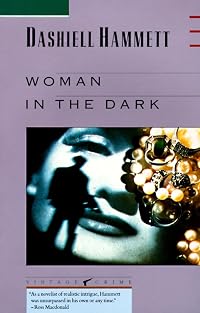
Woman in the Dark
by Dashiell Hammett
On This Page
Description
A frightened and hurt woman appears at the door of an isolated house where she is taken in. Other strangers come looking for her with an aura of violence.Tags
Recommendations



























Member Reviews
This particular work seems to defy classification. It is often listed among Dashiell Hammett’s novels, perhaps because it is subtitled “A Novel of Dangerous Romance.” Originally published in three parts in Liberty magazine in 1933, in my copy (Vintage Crime, 1989) and presumably in the Hardcover that preceded it, the publishers did everything possible to create a more substantial-looking book. There are generous bottom and right-side margins and the title of each of the three parts has its own title page, and a matching blank page. Add an introduction by Robert B. Parker--with its own title and blank page too--and you get a story that concludes on page 78. It ain’t a novel.
Personal classification is also an issue. I can’t show more group it with lesser works like The Dain Curse or The Glass Key. Neither is it a masterpiece like The Maltese Falcon. Nor does it contain the layers of The Thin Man. Red Harvest comes closest with its one man (for the most part) and his attempt to bring down a corrupt town.
But in Woman in the Dark the male protagonist is not an investigator. Brazil (no first name mentioned) is an ex-can, and his trouble with the power structure is forced upon him when he comes to the defense of the Luise Fisher, for whom the book is titled. They end up on the run; Brazil from the law, Luise from a man who thinks he owns her. But there’s a reason I say “male protagonist.” About half way through the book, when Brazil is rendered ineffective, Luise becomes the story’s lead. New to this country by a couple of weeks, at first she is confused and helpless. Once confrontations move into arenas through which she knows how to navigate, however, Luise stands tall. In a stark world where bad guys are good, good guys are bad, and the rich and powerful blatantly use and abuse the system, she strides toward reuniting with Brazil in such a way that they are both free from pursuit.
If the ending comes off as a tad convenient by today’s standards, remember that it conforms to the storytelling norms of the day. Besides, it’s Hammett. Even his lesser work is interesting. And Woman in the Dark is far from the worst of it. show less
Personal classification is also an issue. I can’t show more group it with lesser works like The Dain Curse or The Glass Key. Neither is it a masterpiece like The Maltese Falcon. Nor does it contain the layers of The Thin Man. Red Harvest comes closest with its one man (for the most part) and his attempt to bring down a corrupt town.
But in Woman in the Dark the male protagonist is not an investigator. Brazil (no first name mentioned) is an ex-can, and his trouble with the power structure is forced upon him when he comes to the defense of the Luise Fisher, for whom the book is titled. They end up on the run; Brazil from the law, Luise from a man who thinks he owns her. But there’s a reason I say “male protagonist.” About half way through the book, when Brazil is rendered ineffective, Luise becomes the story’s lead. New to this country by a couple of weeks, at first she is confused and helpless. Once confrontations move into arenas through which she knows how to navigate, however, Luise stands tall. In a stark world where bad guys are good, good guys are bad, and the rich and powerful blatantly use and abuse the system, she strides toward reuniting with Brazil in such a way that they are both free from pursuit.
If the ending comes off as a tad convenient by today’s standards, remember that it conforms to the storytelling norms of the day. Besides, it’s Hammett. Even his lesser work is interesting. And Woman in the Dark is far from the worst of it. show less
This is a novella length story originally published in Liberty Magazine in 1933, but republished as a paperback in the early 1950's probably 1951. It is 76 pages of Hammet's hard boiled; not a wasted word style. A woman breaks the heel of her shoe hurrying down the road in pouring rain. She makes it to the front door of a house and knocks to be let in. Brazil a large man shouts out to come in and Luise Fischer enters the room. Brazil summons the young Evelyn to tend to Luis's ankle and shows no surprise when there are further knocks to his front door and two men enter who have been trailing Luise. A dog: a Great Dane is shot, Brazil gets angry and punches the shooter who falls to the ground cracking his head on the stone fireplace. show more Nobody panics, but Brazil and Luise decide it's time to find a safe house before the police arrive.
A few more characters are added to the mix as Brazil and Luise try and straighten things out, but only succeed in getting deeper in the mire. The story would make an excellent one act play as the dialogue seems to have a rhythm all of its own moving from laconic to tense and back again. It all ends in a bit of a rush in a non too convincing denouement. The story has its moments, but not all the characters are developed satisfactorily to satisfy the demands of the plot. It feels a bit of a throwaway and so 3.5 stars for its unique style. show less
A few more characters are added to the mix as Brazil and Luise try and straighten things out, but only succeed in getting deeper in the mire. The story would make an excellent one act play as the dialogue seems to have a rhythm all of its own moving from laconic to tense and back again. It all ends in a bit of a rush in a non too convincing denouement. The story has its moments, but not all the characters are developed satisfactorily to satisfy the demands of the plot. It feels a bit of a throwaway and so 3.5 stars for its unique style. show less
Dashiell Hammett was one of the pre-eminent American writers of the early 20th Century; arguably, he invented the hardboiled detective genre with such works as “The Maltese Falcon” and “The Continental Op.” “Woman in the Dark,” published in a magazine in 1933 and subsequently as a pulp paperback in the 1950s, is a novella about, well, a woman who appears out of the dark and messes up the life of Brazil, an ex-con trying to live his life. It’s slight, but showcases all of the hallmarks of this type of fiction: the mysterious, perhaps lethal, woman, the man on the run, the mob or mob-type bad guys and the cops, who might also be bad guys too. I found a hardcover edition published by Knopf in 1988 in a local free book box - a show more total fluke, meaning I have no idea if it’s findable in any way other than serendipity, but if you do come across it, you’ll have an enjoyable (if sexist) experience for half an hour or so; recommended! show less
You've got to laugh at the academic industry - this book is as thin as they come, but it warrants an academic introduction because? It's hard to answer that. It doesn't deserve one. It reads like something churned out for a pulp and that's just what it was.
Hammett is an important writer, but I don't think that means we have to behave as if every time he wrote out a shopping list posterity was the winner. Save your limited reading time on this earth for something else.
I did, by the way, put it on my 'better written than HP' shelf, but only after due consideration.
Hammett is an important writer, but I don't think that means we have to behave as if every time he wrote out a shopping list posterity was the winner. Save your limited reading time on this earth for something else.
I did, by the way, put it on my 'better written than HP' shelf, but only after due consideration.
*Partial spoilers ahead*
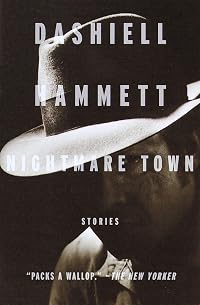
A pretty skimpy little item to have been published as a standalone book, Woman in the Dark (1933) would fit more comfortably in a collection like Nightmare Town or The Big Knockover, alongside an unfinished fragment like "The First Thin Man" or "Tulip". This barely novella-length story has an ending, but doesn't distinguish itself in any particular sense. It's easy to overlook the shallow unpleasantness of the characters in Dashiell Hammett's major works, but that shallowness really begins to grate when combined with mediocre writing. Even Robert B. Parker seems to have had trouble working up any enthusiasm for the story in his introduction. While there are a couple of gritty moments that recall the Hammett of show more old (such as when Brazil and his lady friend Luise, fleeing from the law, turn to Brazil's old friends the Links for help), the hard-boiled element is underplayed in favor of romance. The result, as I'm sure you've gathered by now, is less than spectacular.
For Hammett completists only. The film version (starring Ralph Bellamy, Fay Wray and Melvyn Douglas) is competent but similarly blah. show less
A pretty skimpy little item to have been published as a standalone book, Woman in the Dark (1933) would fit more comfortably in a collection like Nightmare Town or The Big Knockover, alongside an unfinished fragment like "The First Thin Man" or "Tulip". This barely novella-length story has an ending, but doesn't distinguish itself in any particular sense. It's easy to overlook the shallow unpleasantness of the characters in Dashiell Hammett's major works, but that shallowness really begins to grate when combined with mediocre writing. Even Robert B. Parker seems to have had trouble working up any enthusiasm for the story in his introduction. While there are a couple of gritty moments that recall the Hammett of show more old (such as when Brazil and his lady friend Luise, fleeing from the law, turn to Brazil's old friends the Links for help), the hard-boiled element is underplayed in favor of romance. The result, as I'm sure you've gathered by now, is less than spectacular.
For Hammett completists only. The film version (starring Ralph Bellamy, Fay Wray and Melvyn Douglas) is competent but similarly blah. show less
Enjoyable but extremely slight (76 pp.) late novel by Dashiell Hammett has his trademark style and hardboiled attitude, but this is really a novella, if that. More like a long short story. It revolves around a kept woman escaping from her tormentor and the tough ex-con who tries to rescue her. It's always good to read Hammett, but this is decidedly a lesser work on many scores.
A mysterious woman with a hurt ankle appears at Brazil's house late one night. He's never seen her before but she's clearly frightened, and soon two men arrive and try to coax her away. Brazil has some experience with guys like this, so he knows how to sneak her away to a good hideout.
Originally published in three magazine installments, this novella was somehow lost for twenty years. It's a decent story that has tension and little flashes of humor.
Originally published in three magazine installments, this novella was somehow lost for twenty years. It's a decent story that has tension and little flashes of humor.
Members
- Recently Added By
Lists

Books Read in 2025
4,128 works; 98 members
Author Information

363+ Works 32,366 Members
Samuel Dashiell Hammett was born on May 27, 1894 in St Mary's County, Maryland. Raised in Baltimore and Philadelphia, he attended Baltimore Polytechnic until he was 13 years old, but was forced to drop out and work a series of jobs to help support his family. At the age of 21 Hammett was hired by the Pinkerton National Detective Agency as an show more operative. After a stint in the United States Army during World War II, he married a nurse named Josephine Annas Dolan, whom he met when he fell ill with tuberculosis. In 1922, Hammett began writing for Black Mask magazine. Using his background in detective work, he created the tough guy detective characters Sam Spade and the Continental Op, as well as debonair sleuths Nick and Nora Charles. By 1927, Hammett had written the Poisonville series, which later became the novel Red Harvest. He wrote more than 85 short stories and five novels during his lifetime. The novels include The Dain Curse, The Glass Key, The Thin Man, and The Maltese Falcon, which was later adapted into a classic movie starring Humphrey Bogart. He also wrote an autobiography entitled Beams Falling: The Art of Dashiell Hammett. After his marriage faltered in the late 1920s, Hammett met Lillian Hellman, then a married 24-year-old aspiring playwright. In 1930, Hellman left her husband for Hammett. Eventually they both divorced their spouses and, although the two never married, they remained together until Hammett's death on January 10, 1961. (Bowker Author Biography) show less
Some Editions
Series
Belongs to Publisher Series
Work Relationships
Has the adaptation
Common Knowledge
- Canonical title
- Woman in the Dark
- Original title
- Woman in the Dark
- Alternate titles
- Woman in the Dark: A Novel of Dangerous Romance
- Original publication date
- 1933
- People/Characters
- Brazil; Luise Fischer; Kane Robson; Conroy; Link; Fan
- Related movies
- Woman in the Dark (1934 | IMDb)
- First words
- Her right ankle turned under her and she fell.
- Last words
- (Click to show. Warning: May contain spoilers.)Luise Fischer took off her rings and put them on the floor beside Robson's left foot.
- Original language
- English
Classifications
Statistics
- Members
- 653
- Popularity
- 44,364
- Reviews
- 27
- Rating
- (3.37)
- Languages
- 11 — Catalan, Czech, Danish, English, Finnish, French, German, Greek, Italian, Portuguese, Spanish
- Media
- Paper, Ebook
- ISBNs
- 33
- ASINs
- 6