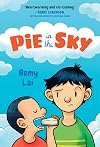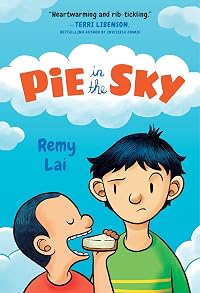
Pie in the Sky
by Remy Lai
On This Page
Description
Knowing very little English, eleven-year-old Jingwen feels like an alien when his family immigrates to Australia, but copes with loneliness and the loss of his father by baking elaborate cakes.Tags
Recommendations



Member Reviews
When Jinwen moves with his mother and brother to Australia, he just cannot fit into this new place. It doesn’t feel like another country -- it feels like another planet. He doesn’t understand English well enough to get on, and it feels like everyone around him is a Martian. The one thing that makes him feel better is baking cakes with his little brother Yanghao. Problem is, their Mama has forbidden them to bake cakes on their own. But how else will Jinwen ever feel okay again?
This story is the perfect blend of sweet and salty, as Jinwen eventually realizes is the recipe for a delicious cake. Jinwen is dealing with guilt and grief over his father’s death, yet the book does not feel dark or heavy. His struggles to make friends at show more school will surely be relatable to many a young reader, even if the specifics of his situation are a little bit different. Yanghao is a constant source of comic relief, and the descriptions of the cakes will leave your mouth watering for a sweet treat. In general, you will become attached to those two characters (and the side characters as well) and be loath to leave them when the book ends.
I thought it was a very important message, told early on, that learning a new language is difficult and can make others seem unapproachable. Furthermore, as Jinwen points out, the shoe can easily be on the other foot -- he feels like the English-speaking Australians are speaking Martian, but he realizes that he and his brother speaking their native language probably sounds like Martian to the English speakers.
Listening to the audiobook, I was wondering how the weird whirls and clicks to indicate the English words Jinwen doesn't understand would be presented in the print book. I ended up consulting a print version of the book and discovered that it is full of pictures! Some of these are in an almost comic book style and definitely add to the story. (For the record, the dialogue from these panels is read aloud in the audiobook, but the imagery really helps sell the story, showing more of Jinwen's emotional states.) For some reason, the audiobook narrator uses an Australian accent even though Jinwen and his family are not Australian*; an odd choice but otherwise he did a really good job of bringing the story alive, with emotion, different voices, etc.
Another thing I liked about the print book was that the words Jinwen and others do use in English are the words that are italicized, a bit of a twist from when words in a non-English are italicized in the text. My one complaint with the language is that it does use some mild oaths like "crap" and "fudge," It's not a huge deal and some caregivers/parents might not mind at all, but I'm not a huge fan of that being in a book for kids. It's about the only reason I dinged the book half a star.
The story itself will appeal to fans of Wonder and the mixed textual prose-comic illustrations style will appeal to fans of Invisible Emmie and Diary of a Wimpy Kid.
*Jinwen and his family's home country is never explicitly stated. I've seen at least one review say China, but I'm not 100% sure of that. At one point, Yanghao responds to no language spoken to him, including Mandarin or Cantonese. Also, the author's blurb biography says she was born in Indonesia and grew up in Singapore, so it seems one of those countries might be more likely. show less
This story is the perfect blend of sweet and salty, as Jinwen eventually realizes is the recipe for a delicious cake. Jinwen is dealing with guilt and grief over his father’s death, yet the book does not feel dark or heavy. His struggles to make friends at show more school will surely be relatable to many a young reader, even if the specifics of his situation are a little bit different. Yanghao is a constant source of comic relief, and the descriptions of the cakes will leave your mouth watering for a sweet treat. In general, you will become attached to those two characters (and the side characters as well) and be loath to leave them when the book ends.
I thought it was a very important message, told early on, that learning a new language is difficult and can make others seem unapproachable. Furthermore, as Jinwen points out, the shoe can easily be on the other foot -- he feels like the English-speaking Australians are speaking Martian, but he realizes that he and his brother speaking their native language probably sounds like Martian to the English speakers.
Listening to the audiobook, I was wondering how the weird whirls and clicks to indicate the English words Jinwen doesn't understand would be presented in the print book. I ended up consulting a print version of the book and discovered that it is full of pictures! Some of these are in an almost comic book style and definitely add to the story. (For the record, the dialogue from these panels is read aloud in the audiobook, but the imagery really helps sell the story, showing more of Jinwen's emotional states.) For some reason, the audiobook narrator uses an Australian accent even though Jinwen and his family are not Australian*; an odd choice but otherwise he did a really good job of bringing the story alive, with emotion, different voices, etc.
Another thing I liked about the print book was that the words Jinwen and others do use in English are the words that are italicized, a bit of a twist from when words in a non-English are italicized in the text. My one complaint with the language is that it does use some mild oaths like "crap" and "fudge," It's not a huge deal and some caregivers/parents might not mind at all, but I'm not a huge fan of that being in a book for kids. It's about the only reason I dinged the book half a star.
The story itself will appeal to fans of Wonder and the mixed textual prose-comic illustrations style will appeal to fans of Invisible Emmie and Diary of a Wimpy Kid.
*Jinwen and his family's home country is never explicitly stated. I've seen at least one review say China, but I'm not 100% sure of that. At one point, Yanghao responds to no language spoken to him, including Mandarin or Cantonese. Also, the author's blurb biography says she was born in Indonesia and grew up in Singapore, so it seems one of those countries might be more likely. show less
This middle grade novel follows 12-year-old Jingwen and his 9-year-old brother Yanghao as they secretly make cakes while their mom is at work following their move from China to Australia. While Yanghao seems to quickly learn English, adapt to their new home, and make friends, Jingwen seemingly lags behind his peers as he struggles with English, is bullied for not understanding them, and struggles to process the grief of losing his father and moving to Australia without him.
In this cathartic and fast-paced novel, written in the style of Diary of a Wimpy Kid, Lai shows her readers a wide range of emotions and a glimpse into a child immigrant's experience learning a language for the first time. The language-learning process is depicted show more extremely well, with the illustrations showing alien-like characters and meaningless symbols whenever someone says something Jingwen does not understand or whenever he feels excluded. It challenges the false assumption that just because a language learner is a child, they will automatically learn quickly, instead showcasing just how much time and effort is required, both by the child and the adults around them to support their learning journey. It also shows how libraries and schools can work to support parents of language learners, providing a wide range of learning experiences and opportunities.
This review is also posted to my school project's website: Language Learners in the Library show less
In this cathartic and fast-paced novel, written in the style of Diary of a Wimpy Kid, Lai shows her readers a wide range of emotions and a glimpse into a child immigrant's experience learning a language for the first time. The language-learning process is depicted show more extremely well, with the illustrations showing alien-like characters and meaningless symbols whenever someone says something Jingwen does not understand or whenever he feels excluded. It challenges the false assumption that just because a language learner is a child, they will automatically learn quickly, instead showcasing just how much time and effort is required, both by the child and the adults around them to support their learning journey. It also shows how libraries and schools can work to support parents of language learners, providing a wide range of learning experiences and opportunities.
This review is also posted to my school project's website: Language Learners in the Library show less
"Two brothers navigate a new country, a new language, and grief through cake.
In this graphic/prose hybrid novel, 12-year-old Jingwen, his little brother, Yanghao, and their mother immigrate to Australia. The family is Chinese, though their home country is never specified. The boys start at the Northbridge Primary School not knowing any English, which has Jingwen feeling they have just arrived on Mars. Quickly he realizes it is he and Yanghao who must appear to be the Martians to everyone else, comically literalized with pictures of a four-eyed, antennae’d Jingwen. While Yanghao quickly picks up English, Jingwen resists, struggling in lessons and to make friends. Piece by piece readers learn it was Jingwen’s father’s dream to open show more a cake shop called Pie in the Sky in Australia before he suddenly passed away. After finding the family’s cookbook, the boys decide to secretly bake all the Pie in the Sky cakes. Jingwen especially takes it to heart, pouring his grief and frustrations into every frosted layer, believing that it “will fix everything.” Herself an immigrant to Australia from Singapore, Lai unfolds the story like a memory, giving brief flashbacks interspersed throughout the daily musings and nuanced relationships among family members. Jingwen’s emotional journey is grounded in honest reality; it ebbs and flows naturally with strategic spots of humor to lighten the overall tone.
Like salted caramel, a perfect balance of flavors, this deftly drawn story is a heartfelt treat. (Graphic/fiction hybrid. 10-13)" A Kirkus Starred Review, www.kirkusreviews.com show less
In this graphic/prose hybrid novel, 12-year-old Jingwen, his little brother, Yanghao, and their mother immigrate to Australia. The family is Chinese, though their home country is never specified. The boys start at the Northbridge Primary School not knowing any English, which has Jingwen feeling they have just arrived on Mars. Quickly he realizes it is he and Yanghao who must appear to be the Martians to everyone else, comically literalized with pictures of a four-eyed, antennae’d Jingwen. While Yanghao quickly picks up English, Jingwen resists, struggling in lessons and to make friends. Piece by piece readers learn it was Jingwen’s father’s dream to open show more a cake shop called Pie in the Sky in Australia before he suddenly passed away. After finding the family’s cookbook, the boys decide to secretly bake all the Pie in the Sky cakes. Jingwen especially takes it to heart, pouring his grief and frustrations into every frosted layer, believing that it “will fix everything.” Herself an immigrant to Australia from Singapore, Lai unfolds the story like a memory, giving brief flashbacks interspersed throughout the daily musings and nuanced relationships among family members. Jingwen’s emotional journey is grounded in honest reality; it ebbs and flows naturally with strategic spots of humor to lighten the overall tone.
Like salted caramel, a perfect balance of flavors, this deftly drawn story is a heartfelt treat. (Graphic/fiction hybrid. 10-13)" A Kirkus Starred Review, www.kirkusreviews.com show less
This made me equal parts hungry, heartsore, and happy.
First, I want to note that while this is sometimes classified as a graphic novel, there is more prose here than illustrations (though there are illustrations scattered throughout).
Eleven year old Jingwen, new to Australia along with his mom and little brother, struggles to adjust to using a new language, making friends proves challenging, and he’s still coming to terms with the loss of his father. The only place Jingwen finds solace is baking the special cakes his father intended to use for their dream “Pie In The Sky” bakery. Jingwen feels so good baking the first one, that he begins to see baking the cakes as the solution to all his problems, but mostly it creates other show more problems, including going against his mother’s rule about using the oven while she’s at work.
I thought this was really well-paced, the gradual reveal of the significance of those cakes, particularly the rainbow one (recipe included), the guilt Jingwen carries over his father’s passing, and Jingwen’s overall growth. This is a kid who keeps his worries and his vulnerabilities bottled up, it’s believable how deep a hole he digs for himself before he’s willing to talk through his problems.
Pie In The Sky is affecting nearly every step of the way, you cringe at Jingwen’s obviously misguided choices, you feel for the kid in his frustrations with and misunderstanding of English, your heart goes out to him in his tentative steps towards friendship, and in the moments where it hits him just how much he does care for his little pain of a brother. Jingwen spends much of this book in misery, feeling alone and alien, anxious over school, anxious over the language barrier, anxious over all the lying he’s done, but it’s a journey that reaches a well-earned uplifting conclusion. show less
First, I want to note that while this is sometimes classified as a graphic novel, there is more prose here than illustrations (though there are illustrations scattered throughout).
Eleven year old Jingwen, new to Australia along with his mom and little brother, struggles to adjust to using a new language, making friends proves challenging, and he’s still coming to terms with the loss of his father. The only place Jingwen finds solace is baking the special cakes his father intended to use for their dream “Pie In The Sky” bakery. Jingwen feels so good baking the first one, that he begins to see baking the cakes as the solution to all his problems, but mostly it creates other show more problems, including going against his mother’s rule about using the oven while she’s at work.
I thought this was really well-paced, the gradual reveal of the significance of those cakes, particularly the rainbow one (recipe included), the guilt Jingwen carries over his father’s passing, and Jingwen’s overall growth. This is a kid who keeps his worries and his vulnerabilities bottled up, it’s believable how deep a hole he digs for himself before he’s willing to talk through his problems.
Pie In The Sky is affecting nearly every step of the way, you cringe at Jingwen’s obviously misguided choices, you feel for the kid in his frustrations with and misunderstanding of English, your heart goes out to him in his tentative steps towards friendship, and in the moments where it hits him just how much he does care for his little pain of a brother. Jingwen spends much of this book in misery, feeling alone and alien, anxious over school, anxious over the language barrier, anxious over all the lying he’s done, but it’s a journey that reaches a well-earned uplifting conclusion. show less
I'm kind of tempted to go back and reread books from my childhood, because I swear I don't remember them doing such a good job of balancing so many issues as some of the ones I've read recently (this one, Stargazing, This Was Our Pact) without distracting or detracting from a great story.
Jingwen is almost twelve and his zany, super-energetic little brother Yanghao is almost ten when they move with their mother to Australia. Jingwen's dad had dreamed of opening a cake shop called Pie in the Sky there--fancier than the one he runs at home--but after he died in a car crash, Jingwen's mother decides to bring the boys herself. She works in a bakery and barely gets a half hour with them between school and work on weekdays, so she trusts show more Jingwen to get his homework done and corral his brother for dinner and a shower...both of which would be easier said than done even if Jingwen wasn't giving up on ever learning English and instead fixating on recreating all the signature cakes that would have been on the Pie in the Sky menu as a way to keep his father's memory alive.
Despite his mother's strict warning not to cook while she's out, Jingwen and Yanghao sneak to the grocery store, hide supplies under their beds, throw open the windows to air out the scent, and devour whole cakes before she gets back from work. For Yanghao, it's just fun and delicious, but for Jingwen, who (sometimes literally, with Lai's cute illustrations) views either his family or English-speakers as aliens (depending on the circumstances), it becomes a way to hide from how poorly he is doing in school, how much trouble he has making friends, how many lies he’s telling, and how far behind his brother he is at picking up English.
If all that sounds heavy, it is...but it's also very, very funny. Yanghao's antics are great and Jingwen has a kind of offbeat-lite sense of humor. Both characters do seem to speak a few years younger than they are—I can’t imagine a 12-year old calling someone a “booger” rather than a rather nastier word, and Jingwen seems just a little too hyperactive for a 9-year-old (though, admittedly, my sample of my sister and her friends is a little dated at this point)—but Yanghao’s inner dialog reveals a much more mature and complicated inner life of emotions and misinterpretations. We get a literal window into this world with Lai’s illustrations, which are not skippable but instead contribute important pieces of the story, often with word bubbles. Lai conveys Yanghao’s (lack of) understanding of English with cryptic-looking characters surrounding the few English words he knows. show less
Jingwen is almost twelve and his zany, super-energetic little brother Yanghao is almost ten when they move with their mother to Australia. Jingwen's dad had dreamed of opening a cake shop called Pie in the Sky there--fancier than the one he runs at home--but after he died in a car crash, Jingwen's mother decides to bring the boys herself. She works in a bakery and barely gets a half hour with them between school and work on weekdays, so she trusts show more Jingwen to get his homework done and corral his brother for dinner and a shower...both of which would be easier said than done even if Jingwen wasn't giving up on ever learning English and instead fixating on recreating all the signature cakes that would have been on the Pie in the Sky menu as a way to keep his father's memory alive.
Despite his mother's strict warning not to cook while she's out, Jingwen and Yanghao sneak to the grocery store, hide supplies under their beds, throw open the windows to air out the scent, and devour whole cakes before she gets back from work. For Yanghao, it's just fun and delicious, but for Jingwen, who (sometimes literally, with Lai's cute illustrations) views either his family or English-speakers as aliens (depending on the circumstances), it becomes a way to hide from how poorly he is doing in school, how much trouble he has making friends, how many lies he’s telling, and how far behind his brother he is at picking up English.
If all that sounds heavy, it is...but it's also very, very funny. Yanghao's antics are great and Jingwen has a kind of offbeat-lite sense of humor. Both characters do seem to speak a few years younger than they are—I can’t imagine a 12-year old calling someone a “booger” rather than a rather nastier word, and Jingwen seems just a little too hyperactive for a 9-year-old (though, admittedly, my sample of my sister and her friends is a little dated at this point)—but Yanghao’s inner dialog reveals a much more mature and complicated inner life of emotions and misinterpretations. We get a literal window into this world with Lai’s illustrations, which are not skippable but instead contribute important pieces of the story, often with word bubbles. Lai conveys Yanghao’s (lack of) understanding of English with cryptic-looking characters surrounding the few English words he knows. show less
Drawing on her own experiences immigrating to Australia, author and illustrator Remy Lai expertly reveals the emotion and hilarious internal life of 11 year old Jingwen. When Jingwen leaves his grandparents and home country behind to move to a new country with his mom and little brother, he feels like he is surrounded by aliens speaking an unrecognizable language. The illustrations emphasize this by showing people speaking with symbols in their speech bubbles. Lai regularly uses the illustrations zoom in on Jingwen's body language and anxiety. Additionally, Lai develop metaphors for the way Jingwen is feeling--illustrations with an developed explanation--to really help readers step in to his experience.
Despite all the feelings, this is show more a laugh out loud, funny book as Jingwen deals with his annoying little brother. With his mom away working at a bakery, Jingwen is left to manage his brother's mischief and get into some of his own--namely baking which he loves. The family had own a bakery before and had dreamed of opening a bakery after they immigrated--they planned to call it 'Pie in the Sky'. This isn't the dream they had planned after the death of Jingwen's father, but they are all working toward a new dream and new life.
**ALSC Notable Children’s Books show less
Despite all the feelings, this is show more a laugh out loud, funny book as Jingwen deals with his annoying little brother. With his mom away working at a bakery, Jingwen is left to manage his brother's mischief and get into some of his own--namely baking which he loves. The family had own a bakery before and had dreamed of opening a bakery after they immigrated--they planned to call it 'Pie in the Sky'. This isn't the dream they had planned after the death of Jingwen's father, but they are all working toward a new dream and new life.
**ALSC Notable Children’s Books show less
https://www.kirkusreviews.com/book-reviews/remy-lai/pie-in-the-sky-lai/
http://www.abbythelibrarian.com/2019/06/middlegrademay-wrap-up.html
Jingwen is floundering in his new country of Australia: unable to speak or understand most English, he feels like he's landed on Mars. On top of that, he's still grieving (and feeling guilty) about his Papa's death in a car accident back in China. He decides that cakes will make everything better: specifically, the cakes that he baked with his Papa for their dream cake shop, Pie in the Sky. Jingwen ropes his annoying little brother Yanghou into his plan, and they develop a list of rules for making cakes - because they are absolutely forbidden to use the oven while Mama is at work. Once they have baked show more all of the Pie in the Sky cakes, surely life will be better for Jingwen - it must be.
The story is told mostly in text, but includes several comic panels and additional illustrations and speech bubbles throughout; this provides a visual not only of the brothers, but also their environment - on the bus, in school, and at home - where English-speaking strangers are rendered as Martians speaking Martian, or sometimes the opposite - they look normal and Jingwen feels like the alien.
Quotes
Funny how I'm suddenly too young when according to Mama, I've always been old enough to know better. (64)
I've always thought that maybe my brain is stupid for forgetting English words, but maybe it's actually genius level and knows something I didn't know until I said it out loud just then....my brain knows we shouldn't have come to Australia without Papa. It knows picking up English equals loving Australia equals abandoning Papa equals I'm a terrible, terrible son. After all, moving here was Papa's dream. It's not right we're living it without him. (172)
...I can't help but think about how I thought lies of omission are invisible and so I could tell as many of them as I wanted. But what if they're like class? I might not see it when I'm not paying attention, but it's there, and I might walk into it and hurt myself. Or someone else might. (335) show less
http://www.abbythelibrarian.com/2019/06/middlegrademay-wrap-up.html
Jingwen is floundering in his new country of Australia: unable to speak or understand most English, he feels like he's landed on Mars. On top of that, he's still grieving (and feeling guilty) about his Papa's death in a car accident back in China. He decides that cakes will make everything better: specifically, the cakes that he baked with his Papa for their dream cake shop, Pie in the Sky. Jingwen ropes his annoying little brother Yanghou into his plan, and they develop a list of rules for making cakes - because they are absolutely forbidden to use the oven while Mama is at work. Once they have baked show more all of the Pie in the Sky cakes, surely life will be better for Jingwen - it must be.
The story is told mostly in text, but includes several comic panels and additional illustrations and speech bubbles throughout; this provides a visual not only of the brothers, but also their environment - on the bus, in school, and at home - where English-speaking strangers are rendered as Martians speaking Martian, or sometimes the opposite - they look normal and Jingwen feels like the alien.
Quotes
Funny how I'm suddenly too young when according to Mama, I've always been old enough to know better. (64)
I've always thought that maybe my brain is stupid for forgetting English words, but maybe it's actually genius level and knows something I didn't know until I said it out loud just then....my brain knows we shouldn't have come to Australia without Papa. It knows picking up English equals loving Australia equals abandoning Papa equals I'm a terrible, terrible son. After all, moving here was Papa's dream. It's not right we're living it without him. (172)
...I can't help but think about how I thought lies of omission are invisible and so I could tell as many of them as I wanted. But what if they're like class? I might not see it when I'm not paying attention, but it's there, and I might walk into it and hurt myself. Or someone else might. (335) show less
Members
- Recently Added By
Lists

Youth: Social Values
194 works; 1 member
Author Information

11 Works 1,047 Members
Awards and Honors
Awards
Distinctions
Notable Lists
Common Knowledge
- Publisher's editor
- Geffen, Brian
Classifications
- Genres
- Kids, Tween, Fiction and Literature, Graphic Novels & Comics
- DDC/MDS
- 823.92 — Literature & rhetoric English & Old English literatures English fiction 1900- 2000-
- LCC
- PZ7.1 .L228 .P — Language and Literature Fiction and juvenile belles lettres Fiction and juvenile belles lettres Juvenile belles lettres
- BISAC
Statistics
- Members
- 344
- Popularity
- 91,824
- Reviews
- 16
- Rating
- (4.41)
- Languages
- English, Italian
- Media
- Paper, Audiobook, Ebook
- ISBNs
- 22
- ASINs
- 3