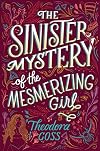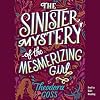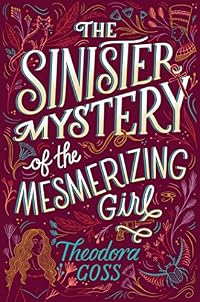
The Sinister Mystery of the Mesmerizing Girl
by Theodora Goss 
The Extraordinary Adventures of the Athena Club (3)
On This Page
Description
Mary Jekyll and her friends return home from Europe to discover that their friend and kitchen maid Alice has vanished-- and so has their friend and employer Sherlock Holmes! They discover that the two kidnappings are only one small part of a plot that threatens Queen Victoria, and the very future of the British Empire. Can Mary, Diana, Beatrice, Catherine, and Justine save their friends-- and save the Empire? -- adapted from jacket.Tags
Recommendations














Member Reviews
This is the third book in the Adventure of the Athena Club series and, I am led to believe, the final book, although nothing about all three novels struck me as “trilogy” and I would be happy for the series to continue. Like The League of Extraordinary Gentlemen above, Goss has repurposed well-known fictional characters from Victorian and Edwardian literature, but to a different purpose. First and foremost, her story is female-led and female-driven. She has had to invent characters in order for this to be the case. Such as Dr Jekyll’s daughter Mary, the leader of the Athena Club; or Catherine Moreau, the puma woman from the HG Wells novel. This is not a weakness but a strength. Like The League of Extraordinary Gentlemen, these show more books are not entirely straightforward, and are framed as penny dreadfuls, explicitly written by Moreau, of the Athena Club’s adventures, in much the same way as the Sherlock Holmes stories were framed as the diary of Dr Watson. Although the books’ definition of penny dreadfuls seems to owe more to the anonymous female-authored books of Regency circulating libraries than it does actual Victorian pulp fiction. Not that the interpolations by the cast, which is all nicely meta, fit either. I’m a big fan of breaking the fourth wall, even if it’s fictionally. Having said all that… I don’t like the titles of these novels, but I love the stories they tell. This one has the Order of the Golden Dawn attempting to turn Britain into, well, pretty much what Johnson’s government has sort of been working toward. It plans to replace Queen Victoria with a compliant clone, and Queen Victoria was far more revered in the late nineteenth century than Queen Elizabeth II is now, and then turn Britain into an “England for Englishman”. Happily, this is derailed pretty quickly – not by the Athena Club, but by the female members of the Order of the Golden Dawn, who had their own plan: resurrect Tera, High Priestess of Isis, who died 5,000 years ago and was mummified, and she will take over the British Empire and remake it according to her desires. While those desires include such un-Victorian things as female emancipation and gender equality, the Athena Club oppose it on principle (no tyranny is ever benevolent, no matter how well-intentioned). The title refers to Tera’s power, which is considerably more than mere hypnotism, although the actual “mesmerizing girl” is the Athena Club’s maid, Alice, who has the same power, albeit a great deal weaker, and whose disappearance kickstarts the plot. I do like the series’s use of its characters – Van Helsing is a villain, Count Dracula is not, Ayesha is head of the Alchemist’s Society – and if there’s some occasional padding, and the plots don’t always quite fit together, never mind, they’re an interesting, and much-needed, take on the literature they pastiche. show less
The Athena Club return to London from one extraordinary adventure and are plunged into another. Their teenaged kitchen maid Alice has been kidnapped, Sherlock Holmes is missing and there is a plot afoot to impersonate the queen.
This story has adventure, teamwork, mystery, unexpected twists, more cameos by characters from popular Victorian fiction, and commentary on late Victorian concerns (like empire and eugenics).
I particularly liked seeing Alice become a central part of the story, and her complicated relationship with her newly-discovered mother.
But my favourite part was not the adventures of the Athena Club but how they tell them -- their interactions when they interrupt the narrative to discuss their lives together, to highlight show more what they think is important or to argue about what Catherine has chosen to include in the narrative. Their voices often are present, even in the middle of a scene that isn’t about them, and I like what these interruptions reveal: a team, a household, a family.
BEATRICE: They are the clothing of the New Woman. They are meant not to be feminine, but practical.
CATHERINE: On women they look like men’s clothing, on men they look like women’s clothing. That’s where the New Woman meets the Dandy.
BEATRICE: Why is it necessary to categorize people in that fashion? Why can we not all wear whatever we wish, whatever is useful and aesthetically pleasing? I believe that someday we shall all wear garments that are light and of a pleasing texture, easy to put on and take off. At the same time, they will express the aspirations of the spirit. They will be like the garments of the Greeks, both graceful and functional. Why can we not dress in such a fashion now?
MRS. POOLE: Because this is England, and you would all catch your deaths of cold. show less
This story has adventure, teamwork, mystery, unexpected twists, more cameos by characters from popular Victorian fiction, and commentary on late Victorian concerns (like empire and eugenics).
I particularly liked seeing Alice become a central part of the story, and her complicated relationship with her newly-discovered mother.
But my favourite part was not the adventures of the Athena Club but how they tell them -- their interactions when they interrupt the narrative to discuss their lives together, to highlight show more what they think is important or to argue about what Catherine has chosen to include in the narrative. Their voices often are present, even in the middle of a scene that isn’t about them, and I like what these interruptions reveal: a team, a household, a family.
BEATRICE: They are the clothing of the New Woman. They are meant not to be feminine, but practical.
CATHERINE: On women they look like men’s clothing, on men they look like women’s clothing. That’s where the New Woman meets the Dandy.
BEATRICE: Why is it necessary to categorize people in that fashion? Why can we not all wear whatever we wish, whatever is useful and aesthetically pleasing? I believe that someday we shall all wear garments that are light and of a pleasing texture, easy to put on and take off. At the same time, they will express the aspirations of the spirit. They will be like the garments of the Greeks, both graceful and functional. Why can we not dress in such a fashion now?
MRS. POOLE: Because this is England, and you would all catch your deaths of cold. show less
SPOILER ALERT: Moriarty's major objective here is to rid England of non-English via eugenics, so he can establish England for "us" Englishmen. At one point, he even insults someone for being a dirty Irishman. Everywhere else, the author seems to have done her research, including little details of obscure and well-known characters from classic horror stories. How did she not know that Moriarty is Irish?! It's such a big mistake to make for such a crucial part of the plot.
This is another adventurous outing for the Athena Club. This book picks up immediately after the events in European Travel for the Monstrous Gentlewoman, so our intrepid monstrous gentlewomen are split up and spread out across England and Europe - and even so, it's up to the Athena Club to find the missing member of their group, and save the world.
It's somewhat hard to review this book without including spoilers for this book or the previous books. The plot is engaging, the characters are lovely and continue their development, and the book-specific mystery as well as the greater-universe mysteries evolve in pleasing ways. Eugenics and other period-specific concerns come into play, in ways that resonate for 2019. As always, I love show more watching these characters continue to make a family with each other - including the bickering in the margins of the book. (Seeing each new voice join the bickering is a lovely way of watching new members of the "family" join in - I love that touch.)
If you like the first two books, you'll like this one. I definitely recommend it. My only complaint is really a concern: some mysteries were solved that I'm afraid means there won't be any further books in the series. But I hope that's not true. I am too afraid to actually check.
I received a free electronic ARC of this book from the publisher via Netgalley in exchange for an honest review. show less
It's somewhat hard to review this book without including spoilers for this book or the previous books. The plot is engaging, the characters are lovely and continue their development, and the book-specific mystery as well as the greater-universe mysteries evolve in pleasing ways. Eugenics and other period-specific concerns come into play, in ways that resonate for 2019. As always, I love show more watching these characters continue to make a family with each other - including the bickering in the margins of the book. (Seeing each new voice join the bickering is a lovely way of watching new members of the "family" join in - I love that touch.)
If you like the first two books, you'll like this one. I definitely recommend it. My only complaint is really a concern: some mysteries were solved that I'm afraid means there won't be any further books in the series. But I hope that's not true. I am too afraid to actually check.
I received a free electronic ARC of this book from the publisher via Netgalley in exchange for an honest review. show less
Another adventure of the Athena Club in which we learn that Alice, the kitchen maid, is yet another product of Alchemists Society. So we have rational Mary Jekyll, the daughter of Dr. Jekyll; wild and willful Diana Hyde, daughter of Jekyll once he has transformed to Hyde; Beatrice Rappaccini, whose work with poisonous plants has turned her to a living contagion; Catherine Moreau, originally a puma converted to human by Dr. Moreau, Justine Frankenstein, another product of Dr. Frankenstein's experiments in revivification; Lucinda Van Helsing, a vampire; and Lydia Raymond, who has the gift of mesmerizing people to the point that they can see objects that seem real. Add in Sherlock Holmes and Dr. Watson, a revived Egyptian queen, a unique show more version of the Golden Dawn, a friend of Oscar Wilde, opium dens---gee have we omitted any horrific aspect of late Victorian literature? Entertaining for those who enjoy catching references to other literature and an adventure story in which the girls are as smart and enterprising as the boys and men. show less
I really enjoyed this final book in the Athena Club trilogy. It was good to see how everything wrapped up, and to see the characters grow in this story. I do want to go back now and read the original stories that the characters are from, but I do appreciate that it's not necessary to have read any of the source material first. More than the others, this one felt like an ensemble story, and it was great to see the perspectives of so many of the club members. (It seemed like there were also fewer interjections in this one than the second, though that could just have been because the second book was longer than either of the other two.)
While not quite all aspects of the trilogy were wrapped up, all of the relevant remaining plot items were show more nicely tied up—including a few that I hadn't remembered were still loose ends. It was a great way to close up the series, while still leaving opportunities for short stories or novellas set in this universe in future. show less
While not quite all aspects of the trilogy were wrapped up, all of the relevant remaining plot items were show more nicely tied up—including a few that I hadn't remembered were still loose ends. It was a great way to close up the series, while still leaving opportunities for short stories or novellas set in this universe in future. show less
For some reason, all the things I found charming and delightful about the first two books -- the asides as the book is written, the multiplicity of characters, made this one a very hard book to get into. I even tried audio version (it was worse). I felt that the sheer number of the asides made it almost impossible for the plot to even get started, and the points of view of characters scattered across Europe dragged it down as well. When I finally got into it, I enjoyed it, but I think I'm done with the Athena club, unless they start to have shorter and more fast paced adventures.
Advanced reader's copy provided by Edelweiss ** so editing may have taken place!
Advanced reader's copy provided by Edelweiss ** so editing may have taken place!
Members
- Recently Added By
Lists

2020 Hugo Eligible Novels
71 works; 12 members

Books Read in 2019
4,052 works; 110 members
Author Information

51+ Works 4,359 Members
Theodora Goss is a LibraryThing Author, an author who lists their personal library on LibraryThing.
Some Editions
Awards and Honors
Distinctions
Series

Work Relationships
Was inspired by
Common Knowledge
- Canonical title
- The Sinister Mystery of the Mesmerizing Girl
- Original publication date
- 2019
- People/Characters
- Mary Jekyll; Diana Hyde; Justine Frankenstein; Beatrice Rappaccini; Catherine Moreau; Alice (Lydia Raymond) (show all 14); Sherlock Holmes; John H. Watson; Mrs. Poole; Ayesha; Lucinda van Helsing; Margaret Trelawney; Queen Tera; Helen Raymond
- Important places
- London, England, UK; Cornwall, England, UK; St. Michael's Mount, Cornwall, England, UK; Marazion, Cornwall, England, UK
- Dedication
- For Mary Shelley, mother of monsters
- First words
- Princess Ayesha stared down into the lotus pool.
- Publisher's editor
- Wolfe, Navah
- Original language
- English
Classifications
Statistics
- Members
- 404
- Popularity
- 77,159
- Reviews
- 16
- Rating
- (3.89)
- Languages
- English
- Media
- Paper, Audiobook, Ebook
- ISBNs
- 6
- ASINs
- 5