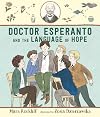
Doctor Esperanto and the Language of Hope
by Mara Rockliff 
On This Page
Description
"Life was harsh in the town of Bialystok, particularly for a Jewish boy like Leyzer Zamenhof. But Leyzer thought he knew the reason for the anger and distrust. With every group speaking a different language, how could people understand each other? Without understanding, how could there be peace? Zamenhof had an idea: a "universal" second language everyone could speak. But a language that would be easy to learn was not easy to invent, especially when even his own father stood between him and show more his dream. Yet when at last in 1887 "Doctor Esperanto" sent his words into the world, a boy's idea became a community that spread across the globe."--Book jacket. show lessTags
Recommendations










Member Reviews
Such a fine and gentle book! This picture book introduces some foundational concepts about language and offers a problem-solving orientation to cultural conflict — a very positive model in these turbulent times. I enjoyed learning about Leyzer Zamenhof and now am interested in learning Esperanto; I also enjoyed studying the historically evocative illustrations.
The story of "Doctor Esperanto" could inspire any perceptive, dreamy reader to learn more about language, grapple with a stubborn problem, or simply pursue a beautiful goal. I recommend this title for school and home libraries.
The story of "Doctor Esperanto" could inspire any perceptive, dreamy reader to learn more about language, grapple with a stubborn problem, or simply pursue a beautiful goal. I recommend this title for school and home libraries.
 This review was written for LibraryThing Early Reviewers.
Doctor Esperanto and the Language of Hope by Mara Rockliff, illustrated by Zosia Dzierzawska is a children's book about how Leyzer Zamenhof created the 'language of hope' - Esperanto. During a time of great turmoil in his town of Bialystok, Poland, he wondered if a common language would bring peace. So, the young Jewish boy set to work to create what would become the most widely spoken 'conlang' in the world.
The book itself is hardcover, with an illustrated cover and a dust cover to match. The story is told over 35 illustrated pages long, with 5 pages of historical information at the end. The artwork is simply drawn and coloured with a muted watercolour effect. The language is suitable for children aged 7+.
The story is relayed in two show more ways. First, as a sweet and simple narration describing the world of Leyzer through both words and pictures. It would have been easy for a book about the creation of a language could be too abstract for a child, but Rockliff does a good job of giving the essence of how languages work, without making it too complex or focusing too much on linguistics. The images were well matched to help make the ideas even more clear. After the conclusion of the picture book there are two sections titled "Why Esperanto?" and "L.L. Zamenhof" that go into greater detail about the language and the man who created it. I think the additional information makes the book one that could be enjoyed over and over as a child grows in their ability to read and understand.
While I enjoyed the book, I have one criticism. In the spirit of inspiring peace and hope in children, I expected it to better represent the diversity of humans reading it. Not that I would have expected to see historically inaccurate depictions of who would have been using Esperanto at that time, but I think the book could have been more inclusive. For example, with one single exception, every individual depicted in the illustrations has light white skin tone. Realistically, the first world Esperanto congress took place in 1905 in France. 688 people were in attendance representing 20 nations. While people of colour may not have been able to attend, there could have been some variation of skin tones in the images of Zamenhof speaking with the audience. I wonder too if diversity of ability could have been represented by the inclusion of a wheelchair (already in common use in the late 19th century) or a cane? A final aspect of access that stands out has to do with language. In order to inspire all children, it is more inclusive to use variations of the term 'people' instead of binary terms like 'gentle boy or girl or man or woman'.
Reading Doctor Esperanto and the Language of Hope by Mara Rockliff was enjoyable and inspired me to read more about this time in history as well as the creative mind of L. L. Zemenhof. If she had written this book five or ten years ago, I think Rockliff would have brought the story to life. Fortunately, we are living in a time now where access and diversity are paramount. It is important for writers and artists to be part of this movement too. I think that Rockliff and Dzierzawska could have been more conscious of the decisions they made in the telling of this story in order to truly inspire peace and hope in the children they are creating for. show less
The book itself is hardcover, with an illustrated cover and a dust cover to match. The story is told over 35 illustrated pages long, with 5 pages of historical information at the end. The artwork is simply drawn and coloured with a muted watercolour effect. The language is suitable for children aged 7+.
The story is relayed in two show more ways. First, as a sweet and simple narration describing the world of Leyzer through both words and pictures. It would have been easy for a book about the creation of a language could be too abstract for a child, but Rockliff does a good job of giving the essence of how languages work, without making it too complex or focusing too much on linguistics. The images were well matched to help make the ideas even more clear. After the conclusion of the picture book there are two sections titled "Why Esperanto?" and "L.L. Zamenhof" that go into greater detail about the language and the man who created it. I think the additional information makes the book one that could be enjoyed over and over as a child grows in their ability to read and understand.
While I enjoyed the book, I have one criticism. In the spirit of inspiring peace and hope in children, I expected it to better represent the diversity of humans reading it. Not that I would have expected to see historically inaccurate depictions of who would have been using Esperanto at that time, but I think the book could have been more inclusive. For example, with one single exception, every individual depicted in the illustrations has light white skin tone. Realistically, the first world Esperanto congress took place in 1905 in France. 688 people were in attendance representing 20 nations. While people of colour may not have been able to attend, there could have been some variation of skin tones in the images of Zamenhof speaking with the audience. I wonder too if diversity of ability could have been represented by the inclusion of a wheelchair (already in common use in the late 19th century) or a cane? A final aspect of access that stands out has to do with language. In order to inspire all children, it is more inclusive to use variations of the term 'people' instead of binary terms like 'gentle boy or girl or man or woman'.
Reading Doctor Esperanto and the Language of Hope by Mara Rockliff was enjoyable and inspired me to read more about this time in history as well as the creative mind of L. L. Zemenhof. If she had written this book five or ten years ago, I think Rockliff would have brought the story to life. Fortunately, we are living in a time now where access and diversity are paramount. It is important for writers and artists to be part of this movement too. I think that Rockliff and Dzierzawska could have been more conscious of the decisions they made in the telling of this story in order to truly inspire peace and hope in the children they are creating for. show less
This review was written for LibraryThing Early Reviewers.I loved this book. I was interested in Esperanto in college but never found a way to make space to take it. But I’ve learned a lot from this book because I hadn’t realized it is been around for as long as it has. I was under the impression it was a fairly new language circa the early 1970s. This is a lovely story about the man who created this language and why he did. It’s a wonderful picture book biography and includes interesting historical information. Wonderful illustrations! I loved them. There are Interesting and useful extras in the back of the book although they are not lengthy. Very touching!
four & one half stars
four & one half stars
“Doctor Esperanto and the Language of Hope’ was a wonderfully illustrated and informative children’s book about the life and mission of Dr. Zamenhof that my daughters and I thoroughly enjoyed.
Here is what my oldest, 6 years old, had to say:
“I really loved the book. It begins when the people of Biatystok were angry because they could understand each other. In the town there lived a little boy called Leyzer Zamenhof and the angry words they used cut him like sharp stones, so he decided to make a universal language called Esperanto. I really enjoyed the fact that this was a true story, and that people learn Esperanto today.”
In addition to the story itself, I liked the fact the book had further resource suggestions on Esperanto show more allowing for continued exploration with your child, or for yourself, after finishing the book.
My only suggestion would be to add a glossary for the foreign language words used as I stumbled a bit on some of them.
I highly recommend this book for children and adults alike; it is well done, and we all learned something about Dr. Zamenhof and his language of hope. show less
Here is what my oldest, 6 years old, had to say:
“I really loved the book. It begins when the people of Biatystok were angry because they could understand each other. In the town there lived a little boy called Leyzer Zamenhof and the angry words they used cut him like sharp stones, so he decided to make a universal language called Esperanto. I really enjoyed the fact that this was a true story, and that people learn Esperanto today.”
In addition to the story itself, I liked the fact the book had further resource suggestions on Esperanto show more allowing for continued exploration with your child, or for yourself, after finishing the book.
My only suggestion would be to add a glossary for the foreign language words used as I stumbled a bit on some of them.
I highly recommend this book for children and adults alike; it is well done, and we all learned something about Dr. Zamenhof and his language of hope. show less
This review was written for LibraryThing Early Reviewers.Doctor Espéranto
Written By: Mars Rockliff
Illustrated by: Zosia Dzierzawska
I received a free ARC of this book in exchange for my honest opinion.
Wow, I loved this book! It is a fantastic story about a truly inspiring family.
Story:
I had no idea about the story behind the Espéranto language. Zamenhof was a Jew born in Russian occupied Poland and so he heard and learned multiple languages as a child. His theory was that a common language (such as Espéranto which combined elements of many languages) would lead to peace. I just think this concept shows Dr. Zamenhof’s spirit. The reality is much more complicated isn’t it? But, I love the concept that if we could all just understand each other verbally then we could find a way to really show more know each other.
The author also does a great job in presenting this language. She explains it simply, shows the language development over time, and gives us the words in a way we can understand them.
This storybook has a happy ending showing the world-wide growth and the love and understanding garnered by this language. At the end of the book there is a short biography of Dr. Zamenhof which led me to do a bit of research on my own. He was such a fascinating man. Dr. Zamenhof’s children continued his work after his death. His son was an ophthalmologist who did a lot of work on “blind spots”. His youngest daughter was a writer and toured the world. I couldn’t find much on the older daughter. The sad part is that they all died during WWII in Nazi concentration camps. Truly, the travesty of the Holocaust becomes ever more heartbreaking as we encounter real people who suffered and died.
Illustrations:
I loved that the illustrator is from Poland. She said in her blurb at the end of the book that she used old “photographs, paintings, and stories” to help “soak” herself in the story setting. It really shows throughout the book. The outfits of the people are just beautifully detailed and the settings are staged as if I was watching a play. The pictures immersed me in Zamenhof’s world. The illustrations also played a role in showing the language development and meaning of words.
In conclusion:
Please read this book! Even my husband was interested in this story and he doesn’t read for pleasure. We found Espéranto on Duolingo and are having fun. show less
Written By: Mars Rockliff
Illustrated by: Zosia Dzierzawska
I received a free ARC of this book in exchange for my honest opinion.
Wow, I loved this book! It is a fantastic story about a truly inspiring family.
Story:
I had no idea about the story behind the Espéranto language. Zamenhof was a Jew born in Russian occupied Poland and so he heard and learned multiple languages as a child. His theory was that a common language (such as Espéranto which combined elements of many languages) would lead to peace. I just think this concept shows Dr. Zamenhof’s spirit. The reality is much more complicated isn’t it? But, I love the concept that if we could all just understand each other verbally then we could find a way to really show more know each other.
The author also does a great job in presenting this language. She explains it simply, shows the language development over time, and gives us the words in a way we can understand them.
This storybook has a happy ending showing the world-wide growth and the love and understanding garnered by this language. At the end of the book there is a short biography of Dr. Zamenhof which led me to do a bit of research on my own. He was such a fascinating man. Dr. Zamenhof’s children continued his work after his death. His son was an ophthalmologist who did a lot of work on “blind spots”. His youngest daughter was a writer and toured the world. I couldn’t find much on the older daughter. The sad part is that they all died during WWII in Nazi concentration camps. Truly, the travesty of the Holocaust becomes ever more heartbreaking as we encounter real people who suffered and died.
Illustrations:
I loved that the illustrator is from Poland. She said in her blurb at the end of the book that she used old “photographs, paintings, and stories” to help “soak” herself in the story setting. It really shows throughout the book. The outfits of the people are just beautifully detailed and the settings are staged as if I was watching a play. The pictures immersed me in Zamenhof’s world. The illustrations also played a role in showing the language development and meaning of words.
In conclusion:
Please read this book! Even my husband was interested in this story and he doesn’t read for pleasure. We found Espéranto on Duolingo and are having fun. show less
This review was written for LibraryThing Early Reviewers.Doctor Esperanto and the Language of Hope is a fascinating look into the life of Leyzer Zamenhof, the creator of the language Esperanto. The fact that any one person can create a language is remarkable. Author Mara Rockliff has done a wonderful job of explaining Zamenhof's life and passion in an easy to understand story for children. Zosia Dzierzawska's illustrations add a charming touch and will help to get all readers thinking about language in a new way. I can imagine that my elementary school students will want to start creating their own languages after reading this story. I look forward to sharing it with them.
** I received this book through LibraryThing's Early Review program, but all opinions are my own. **
** I received this book through LibraryThing's Early Review program, but all opinions are my own. **
This review was written for LibraryThing Early Reviewers.*I received a free copy of this book from LibraryThing's Early Review program, but all opinions are my own.
I wanted to love this book; I really did. But something about it fell a little flat for me. I read it twice, once alone, and once aloud to my children, but the story just didn't quite resonate for me. I understand that Dr. Esperanto created a language, but I didn't really quite feel the need for a new language in a deep enough way that I could understand and relate to his motivation as a character.
That being said, the illustrations in this book are wonderful and add a lot to the text. Also, this is a book that I think adds a lot of value and interest to the study of grammar, which can otherwise seem like a dull and tedious subject show more for children. Overall, I'm glad we were able to add it to our picture book library, but I don't think it's quite up the standard of some of our favorite picture book biographies. show less
I wanted to love this book; I really did. But something about it fell a little flat for me. I read it twice, once alone, and once aloud to my children, but the story just didn't quite resonate for me. I understand that Dr. Esperanto created a language, but I didn't really quite feel the need for a new language in a deep enough way that I could understand and relate to his motivation as a character.
That being said, the illustrations in this book are wonderful and add a lot to the text. Also, this is a book that I think adds a lot of value and interest to the study of grammar, which can otherwise seem like a dull and tedious subject show more for children. Overall, I'm glad we were able to add it to our picture book library, but I don't think it's quite up the standard of some of our favorite picture book biographies. show less
This review was written for LibraryThing Early Reviewers.Members
- Recently Added By
Author Information

89 Works 3,018 Members
Mara Rockliff is a LibraryThing Author, an author who lists their personal library on LibraryThing.
All Editions
Awards and Honors
Classifications
- DDC/MDS
- 499.992 — Language Other languages Non-Austronesian languages of Oceania, Austronesian languages, miscellaneous languages Miscellaneous languages Artificial languages Esperanto
- LCC
- PM8206 .A2 .D63 — Language and Literature Hyperborean, Native American, and artificial languages Hyperborean, Indian, and artificial languages Artificial languages--Universal languages Esperanto
- BISAC
Statistics
- Members
- 82
- Popularity
- 387,850
- Reviews
- 15
- Rating
- (4.16)
- Languages
- English
- Media
- Paper
- ISBNs
- 3