
Simms Taback (1932–2011)
Author of There Was an Old Lady Who Swallowed a Fly
About the Author
Simms Taback was born on February 13, 1932 in New York City. Before serving two years in the Army, he graduated from Cooper Union for the Advancement of Science and Art in 1953. He worked as an art director at CBS Records and The New York Times and as an advertising art director at William Douglas show more McAdams. He designed and illustrated the first McDonald's Happy Meal box in the 1970s. During his lifetime, he was the illustrator and occasional author of about 50 children's books including There Was an Old Lady Who Swallowed a Fly, Joseph Had a Little Overcoat, which won the Caldecott Medal in 2000, and Postcards from Camp. He died of pancreatic cancer on December 25, 2011 at the age of 79. (Bowker Author Biography) show less
Image credit: mcgrawhill.com
Works by Simms Taback
Associated Works
Please share that peanut!: A preposterous pageant in fourteen acts, concerned with the exquisite joys and extraordinary adventures of young ladies and ... in the pleasurable… (1965) — Illustrator — 9 copies
Games, Puzzles, and Toys: Hand on Science Activity Projects from the Smithsonian Institution (Hands-On Science) (1993) — Illustrator — 5 copies, 1 review
Tagged
Common Knowledge
- Birthdate
- 1932-02-13
- Date of death
- 2011-12-25
- Gender
- male
- Education
- Cooper Union (1953)
- Occupations
- illustrator
author
graphic artist - Organizations
- Illustrators Guild (co-founder)
Society of Illustrators
Graphic Artists Guild (National President) - Awards and honors
- Caldecott Medal
- Relationships
- Ruffins, Reynold (partner)
- Nationality
- USA
- Birthplace
- The Bronx, New York, New York, USA
- Places of residence
- New York, New York, USA
Ventura, California, USA
Willows, New York, USA
Florida, USA
Woodstock, New York, USA - Place of death
- Ventura, California, USA
- Associated Place (for map)
- New York, USA
Members
Reviews
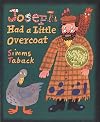
Joseph's overcoat gets worn and tatterrd, so he turns it into a jacket, then a vest, and so on it goes. Children follow along turning the pages where there are cutouts that show the progression of Joseph's coat. The mixed media style illustration are entertaining and engaging. This is one of the absolute cutest books we own. We love it!

As his overcoat gets worn, Joseph, a clever man in a Polish shtetl turns it into a jacket, and then a vest. He continues to recycle it until it’s reduced to a button. Then when he loses it, he turns it into a book and a song. “Which shows you can always make something out of nothing.”
Taback’s bright and spritely mixed media illustrations of watercolor, gouache, and collage include family portraits, sly references to Sholem Aleichem’s stories about Tevye the dairyman and images in show more Marc Chagall’s paintings. A newspaper lying in the street has the headline “Fiddler on Roof Falls Off Roof” and jokes about the rabbi from Chelm (the village of notorious dimwits) who discovers that the sea is salty because it’s full of herring. show less
Taback’s bright and spritely mixed media illustrations of watercolor, gouache, and collage include family portraits, sly references to Sholem Aleichem’s stories about Tevye the dairyman and images in show more Marc Chagall’s paintings. A newspaper lying in the street has the headline “Fiddler on Roof Falls Off Roof” and jokes about the rabbi from Chelm (the village of notorious dimwits) who discovers that the sea is salty because it’s full of herring. show less

Based upon a Yiddish song, Hob Ich Mir a Mantl ("I Had a Little Overcoat"), which author Simms Taback loved as a young boy, this Caldecott Medal winning picture-book tells the story of Joseph, a shtetl-dwelling man who wears his beloved overcoat to tatters. Undaunted by this catastrophe, he transforms his coat into a shorter jacket, and - when that in turn is worn and tattered - into a vest. And so it goes, as Joseph's erstwhile overcoat becomes smaller and smaller, until he has nothing. But show more (and here's the moral promised on the title page), "you can always make something out of nothing..."
I enjoyed Joseph Had a Little Overcoat, which apparently first saw print in 1977, with different illustrations, and think the zany mixed media artwork - done in watercolor, gouache, pencil, ink and collage - was creative and attention-grabbing. Certainly, I can see why it won Taback the Caldecott! I also enjoyed many of the little visual references to aspects of eastern European Jewish culture - the little tributes to Sholem Aleichem, the letters written in Hebrew (or in Yiddish, using the Hebrew syllabary) - and appreciated the fact that the song which provided the inspiration for this story was included at the rear, in English translation. All in all, a most engaging book, with a fun story (AND a moral!), and entertaining artwork. show less
I enjoyed Joseph Had a Little Overcoat, which apparently first saw print in 1977, with different illustrations, and think the zany mixed media artwork - done in watercolor, gouache, pencil, ink and collage - was creative and attention-grabbing. Certainly, I can see why it won Taback the Caldecott! I also enjoyed many of the little visual references to aspects of eastern European Jewish culture - the little tributes to Sholem Aleichem, the letters written in Hebrew (or in Yiddish, using the Hebrew syllabary) - and appreciated the fact that the song which provided the inspiration for this story was included at the rear, in English translation. All in all, a most engaging book, with a fun story (AND a moral!), and entertaining artwork. show less
In this cumulative tale, a Jewish farmer named Joseph has an overcoat which grows too old and worn, so he turns it into a jacket. When that becomes too worn, he makes it into a vest, then a scarf, and so on, until in the end, Joseph has nothing but a button. When he loses the button, he writes a story about the overcoat.
Based on a Yiddish song, Joseph Had a Little Overcoat is a type of folktale known as a "cumulative tale", where a repetitive action is completed, usually with a surprise show more ending. In this case, Joseph continues to make his overcoat into something new - and smaller - with each iteration, until finally all that is left is a button. At the end, he loses the button, but is able to write a story about it, which leads to the explicitly stated moral at the end: "Which shows... you can always make something out of nothing." The axiom is lampshaded and told tongue-in-cheek, as evident by the title page, which has the tag, "He wore the coat for a long time and then something happened to it. (and there's a moral, too!)".
The book itself is unusual through the artwork and style. Most noticeably, there are shapes cut out from the right-hand side of almost every page. Though what is shown of the page beneath matches the illustrations on the page above, when readers turn the page, the shapes outline the new article of clothing Joseph has made each time. The cut-out shapes gradually grow smaller and smaller, until all that is left is a tiny hole: the button.
The artwork is busy and bold. Done in a collage style, there is little perspective, the scale of objects are off (on the first page, a rooster is nearly as large as Joseph himself), and there is a riotous mash of disparate styles. Mismatched patterns are jumbled together, crude drawings are juxtaposed with real pictures of people hanging on the wall, and bright reds and deep greens clash on nearly every page. The effect is startling at first, though vaguely reminiscent of Russian folkart. The effect can be overwhelming, but does offer little gems to discover with each re-reading. For instance, a cat shows up on nearly every page in a new position, the realistic pictures on the wall offer allusions to famous Jewish philosophers and authors, and on nearly every page is a reference to what is happening in the story hidden in framed cross-stitches on the walls or in writing on a letter lying in the corner of the page.
The book also highlights and celebrates Jewish heritage. Newspapers in some of the frames are written in Yiddish and a fiddler on the roof sings snatches of the traditional song the story is based on. Some of the references may be there for parents or other adults enjoying the story more than children, like the newspaper headline that reads, "Fiddler on Roof Falls Off Roof" or a recipe card that says, "Mix a shlemiel and a shlimazel and you'll get a shmegegge".
For such a short book, Joseph Had a Little Overcoat offers much. From its tongue-in-cheek humor, its distinct, bold collage style, and the wealth of new things to find on every page, Joseph Had a Little Overcoat is a hit with children and adults. show less
Based on a Yiddish song, Joseph Had a Little Overcoat is a type of folktale known as a "cumulative tale", where a repetitive action is completed, usually with a surprise show more ending. In this case, Joseph continues to make his overcoat into something new - and smaller - with each iteration, until finally all that is left is a button. At the end, he loses the button, but is able to write a story about it, which leads to the explicitly stated moral at the end: "Which shows... you can always make something out of nothing." The axiom is lampshaded and told tongue-in-cheek, as evident by the title page, which has the tag, "He wore the coat for a long time and then something happened to it. (and there's a moral, too!)".
The book itself is unusual through the artwork and style. Most noticeably, there are shapes cut out from the right-hand side of almost every page. Though what is shown of the page beneath matches the illustrations on the page above, when readers turn the page, the shapes outline the new article of clothing Joseph has made each time. The cut-out shapes gradually grow smaller and smaller, until all that is left is a tiny hole: the button.
The artwork is busy and bold. Done in a collage style, there is little perspective, the scale of objects are off (on the first page, a rooster is nearly as large as Joseph himself), and there is a riotous mash of disparate styles. Mismatched patterns are jumbled together, crude drawings are juxtaposed with real pictures of people hanging on the wall, and bright reds and deep greens clash on nearly every page. The effect is startling at first, though vaguely reminiscent of Russian folkart. The effect can be overwhelming, but does offer little gems to discover with each re-reading. For instance, a cat shows up on nearly every page in a new position, the realistic pictures on the wall offer allusions to famous Jewish philosophers and authors, and on nearly every page is a reference to what is happening in the story hidden in framed cross-stitches on the walls or in writing on a letter lying in the corner of the page.
The book also highlights and celebrates Jewish heritage. Newspapers in some of the frames are written in Yiddish and a fiddler on the roof sings snatches of the traditional song the story is based on. Some of the references may be there for parents or other adults enjoying the story more than children, like the newspaper headline that reads, "Fiddler on Roof Falls Off Roof" or a recipe card that says, "Mix a shlemiel and a shlimazel and you'll get a shmegegge".
For such a short book, Joseph Had a Little Overcoat offers much. From its tongue-in-cheek humor, its distinct, bold collage style, and the wealth of new things to find on every page, Joseph Had a Little Overcoat is a hit with children and adults. show less
Lists
Letters (1)
Awards


You May Also Like


Associated Authors
Statistics
- Works
- 42
- Also by
- 15
- Members
- 8,496
- Popularity
- #2,833
- Rating
- 4.1
- Reviews
- 461
- ISBNs
- 165
- Languages
- 7
- Favorited
- 3