
Audrey Wood (1) (1948–)
Author of The Napping House
For other authors named Audrey Wood, see the disambiguation page.
About the Author
Audrey Wood was born on August 12, 1948. She is a children's book author and illustrator. Her books include Blue Sky, Silly Sally, Weird Parents, The Red Racer, and Tugford Wanted To Be Bad. She also collaborates with her husband Don Wood on picture books. These include Moonflute, The Napping show more House, Tickle-Octopus, Bright and Early Thursday Evening, and The Full Moon at the Napping House. (Bowker Author Biography) show less
Works by Audrey Wood
Tagged
Common Knowledge
- Other names
- Brewer, Susan (birth)
- Birthdate
- 1948-08-12
- Gender
- female
- Occupations
- illustrator
- Awards and honors
- Caldecott Medal
- Relationships
- Wood, Don (husband)
Wood, Bruce (son) - Nationality
- USA
- Birthplace
- Little Rock, Arkansas, USA
- Places of residence
- Sarasota, Florida, USA
San Miguel de Allende, Mexico
Santa Barbara, California, USA - Associated Place (for map)
- USA
Members
Discussions
Found: Children's Picture Book (Mother, Lots of Children, Magic, Personality)) in Name that Book (September 2021)
Reviews

In this engaging picture-book exploration of "bad words," Audrey and Don Wood - the team who created such classics of the genre as The Napping House, King Bidgood's in the Bathtub and Heckedy Peg - follow young Elbert as he picks up a very ugly word, while at a party for grown-ups, and causes quite a stir, when he uses it himself. His mother's outrage - she washes his mouth out with soap - is followed by a more practical solution, provided by the family gardener (and secret magician): the show more creation of other, more-satisfying words to express pain or frustration.
I enjoyed Elbert's Bad Word, liked the physical manifestation of the bad word, and approved of the solution depicted. I liked the fact that the story demonstrates that children often pick up bad language from their elders, and that it takes into account the natural desire of any person, child or adult, to express strong negative emotions. That said, I didn't like the scene in which Elbert's mother forces him to wash out his mouth with soap, or that the thoughtful discussion of the issue occurs, not with her, but with a servant. Although that may be a dynamic found in some homes, I think that most young readers would have more affinity with a tale in which the young "offender" must contend with his parents - discussing the issue with them.
Still, Elbert's Bad Word is definitely one of the few picture-books I've seen that addresses this topic through story, rather than the overt didacticism to be found in guides on correct behavior. Despite its flaws, it works fairly well, I think, and I would recommend it to parents who are looking to start a conversation with children on the topic. show less
I enjoyed Elbert's Bad Word, liked the physical manifestation of the bad word, and approved of the solution depicted. I liked the fact that the story demonstrates that children often pick up bad language from their elders, and that it takes into account the natural desire of any person, child or adult, to express strong negative emotions. That said, I didn't like the scene in which Elbert's mother forces him to wash out his mouth with soap, or that the thoughtful discussion of the issue occurs, not with her, but with a servant. Although that may be a dynamic found in some homes, I think that most young readers would have more affinity with a tale in which the young "offender" must contend with his parents - discussing the issue with them.
Still, Elbert's Bad Word is definitely one of the few picture-books I've seen that addresses this topic through story, rather than the overt didacticism to be found in guides on correct behavior. Despite its flaws, it works fairly well, I think, and I would recommend it to parents who are looking to start a conversation with children on the topic. show less

The fifth and final version of this story that I have rated and reviewed recently, Audrey Wood's When the Root Children Wake Up is a very loose prose reinterpretation of a classic German picture-book, Etwas von den Wurzelkindern ("Something About the Root Children") that was originally written and illustrated by Sibylle von Olfers in 1906. It is noteworthy, in that it manages to retain almost none of the charm of that original work, while inserting a great many disturbing elements, both show more visually and textually. I decidedly do not recommend this edition, although I am glad to have read it, as I think some readers may imagine that it represents von Olfers' work, after a fashion. It doesn't.
The original, which I have been fortunate enough to read, was written in rhyming poetry, a form retained in Mother Earth and Her Children: A Quilted Fairy Tale, which pairs a fairly faithful translation by Jack Zipes with quilted illustrations inspired by von Olfers' artwork. Prose adaptations can be found in The Story of the Root-Children, put out by the UK-based Floris Books, who (unfortunately) seem not to have acknowledged that their title is a significant adaptation, rather than a translation; and in Helen Dean Fish's When the Root Children Wake Up, which was originally published in 1941, seems to be the first English-language edition of the story, and does acknowledge its status as an adaptation. Both of these prose editions, although they diverge widely from von Olfers' text, do retain her artwork.
And then there's this book... Here too we have a prose adaptation, but the differences in storyline from the original are far more extreme than either the Floris Books or Helen Dean Fish editions, which were guided by the basic narrative laid out in von Olfers' art. Here we have Old Grandfather Winter, who does not appear in any other version, opening the story; we have Robin Redbreast waking the Root Children in time for Spring, rather than Mother Earth; and we have Aunt Spring, Cousin Summer and Uncle Fall all appearing as characters. Of course, as an adaptation, one could argue that these changes demonstrate that Audrey Wood is making the tale her own - making it into something new and fresh. Unfortunately, it's difficult to see what these changes add.
Then there's the artwork, done by Ned Bittinger in oil paint. Although I can't deny that they have a beauty of their own - hence the two stars, rather than one - they just don't suit the story, in my opinion. They're a little too creepy, a little too "dark fairy-tale" feeling to me, and that isn't what the Root Children is all about! Moreover, the Root Children themselves have been transformed into fairies, complete with gossamer wings! No! Worst of all, Mother Earth, who is an old woman in all the other versions of this story that I have seen, is young and beautiful here. Argh!
Do yourself a favor, if you are at all interested in this story, and pick up either the Zipes or Fish editions, mentioned above - this one just doesn't cut it! Of course, you may still be turned off by the cute anthropomorphism, but at least you'll be getting the real thing! show less
The original, which I have been fortunate enough to read, was written in rhyming poetry, a form retained in Mother Earth and Her Children: A Quilted Fairy Tale, which pairs a fairly faithful translation by Jack Zipes with quilted illustrations inspired by von Olfers' artwork. Prose adaptations can be found in The Story of the Root-Children, put out by the UK-based Floris Books, who (unfortunately) seem not to have acknowledged that their title is a significant adaptation, rather than a translation; and in Helen Dean Fish's When the Root Children Wake Up, which was originally published in 1941, seems to be the first English-language edition of the story, and does acknowledge its status as an adaptation. Both of these prose editions, although they diverge widely from von Olfers' text, do retain her artwork.
And then there's this book... Here too we have a prose adaptation, but the differences in storyline from the original are far more extreme than either the Floris Books or Helen Dean Fish editions, which were guided by the basic narrative laid out in von Olfers' art. Here we have Old Grandfather Winter, who does not appear in any other version, opening the story; we have Robin Redbreast waking the Root Children in time for Spring, rather than Mother Earth; and we have Aunt Spring, Cousin Summer and Uncle Fall all appearing as characters. Of course, as an adaptation, one could argue that these changes demonstrate that Audrey Wood is making the tale her own - making it into something new and fresh. Unfortunately, it's difficult to see what these changes add.
Then there's the artwork, done by Ned Bittinger in oil paint. Although I can't deny that they have a beauty of their own - hence the two stars, rather than one - they just don't suit the story, in my opinion. They're a little too creepy, a little too "dark fairy-tale" feeling to me, and that isn't what the Root Children is all about! Moreover, the Root Children themselves have been transformed into fairies, complete with gossamer wings! No! Worst of all, Mother Earth, who is an old woman in all the other versions of this story that I have seen, is young and beautiful here. Argh!
Do yourself a favor, if you are at all interested in this story, and pick up either the Zipes or Fish editions, mentioned above - this one just doesn't cut it! Of course, you may still be turned off by the cute anthropomorphism, but at least you'll be getting the real thing! show less
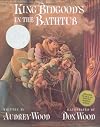
This Caldecott Honor book was one of my absolute my favorites as a child, and remains one of my favorites to this day. I have read it to the children I nanny for and they also love it. The setting is a castle's bathroom and follows the day of King Bidgood refusing to get out of the bathtub, and all the different ways members of the court try to get him to leave. The setting allows for crazy, imaginative, and wonderfully detailed illustrations. The story is funny and creative, but it is also show more something a lot of young children could relate to. Bath time is a huge deal in many households with young children, whether the parents are coercing their children into the tub or out of it. This book can help in both ways--either by letting children imagine they can do their favorite activities even in the bathtub, or how absurd it is to spend the whole day in the tub. It is a fun way to teach young kids about the importance of personal hygiene. show less

When their mother, setting out to the market in town, must leave them home alone, seven rambunctious siblings - named for the seven days of the week - keep to her instructions at first, refusing to open the door for strangers, or to touch the fire. But a crafty witch named Heckedy Peg (who'd lost her leg) soon comes along, tempting them with a bag of gold, and - when they finally do admit her to the cottage - transforming them into various food items! It falls to their determined and show more resourceful mother, returned home with the items they requested, to rescue her children from the witch who plans to eat them...
The third picture-book from storytelling team Audrey and Don Wood that I have read - the previous two being King Bidgood's in the Bathtub and The Napping House - this tale of a family that triumphs over the machinations of one very evil witch is an absolute delight! I enjoyed the story, appreciated the clever way in which the items each child requested from the market matched up (in various ways) with the food into which they had been transformed, and really liked the fact that it is the mother who is the hero. As for the illustrations, done by Don Wood in oil, they are simply gorgeous - a pure visual feast! All in all, Heckedy Peg is just a delightful book, one I recommend to all young fairy-tale lovers, and to fans of the Woods. show less
The third picture-book from storytelling team Audrey and Don Wood that I have read - the previous two being King Bidgood's in the Bathtub and The Napping House - this tale of a family that triumphs over the machinations of one very evil witch is an absolute delight! I enjoyed the story, appreciated the clever way in which the items each child requested from the market matched up (in various ways) with the food into which they had been transformed, and really liked the fact that it is the mother who is the hero. As for the illustrations, done by Don Wood in oil, they are simply gorgeous - a pure visual feast! All in all, Heckedy Peg is just a delightful book, one I recommend to all young fairy-tale lovers, and to fans of the Woods. show less
Lists
ABC (1)
Awards


You May Also Like


Associated Authors
Statistics
- Works
- 69
- Members
- 43,281
- Popularity
- #392
- Rating
- 4.1
- Reviews
- 1,092
- ISBNs
- 519
- Languages
- 13
- Favorited
- 4