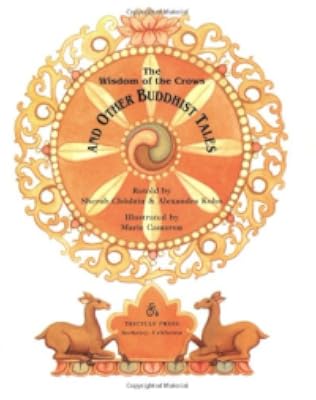
The Wisdom of the Crows and Other Buddhist Tales
by Sherab Chodzin, Alexandra Kohn
On This Page
Description
A collection of thirteen retold Buddhist tales from all over Asia, illustrating various aspects of Buddhist thought.Tags
Recommendations














Member Reviews
Originally published as The Barefoot Book of Buddhist Tales, this collection of thirteen folktales is taken from the Burmese, Chinese, Indian, Japanese, and Tibetan traditions, and focuses on stories which reveal a particular Buddhist teaching. The idea that "self-sacrificing generosity" leads to the "acquisition of a feminine power" can be seen in selections like The Living Kuan Yin or Goodheart and the Goddess of the Forest; while the importance of humor, which allows us to see life as "real but also somewhat transparent," can be seen in The Foolish Boy, and in the Zen tales, Useless Work and Where Are You Going? These and other themes are explained in the brief foreword, while sources for the tales are given at the rear. In between, show more the tales themselves are beautifully illustrated by Marie Cameron, whose decorative border-work is particularly lovely. Selections include:
The Living Kuan Yin, a Chinese tale in which a generous young man named Chin Po-wan, traveling to the South Sea to see the goddess Kuan Yin, agrees to ask questions for three people he meets upon his journey, only realizing too late that this will preclude him from asking his own question, as each supplicant is limited to three queries. His decision to honor his promises ends up being less of a sacrifice than he thought...
The Most Important Thing, a very brief Chinese parable, in which a poet travels a great distance to learn about the Buddha from a famous teacher, and is taken aback at the answer he receives.
The Man Who Didn't Want to Die, a Japanese fairy-tale about a well-to-do man, Sentaro, who decides that he would rather not die, and sets out to find the hermit that can tell him the secret of the elixir of life. Finding himself at last in a temple dedicated to Jofoku, he has an incredible dream, in which he is dispatched by the god to the Land of Neverending Life, and then returns.
Useless Work, a Zen parable in which two monks, meeting a woman at a stream, have very different responses to her request that one of them carry her over the water. The punchline here is especially effective!
The Conch Maiden, a Tibetan tale in which three sisters - the golden maiden, the silver maiden, and the conch maiden - behave very differently to the dirty beggar (really Lord Mipham in disguise) camped out in front of their house.
The Wisdom of the Crows, a brief Japanese story which highlights, through the answers given by three different crows to the same question, that wisdom involves being able to see beneath the surface of things.
The Stone Ape, a Chinese folktale about the wild and destructive Monkey King, and how he was eventually tamed by the Buddha. This tale, according to the foreword, highlights the idea that no matter how far we travel, we do not escape our mind, which travels with us.
Where Are You Going?, an amusing Zen story in which two pupils meet every morning on their way to market, with one continually bested by the other, in their ongoing battle of wits.
Agulimala the Brigand, an Indian tale that is also one of the canonical stories about the life of the Buddha, in which a terrible and bloodthirsty outlaw named Agulimala is reformed through his encounter with the Buddha, and begins to lead a very different kind of life. The idea of paying for one's transgressions - in Angulimala's case, the abuse he must suffer at the hands of those he used to terrorize - is important here.
Learning to Be Silent, another Zen parable, this one involving four young men who are studying meditation, and who find that their vow of silence is more difficult to keep than they imagined.
Goodheart and the Goddess of the Forest, a Burmese tale in which Goodheart, sent away from home because he is too generous with his family's money, giving it to the needy, marries the Goddess of the Forest. After many trials, the couple and their son ascend to the heavens.
The Death of a Teacup, another Zen story, in which a young pupil uses his instructor's own teaching to get out of trouble, when he breaks a valuable teacup.
And finally, The Foolish Boy, a Tibetan tale in which a foolish young man, continually led into trouble by his credulous ways, is very fortunate in both his mother and wife.
All in all, I enjoyed this collection of stories, and although I approached it more as a folklorist, than as someone with a great interest Buddhist teaching, I think The Wisdom of the Crows and Other Buddhist Tales will have appeal for either kind of reader. show less
The Living Kuan Yin, a Chinese tale in which a generous young man named Chin Po-wan, traveling to the South Sea to see the goddess Kuan Yin, agrees to ask questions for three people he meets upon his journey, only realizing too late that this will preclude him from asking his own question, as each supplicant is limited to three queries. His decision to honor his promises ends up being less of a sacrifice than he thought...
The Most Important Thing, a very brief Chinese parable, in which a poet travels a great distance to learn about the Buddha from a famous teacher, and is taken aback at the answer he receives.
The Man Who Didn't Want to Die, a Japanese fairy-tale about a well-to-do man, Sentaro, who decides that he would rather not die, and sets out to find the hermit that can tell him the secret of the elixir of life. Finding himself at last in a temple dedicated to Jofoku, he has an incredible dream, in which he is dispatched by the god to the Land of Neverending Life, and then returns.
Useless Work, a Zen parable in which two monks, meeting a woman at a stream, have very different responses to her request that one of them carry her over the water. The punchline here is especially effective!
The Conch Maiden, a Tibetan tale in which three sisters - the golden maiden, the silver maiden, and the conch maiden - behave very differently to the dirty beggar (really Lord Mipham in disguise) camped out in front of their house.
The Wisdom of the Crows, a brief Japanese story which highlights, through the answers given by three different crows to the same question, that wisdom involves being able to see beneath the surface of things.
The Stone Ape, a Chinese folktale about the wild and destructive Monkey King, and how he was eventually tamed by the Buddha. This tale, according to the foreword, highlights the idea that no matter how far we travel, we do not escape our mind, which travels with us.
Where Are You Going?, an amusing Zen story in which two pupils meet every morning on their way to market, with one continually bested by the other, in their ongoing battle of wits.
Agulimala the Brigand, an Indian tale that is also one of the canonical stories about the life of the Buddha, in which a terrible and bloodthirsty outlaw named Agulimala is reformed through his encounter with the Buddha, and begins to lead a very different kind of life. The idea of paying for one's transgressions - in Angulimala's case, the abuse he must suffer at the hands of those he used to terrorize - is important here.
Learning to Be Silent, another Zen parable, this one involving four young men who are studying meditation, and who find that their vow of silence is more difficult to keep than they imagined.
Goodheart and the Goddess of the Forest, a Burmese tale in which Goodheart, sent away from home because he is too generous with his family's money, giving it to the needy, marries the Goddess of the Forest. After many trials, the couple and their son ascend to the heavens.
The Death of a Teacup, another Zen story, in which a young pupil uses his instructor's own teaching to get out of trouble, when he breaks a valuable teacup.
And finally, The Foolish Boy, a Tibetan tale in which a foolish young man, continually led into trouble by his credulous ways, is very fortunate in both his mother and wife.
All in all, I enjoyed this collection of stories, and although I approached it more as a folklorist, than as someone with a great interest Buddhist teaching, I think The Wisdom of the Crows and Other Buddhist Tales will have appeal for either kind of reader. show less
"Sherab Chödzin. . .has been teaching Buddhism and meditation worldwide since 1973. A close student of Tibetan master Chögyam Trungpa, he has edited a number of his master's writings and is also the author of a biography of the Buddha, 'The Awakened One.'" "Alexandra Kamala Kohn was born in Vienna, Austria. . .Her father, being a teacher of Buddhism, she began meditating at an early age and grew up in an atmosphere permeated by the Buddhist teachings." "Marie Cameron is a painter and giftware designer. Since graduating in Fine Arts at Mount Allison University in Sackville, New Brunswick, she has studied Muslim, Hindu and Buddhist art. . ." Source: Inside the book's back cover. "Having flourished for centuries in Asia, Buddhism is now show more the fastest growing religion in the United States and Europe. This beautifully illustrated collection will be welcomed by everyone who is interested in Buddhist ideas. . ." Source: Inside the book's front cover. show less
Ratings
Members
- Recently Added By
Lists

The Story of the World: History for the Classical Child: Activity Book One
291 works; 3 members

The Story of the World: History for the Classical Child: Activity Book Two
415 works; 2 members
Author Information
10+ Works 858 Members
1 Work 65 Members
All Editions
Common Knowledge
- Canonical title
- The Wisdom of the Crows and Other Buddhist Tales
Classifications
Statistics
- Members
- 65
- Popularity
- 479,936
- Reviews
- 2
- Rating
- (3.67)
- Languages
- English
- Media
- Paper
- ISBNs
- 2