
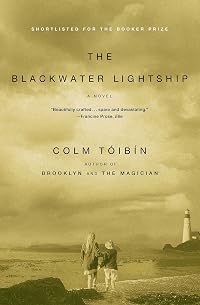
The Blackwater Lightship
by Colm Tóibín
On This Page
Description
It is Ireland in the early 1990s. Helen, her mother, Lily, and her grandmother, Dora have come together to tend to Helen's brother, Declan, who is dying of AIDS. With Declan's two friends, the six of them are forced to plumb the shoals of their own histories and to come to terms with each other. Shortlisted for the Booker Prize, The Blackwater Lightship is a deeply resonant story about three generations of an estranged family reuniting to mourn an untimely death. In spare, luminous prose, show more Colm Tóibín explores the nature of love and the complex emotions inside a family at war with itself. Hailed as "a genuine work of art" (Chicago Tribune), this is a novel about the capacity of stories to heal the deepest wounds. show lessTags
Recommendations
















Member Recommendations


Member Reviews
This is an early novel from Toibin, whose rather quiet explorations of human interaction and emotion sort of sneak up and clobber you. Helen, a married woman with two small sons, learns that her brother Declan is desperately ill and has asked for her. When she arrives at the hospital in the company of her brother's friend, a stranger to her, she realizes the nature of Declan's illness, and what it means about his life. Declan is dying of AIDS-related complications; he is a gay man in Ireland in the 1990's, and has no permanent partner...just a good many loving and caring friends. Declan and Helen have been estranged from their mother and grandmother for years, (in fact her husband and children have never met her mother) but he insists show more that she must go inform their mother of his situation. Furthermore, he wants to spend time at their grandmother's home on the coast, where they were "abandoned" as children one summer while their father--unbeknownst to them at the time--was dying. In the course of a difficult few days, Helen shares stories with Declan's friends, Larry and Paul, who have been caring for him during his bad patches. She learns a good deal about them, about Declan's life, and of course, about herself. Eventually, she and her mother find some common ground in their love for Declan and desire to help him. There are flashes of brilliant humor, both the wry and the raucous sort.. There are also moments that unexpectedly knock the wind out of your chest and make your eyes a bit leaky. I loved it. show less
What a beautifully told story! I looked this one up after a recommendation by Sarah Winman in her novel Tin Man and I'm so glad I did. For me, there are two threads to the tale, both equally devastating - a young man succumbing to AIDS, and the strong women in his close family reuniting over the tragedy. The scenes with Declan are very powerful, and I love that he has two of his friends there to balance the tension between his sister, mother and grandmother, yet the dialogue between Helen and her mother Lily, and Lily and her mother Dora, are what really resonated with me. I know these women! If I were Irish, this could almost be a biography! When Lily tells Helen that she wishes her daughter were different, or more like Lily herself, show more was like a punch in the gut. But then Lily isn't a complete monster either, when she starts to open up. I think this book is better therapy than buying self-help books about toxic mothers!
Personal feelings aside, the atmosphere of the damp house by the crumbling cliff in Wexford is also perfect for the story, and I loved the imagery of the lighthouse and the 'Blackwater Lightship' as told by Lily. Probably not recommended for readers who need a plot to follow or action to keep them going, but I would definitely encourage anyone who reads for characters and the beauty of a story well told to dedicate an afternoon to this short but bittersweet study of a family in turmoil. show less
Personal feelings aside, the atmosphere of the damp house by the crumbling cliff in Wexford is also perfect for the story, and I loved the imagery of the lighthouse and the 'Blackwater Lightship' as told by Lily. Probably not recommended for readers who need a plot to follow or action to keep them going, but I would definitely encourage anyone who reads for characters and the beauty of a story well told to dedicate an afternoon to this short but bittersweet study of a family in turmoil. show less
This isn't my usual type of reading material, but the book came as a bundle with the author's "House of Names", a reinterpretation of the Ancient Greek myth of Agamemnon/Clytemnestra et al, which I bought because I'm reading quite a few retellings of Greek Mythology at present. As such, I'm not the best audience for this, but I found it interesting in parts. The book was published in 1999 and concerns the terminal illness of Declan, a gay man who has contracted AIDS, and the womenfolk of his family who have been locked in a feud for many years.
The main character, Helen, who is Declan's sister, is happily married, the mother of two boys and a successful headmistress of a school. But her early life continues to haunt her, dating back to show more the death of her father of an unstated illness, almost certainly cancer. When he was taken to hospital, her mother sent her and Declan away to their grandparents' B&B by the sea in a remote area of Ireland, while she remained in Dublin. The children never saw him again and she did not visit. Eventually he died and they were brought back, but Helen felt that her mother was cold and rejecting and an attention-seeker.
As a student, Helen was guilt-tripped into acting as a skivvy at her grandmother's B&B each summer while her, now widowed, grandmother gave the orders. Due to this, Helen gave up the chance to go to America two summers running with Hugh, who subsequently cold-shouldered her, so it is odd that they married and the author does not explain what happened to change Hugh's attitude. Eventually, she stood up to them and resisted their attempt to prevent her taking a teaching job in Dublin. As a result of all this, Helen didn't invite her mother, Lily, to her wedding or home, and Lily has never seen her grandsons. Helen dreaded having to tell her about Declan, and as the days wear on at granny's house, all of them living together with Paul and Larry, two friends of Declan's, who have come to help with his physical and mental support, tensions rise. Despite this, the characters have to overcome their mutual antipathies and antagonisms to help Declan and bring him comfort.
The characters are rather unevenly written, though possibly this is an attempt to portray real people. The attitude of Paul towards Helen is annoying : when she explains the situation that arose from her mother and grandmother trying to railroad her into a job at what sounds to have been an inferior, though local, school, he dismisses this in a superior manner as insufficient reason for her to have cut her mother out of her life. But they had attempted to control and manipulate her, to the extent of bringing paper for her to write a letter withdrawing her application to the job she'd already accepted! Helen "admits" that the real reason is Lily's coldness to her since her father's death, but the attempt to sabotage her budding career was more than enough, given the difficulties a woman faced in making a life for herself, especially in Ireland in the 1990s. They did not, of course, do the same thing to Declan when he left school or college, and try to inveigle him into staying home and helping out domestically! As Helen finally says to Lily, her mother has never accepted her for who she is and has always wanted her to be someone different. However, as the story draws to a close, there is an indication that bridges are tentatively being reconstructed between mother and daughter.
Not my usual genre, as I said at the beginning, but overall I would rate it at 3 stars. show less
The main character, Helen, who is Declan's sister, is happily married, the mother of two boys and a successful headmistress of a school. But her early life continues to haunt her, dating back to show more the death of her father of an unstated illness, almost certainly cancer. When he was taken to hospital, her mother sent her and Declan away to their grandparents' B&B by the sea in a remote area of Ireland, while she remained in Dublin. The children never saw him again and she did not visit. Eventually he died and they were brought back, but Helen felt that her mother was cold and rejecting and an attention-seeker.
As a student, Helen was guilt-tripped into acting as a skivvy at her grandmother's B&B each summer while her, now widowed, grandmother gave the orders. Due to this, Helen gave up the chance to go to America two summers running with Hugh, who subsequently cold-shouldered her, so it is odd that they married and the author does not explain what happened to change Hugh's attitude. Eventually, she stood up to them and resisted their attempt to prevent her taking a teaching job in Dublin. As a result of all this, Helen didn't invite her mother, Lily, to her wedding or home, and Lily has never seen her grandsons. Helen dreaded having to tell her about Declan, and as the days wear on at granny's house, all of them living together with Paul and Larry, two friends of Declan's, who have come to help with his physical and mental support, tensions rise. Despite this, the characters have to overcome their mutual antipathies and antagonisms to help Declan and bring him comfort.
The characters are rather unevenly written, though possibly this is an attempt to portray real people. The attitude of Paul towards Helen is annoying : when she explains the situation that arose from her mother and grandmother trying to railroad her into a job at what sounds to have been an inferior, though local, school, he dismisses this in a superior manner as insufficient reason for her to have cut her mother out of her life. But they had attempted to control and manipulate her, to the extent of bringing paper for her to write a letter withdrawing her application to the job she'd already accepted! Helen "admits" that the real reason is Lily's coldness to her since her father's death, but the attempt to sabotage her budding career was more than enough, given the difficulties a woman faced in making a life for herself, especially in Ireland in the 1990s. They did not, of course, do the same thing to Declan when he left school or college, and try to inveigle him into staying home and helping out domestically! As Helen finally says to Lily, her mother has never accepted her for who she is and has always wanted her to be someone different. However, as the story draws to a close, there is an indication that bridges are tentatively being reconstructed between mother and daughter.
Not my usual genre, as I said at the beginning, but overall I would rate it at 3 stars. show less
‘’When I was young, lying in bed [...] I used to believe that Tuscar was a man and the Blackwater Lightship was a woman and they were both sending signals to each other and to other lighthouses, like mating calls.’’
Colm Toibin entered my top-5 squad of contemporary writers with his haunting rendition of the Atreides tragedy House of Names. I wanted to start my research of his work with a number of his earlier novels before I move on to Brooklyn and The Blackwater Lightship came my way. It was one of the best books I’ve read this year and it showcases how simple stories can cause a major impact on the reader when they’re well-written. And Colm Toibin definitely knows his Art…
The story is set in Ireland during the mid-90s, show more in Blackwater, in County Wexford, not very far from Dublin and close to the sea. Helen, a bright mind, the youngest school principal in the country, is happily married to Hugh and has succeeded in finding the balance between her career and the raising of two sons. Everything changes when she receives the news that her younger brother, Declan, is seriously ill, infected with HIV. So, she’s forced to reunite with Lily, her cruel mother, under the roof of Dora, her grandmother. A number of people has to come together for Declan’s sake and this is where the memories and faults of the past return to haunt Helen.
It is a simple story, a familiar ordeal during the 80s and the 90s when AIDS was at its peak, but great writers know how to create works of Art out of daily life. Toibin brings to focus the implications of the disease without a hint of melodrama but, most importantly, he centres his story around the complexity of human relationships that grow within a family and never let go. He writes about motherhood and the fragile, delicate balance between the three women of the family and I loved the way he depicted Helen’s fears and her struggle not to become the kind of mother Lily has been to her. He illustrates the dynamics in a problematic family and the implications of a mother’s actions and choices in direct, evocative prose that contains many moments of haunting beauty.
There are a number of elements that make this sad story such a beautiful thing to read. The setting is magical, the community by the water, the lighthouse that gives its light in Dora’s house during the evenings, the fact that most of the interactions take place at night. He creates a beautiful metaphor by using the lighthouse that once stood proudly and the name Blackwater to refer to the events of the story. Tuskar, the remaining, lonely lighthouse, dimly sheds its rays in the evening of Declan’s life and creates a haunting, foreboding atmosphere. The bleakness of the landscape is further emphasized by the lyrics of the Irish songs and the fact that Death is everywhere. The shadow of a loved one now long lost and the death that awaits in the doorstep to snatch a younger soul. The stages of grief are beautifully described in a sequence of striking scenes about the aftermath of loss, as are the omens associated with Death in the Irish culture.
Toibin transports us to the place and time with his references to politics and religious issues. I appreciated the reference to Mary Robinson -one of my favourite politicians- and the fact that he presents an extremely balanced view of the impact of Religion in the Irish community. Τhe shelter and comfort that it provides during the moments of agony and the restrictions that often come by abiding to Catholic traditions are perfectly depicted throughout the course of the story.
And then, we have the characters. Quite an oppressive family for Helen, to be honest, especially the mother. Lily simply refuses to accept what is different and tries to alter everything that doesn’t conform to the’’ family history’’ and her ideas of propriety. At the same time, Lily can do everything she wants just because she thinks she’s entitled to. A truly infuriating woman...Had I been Helen, well, let’s just say that I would have considered myself to be motherless, as cruel as it may sound. No amount of pain is an excuse for her cruelty, bigotry and narrow-mindedness. Helen, Declan and Paul are all wonderful, realistic characters. Declan is such a brave, brave man and Paul is loyal and considerate to the extreme. Larry is absolutely useless but for me, the character who shares the spotlight with Helen is Dora. I ended up appreciating her deeply and I thought she was a much better mother to Helen than Lily ever was. This is the kind of story where the characters take a step back to let the past and the interactions speak for themselves and it works.
Through the descriptions of the daily life in a small Irish community, the religious and social expectations and prejudices, the aspirations of the characters and the dynamics within a family, Toibin weaves a story that is beautiful and poignant in its calm, underlying sadness. Above all, it is the way a determined, intelligent woman and a brave man fight against those who wanted to chain them to the ground. And Toibin proves, once again, why he is considered a powerhouse in today’s Literature.
*Στους φίλους από Ελλάδα οι οποίοι θα διαβάσουν το παραπάνω κείμενο, οφείλω να πώ μακριά από την μετάφραση του Gutenberg. Είναι φρικτή. Λάθη στα τοπωνύμια, λάθη στην απόδοση των εκφράσεων, λεξιλόγιο πεζοδρομίου. Πραγματικά, αδυνατώ να καταλάβω ποιες λέξεις μετέφραζε η κυρία Δημητριάδου με τον τρόπο που τις απέδιδε στα Ελληνικά...Μάλλον η ‘’μεταφράστρια’’ εμπνεύστηκε από Ελληνικές σειρές επιπέδου...ελληνικού. Δεν περίμενα βέβαια και τίποτα καλύτερο…*
My reviews can also be found on https://theopinionatedreaderblog.wordpress.com show less
Colm Toibin entered my top-5 squad of contemporary writers with his haunting rendition of the Atreides tragedy House of Names. I wanted to start my research of his work with a number of his earlier novels before I move on to Brooklyn and The Blackwater Lightship came my way. It was one of the best books I’ve read this year and it showcases how simple stories can cause a major impact on the reader when they’re well-written. And Colm Toibin definitely knows his Art…
The story is set in Ireland during the mid-90s, show more in Blackwater, in County Wexford, not very far from Dublin and close to the sea. Helen, a bright mind, the youngest school principal in the country, is happily married to Hugh and has succeeded in finding the balance between her career and the raising of two sons. Everything changes when she receives the news that her younger brother, Declan, is seriously ill, infected with HIV. So, she’s forced to reunite with Lily, her cruel mother, under the roof of Dora, her grandmother. A number of people has to come together for Declan’s sake and this is where the memories and faults of the past return to haunt Helen.
It is a simple story, a familiar ordeal during the 80s and the 90s when AIDS was at its peak, but great writers know how to create works of Art out of daily life. Toibin brings to focus the implications of the disease without a hint of melodrama but, most importantly, he centres his story around the complexity of human relationships that grow within a family and never let go. He writes about motherhood and the fragile, delicate balance between the three women of the family and I loved the way he depicted Helen’s fears and her struggle not to become the kind of mother Lily has been to her. He illustrates the dynamics in a problematic family and the implications of a mother’s actions and choices in direct, evocative prose that contains many moments of haunting beauty.
There are a number of elements that make this sad story such a beautiful thing to read. The setting is magical, the community by the water, the lighthouse that gives its light in Dora’s house during the evenings, the fact that most of the interactions take place at night. He creates a beautiful metaphor by using the lighthouse that once stood proudly and the name Blackwater to refer to the events of the story. Tuskar, the remaining, lonely lighthouse, dimly sheds its rays in the evening of Declan’s life and creates a haunting, foreboding atmosphere. The bleakness of the landscape is further emphasized by the lyrics of the Irish songs and the fact that Death is everywhere. The shadow of a loved one now long lost and the death that awaits in the doorstep to snatch a younger soul. The stages of grief are beautifully described in a sequence of striking scenes about the aftermath of loss, as are the omens associated with Death in the Irish culture.
Toibin transports us to the place and time with his references to politics and religious issues. I appreciated the reference to Mary Robinson -one of my favourite politicians- and the fact that he presents an extremely balanced view of the impact of Religion in the Irish community. Τhe shelter and comfort that it provides during the moments of agony and the restrictions that often come by abiding to Catholic traditions are perfectly depicted throughout the course of the story.
And then, we have the characters. Quite an oppressive family for Helen, to be honest, especially the mother. Lily simply refuses to accept what is different and tries to alter everything that doesn’t conform to the’’ family history’’ and her ideas of propriety. At the same time, Lily can do everything she wants just because she thinks she’s entitled to. A truly infuriating woman...Had I been Helen, well, let’s just say that I would have considered myself to be motherless, as cruel as it may sound. No amount of pain is an excuse for her cruelty, bigotry and narrow-mindedness. Helen, Declan and Paul are all wonderful, realistic characters. Declan is such a brave, brave man and Paul is loyal and considerate to the extreme. Larry is absolutely useless but for me, the character who shares the spotlight with Helen is Dora. I ended up appreciating her deeply and I thought she was a much better mother to Helen than Lily ever was. This is the kind of story where the characters take a step back to let the past and the interactions speak for themselves and it works.
Through the descriptions of the daily life in a small Irish community, the religious and social expectations and prejudices, the aspirations of the characters and the dynamics within a family, Toibin weaves a story that is beautiful and poignant in its calm, underlying sadness. Above all, it is the way a determined, intelligent woman and a brave man fight against those who wanted to chain them to the ground. And Toibin proves, once again, why he is considered a powerhouse in today’s Literature.
*Στους φίλους από Ελλάδα οι οποίοι θα διαβάσουν το παραπάνω κείμενο, οφείλω να πώ μακριά από την μετάφραση του Gutenberg. Είναι φρικτή. Λάθη στα τοπωνύμια, λάθη στην απόδοση των εκφράσεων, λεξιλόγιο πεζοδρομίου. Πραγματικά, αδυνατώ να καταλάβω ποιες λέξεις μετέφραζε η κυρία Δημητριάδου με τον τρόπο που τις απέδιδε στα Ελληνικά...Μάλλον η ‘’μεταφράστρια’’ εμπνεύστηκε από Ελληνικές σειρές επιπέδου...ελληνικού. Δεν περίμενα βέβαια και τίποτα καλύτερο…*
My reviews can also be found on https://theopinionatedreaderblog.wordpress.com show less
This came as a bit of a hiccup in a long line of excellent books I've been reading lately.
It's 1990 or so in Eire and Declan is about to die from AIDS complications. His mother, sister and grandmother who all don't get on are suddenly forced together as a result of his terminal state.
The dispute between the women is presented as something far more important than it really is. It occurs to me that the repetitive agonizing over past hurts between these family members might so easily have been reconciled by an earlier chat and a pot of tea at the kitchen table rather than taking place at this late stage. The ruminations of Helen, Declan's sister, become tedious after a time.
We learn very little about the doomed brother; he's seems to be show more present in the story principally as a means of bringing the conflict between the sisters into play.
The Blackwater Lightship reference is lost on me too.
What is also sadly lacking is more commentary and space being devoted to Declan's plight as a terminal AIDS sufferer in Ireland in the nineties.
Moving right along now. show less
It's 1990 or so in Eire and Declan is about to die from AIDS complications. His mother, sister and grandmother who all don't get on are suddenly forced together as a result of his terminal state.
The dispute between the women is presented as something far more important than it really is. It occurs to me that the repetitive agonizing over past hurts between these family members might so easily have been reconciled by an earlier chat and a pot of tea at the kitchen table rather than taking place at this late stage. The ruminations of Helen, Declan's sister, become tedious after a time.
We learn very little about the doomed brother; he's seems to be show more present in the story principally as a means of bringing the conflict between the sisters into play.
The Blackwater Lightship reference is lost on me too.
What is also sadly lacking is more commentary and space being devoted to Declan's plight as a terminal AIDS sufferer in Ireland in the nineties.
Moving right along now. show less
I thought this was an excellent book. I found the relationship between the women of the three generations to be well presented with the right balance of mystery and revelation. The context of the homes in Ireland was, of course, also one of the features of the book, but Toibin seemed to be generalising that too - the idea that places we encounter when we're growing up can have a lasting impact on our lives. Similarly, a person's childhood relationships with siblings and parents can leave them emotionally scarred (or presumably the opposite), or at the very least can be an enduring unconscious influence on our later feelings and behaviours.
The gay people and their relationships seemed to be appropriately dealt with, and reflecting of show more the degree of actual and feared social rejection that I would have expected would have been present at the time. show less
The gay people and their relationships seemed to be appropriately dealt with, and reflecting of show more the degree of actual and feared social rejection that I would have expected would have been present at the time. show less
This is a wonderful book, perfectly paced and beautifully simple. The characters are all believable and I found the journey of the protagonist, Helen, very easy to relate to. The details of relationships may be different, but the challenge of living with old patterns of behaviour is surely something everyone struggles with.
The prose is incredibly controlled, so tight and honest that the simplest images or thoughts can have a searing impact.
The only reservation I would make to my prose is that the last quarter or so tends a little toward soap opera, but maybe this is justified as the characters face momentous challenges in their lives.
The prose is incredibly controlled, so tight and honest that the simplest images or thoughts can have a searing impact.
The only reservation I would make to my prose is that the last quarter or so tends a little toward soap opera, but maybe this is justified as the characters face momentous challenges in their lives.
Members
- Recently Added By
Published Reviews
Set in Ireland during the early 1990s, Declan is dying of AIDS. With the help of two gay companions, he leaves the hospital to spend a few days at the seaside home of his grandmother. There, at the crumbling place of his youth, his sister Helen, his mother Lily, and his grandmother Dora gather after a decade of estrangement. The three women had no idea Declan was gay, let alone terminally ill show more with AIDS. Once they recover from the shock, their primary goal becomes caring for Declan, who had always been the binding force in this dysfunctional family.
Like six castaways on a desert island, from different generations and with clashing beliefs and lifestyles, they are forced to face their own dark histories in order to deal with each other to achieve the common goal of keeping Declan alive and comfortable.
The Blackwater Lightship is predominately a story of three generations of iron-willed women from a divided family who reunite to help each other face a tragic situation. It is beautifully told in luminous prose, and with all the tenderness and insight that readers have come to expect from this superlative storyteller. Toibin takes the reader deep into the hearts of a family at war with itself in order to explore the nature of love. It is an emotional study of people grappling with the love and resentments that bind them, and ultimately it is a story of hope, showing love (or perhaps tragedy) has the capacity to heal the deepest wounds.
This is a tragic and moving journey, not for the faint of heart. It is, however, a destination well worth the effort. It moves slowly for the first half of the book, and then builds in intensity until I couldn’t put it down. It is not simply a wonderful story; it is a literary achievement. show less
Like six castaways on a desert island, from different generations and with clashing beliefs and lifestyles, they are forced to face their own dark histories in order to deal with each other to achieve the common goal of keeping Declan alive and comfortable.
The Blackwater Lightship is predominately a story of three generations of iron-willed women from a divided family who reunite to help each other face a tragic situation. It is beautifully told in luminous prose, and with all the tenderness and insight that readers have come to expect from this superlative storyteller. Toibin takes the reader deep into the hearts of a family at war with itself in order to explore the nature of love. It is an emotional study of people grappling with the love and resentments that bind them, and ultimately it is a story of hope, showing love (or perhaps tragedy) has the capacity to heal the deepest wounds.
This is a tragic and moving journey, not for the faint of heart. It is, however, a destination well worth the effort. It moves slowly for the first half of the book, and then builds in intensity until I couldn’t put it down. It is not simply a wonderful story; it is a literary achievement. show less
Lists

The Guardian's 1000 Novels Everyone Must Read
1,005 works; 550 members

Favourite Booker Prize contenders
73 works; 21 members
Booker Prize
491 works; 62 members

Best Books About Plagues and Epidemics
99 works; 17 members

Irish writers
87 works; 17 members

International IMPAC Dublin Literary Award
179 works; 6 members

Tour of Ireland
40 works; 11 members

A Novel Cure
742 works; 23 members

Man Booker Prize Longlist 1999
6 works; 2 members

Books Read in 2023
5,547 works; 145 members

End of Your Life Book Club
134 works; 4 members

Good LGBT fiction for LGBT folk and friends
545 works; 54 members

Booker Prize Shortlist: Titles Not Yet Read
161 works; 4 members

Fiction (Non-Fantasy) by Irish Authors Set in Ireland
87 works; 3 members
Author Information

87+ Works 25,375 Members
Colm Tóibín was born in Enniscorthy, Ireland in 1955. He studied history and English at University College Dublin, earning his B.A. in 1975. After graduating he moved to Barcelona for three years and taught at the Dublin School of English. In 1978 he returned to Dublin and began working on an M.A. in Modern English and American Literature. He show more wrote for In Dublin, Hibernia, and The Sunday Tribune. He became the Features Editor of In Dublin in 1981, and then a year later accepted the position of Editor for the Irish current affairs magazine Magill. His first book, Walking Along the Border, was published in 1987 and his first novel, The South, was published in 1990. He wrote for The Sunday Independent as a drama or television critic and political commentator. He writes regularly for The London Review of Books. He has written several other novels including The Story of the Night, The Blackwater Lightship, Brooklyn, The Testament of Mary, and Nora Webster. The Heather Blazing received the 1993 Encore Award and The Master received the 2006 International IMPAC Dublin Literary Award, the Stonewall Book Award, and the Lambda Literary Award. In 2015 he made The New Zealand High Profile Titles List with All The Light We Cannot See. He was short listed for the 2015 Folio Prize for his title Nora Webster. (Bowker Author Biography) show less
All Editions
Some Editions
Awards and Honors
Awards
Notable Lists
Series
Belongs to Publisher Series
Aldina (2)
Work Relationships
Common Knowledge
- Canonical title
- The Blackwater Lightship
- Original title
- The Blackwater Lightship
- Original publication date
- 1999
- Important places
- Ireland
- Related movies
- Hallmark Hall of Fame: The Blackwater Lightship (2004 | IMDb)
- First words
- Helen woke in the night to the sound of Manus whimpering.
Classifications
Statistics
- Members
- 1,616
- Popularity
- 13,932
- Reviews
- 49
- Rating
- (3.70)
- Languages
- 12 — Danish, Dutch, English, French, German, Greek, Hebrew, Icelandic, Italian, Latvian, Portuguese, Spanish
- Media
- Paper, Audiobook, Ebook
- ISBNs
- 32
- ASINs
- 11