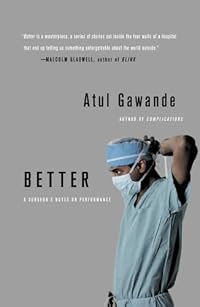
Better: A Surgeon's Notes on Performance
by Atul Gawande
On This Page
Description
NATIONAL BESTSELLERThe New York Times bestselling author of Being Mortal and Complications examines, in riveting accounts of medical failure and triumph, how success is achieved in a complex and risk-filled profession
The struggle to perform well is universal: each one of us faces fatigue, limited resources, and imperfect abilities in whatever we do. But nowhere is this drive to do better more important than in medicine, where lives are on the line with every decision. In this book, Atul show more Gawande explores how doctors strive to close the gap between best intentions and best performance in the face of obstacles that sometimes seem insurmountable.
Gawande's gripping stories of diligence, ingenuity, and what it means to do right by people take us to battlefield surgical tents in Iraq, to labor and delivery rooms in Boston, to a polio outbreak in India, and to malpractice courtrooms around the country. He discusses the ethical dilemmas of doctors' participation in lethal injections, examines the influence of money on modern medicine, and recounts the astoundingly contentious history of hand washing. And as in all his writing, Gawande gives us an inside look at his own life as a practicing surgeon, offering a searingly honest firsthand account of work in a field where mistakes are both unavoidable and unthinkable.
At once unflinching and compassionate, Better is an exhilarating journey narrated by "arguably the best nonfiction doctor-writer around" (Salon). Gawande's investigation into medical professionals and how they progress from merely good to great provides rare insight into the elements of success, illuminating every area of human endeavor.
. show less
Tags
Recommendations











Member Recommendations
Member Reviews
How can you not marvel at the human body? It's mysterious yet incredibly efficient, vulnerable but surprisingly resilient, rugged and delicate... it's a marvel and a mystery wrapped in an enigma. And yet Gawande and millions of others world-wide are tasked with keeping us all going for as long as possible, while (hopefully) allowing us to maintain a high quality of life.
In Better, Gawande takes us on a journey through the daily grind of medical professionals in situations as varied as dealing with blown-off limbs on the battlefield and delivering a baby in a parking lot. I've always admired those in the medical field, but after reading Better, I'm even more awed by what medical professionals do, often in adverse situations and with show more limited resources at hand.
I'm a big fan of Dr. Gawande. This is the second book I've read by him, and it won't be the last. I particularly appreciate his candidness in admitting his own shortcomings and reflecting on them. After holding a mirror up to himself, Gawande turns it on the medical world--and isn't afraid to reveal both its imperfections and its relentless pursuit of excellence.
What also struck me about this book is how universally applicable it is. Yes, it's about medicine, but the lessons delved into here are applicable to any profession. The themes of continuous improvement, ethical quandaries, and personal introspection are as relevant to an accountant or a lawyer as they are to a surgeon. "Better" is a perspective-changer. Whether you're in medicine, the arts, technology, or any other field, there's something in it for you. This is a book not just about being a better doctor, but about being a better human. show less
In Better, Gawande takes us on a journey through the daily grind of medical professionals in situations as varied as dealing with blown-off limbs on the battlefield and delivering a baby in a parking lot. I've always admired those in the medical field, but after reading Better, I'm even more awed by what medical professionals do, often in adverse situations and with show more limited resources at hand.
I'm a big fan of Dr. Gawande. This is the second book I've read by him, and it won't be the last. I particularly appreciate his candidness in admitting his own shortcomings and reflecting on them. After holding a mirror up to himself, Gawande turns it on the medical world--and isn't afraid to reveal both its imperfections and its relentless pursuit of excellence.
What also struck me about this book is how universally applicable it is. Yes, it's about medicine, but the lessons delved into here are applicable to any profession. The themes of continuous improvement, ethical quandaries, and personal introspection are as relevant to an accountant or a lawyer as they are to a surgeon. "Better" is a perspective-changer. Whether you're in medicine, the arts, technology, or any other field, there's something in it for you. This is a book not just about being a better doctor, but about being a better human. show less
I found this book surprisingly enjoyable. I don't read much nonfiction, but I took a chance on this after noticing the author's increasing profile (most notably on NPR) and seeing in his bio that he works at Brigham and Women's Hospital, which is in my neighborhood (and is also where my wife works).
I thought at first I was getting into a collection of feature-length pieces on assorted aspects of medicine, and that is overall what comprises the book. Gawande is very good at explaining the basics about any of the topics he tackles (the importance of hand washing to stem the spread of infection in hospitals, innovations in battlefield medicine in our most recent military conflicts, the complicated ethics of having doctors attend show more executions, the ways in which doctors in India improvise with limited supplies and inadequate staffing), and he is a good storyteller besides, injecting every story with personal details and human stories to bring his subject to life. The book would have been quite good if it had been merely a collection, because these qualities appear throughout.
Yet I appreciated also the fact that the pieces were tied together both structurally and thematically. No matter the topic, Gawande underscores the way in which doctors strive to improve their practices and performances on an ongoing basis. While it is not difficult to see where any single chapter here could easily have been published without reference to the others, they have been reworked to form a more cohesive whole, and the theme works well both to tie them together and strengthen their effect. He caps off the book with a brief article that relays the five suggestions he makes to doctors to help them avoid the tendency toward routine practices and to seek out new ways for them all to continue to get "better." Often, I fault nonfiction books for tacking on similar "now what?" chapters, but this one felt like more than a rehash of the salient points and a few vague suggestions. It had the feel of being applicable for anyone who hope to do more than scrape by in his life and work. Yes, it smacks of some popular self-improvement books, but in the context of all the courageous, innovative, and humbling stories that have gone before it, the suggestions have unusual resonance. show less
I thought at first I was getting into a collection of feature-length pieces on assorted aspects of medicine, and that is overall what comprises the book. Gawande is very good at explaining the basics about any of the topics he tackles (the importance of hand washing to stem the spread of infection in hospitals, innovations in battlefield medicine in our most recent military conflicts, the complicated ethics of having doctors attend show more executions, the ways in which doctors in India improvise with limited supplies and inadequate staffing), and he is a good storyteller besides, injecting every story with personal details and human stories to bring his subject to life. The book would have been quite good if it had been merely a collection, because these qualities appear throughout.
Yet I appreciated also the fact that the pieces were tied together both structurally and thematically. No matter the topic, Gawande underscores the way in which doctors strive to improve their practices and performances on an ongoing basis. While it is not difficult to see where any single chapter here could easily have been published without reference to the others, they have been reworked to form a more cohesive whole, and the theme works well both to tie them together and strengthen their effect. He caps off the book with a brief article that relays the five suggestions he makes to doctors to help them avoid the tendency toward routine practices and to seek out new ways for them all to continue to get "better." Often, I fault nonfiction books for tacking on similar "now what?" chapters, but this one felt like more than a rehash of the salient points and a few vague suggestions. It had the feel of being applicable for anyone who hope to do more than scrape by in his life and work. Yes, it smacks of some popular self-improvement books, but in the context of all the courageous, innovative, and humbling stories that have gone before it, the suggestions have unusual resonance. show less
Atul Gawande is a surgeon in Boston who is now known for the best-selling book Being Mortal. Better was his second book, in which he collects essays (in slightly different form, probably expanded) that were previous published in The New England Journal of Medicine and The New Yorker. In each, he explores ways in which doctors have attempted to improve performance, through the three large themes of diligence, doing right, and allowing ingenuity.
Though the book is was published in 2007, I imagine much of what he tackles in this book is still relevant in the medical field today. These themes are broad and allow him to reflect on topics as diverse as hand-washing (you'd be shocked by how much disease still travels because medical show more professionals don't wash hands between patients), ethical questions regarding doctors' presence or involvement in administration of the death penalty, and the difficulty in knowing when to stop fighting a disease and let someone live out their last days without medical intervention. It's a fascinating account that I would recommend to anyone. show less
Though the book is was published in 2007, I imagine much of what he tackles in this book is still relevant in the medical field today. These themes are broad and allow him to reflect on topics as diverse as hand-washing (you'd be shocked by how much disease still travels because medical show more professionals don't wash hands between patients), ethical questions regarding doctors' presence or involvement in administration of the death penalty, and the difficulty in knowing when to stop fighting a disease and let someone live out their last days without medical intervention. It's a fascinating account that I would recommend to anyone. show less
It's precisely because of our enormous success that people are bound to wonder what went wrong when we fail. (106)
This book was terrifyingly informative. From a polio vaccination campaign in India, to modern childbirth, to treatment for cystic fibrosis, to medical malpractice, it was fascinating, visceral, and horrifying by turns and sometimes all at once; the author's scientific, commonsense approach seems unique in the world of medicine. One of the main takeaway points is that no matter how good technology gets, human error and inconsistency tend to be the real culprits in the majority of situations. One major example of this is doctors neglecting to wash their hands between patients, and thus spreading infections throughout show more hospitals. Better ought to be required reading for all doctors, nurses, and patients. show less
First published at Booking in Heels.
The key thing to know about this book is that it's not about how doctors can make their patients better, it's about the ways they can improve to make their own practice and treatment regime better. That said, it's far from a manual aimed at lecturing hospital staff, it's an accessible and engaging collection of thoughts that I would say is aimed at the general public.
Mr Gawande has divided his book into three sections - Diligence, Doing Right and Ingenuity - which he says are the three core requirements for success in medicine, or any endeavour that involves risk and responsibility.
Diligence was perhaps my favourite of the three sections as it focuses more on doctors as people, and the tiny little show more everyday responsibilities that I find fascinating. It looks at how, despite the movement started in the 1840s to encourage doctors to wash their hands, a surprisingly large amount of them still forget when running from patient to patient. We also examine the huge-scale campaigns to eradicate polio and the effort required to vaccinate every single child in India, and the brave doctors who accompany the military to Iraq, Afghanistan and every other campaign across the globe.
Doing Right looks at the obligations that doctors and other medical professionals are under, and whether they are always strictly fair. For example, there's a chapter on whether it should be obligatory for a doctor to attend during a state execution or whether this directly contravenes their purpose, which is to heal people. I also really enjoyed the chapter about how doctors examine the more intimate areas of a person's body and whether a chaperone should be required.
Lastly, we look at Ingenuity, which covers the introduction of the Apgar score (which assesses the health of a newborn baby) as well as looking at how medical centers and hospitals and can improve by comparing the statistics of other, similar centers.
However, the topics almost fall into irrelevance when compared to Mr Gawande's prose. He writes with such humanity and grace that you'd be forgiven for thinking he was an author by trade, not a surgeon. I was also impressed by his seeming complete lack of bias. There's a chapter on medical malpractice lawsuits which was angering me more and more as I read on (as a disclaimer, I defend doctors from lawsuits for a living!) but he maintains a perfect tone throughout that accepts that doctors are people too. Mistakes are made, some are unavoidable whilst some are not, but perhaps patients do deserve some compensation when an avoidable mistake is made.
I'm unsure which of the two books, Complications or Better, I prefer. The topics are slightly different but naturally there is some overlap. Complications focuses more on surgical procedures but therefore involves more case studies, which doesn't really interest me because I do nothing but nosy at other people's illnesses at work. I can see how that might interest people not quite as pompous as myself, however.
Better doesn't feature any case studies and the sections on execution chambers and eradicating polio (amongst others) were fascinating. However, there are a few chapters on the cost of treatments, statistics and medical hierarchy that just weren't applicable to countries other than America. I ended up skipping the section on funding because it made so little sense to me. It's written just as well as the remainder of the book, but it just didn't appeal to me as a UK resident.
To solve the comparison problem, I'd honestly just read both of them. And also Being Mortal: Illness, Medicine and What Matters in the End. I haven't read it yet, but I don't see it being anything less than amazing if his previous books are anything to go by. My one complaint about these series is that the silver leaf around the edges of the book does tend to rub off, which looks quite scruffy 280 pages later. show less
The key thing to know about this book is that it's not about how doctors can make their patients better, it's about the ways they can improve to make their own practice and treatment regime better. That said, it's far from a manual aimed at lecturing hospital staff, it's an accessible and engaging collection of thoughts that I would say is aimed at the general public.
Mr Gawande has divided his book into three sections - Diligence, Doing Right and Ingenuity - which he says are the three core requirements for success in medicine, or any endeavour that involves risk and responsibility.
Diligence was perhaps my favourite of the three sections as it focuses more on doctors as people, and the tiny little show more everyday responsibilities that I find fascinating. It looks at how, despite the movement started in the 1840s to encourage doctors to wash their hands, a surprisingly large amount of them still forget when running from patient to patient. We also examine the huge-scale campaigns to eradicate polio and the effort required to vaccinate every single child in India, and the brave doctors who accompany the military to Iraq, Afghanistan and every other campaign across the globe.
Doing Right looks at the obligations that doctors and other medical professionals are under, and whether they are always strictly fair. For example, there's a chapter on whether it should be obligatory for a doctor to attend during a state execution or whether this directly contravenes their purpose, which is to heal people. I also really enjoyed the chapter about how doctors examine the more intimate areas of a person's body and whether a chaperone should be required.
Lastly, we look at Ingenuity, which covers the introduction of the Apgar score (which assesses the health of a newborn baby) as well as looking at how medical centers and hospitals and can improve by comparing the statistics of other, similar centers.
However, the topics almost fall into irrelevance when compared to Mr Gawande's prose. He writes with such humanity and grace that you'd be forgiven for thinking he was an author by trade, not a surgeon. I was also impressed by his seeming complete lack of bias. There's a chapter on medical malpractice lawsuits which was angering me more and more as I read on (as a disclaimer, I defend doctors from lawsuits for a living!) but he maintains a perfect tone throughout that accepts that doctors are people too. Mistakes are made, some are unavoidable whilst some are not, but perhaps patients do deserve some compensation when an avoidable mistake is made.
I'm unsure which of the two books, Complications or Better, I prefer. The topics are slightly different but naturally there is some overlap. Complications focuses more on surgical procedures but therefore involves more case studies, which doesn't really interest me because I do nothing but nosy at other people's illnesses at work. I can see how that might interest people not quite as pompous as myself, however.
Better doesn't feature any case studies and the sections on execution chambers and eradicating polio (amongst others) were fascinating. However, there are a few chapters on the cost of treatments, statistics and medical hierarchy that just weren't applicable to countries other than America. I ended up skipping the section on funding because it made so little sense to me. It's written just as well as the remainder of the book, but it just didn't appeal to me as a UK resident.
To solve the comparison problem, I'd honestly just read both of them. And also Being Mortal: Illness, Medicine and What Matters in the End. I haven't read it yet, but I don't see it being anything less than amazing if his previous books are anything to go by. My one complaint about these series is that the silver leaf around the edges of the book does tend to rub off, which looks quite scruffy 280 pages later. show less
One of my favorite nonfiction writers. Atul Gawande is always worth a read. In "Better", he considers the question of what might make medicine as a whole industry ... better. In terms of cost, effectiveness, reach, and advancement of knowledge. For doctors and patients, and to a lesser extent, society as a whole.
This is an enormous question, of course, and Gawande does manage to address it in a meaningful way by detailing three major case studies and several smaller ones. I found the case study of polio eradication in India the most fascinating. That so few local overseers belonging to UN agencies coordinate such a massive effort for eradication is astounding, especially knowing the challenges of Indian systems intimately like I do. show more
The other case studies, such as hand washing among doctors and the medical side of childbirth are also memorable. Hand washing especially, I went in with something like a "duh why can't they do it properly" attitude, and Gawande's case study left me with a deep understanding of exactly why not.
There were two slightly frustrating things about this book. One was that Gawande is so scrupulously apolitical that it gets a bit annoying. When he discusses health insurance, for example, it is hard to see how he can possible do it well while steadfastly remaining apolitical, and yeah, his reticence does hurt the chapter. He leaves many options for alternative systems for healthcare provisions unexamined because of it.
The other slightly annoying thing is how Gawande seems to see doctors as demigods, if not actually divine. Often this is an endearing attitude. But sometimes it grates, this high-and-mighty way he has of suggesting throughout that doctors are ever so Special and must be held to godly standards of performance and morality, etc. I am not one to suggest doctors are the same as any other profession like car sales, but Atul Gawande is on a completely new level of reverence for the profession. Like I said, this IS usually endearing. If I had to choose a doctor I'd most certainly choose one who felt the special weight of doctorly responsibility than one who is in it just for the money. But in some chapters, like the one on childbirth, Gawande's reverence leaves him utterly unable to admit the depth of the medical profession's failure in treating women like people, and accepting the fact that sheer greed is what is behind the over medicalization of childbirth throughout the previous venture that continues to this day. Any failures of the medical profession are blamed on lack of knowledge and good intentions. This is annoying.
But regardless, a really good book, great fun to read. show less
This is an enormous question, of course, and Gawande does manage to address it in a meaningful way by detailing three major case studies and several smaller ones. I found the case study of polio eradication in India the most fascinating. That so few local overseers belonging to UN agencies coordinate such a massive effort for eradication is astounding, especially knowing the challenges of Indian systems intimately like I do. show more
The other case studies, such as hand washing among doctors and the medical side of childbirth are also memorable. Hand washing especially, I went in with something like a "duh why can't they do it properly" attitude, and Gawande's case study left me with a deep understanding of exactly why not.
There were two slightly frustrating things about this book. One was that Gawande is so scrupulously apolitical that it gets a bit annoying. When he discusses health insurance, for example, it is hard to see how he can possible do it well while steadfastly remaining apolitical, and yeah, his reticence does hurt the chapter. He leaves many options for alternative systems for healthcare provisions unexamined because of it.
The other slightly annoying thing is how Gawande seems to see doctors as demigods, if not actually divine. Often this is an endearing attitude. But sometimes it grates, this high-and-mighty way he has of suggesting throughout that doctors are ever so Special and must be held to godly standards of performance and morality, etc. I am not one to suggest doctors are the same as any other profession like car sales, but Atul Gawande is on a completely new level of reverence for the profession. Like I said, this IS usually endearing. If I had to choose a doctor I'd most certainly choose one who felt the special weight of doctorly responsibility than one who is in it just for the money. But in some chapters, like the one on childbirth, Gawande's reverence leaves him utterly unable to admit the depth of the medical profession's failure in treating women like people, and accepting the fact that sheer greed is what is behind the over medicalization of childbirth throughout the previous venture that continues to this day. Any failures of the medical profession are blamed on lack of knowledge and good intentions. This is annoying.
But regardless, a really good book, great fun to read. show less
This book is far less engaging than his first, and espouses a mildly distasteful and shockingly simplistic message. Don't look for a enlightened analysis in Gawande's views here. In each chapter, Gawande examines the complexities of the topic and then tops it off with a barely argued conclusion that ignores all the subtleties of the issues at hand.
Nowhere is this more evident than in his essay on the death penalty. There he, as always, weaves a truly engaging narrative about the doctors who aid in capital punishment. At the beginning he suggests that its a complicated issue with no clear moral conclusion. At the end, he asserts his own conclusion in a moral black and white. No matter that he has just finished a very convincing essay show more about how it is not possible to come to such a clear conclusion. The whole message comes off as arrogant and, inexplicably, uninformed.
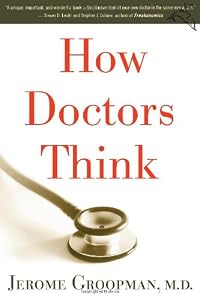
A better, though drier, analysis of a similar topic can be found in "How Doctors Think" by Jerome Groopman. There, the author fully confronts the complexities of the issues at hand and doesn't make a conclusion just because it is the end of a chapter. show less
Nowhere is this more evident than in his essay on the death penalty. There he, as always, weaves a truly engaging narrative about the doctors who aid in capital punishment. At the beginning he suggests that its a complicated issue with no clear moral conclusion. At the end, he asserts his own conclusion in a moral black and white. No matter that he has just finished a very convincing essay show more about how it is not possible to come to such a clear conclusion. The whole message comes off as arrogant and, inexplicably, uninformed.
A better, though drier, analysis of a similar topic can be found in "How Doctors Think" by Jerome Groopman. There, the author fully confronts the complexities of the issues at hand and doesn't make a conclusion just because it is the end of a chapter. show less
Members
- Recently Added By
Lists

Best Medical Nonfiction
79 works; 29 members

So you want to get into medicine
29 works; 6 members

Authors from the United States
245 works; 3 members
Author Information

12+ Works 16,911 Members
Atul Gawande is a surgical resident in Boston and staff writer on medicine and science for The New Yorker. A former Rhodes scholar, he received his M.D. from Harvard Medical School. He lives with his wife and three children in Newton, Massachusetts. (Publisher Fact Sheets) Atul Gawande is a surgeon at Brigham and Women's Hospital in Boston, a show more staff writer for The New Yorker, and a professor at Harvard Medical School and the Harvard School of Public Health. He is also the Executive Director of Ariadne Labs and chairman of Lifebox, a nonprofit organization making surgery safer globally. He has written several books including Complications, Better, The Checklist Manifesto, and Being Mortal: Medicine and What Matters in the End. He has won the Lewis Thomas Prize for Writing about Science and two National Magazine Awards. He will be appearing at the 2015 Auckland Writers Festival in New Zealand. He won the prize for Adult Non-fiction in the Indies Choice Book Awards 2015 with Being Mortal: Medicine and What Matters in the End. (Bowker Author Biography) show less
Awards and Honors
Distinctions
Common Knowledge
- Alternate titles
- Better
- Original publication date
- 2007
- People/Characters
- Atul Gawande
- Important places
- Rochester, Minnesota, USA; India; Iraq
- Dedication
- For my parents and sister
- First words
- Several years ago, in my final year of medical school, I took care of a patient who has stuck in my mind.
- Blurbers
- Gladwell, Malcolm; Ackerman, Diane; Lewis, Michael
- Original language
- English
Classifications
Statistics
- Members
- 2,455
- Popularity
- 7,856
- Reviews
- 72
- Rating
- (4.06)
- Languages
- 6 — Dutch, English, German, Italian, Portuguese, Spanish
- Media
- Paper, Audiobook, Ebook
- ISBNs
- 23
- ASINs
- 12