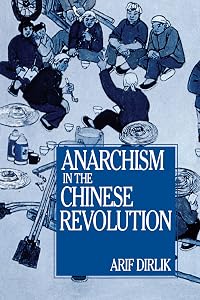
Anarchism in the Chinese Revolution
by Arif Dirlik
On This Page
Description
Arif Dirlik's latest offering is a revisionist perspective on Chinese radicalism in the twentieth century. He argues that the history of anarchism is indispensable to understanding crucial themes in Chinese radicalism. And anarchism is particularly significant now as a source of democratic ideals within the history of the socialist movement in China. Dirlik draws on the most recent scholarship and on materials available only in the last decade to compile the first comprehensive history of show more his subject available in a Western language. He emphasizes the anarchist contribution to revolutionary discourse and elucidates this theme through detailed analysis of both anarchist polemics and social practice. The changing circumstances of the Chinese revolution provide the immediate context, but throughout his writing the author views Chinese anarchism in relation to anarchism worldwide. show lessTags
Recommendations












Member Recommendations

Member Reviews
Without knowing it you would not conclude Anarchism was much to be reckoned with in early 20th century China, but you would be wrong. Arif Dirlik demonstrates using primary Chinese source material that while committed anarchists were never more than thousands in number, they outnumbered the Communists until this was reversed in the early to mid 20's after Guomintang-Communist Party united front work, anarchists setup the Communist Party (which Moscow was at pains to purge ideologically), quite a number of recognisable names passed through the anarchists political work (including Chen Duxiu and Deng Xiaopeng!), their ideas were key to the May Fourth movement and the New Culture Movement, between 1922-28 there were more than 90 active show more anarchist groups across China (mainly Guangzhou and Shanghai), anarchists organised the first labour unions in China and had a national university dedicated to labour organising.
The book operates less as an historical overview of the period in question, but more as a source for analysing the political debates within anarchism (particularly as there were two main schools of thought from the outset) from its inception in the late 1800's to the movements nose dive when the Communist party becomes an independent force. For this reason its slightly lacking as things like the May Fourth Movement and Sun Yat-Sen's 'Three Principles' need to be discussed and placed within a much wider context. And it would have also helped if an appendix could have summarised the groups, individuals involved, influences and publications as it was hard to retain this information as the book went on.
That said the debates and themes the book covers are highly relevant and give a good flavour of the times. Whether were talking Liu Shifu's turn from nilihist terrorism to becoming the leading most articulate theoritician of revolutionary anarchism or Ou Shengbai's grand sweeping criticism of Bolshevism and the nasty turns within the Guomintang. As the debates persist you can see a number of flaws reoccur (errorneous attitude towards the Guomintang and being unabble to organise nationally) and then events take their course, and the rest is then history as they say. As an introduction to an under-researched topic this was both rewarding and informative. show less
The book operates less as an historical overview of the period in question, but more as a source for analysing the political debates within anarchism (particularly as there were two main schools of thought from the outset) from its inception in the late 1800's to the movements nose dive when the Communist party becomes an independent force. For this reason its slightly lacking as things like the May Fourth Movement and Sun Yat-Sen's 'Three Principles' need to be discussed and placed within a much wider context. And it would have also helped if an appendix could have summarised the groups, individuals involved, influences and publications as it was hard to retain this information as the book went on.
That said the debates and themes the book covers are highly relevant and give a good flavour of the times. Whether were talking Liu Shifu's turn from nilihist terrorism to becoming the leading most articulate theoritician of revolutionary anarchism or Ou Shengbai's grand sweeping criticism of Bolshevism and the nasty turns within the Guomintang. As the debates persist you can see a number of flaws reoccur (errorneous attitude towards the Guomintang and being unabble to organise nationally) and then events take their course, and the rest is then history as they say. As an introduction to an under-researched topic this was both rewarding and informative. show less
Ratings
Members
- Recently Added By
Lists

Library Wishlist
46 works; 1 member
Author Information
31+ Works 274 Members
Arif Dirlik is Knight Professor of Social Science at the University of Oregon.
Common Knowledge
- People/Characters
- Ba Jin; Emma Goldman; Chen Duxiu; Peter Kropotkin; Leo Tolstoy
- Important events
- May Fourth Movement; Chinese Revolution of 1911; Chinese Civil War
Classifications
Statistics
- Members
- 58
- Popularity
- 532,159
- Reviews
- 1
- Rating
- (2.50)
- Languages
- English
- Media
- Paper, Ebook
- ISBNs
- 4