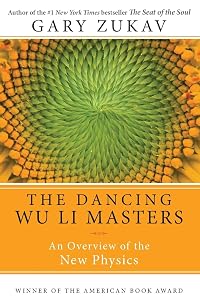
The Dancing Wu Li Masters: An Overview of the New Physics
by Gary Zukav
On This Page
Description
Gary Zukav's timeless, humorous, New York Times bestselling masterpiece, The Dancing Wu Li Masters, is arguably the most widely acclaimed introduction to quantum physics ever written. Accessible, edifying, and endlessly entertaining, The Dancing Wu Li Masters is back in a beautiful new edition-and the doors to the fascinating, dazzling, remarkable world of quantum physics are opened to all once again, no previous mathematical or technical expertise required.Tags
Recommendations











Member Recommendations
Limelite Eminently readable, fun, and adventurous with the added bonus of being about actual quantum physics.
Member Reviews
There are a good number of books on the shelf near my desk that I notice have a bookmark sticking up out of the pages. THE DANCING WU LI MASTERS was one of them. I always thought of this title as one of the great primers on modern physics but I had not made it through to the end. Now that I have I am starting to think that Gary Zukav may be one of our great thinkers. I am sitting here deeply impressed with how the last chapter, "The End of Science," written around 1978 is the prelude to George Musser's late 2015 book on physics and the end of space, SPOOKY ACTION AT A DISTANCE.
I believe it was Richard Feynman who told his sister Joan that when you dive into a difficult book and get stuck, go back to the beginning and start over. I think show more of this as similar to getting a car up a snowy road. Now that I have made it all the way through DANCING in the mass paperback version, I ordered a good copy of the hardback and plan to back up and get a start on the icy hill yet another time.
Zukav claims to have a lack of education in physics and a liberal arts mentality. When Zukav wrote DANCING there were not many physicists yet who were familiar with John Stewart Bell's theorem regarding quantum entanglement and the fact that it was being proven. Yet Zukav looked into and predicted the end of science. Which is much of where Musser arrives today with SPOOKY. As you read them, pay no attention to your smoke alarm. That is just the stuff curling from your ears. show less
I believe it was Richard Feynman who told his sister Joan that when you dive into a difficult book and get stuck, go back to the beginning and start over. I think show more of this as similar to getting a car up a snowy road. Now that I have made it all the way through DANCING in the mass paperback version, I ordered a good copy of the hardback and plan to back up and get a start on the icy hill yet another time.
Zukav claims to have a lack of education in physics and a liberal arts mentality. When Zukav wrote DANCING there were not many physicists yet who were familiar with John Stewart Bell's theorem regarding quantum entanglement and the fact that it was being proven. Yet Zukav looked into and predicted the end of science. Which is much of where Musser arrives today with SPOOKY. As you read them, pay no attention to your smoke alarm. That is just the stuff curling from your ears. show less
There are a good number of books on the shelf near my desk that I notice have a bookmark sticking up out of the pages. THE DANCING WU LI MASTERS was one of them. I always thought of this title as one of the great primers on modern physics but I had not made it through to the end. Now that I have I am starting to think that Gary Zukav may be one of our great thinkers. I am sitting here deeply impressed with how the last chapter, "The End of Science," written around 1978 is the prelude to George Musser's late 2015 book on physics and the end of space, SPOOKY ACTION AT A DISTANCE.
I believe it was Richard Feynman who told his sister Joan that when you dive into a difficult book and get stuck, go back to the beginning and start over. I think show more of this as similar to getting a car up a snowy road. Now that I have made it all the way through DANCING in the mass paperback version, I ordered a good copy of the hardback and plan to back up and get a start on the icy hill yet another time.
Zukav claims to have a lack of education in physics and a liberal arts mentality. When Zukav wrote DANCING there were not many physicists yet who were familiar with John Stewart Bell's theorem regarding quantum entanglement and the fact that it was being proven. Yet Zukav looked into and predicted the end of science. Which is much of where Musser arrives today with SPOOKY. As you read them, pay no attention to your smoke alarm. That is just the stuff curling from your ears. show less
I believe it was Richard Feynman who told his sister Joan that when you dive into a difficult book and get stuck, go back to the beginning and start over. I think show more of this as similar to getting a car up a snowy road. Now that I have made it all the way through DANCING in the mass paperback version, I ordered a good copy of the hardback and plan to back up and get a start on the icy hill yet another time.
Zukav claims to have a lack of education in physics and a liberal arts mentality. When Zukav wrote DANCING there were not many physicists yet who were familiar with John Stewart Bell's theorem regarding quantum entanglement and the fact that it was being proven. Yet Zukav looked into and predicted the end of science. Which is much of where Musser arrives today with SPOOKY. As you read them, pay no attention to your smoke alarm. That is just the stuff curling from your ears. show less
Attempts to build connections between the tricky concepts of physics, e.g. the way that some things do not 'exist' until they are observed, with mystical /religious/ metaphysical concepts. However he misses the points that : 1. the effects he discusses are at the quantum level, when matter is collected in bulk (i.e. more than a few pico grams) then bulk effects come into play which swamp quantum effects; 2. humans have evolved in the bulk universe & so are not sensitive to quantum level effects. (even when quantum effects are harnessed by modern technology they are done so in bulk)
He raises fair points about the ability of the human mind to think in different ways in order to understand the counter-intuitive parts of physics. But that show more does not mean we have to become bhuddist mystics. show less
He raises fair points about the ability of the human mind to think in different ways in order to understand the counter-intuitive parts of physics. But that show more does not mean we have to become bhuddist mystics. show less
I've finally finished The Dancing Wu Li Masters after years of it sitting on my shelf and weeks of reflecting on what it is saying. It's an old book when considering present developments in the observation of quantum mechanics, but quantum theory itself is twice as old and since its inception has hardly changed. This book however is the first I've read that was capable of viscerally explaining the non-locality and non-linearity of space-time. Limited by "symbols" it acknowledges this limit and it dances with you within these confines so as to allow you, the reader, to experience the reality that the ambiguity of language prohibits. I've read books that describe the world in terms of eastern philosophy, relativity, string theory, quantum show more electrodynamics, probability functions, and from the historical perspective of the human perception of time itself, and yet none of them were able to convey what was on the tip of their brains, and the tip of mine as well. They all touch upon the fact that at the plank level no further observations are possible, or that energy and matter, waves and particles, are merely two different manifestations of the underlying fabric of space-time. That the linear passage of time is only a construct resulting from the methods with which the relativistic mind collects the information, while space-time itself is only motion, with no preference towards forward or backward. They all extol the words of Bohm, Bell and Schrödinger, but none of them ever try to conceptualize these precepts beyond the application of their useless symbolism, or then take so many angles in driving home the truth of the matter.
Here's a mantra saved like a jewel in one of the very last pages.
Reality is what we take to be true. What we take to be true is what we believe. What we believe is based upon our perceptions. What we perceive depends upon what we look for. What we look for depends upon what we think. What we think depends upon what we perceive. What we perceive determines what we believe. What we believe determines what we take to be true. What we take to be true is our reality.
As far as information is concerned, this book pales in comparison to the likes of In Search of Schrödinger's Kittens or The Elegant Universe, but it's what this book leaves open to interpretation that brought me the most pleasure. show less
Here's a mantra saved like a jewel in one of the very last pages.
Reality is what we take to be true. What we take to be true is what we believe. What we believe is based upon our perceptions. What we perceive depends upon what we look for. What we look for depends upon what we think. What we think depends upon what we perceive. What we perceive determines what we believe. What we believe determines what we take to be true. What we take to be true is our reality.
As far as information is concerned, this book pales in comparison to the likes of In Search of Schrödinger's Kittens or The Elegant Universe, but it's what this book leaves open to interpretation that brought me the most pleasure. show less
My favorite quote from the novel:
‰ÃÃÂêReality is what we take to be true. What we take to be true is what we believe. What we believe is based upon our perceptions. What we perceive depends upon what we look for. What we look for depends upon what we think. What we think depends upon what we perceive. What we perceive determines what we believe. What we believe determines what we take to be true. What we take to be true is our reality.ÂÃÂ
Touted as an easy laymanÂês introduction to the history of Quantum Physics, I took a while not because the experiments of Planck, Einstein, Finkelstein and Bohm the author breaks down for his reader so well are hard to conceptualize. It is the meaning of the ideas show more behind these experiments that are heavy to digest.
A central idea is that there is energy in everything and what happens to B will always affect A in some way. Although you canÂêt predict specific events, you can predict probabilities. And, ÂÃÃNot only do we influence our reality ÂÃ_ we actually create it.ÂÃÂ
Another idea is the fundamental belief that we donÂêt know what we donÂêt know and that the new physics might actually be the study of consciousness.
There are also intriguing comparisons made in this book between some of the tenants of new physics and eastern religion and mysticism.
Some argue that Quantum Mechanics is the only science that allows for the concept of God. Newtonian physics doesnÂêt apply to the subatomic world although the subatomic world includes Newtonian physics. Quantum Physics goes beyond the machinery of things and explains matter in terms of energy and organics. It describes an openness to experience, rather than sole reliance on scientific description that physicists have learned to place value on.
In this book Zukav captures a moment for scientists when they realized they didnÂêt know what they thought they knew. It wasnÂêt the first time the scientific community and the world had come to such realization, of course. For hundreds of years we thought the world was flat only to find out it was round. But I was fascinated by the idea in a more recent day and age of how such enlightenment and monumental shift in thinking might feel. show less
‰ÃÃÂêReality is what we take to be true. What we take to be true is what we believe. What we believe is based upon our perceptions. What we perceive depends upon what we look for. What we look for depends upon what we think. What we think depends upon what we perceive. What we perceive determines what we believe. What we believe determines what we take to be true. What we take to be true is our reality.ÂÃÂ
Touted as an easy laymanÂês introduction to the history of Quantum Physics, I took a while not because the experiments of Planck, Einstein, Finkelstein and Bohm the author breaks down for his reader so well are hard to conceptualize. It is the meaning of the ideas show more behind these experiments that are heavy to digest.
A central idea is that there is energy in everything and what happens to B will always affect A in some way. Although you canÂêt predict specific events, you can predict probabilities. And, ÂÃÃNot only do we influence our reality ÂÃ_ we actually create it.ÂÃÂ
Another idea is the fundamental belief that we donÂêt know what we donÂêt know and that the new physics might actually be the study of consciousness.
There are also intriguing comparisons made in this book between some of the tenants of new physics and eastern religion and mysticism.
Some argue that Quantum Mechanics is the only science that allows for the concept of God. Newtonian physics doesnÂêt apply to the subatomic world although the subatomic world includes Newtonian physics. Quantum Physics goes beyond the machinery of things and explains matter in terms of energy and organics. It describes an openness to experience, rather than sole reliance on scientific description that physicists have learned to place value on.
In this book Zukav captures a moment for scientists when they realized they didnÂêt know what they thought they knew. It wasnÂêt the first time the scientific community and the world had come to such realization, of course. For hundreds of years we thought the world was flat only to find out it was round. But I was fascinated by the idea in a more recent day and age of how such enlightenment and monumental shift in thinking might feel. show less
This is an amazing book and amazing so, because it revitalized the science training within me! As a teenager, I was so absorbed and completely fascinated by Neils Bohr's postulates, Max Planck's Theory that Physics was the air i breathed! And, after that phase I realized I was so out of touch of this very nature- atoms/protons/ quasi-protons/ quarks! Wow! This book truly is meant for the ordinary layman who is or was never a science student! I can even think of a few friends I can gift this book to! What science really means in the life of a student and a researcher versus in the ordinary life of a layman, this book completely closes gaps on it!
What a wonderful lucid style of explaining modern physics! I kept reading hungrily, show more savouring every single word, if there were equations, my joy would have have known no bounds! Clearly, one of the best resource books for everyone! The Wu Li masters philosophy is interesting too! This book is highly recommended and if i were on the education board, this would just be THE book to study! show less
What a wonderful lucid style of explaining modern physics! I kept reading hungrily, show more savouring every single word, if there were equations, my joy would have have known no bounds! Clearly, one of the best resource books for everyone! The Wu Li masters philosophy is interesting too! This book is highly recommended and if i were on the education board, this would just be THE book to study! show less
Silly Drivel; Welcome to the world of pseudo scientists claiming that quantum physics can prove any theory. Deepak Chopra would be proud.
If this book were what it claimed to be, a sort of physics for the layperson, I could get behind that. But its not- it's more about Zukav trying to use physics to prove his favorite flavor of eastern philosophy.
Anyone who thinks by reading this book they can hold their own in an actual scientific conversation will be sorely embarrassed. You will be pegged as a new age nut job in the first 5 minutes.
If this book were what it claimed to be, a sort of physics for the layperson, I could get behind that. But its not- it's more about Zukav trying to use physics to prove his favorite flavor of eastern philosophy.
Anyone who thinks by reading this book they can hold their own in an actual scientific conversation will be sorely embarrassed. You will be pegged as a new age nut job in the first 5 minutes.
Members
- Recently Added By
Author Information

15+ Works 7,175 Members
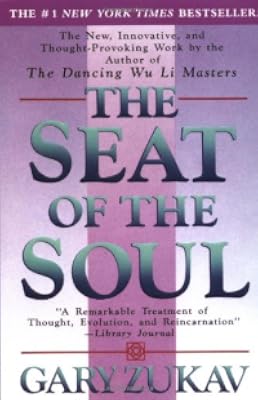
Gary Zukav is the author of the #1 New York Times bestseller The Seat of the Soul and The Dancing Wu Li Masters, winner of the American Book Award for Science. His books have sold millions of copies and are published in thirty languages. He is a graduate of Harvard and a former US Army Special Forces (Green Beret) officer with Vietnam service. He show more lives in Oregon with his spiritual partner, Linda Francis. To learn more about Gary Zukav visit www.seatofthesoul.com. show less
Some Editions
Awards and Honors
Awards
Series
Belongs to Publisher Series
Common Knowledge
- Canonical title
- The Dancing Wu Li Masters: An Overview of the New Physics
- Original title
- The Dancing Wu Li Masters: An Overview of the New Physics
- Alternate titles*
- De dansende Woe-Li meesters : een overzicht van de nieuwe fysica
- Original publication date
- 1979
- People/Characters
- Louis de Broglie
- Epigraph
- Most of the fundamental ideas of science are essentially simple, and may, as a rule, be expressed in a language comprehensible to everyone.
--Albert Einstein, The Evolution of Physics, p. 27
Even for the physicist the description in plain language will be a criterion of the degree of understanding that has been reached.
--Werner Heisenberg, Physics and Philosophy, p. 168
If you cannot--in the long run--tell everyone what you have been doing, your doing has been worthless.
--Erwin Schrodinger, Science and Humanism, p. 7-8 - Dedication
- This book is dedicated to you, who are drawn to read it.
- First words
- When I tell my friends that I study physics, they move their heads from side to side, they shake their hands at the wrist, and they whistle, "Whew! That's difficult."
Introduction: My first exposure to quantum physics occurred a few years ago when a friend invited me to an afternoon conference at the Lawrence Berkeley Laboratory in Berkeley, California.
Foreward: When Gary Zukav announced his plans for this book, creating the outline with Al Huang and me watching at a dinner table at Esalen, 1976, I did not realize the magnitude of the job he took on with such joy. - Last words
- (Click to show. Warning: May contain spoilers.)My God! We're back to the title of the book.
- Blurbers
- Gardner, Martin; Lehman-Haupt, Christopher
- Original language
- English
*Some information comes from Common Knowledge in other languages. Click "Edit" for more information.
Classifications
Statistics
- Members
- 2,972
- Popularity
- 6,006
- Reviews
- 33
- Rating
- (3.73)
- Languages
- 8 — Dutch, English, French, German, Italian, Polish, Spanish, Swedish
- Media
- Paper, Audiobook, Ebook
- ISBNs
- 43
- ASINs
- 25