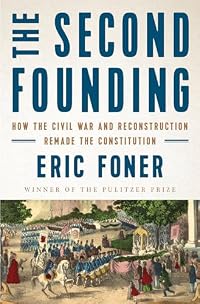
The Second Founding: How the Civil War and Reconstruction Remade the Constitution
by Eric Foner
On This Page
Description
From the Pulitzer Prize-winning scholar, a timely history of the constitutional changes that built equality into the nation's foundation and how those guarantees have been shaken over time. The Declaration of Independence announced equality as an American ideal, but it took the Civil War and the subsequent adoption of three constitutional amendments to establish that ideal as American law. The Reconstruction amendments abolished slavery, guaranteed all persons due process and equal show more protection of the law, and equipped black men with the right to vote. They established the principle of birthright citizenship and guaranteed the privileges and immunities of all citizens. The federal government, not the states, was charged with enforcement, reversing the priority of the original Constitution and the Bill of Rights. In grafting the principle of equality onto the Constitution, these revolutionary changes marked the second founding of the United States. Eric Foner's compact, insightful history traces the arc of these pivotal amendments from their dramatic origins in pre-Civil War mass meetings of African-American "colored citizens" and in Republican party politics to their virtual nullification in the late nineteenth century. A series of momentous decisions by the Supreme Court narrowed the rights guaranteed in the amendments, while the states actively undermined them. The Jim Crow system was the result. Again today there are serious political challenges to birthright citizenship, voting rights, due process, and equal protection of the law. Like all great works of history, this one informs our understanding of the present as well as the past: knowledge and vigilance are always necessary to secure our basic rights. show lessTags
Recommendations






Member Recommendations
Member Reviews
We shouldn’t forget that the original United States Constitution, for all its brilliance, did explicitly condone the practice of slavery. For example, the “three-fifths compromise” counted slaves as three-fifths of a person for the purpose of calculating state representation in Congress, while Article 1, Section 9, Clause 1 prohibited Congress from passing laws banning slavery until 1808. Additionally, Article 4, Section 2 states, in essence, that escaped slaves must be returned to their owners in the original state from which they fled.
In other words, the Constitution was far from perfect (luckily, it allowed for its own modification). And that’s why many historians consider the “second founding” during the Reconstruction show more era to be of equal or greater significance than the founding itself. The Reconstruction era that followed the Civil War saw the passage of three amendments that would forever transform politics in the US, both in terms of civil rights and in the balance of power between the federal government and the states.
In “The Second Founding,” historian and Reconstruction expert Eric Foner tells the story of how these three amendments—the thirteenth, fourteenth, and fifteenth—together represent the foundation for the continuing struggle for universal rights. The abolition of slavery, birthright citizenship, equal protection under the laws, universal suffrage, and the Incorporation Doctrine (which forces the states to honor the Bill of Rights) are all the direct or indirect result of these three crucial amendments. And yet the “second founding” remains less well-known among the public than the first.
This book is the remedy for that gap in public knowledge, and is invaluable for understanding not only the Reconstruction era but also the subsequent civil rights movements and the modern conservative attack on equality. Foner shows, for example, how talk of “state rights” has almost always been a cover for blatant discrimination. “State rights” has variously meant the right to enslave, the right to deny the vote to blacks and women, the right to violate the Bill of Rights, and the right to discriminate based on race and gender. As Foner wrote, “Before the war, for example, southern states adopted laws making criticism of slavery a crime without violating the First Amendment since these were state laws and not acts of Congress.” The real danger, in terms of rights violations, has always been greater within the individual states.
This book can also act as a good inoculant against conservative rhetoric that hasn’t changed in at least 156 years. The reader will be amused to find the same state’s rights and reverse discrimination arguments throughout the book. Andrew Johnson, for example, in his opposition to the fourteenth amendment, said, “The distinction of race and color is by the bill made to operate in favor of the colored against the white race.” As Foner wrote, “In the idea that expanding the rights of nonwhites somehow punishes the white majority, the ghost of Andrew Johnson still haunts our discussions of race.”
The underlying message of the book seems to be that any rights granted by the Constitution are worthless if not enforced. Constitutional rights can be ignored, distorted, or narrowly interpreted to deprive certain groups of equal protection and treatment under the law. But if we can’t even recognize when this is happening—and we don’t properly understand what the second founding was trying to accomplish—then we are all powerless to prevent a regression to discriminatory politics under the guise of “state’s rights,” “originalism,” and all the rest. show less
In other words, the Constitution was far from perfect (luckily, it allowed for its own modification). And that’s why many historians consider the “second founding” during the Reconstruction show more era to be of equal or greater significance than the founding itself. The Reconstruction era that followed the Civil War saw the passage of three amendments that would forever transform politics in the US, both in terms of civil rights and in the balance of power between the federal government and the states.
In “The Second Founding,” historian and Reconstruction expert Eric Foner tells the story of how these three amendments—the thirteenth, fourteenth, and fifteenth—together represent the foundation for the continuing struggle for universal rights. The abolition of slavery, birthright citizenship, equal protection under the laws, universal suffrage, and the Incorporation Doctrine (which forces the states to honor the Bill of Rights) are all the direct or indirect result of these three crucial amendments. And yet the “second founding” remains less well-known among the public than the first.
This book is the remedy for that gap in public knowledge, and is invaluable for understanding not only the Reconstruction era but also the subsequent civil rights movements and the modern conservative attack on equality. Foner shows, for example, how talk of “state rights” has almost always been a cover for blatant discrimination. “State rights” has variously meant the right to enslave, the right to deny the vote to blacks and women, the right to violate the Bill of Rights, and the right to discriminate based on race and gender. As Foner wrote, “Before the war, for example, southern states adopted laws making criticism of slavery a crime without violating the First Amendment since these were state laws and not acts of Congress.” The real danger, in terms of rights violations, has always been greater within the individual states.
This book can also act as a good inoculant against conservative rhetoric that hasn’t changed in at least 156 years. The reader will be amused to find the same state’s rights and reverse discrimination arguments throughout the book. Andrew Johnson, for example, in his opposition to the fourteenth amendment, said, “The distinction of race and color is by the bill made to operate in favor of the colored against the white race.” As Foner wrote, “In the idea that expanding the rights of nonwhites somehow punishes the white majority, the ghost of Andrew Johnson still haunts our discussions of race.”
The underlying message of the book seems to be that any rights granted by the Constitution are worthless if not enforced. Constitutional rights can be ignored, distorted, or narrowly interpreted to deprive certain groups of equal protection and treatment under the law. But if we can’t even recognize when this is happening—and we don’t properly understand what the second founding was trying to accomplish—then we are all powerless to prevent a regression to discriminatory politics under the guise of “state’s rights,” “originalism,” and all the rest. show less
Pulitzer Prize winner Eric Foner is recognized as America’s leading expert on the history of the period immediately after the U.S. Civil War, known as Reconstruction, during which the North tried to build an egalitarian society. The title of his latest book, The Second Founding, encapsulates his thesis that the changes to American society effected during Reconstruction were so profound they amounted to a new beginning - indeed, a second founding - of the nation.
The principal purpose of the original ten amendments to the Constitution, the Bill Of Rights, was to protect individuals from the power of the new central government. Though the original authors of these documents (often hallowed as “the Founders”) wanted a national show more government more formidable than the one established by the feckless Articles of Confederation, they sought to limit the power it could exercise over its citizens. But those constraints did not apply to individual states. For example, many of the states continued to have established religions even though the first Amendment forbade the national government from establishing any single religion.
Foner argues convincingly that the Civil War was fought over the southern states’ efforts to preserve the institution of slavery. [Although the declarations of secession by Southern states clearly articulated that the protection of slavery was the paramount impetus for the rupture per, for example, Confederate Vice President Alexander Stephens, enough later Southern history revisionists averred that secession was actually about "states' rights" that the argument has to be constantly relitigated.] But even though the North had won the war, there was no immediate legal basis for eliminating slavery or for protecting the newly freed slaves from the depredations or their former masters. Ironically, the Emancipation Proclamation of 1863 had “freed” only those slaves still under the control of the rebel armies, leaving slaves in the northern and border states in a legal no-man’s-land concerning servitude.
The legal scaffolding for reorganizing the country took the form of three transformative amendments to the Constitution: the 13th, 14th, and 15th. The 13th abolished slavery throughout the country. The 14th established birthright citizenship for any person born in the United States “and subject to the jurisdiction thereof,” along with requiring the states to provide “due process” and “equal protection” to all “persons within their jurisdiction.” The 15th prohibited the states from denying the right to vote to any person on the basis of “race, color, or previous condition of servitude.” The effect of these amendments and the Civil Rights Act of 1866 was to attempt to put into practice the ideal of equality expressed in the Declaration of Independence. To that end, the amendments invested substantially more power in the national government and provided the means to make the national government the protector of individuals against discrimination and unfair treatment by states or local governments.
This indeed was revolutionary.
Discussion: Foner is not only superb historian, he is an excellent legal analyst. As an historian, his description of the political maneuvering behind the adoption of the amendments is riveting. But what really stands out in his narration is his explication of the legal niceties behind the language adopted. [Well, maybe that’s just the lawyer in me enjoying some good legal writing.]
Unfortunately, the story of the second founding does not end with the adoption of praiseworthy amendments. As Foner recounts, the language of the amendments left enough wiggle room for malevolent racists in the postwar South to reestablish white race-based hegemony. With the end of U.S. Grant’s presidency in 1877 (Grant was dedicated to ensuring that freed blacks realized their newly legislated rights), national commitment to helping and protecting blacks ended in large part as well. Northern troops were withdrawn from the South. “Jim Crow” laws taking rights away from blacks were enacted in one state of the South after another. The Klan was given free rein to exercise police power over blacks without fear of reprisal. Schools and other public services for blacks were defunded. History textbooks used in southern schools were designed to teach white superiority and black backwardness, so that children imbibed these ideas from the earliest age. These practices persisted until the Civil Rights movement of the 1960s, but did not end entirely. Rather, they took on new shapes; the battle for racial justice continues to this day.
Foner recapitulates the sorry history of how a complicit United States Supreme Court abetted racist politicians and lower court judges in their efforts to eviscerate the original intent of Civil War Amendments for almost 100 years after their enactment. Again, his legal skills come to the fore as he takes us through the intricacies of numerous cases that constitute the corpus of civil rights jurisprudence.
Evaluation: This book is surprisingly brief (only 176 pages) considering the depth with which it treats a complex subject. It’s principal thesis, that the Civil War and Reconstruction completely overhauled the Constitution and the society it governed, is ably and cogently argued. I very highly recommend it as required history for all American citizens.
(JAB) show less
The principal purpose of the original ten amendments to the Constitution, the Bill Of Rights, was to protect individuals from the power of the new central government. Though the original authors of these documents (often hallowed as “the Founders”) wanted a national show more government more formidable than the one established by the feckless Articles of Confederation, they sought to limit the power it could exercise over its citizens. But those constraints did not apply to individual states. For example, many of the states continued to have established religions even though the first Amendment forbade the national government from establishing any single religion.
Foner argues convincingly that the Civil War was fought over the southern states’ efforts to preserve the institution of slavery. [Although the declarations of secession by Southern states clearly articulated that the protection of slavery was the paramount impetus for the rupture per, for example, Confederate Vice President Alexander Stephens, enough later Southern history revisionists averred that secession was actually about "states' rights" that the argument has to be constantly relitigated.] But even though the North had won the war, there was no immediate legal basis for eliminating slavery or for protecting the newly freed slaves from the depredations or their former masters. Ironically, the Emancipation Proclamation of 1863 had “freed” only those slaves still under the control of the rebel armies, leaving slaves in the northern and border states in a legal no-man’s-land concerning servitude.
The legal scaffolding for reorganizing the country took the form of three transformative amendments to the Constitution: the 13th, 14th, and 15th. The 13th abolished slavery throughout the country. The 14th established birthright citizenship for any person born in the United States “and subject to the jurisdiction thereof,” along with requiring the states to provide “due process” and “equal protection” to all “persons within their jurisdiction.” The 15th prohibited the states from denying the right to vote to any person on the basis of “race, color, or previous condition of servitude.” The effect of these amendments and the Civil Rights Act of 1866 was to attempt to put into practice the ideal of equality expressed in the Declaration of Independence. To that end, the amendments invested substantially more power in the national government and provided the means to make the national government the protector of individuals against discrimination and unfair treatment by states or local governments.
This indeed was revolutionary.
Discussion: Foner is not only superb historian, he is an excellent legal analyst. As an historian, his description of the political maneuvering behind the adoption of the amendments is riveting. But what really stands out in his narration is his explication of the legal niceties behind the language adopted. [Well, maybe that’s just the lawyer in me enjoying some good legal writing.]
Unfortunately, the story of the second founding does not end with the adoption of praiseworthy amendments. As Foner recounts, the language of the amendments left enough wiggle room for malevolent racists in the postwar South to reestablish white race-based hegemony. With the end of U.S. Grant’s presidency in 1877 (Grant was dedicated to ensuring that freed blacks realized their newly legislated rights), national commitment to helping and protecting blacks ended in large part as well. Northern troops were withdrawn from the South. “Jim Crow” laws taking rights away from blacks were enacted in one state of the South after another. The Klan was given free rein to exercise police power over blacks without fear of reprisal. Schools and other public services for blacks were defunded. History textbooks used in southern schools were designed to teach white superiority and black backwardness, so that children imbibed these ideas from the earliest age. These practices persisted until the Civil Rights movement of the 1960s, but did not end entirely. Rather, they took on new shapes; the battle for racial justice continues to this day.
Foner recapitulates the sorry history of how a complicit United States Supreme Court abetted racist politicians and lower court judges in their efforts to eviscerate the original intent of Civil War Amendments for almost 100 years after their enactment. Again, his legal skills come to the fore as he takes us through the intricacies of numerous cases that constitute the corpus of civil rights jurisprudence.
Evaluation: This book is surprisingly brief (only 176 pages) considering the depth with which it treats a complex subject. It’s principal thesis, that the Civil War and Reconstruction completely overhauled the Constitution and the society it governed, is ably and cogently argued. I very highly recommend it as required history for all American citizens.
(JAB) show less
The Fourteenth Amendment was badly written. Its language of "no state shall" opened it up to interpretation as applying only to action by the states, and its reference to "privileges or immunities" left it vague how broad or narrow these were. In the Slaughterhouse and Civil Rights Cases respectively, SCOTUS gave it these narrow readings and thereby betrayed the hopes of the Republicans who passed the amendment through Congress and wanted to root out most, if not all, the vestiges of race slavery. The book is worth reading even for the final chapter alone, which explains how this happened.
Could the interpretive history of A14 have gone differently? The book indicates dissents and arguments that would have done so. Did privileges and show more immunities include all the Bill of Rights and more? Could the enforcement clause empower Congress to step in with federal authority where states refused to protect civil rights or implement equal protection of the law? Did the federal government indeed retain the power to enforce rights expressly or impliedly set out in the Constitution?
It was a disaster at the time, with white mobs terrorizing African Americans as SCOTUS forbade the US government from taking action against them, but I'm not convinced it matters much today. By back-roads and byways of the Constitution, America has enacted most of the laws that Radicals foresaw: a public accommodations law under the Commerce Clause, even a Fair Housing Act with a fairly sweeping disparate impact construction put on it, a racial hate-crime law under the Thirteenth Amendment badges of slavery doctrine (blessedly unmarred by a state action clause), a Voting Rights Act against racial discrimination under the Fifteenth, and eventually incorporating the Bill of Rights under the guise of deprivation of liberty without due process.
What is wrong with the federal government's role in race in America today is not so much what it cannot do, but what it will not do. For example: regulate federal elections to prevent voter suppression and gerrymandering, require public housing it funds to be sited in areas with good jobs and schools, mandate civil rights training standards for police forces it funds. No hiding behind the state action doctrine! show less
Could the interpretive history of A14 have gone differently? The book indicates dissents and arguments that would have done so. Did privileges and show more immunities include all the Bill of Rights and more? Could the enforcement clause empower Congress to step in with federal authority where states refused to protect civil rights or implement equal protection of the law? Did the federal government indeed retain the power to enforce rights expressly or impliedly set out in the Constitution?
It was a disaster at the time, with white mobs terrorizing African Americans as SCOTUS forbade the US government from taking action against them, but I'm not convinced it matters much today. By back-roads and byways of the Constitution, America has enacted most of the laws that Radicals foresaw: a public accommodations law under the Commerce Clause, even a Fair Housing Act with a fairly sweeping disparate impact construction put on it, a racial hate-crime law under the Thirteenth Amendment badges of slavery doctrine (blessedly unmarred by a state action clause), a Voting Rights Act against racial discrimination under the Fifteenth, and eventually incorporating the Bill of Rights under the guise of deprivation of liberty without due process.
What is wrong with the federal government's role in race in America today is not so much what it cannot do, but what it will not do. For example: regulate federal elections to prevent voter suppression and gerrymandering, require public housing it funds to be sited in areas with good jobs and schools, mandate civil rights training standards for police forces it funds. No hiding behind the state action doctrine! show less
Short book. “Members of Congress during the Civil War and Reconstruction had the irritating habit of not debating at length, or at all, concerns that have driven recent jurisprudence relating to the amendments.” The Supreme Court screwed up the amendments early on by limiting them to favor whites (and expanding them to favor corporations), and we haven’t yet fixed that. As he points out, by the 1890s, when the Reconstruction amendments started to get their still-fixed interpretations, “the Court’s members included Edward D. White, a former Confederate soldier with a deep abhorrence of Reconstruction who as a young man had participated in efforts by a white paramilitary organization to overthrow Louisiana’s biracial show more government,” and who became Chief Justice in 1910. The Court struck down laws that tried to protect voting rights generally and to protect citizens against private racist violence. At every point, even though the history is contested and there were always different views of the meaning of the amendments, the Court has taken the narrow view.
Foner also covers how black voices have been ignored in discerning the framers’ intent, even though black votes were key to passing the Fourteenth Amendment, and how Chinese exclusion was “promoted, in part, as a fulfillment of the Thirteenth Amendment” by keeping out people allegedly too servile to be citizens. And the amendments themselves were a hodgepodge of compromise; a few far-sighted commentators noted that the exemption for prisoners in the Thirteenth Amendment could do great damage, and now it has. Also, did you know that the Fourteenth Amendment provides for reduction of representation if states disenfranchised significant numbers of male voters, but that was never implemented? And the Fifteenth Amendment could have guaranteed a right to vote, precluding most of the tactics now being deployed against mostly minority voters, but it didn’t, in part because many white Westerners wanted to exclude Asians and some Northeastern states imposed literacy or property tests on immigrants. As for Southern tactics to suppress voting, “Republican leaders also did not expect that the South’s political leaders would not mind—or might even welcome—the fact that significant numbers of poorer whites would lose the right to vote because of such laws.” show less
Foner also covers how black voices have been ignored in discerning the framers’ intent, even though black votes were key to passing the Fourteenth Amendment, and how Chinese exclusion was “promoted, in part, as a fulfillment of the Thirteenth Amendment” by keeping out people allegedly too servile to be citizens. And the amendments themselves were a hodgepodge of compromise; a few far-sighted commentators noted that the exemption for prisoners in the Thirteenth Amendment could do great damage, and now it has. Also, did you know that the Fourteenth Amendment provides for reduction of representation if states disenfranchised significant numbers of male voters, but that was never implemented? And the Fifteenth Amendment could have guaranteed a right to vote, precluding most of the tactics now being deployed against mostly minority voters, but it didn’t, in part because many white Westerners wanted to exclude Asians and some Northeastern states imposed literacy or property tests on immigrants. As for Southern tactics to suppress voting, “Republican leaders also did not expect that the South’s political leaders would not mind—or might even welcome—the fact that significant numbers of poorer whites would lose the right to vote because of such laws.” show less
In this short book, Dr. Foner goes through the background to the Thirteenth, Fourteenth and Fifteenth Amendments to the U.S. Constitution, using contemporary sources, to make the case that those three amendments did not simply abolish slavery but established broad principals that should have governed the expansion of civil rights for African-Americans but that were limited by later Supreme Court decisions that shied away from the clear intentions of the Amendments and permitted the exclusion of black voters, the Jim Crow laws, and the use of violence to keep African-Americans from exercising their rights. The parallels with our recent and ongoing Supreme Court decisions are obvious.
It's just so g*****n bleak. We've done this before, and given in at the finish line. We are one more federal election way from a minority party nullifying election results they don't like. The terrible thing is that would mean the cynics were right all along.
Not that great. Better off with the full Reconstruction tome by the same fellow. This follows the career of the 13th, 14th and 15th amendments, along with the 1866 Civil Rights act - but to my reading in a bit of muddled way. Meaning he sorts of drifts between the contemporaneous debates on these items and the many changes / compromises that were part of that record, and then hearkens forward to later application of the item under discussion. Probably it is on me and my too casual reading (sorry) but I got muddled up often enough about just where we were and what we were talking about. Well intentioned of course and history with an agenda...
Members
- Recently Added By
Author Information

66+ Works 10,306 Members
Eric Foner is the preeminent historian of his generation. His books have won the top awards in the profession, and he has been president of both major history organizations, the American Historical Association and the Organization of American Historians. He is the author of Give Me Liberty!, which displays all of his trademark strengths as a show more scholar, teacher, and writer. A specialist on the Civil War/Reconstruction period, he regularly teaches the nineteenth-century survey at Columbia University, where he is DeWitt Clinton Professor of History. In 2011, Foner's The Fiery Trial: Abraham Lincoln and American Slavery won the Pulitzer Prize in History, the Bancroft Prize, and the Lincoln Prize. His Gateway to Freedom: The Hidden History of the Underground Railroad is a 2015 New York Times bestseller. (Bowker Author Biography) show less
Awards and Honors
Common Knowledge
- Canonical title
- The Second Founding: How the Civil War and Reconstruction Remade the Constitution
- Important places
- USA
- Important events
- American Civil War; Reconstruction
- Original language
- English
Classifications
- Genres
- Politics and Government, History, Nonfiction, General Nonfiction
- DDC/MDS
- 342.73 — Society, Government, and Culture Law U.S. Constitution - Bill of Rights, Amendments North America Constitutional law--United States
- LCC
- KF4541 .F68 — Law Law of the United States Law of the United States (Federal) Constitutional law Constitutional history of the United States
- BISAC
Statistics
- Members
- 506
- Popularity
- 59,008
- Reviews
- 9
- Rating
- (4.18)
- Languages
- English
- Media
- Paper, Audiobook, Ebook
- ISBNs
- 11
- ASINs
- 2