On This Page
Description
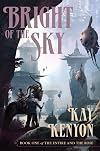
Fantasy. Fiction. Science Fiction. HTML:Kay Kenyon, noted for her science fiction world-building, has in this new series created her most vivid and compelling society, the Universe Entire. In a land-locked galaxy that tunnels through our own, the Entire is a bizarre and seductive mix of long-lived quasi-human and alien beings gathered under a sky of fire, called the bright. A land of wonders, the Entire is sustained by monumental storm walls and an exotic, never-ending river. Over all, the show more elegant and cruel Tarig rule supreme.Into this rich milieu is thrust Titus Quinn, former star pilot, bereft of his beloved wife and daughter who are assumed dead by everyone on earth except Quinn. Believing them trapped in a parallel universe—one where he himself may have been imprisoned—he returns to the Entire without resources, language, or his memories of that former life. He is assisted by Anzi, a woman of the Chalin people, a Chinese culture copied from our own universe and transformed by the kingdom of the bright. Learning of his daughter's dreadful slavery, Quinn swears to free her. To do so, he must cross the unimaginable distances of the Entire in disguise, for the Tarig are lying in wait for him. As Quinn's memories return, he discovers why. Quinn's goal is to penetrate the exotic culture of the Entire—to the heart of Tarig power, the fabulous city of the Ascendancy, to steal the key to his family's redemption.
But will his daughter and wife welcome rescue? Ten years of brutality have forced compromises on everyone. What Quinn will learn to his dismay is what his own choices were, long ago, in the Universe Entire. He will also discover why a fearful multiverse destiny is converging on him and what he must sacrifice to oppose the coming storm.
This is high-concept SF written on the scale of Philip Jose Farmer's Riverworld, Roger Zelazny's Amber Chronicles, and Dan Simmons's Hyperion. show less
Tags
Recommendations
















Member Recommendations
by anonymous user
Member Reviews
It's not often that an author manages to create a world that feels new to me. Too often...whether I like a book or not...I'm left hearing an echo of Middle Earth, or Dune, or Aurora, or whatever. Ms. Kenyon's The Entire left me with none of that. She's done a marvelous job of world-building, from the geography, through the sentient races, to the complex politics.
Only slightly less well-done are her characters. While your reaction to them varies, they are all very vividly drawn. I found myself sucked into their stories from the first page. There is also a nice element of realism to their makeup—there are very few that you either love or hate unreservedly. Even the "hero" of this book elicited mixed reactions from me.
The book is not show more perfect. Most noticeably, some things just go a little too smoothly. Too many people just find themselves inexplicably drawn to help Titus, at the risk of their lives, and despite everything in their cultural conditioning. The fundamental shifts in the millenia-old Inyx culture come out of left field, with no real foundation in the story. Escape from the ultra-advanced Tarig seems to be as simple as suddenly "remembering" that you know how to tunnel through their buildings and re-program their spaceships.
Nonetheless, Kenyon's writing ability makes up for this and, with barely a flicker of "oh, come on!", disbelief is suspended again and the result is a very enjoyable story. I look forward to the arrival of the sequel, A World Too Near. Though the story is fairly firmly science fiction, the tone and the "sufficiently advanced technology...indistinguishable from magic" make this a book that will likely appeal to hardcore fantasy fans, as well. show less
Only slightly less well-done are her characters. While your reaction to them varies, they are all very vividly drawn. I found myself sucked into their stories from the first page. There is also a nice element of realism to their makeup—there are very few that you either love or hate unreservedly. Even the "hero" of this book elicited mixed reactions from me.
The book is not show more perfect. Most noticeably, some things just go a little too smoothly. Too many people just find themselves inexplicably drawn to help Titus, at the risk of their lives, and despite everything in their cultural conditioning. The fundamental shifts in the millenia-old Inyx culture come out of left field, with no real foundation in the story. Escape from the ultra-advanced Tarig seems to be as simple as suddenly "remembering" that you know how to tunnel through their buildings and re-program their spaceships.
Nonetheless, Kenyon's writing ability makes up for this and, with barely a flicker of "oh, come on!", disbelief is suspended again and the result is a very enjoyable story. I look forward to the arrival of the sequel, A World Too Near. Though the story is fairly firmly science fiction, the tone and the "sufficiently advanced technology...indistinguishable from magic" make this a book that will likely appeal to hardcore fantasy fans, as well. show less
Started cautiously, but I'm swept up. There is 'enough' of everything necessary: decent writing, characters, and world-building to keep me on board, plus a dollop of fey or weird (in the older sense). Such as calling our universe 'the rose'? But the story is growing on me. I suppose the weakest thing is the starting premise, esp the bad guys and gals, but as new aspects of the Entire are revealed, I suspect they and their schemes will fall by the wayside, more scaffolding than central, where Kenyon began but not where she will end. The premise? An alternate universe touching ours. Titus Quinn, a pilot, falls into it with his wife and daughter. after an error destroys a research space station far afield. This universe, called the Entire show more is in a wheel/spoke shape and is, in a sense, entirely artificial, created by the Tarig, humanoid, but evoking serious non-human insectile/reptile -- taller, faster, stronger, and the kind of rational that allows for insane cruelties along with beauty. They have created the residents of the Entire from sentients they have observed on worlds in the Rose, although they would appear to favor their human creations, known as the Chalin (alabaster--way beyond our white--skin, jet black hair and golden eyes, like but not like, us). To keep everyone occupied there is a Long War against a somewhat mysterious enemy which pretty much all able-bodied residents must participate in. I could go on and on about the residents and captives of the Entire, but suffice it to say, they are many and interesting. There are evocations much else I've read in the sf and fantasy genre--but used with energy and originality mostly--and the line here between magic and science is as thin as the membrane between these two 'verses. All things I enjoy. My one quibble is that Titus Quinn feels a bit Conan-y, the amazing guy you just can't get ride of, but he deserves a place as much as anyone in this book which does have a Mrs. Murphy's stew quality. The most compelling character is his daughter, Sydney, left (not by parental choice) to her own fate on the Entire, who has been ritually blinded (by the Tarig) and sent to partner with one of the sentient warriors, the Inyx, who resemble gigantic horses with horns who communicate telepathically and who live in their own portion of the Entire. Towards the end of Bk 1 a larger (and much more interesting!) plot is revealed. I look forward to learning more, especially about the Tarig, what their origins are and what motivated them to create the Entire. And how fares Sydney, the daughter. ***1/2 - leaving room for higher marks as we go. show less
Titus Quinn , his wife Johanna and 9 year old daughter Sydney are stranded in a parallel universe. That is where the similarities to other books I have read end.
The Setting: The new universe, called the "Entire"is described in vivid detail. The book flips back and forth between a future day earth and the parallel universe. The Entire is described in vivid detail and it allowed my imagination to take over and form a three dimensional planet as I read.
I found some of the more "scientific" explanations beyond my grasp, but it did not distract me too much from the actual story. Some will find these explanations interesting and supportive details necessary to the book. I'm just not one of them.
The Characters: Titus Quinn is a wonderfully show more flawed hero. His character and many of the others seemed to walk right off the page. The reader get incite into all aspects of his personality and his character as it changes throughout the book.
The other characters are just as engaging. The different species and variety of sentient beings that walk in and out of the storyline are odd and interesting in ways that are sometimes surprising. They add to the texture of the Entire, giving it life.
What I liked: Obviously, the characters and the world of the Entire. There are many under lying themes within this book. It would be an interesting book club selection. The topic of discussion range from religion to ethics. For those of you that prefer not to look to deeply and just want to be entertained, this book will satisfy!
The writing flowed well, with the exception of one part in the middle of the book. The fact that it is meant to be a series and the book left several plots unfinished. I love that I can look forward to reading more about this intriguing new universe and these interesting characters!
What I did not like: As I mentioned the more detailed technical explanations seemed to distract me from the plot. The writer was very cognizant of this fact and kindly repeated many of the details so I didn't have to back track to remember what a certain term meant. As I said, many will find that this adds to the story. Don't let this scare you away from this book...it is a journey worth taking! show less
The Setting: The new universe, called the "Entire"is described in vivid detail. The book flips back and forth between a future day earth and the parallel universe. The Entire is described in vivid detail and it allowed my imagination to take over and form a three dimensional planet as I read.
I found some of the more "scientific" explanations beyond my grasp, but it did not distract me too much from the actual story. Some will find these explanations interesting and supportive details necessary to the book. I'm just not one of them.
The Characters: Titus Quinn is a wonderfully show more flawed hero. His character and many of the others seemed to walk right off the page. The reader get incite into all aspects of his personality and his character as it changes throughout the book.
The other characters are just as engaging. The different species and variety of sentient beings that walk in and out of the storyline are odd and interesting in ways that are sometimes surprising. They add to the texture of the Entire, giving it life.
What I liked: Obviously, the characters and the world of the Entire. There are many under lying themes within this book. It would be an interesting book club selection. The topic of discussion range from religion to ethics. For those of you that prefer not to look to deeply and just want to be entertained, this book will satisfy!
The writing flowed well, with the exception of one part in the middle of the book. The fact that it is meant to be a series and the book left several plots unfinished. I love that I can look forward to reading more about this intriguing new universe and these interesting characters!
What I did not like: As I mentioned the more detailed technical explanations seemed to distract me from the plot. The writer was very cognizant of this fact and kindly repeated many of the details so I didn't have to back track to remember what a certain term meant. As I said, many will find that this adds to the story. Don't let this scare you away from this book...it is a journey worth taking! show less
Originally posted on my review blog, Stomping on Yeti, at the following location [http://yetistomper.blogspot.com/2010/03/yetireview-entire-and-rose-by-kay.html]
30 Words or Less: An undeniable triumph of world building, Kay Kenyon's The Entire and The Rose is a science fantasy tale of two worlds worth exploring despite the gradual pace dictated by occasional prose problems.
The Good: Absolutely unique world-building that combines science fiction and fantasy elements and continues to grow throughtout the entire series; Carefully plotted narrative that spans and evolves over four volumes; The world is exceptionally well integrated into the narrative rather than being adjacent to it.
The Bad: Early volumes have problems with jarring show more perspective changes; Worldbuilding often uses infodumping rather than in-narrative elements; The story isn't well segmented into individual novels, leaving readers with an all-or-none decision.
The Review: Any sufficiently advanced technology is indistinguishable from magic." Rarely is this truer than in Kay Kenyon's science fiction/fantasy hybrid quadrilogy. An undeniable triumph of world building split into four books, The Entire and the Rose is 1700 pages of complex characters and intricate narrative. The events of the series revolve around Titus Quinn, the first denizen of the Rose (our universe) to cross through into The Entire, a complex infinite world constructed by the harsh, alien Tarig and inhabited by a number of races of their creation. Several years before the series begins, Quinn and his wife and daughter were pulled into the Entire when the ship he was piloting broke apart mid-wormhole jump. Quinn returns months later in our time with no family and little recollection of what happened despite living in the Entire for over a decade. When science proves that his ravings about a second reality may in fact be true, Quinn returns to the Entire in search of his missing wife and daughter and to explore what, if any, benefit The Entire may offer Earth. As Quinn quickly becomes embroiled in the politics of the world he left behind, it becomes obvious that much more is at stake than the fate of his family. The plot only gets more complex from there, the majority of which takes place in the profoundly strange world of the Entire, although the story does take place in both universes.
To provide any more detail than that would ruin the game-changing revelations that occur frequently throughout the series, shifting plots and loyalties in unexpected but exciting ways. There are several power players on both sides of the divide and rarely is there any way of knowing who is playing who. If the Earth universe is referred to as the Rose, the other universe labeled as the Entire might be better known as the Onion. From the start of the series to the final pages, Kenyon slowly peels back layer after layer of world building, unveiling an amazingly concocted world. Religion, politics, cultural divides, a forever war, teenage cults, complex transit systems: the facets of the Entire go on and on. Kenyon details aspect after aspect of her created universe and she does an unbelievable job of unobtrusively bringing the elements she has previously cultivated back into the main plot.
It's a rare occurence but if anything there is almost too much world building. The Entire is inhabited by a number of races and species all of which are fairly unique when compared to the genre standards. However, a few of these races are almost superfluous, with not a single primary or secondary character coming from their ranks. Kenyon could have either edited them out or integrated them into the story as well as she did the primary species of Humans, Chalin, Tarig, Inyx, Hirrin, and Paion. The cultural depth of these imagined races is continually capitalized upon by Kenyon and as a result the few species that don't get starring roles ultimately fall to the wayside.
While the extraneous elements could have been handled better, the world of the Entire and the thoroughly constructed characters that inhabit it are the main attractions of the series. Kenyon's writing, on the other hand, leaves a little bit to be desired especially in the early volumes. Kenyon writes from an extremely tight third person perspective and she has an unfortunate tendency to jump perspectives mid-scene without warning, generating confusion and necessitating rereading just to confirm which character was thinking what. Kenyon gets better at this as the books go on but early on these jarring transitions occur disappointingly often especially considering a small change symbol (which is often used to switch perspectives between scenes) could have easily been used to remedy this problem. As the books progress, Kenyon does manage to reduce the frequency with which these occur. The third and fourth volumes are much stronger than the first in this regard.
Kenyon also has a propensity to take a "tell not show" approach to her worldbuilding and while the world is interesting enough, there is no in-narrative reason for the characters to lecture the way they do. Consequently, the books of The Entire and The Rose read somewhat slowly. While not a bad thing in and of itself, these are not necessarily beach reads and due to the complex nature of the world and plot, it should be read in its entirety for full effect, commanding a significant time investment on the part of the reader.
Additionally, it is important to bear in mind that this epic series would be best described as science fantasy. While Kenyon maintains the premise that all of the places and structures of her world are science-based, the science satisfies Clarke's axiom and is indistinguishable from magic. Anyone who goes into this series expecting to understand the physics underpinning the world will be sorely disappointed. Despite the trappings of science that frame the Entire, at its core it's a fantasy world; it exists and behaves the way it does because the story dictates the way it does. But it works and it works well.
Here are individual reviews of each of the four volumes in the series.
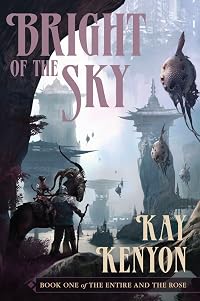
Bright of the Sky: Arguably the weakest book in the series, Kenyon's series debut suffers from exposition overload. Kenyon essentially sets up the story three times; first in the future Earth universe, than in the future Entire world, and then revealing Quinn's backstory and what occurred during his first trip to the Entire. With three full histories to explain in additional to all of the characters she introduces, it doesn't feel like a whole lot happens. The last fifty or so pages feel rushed when compared to the whole and while the end of the book comes at a natural stopping point it doesn't really resolve any of the threads introduced. With such a To-Be-Continued ending, it produces contradictory emotions - on one hand there was too little payoff after the slower prose associated with complex world building; on the other hand, A World Too Near beckoned from the shelf immediately. Bright of the Sky is also the book that suffers the most from those aforementioned perspective shifts.
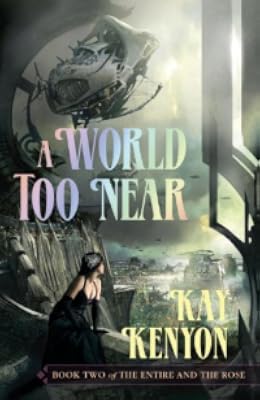
A World Too Near: With A World Too Near and subsequent novels, the pace begins to pick up as Kenyon spends less time crafting her world and more time playing in it. Building on some of the surprises that emerge toward the end of Bright of the Sky, the principal conflict of the series is revealed and the battle lines are drawn. The question of who to trust is paramount and a looming decision allows Kenyon to really dig into her cast of characters. Where Bright of the Sky was about introducing the Entire, A World Too Near is really about establishing the key characters and fleshing out their motivations as they traverse the fantastic civilization. One of the most significant developments in this regard is the introduction of Helice Maki, another transplanted Earthling with an endgame that may or may not align with Quinn's. Upon entering the Entire, the plot evolves from a simple us-versus-them conflict into a more complex adventure. Although it suffers slighty from middle novel syndrome, A World Too Near really sets the stage well for the last half of the series.
A City Without End: The strongest and most science fictional of the volumes, A City Without End sees Kenyon accelerate the thread of Quinn's battle with the fearsome Tarig to a frenetic pace. Even though she still pens a few new characters, Kenyon's takes advantage of the gradual set up of the first two novels and really pushes the plot forward in unexpected directions. Unlike the other novels, A City Without Endalso includes a strong second plotline set in the Rose universe; one that could support an entire novel in and of itself. As it is, this thought provoking idea is only furthers the existing conflict. As the Rose and Entire plotlines collide on an unexpected battleground, the pages really start to turn. While the first two books were structured similar to classic "journey fantasies", A City Without End is more of a political SF thriller than a traditional fantasy. There is a great balance between closure and setup as Kenyon slams some doors and opens others, creating numerous possibilities for the direction of the concluding volume, Prince of Storms.
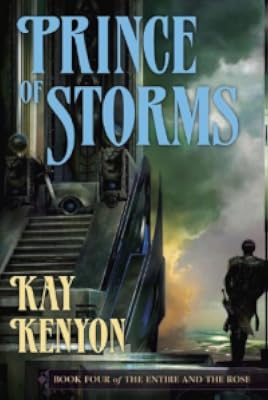
Prince of Storms: In the concluding volume of the series, Kenyon manages to wrap up the numerous threads of The Entire and The Rose while continuing to grow her characters in the face of new challenges. At first the final volume feels likes it would just be a prolonged epilogue especially after the spectacular ending of A City Without End but it's clear that Kenyon has a few more tricks up her sleeve. Prince of Storms takes a more fantastical approach to the Entire, taking advantage of some of the more unexplained intricacies of the Entire to raise the stakes once again. Reading the final book made it extremely clear how well Kenyon had planned out the entire series. Things that seemed to be throw away lines in the first two volumes were brought full circle, adding an appreciated cohesion to the story and lending credence to the final climax. Prince of Storms ends the series on a strong note, leaving the readers with a robust narrative that doesn't leave the door open for future derivative adventures.
Ultimately, The Entire and The Rose is more than a sum of its composite volumes, so much so that it was too difficult to reach a conclusion on one book before reading the others. The story flows through the pages like one of the arms of the Nigh (a river of exotic matter from the story), bearing strongly motivated characters through alternating periods of slow progress and torrential action. The narrative twists and turns unexpectedly, creating new letters to place between points A and B. At the core of Kenyon's series is her imagined Entire, rivaling any fantasy world for its complexity and surpassing the vast majority for sheer inventiveness. Despite some missteps in presentation, Kay Kenyon's The Entire and The Rose has created a unique science fantasy series that is worth reading, well, in its entirety. show less
30 Words or Less: An undeniable triumph of world building, Kay Kenyon's The Entire and The Rose is a science fantasy tale of two worlds worth exploring despite the gradual pace dictated by occasional prose problems.
The Good: Absolutely unique world-building that combines science fiction and fantasy elements and continues to grow throughtout the entire series; Carefully plotted narrative that spans and evolves over four volumes; The world is exceptionally well integrated into the narrative rather than being adjacent to it.
The Bad: Early volumes have problems with jarring show more perspective changes; Worldbuilding often uses infodumping rather than in-narrative elements; The story isn't well segmented into individual novels, leaving readers with an all-or-none decision.
The Review: Any sufficiently advanced technology is indistinguishable from magic." Rarely is this truer than in Kay Kenyon's science fiction/fantasy hybrid quadrilogy. An undeniable triumph of world building split into four books, The Entire and the Rose is 1700 pages of complex characters and intricate narrative. The events of the series revolve around Titus Quinn, the first denizen of the Rose (our universe) to cross through into The Entire, a complex infinite world constructed by the harsh, alien Tarig and inhabited by a number of races of their creation. Several years before the series begins, Quinn and his wife and daughter were pulled into the Entire when the ship he was piloting broke apart mid-wormhole jump. Quinn returns months later in our time with no family and little recollection of what happened despite living in the Entire for over a decade. When science proves that his ravings about a second reality may in fact be true, Quinn returns to the Entire in search of his missing wife and daughter and to explore what, if any, benefit The Entire may offer Earth. As Quinn quickly becomes embroiled in the politics of the world he left behind, it becomes obvious that much more is at stake than the fate of his family. The plot only gets more complex from there, the majority of which takes place in the profoundly strange world of the Entire, although the story does take place in both universes.
To provide any more detail than that would ruin the game-changing revelations that occur frequently throughout the series, shifting plots and loyalties in unexpected but exciting ways. There are several power players on both sides of the divide and rarely is there any way of knowing who is playing who. If the Earth universe is referred to as the Rose, the other universe labeled as the Entire might be better known as the Onion. From the start of the series to the final pages, Kenyon slowly peels back layer after layer of world building, unveiling an amazingly concocted world. Religion, politics, cultural divides, a forever war, teenage cults, complex transit systems: the facets of the Entire go on and on. Kenyon details aspect after aspect of her created universe and she does an unbelievable job of unobtrusively bringing the elements she has previously cultivated back into the main plot.
It's a rare occurence but if anything there is almost too much world building. The Entire is inhabited by a number of races and species all of which are fairly unique when compared to the genre standards. However, a few of these races are almost superfluous, with not a single primary or secondary character coming from their ranks. Kenyon could have either edited them out or integrated them into the story as well as she did the primary species of Humans, Chalin, Tarig, Inyx, Hirrin, and Paion. The cultural depth of these imagined races is continually capitalized upon by Kenyon and as a result the few species that don't get starring roles ultimately fall to the wayside.
While the extraneous elements could have been handled better, the world of the Entire and the thoroughly constructed characters that inhabit it are the main attractions of the series. Kenyon's writing, on the other hand, leaves a little bit to be desired especially in the early volumes. Kenyon writes from an extremely tight third person perspective and she has an unfortunate tendency to jump perspectives mid-scene without warning, generating confusion and necessitating rereading just to confirm which character was thinking what. Kenyon gets better at this as the books go on but early on these jarring transitions occur disappointingly often especially considering a small change symbol (which is often used to switch perspectives between scenes) could have easily been used to remedy this problem. As the books progress, Kenyon does manage to reduce the frequency with which these occur. The third and fourth volumes are much stronger than the first in this regard.
Kenyon also has a propensity to take a "tell not show" approach to her worldbuilding and while the world is interesting enough, there is no in-narrative reason for the characters to lecture the way they do. Consequently, the books of The Entire and The Rose read somewhat slowly. While not a bad thing in and of itself, these are not necessarily beach reads and due to the complex nature of the world and plot, it should be read in its entirety for full effect, commanding a significant time investment on the part of the reader.
Additionally, it is important to bear in mind that this epic series would be best described as science fantasy. While Kenyon maintains the premise that all of the places and structures of her world are science-based, the science satisfies Clarke's axiom and is indistinguishable from magic. Anyone who goes into this series expecting to understand the physics underpinning the world will be sorely disappointed. Despite the trappings of science that frame the Entire, at its core it's a fantasy world; it exists and behaves the way it does because the story dictates the way it does. But it works and it works well.
Here are individual reviews of each of the four volumes in the series.
Bright of the Sky: Arguably the weakest book in the series, Kenyon's series debut suffers from exposition overload. Kenyon essentially sets up the story three times; first in the future Earth universe, than in the future Entire world, and then revealing Quinn's backstory and what occurred during his first trip to the Entire. With three full histories to explain in additional to all of the characters she introduces, it doesn't feel like a whole lot happens. The last fifty or so pages feel rushed when compared to the whole and while the end of the book comes at a natural stopping point it doesn't really resolve any of the threads introduced. With such a To-Be-Continued ending, it produces contradictory emotions - on one hand there was too little payoff after the slower prose associated with complex world building; on the other hand, A World Too Near beckoned from the shelf immediately. Bright of the Sky is also the book that suffers the most from those aforementioned perspective shifts.
A World Too Near: With A World Too Near and subsequent novels, the pace begins to pick up as Kenyon spends less time crafting her world and more time playing in it. Building on some of the surprises that emerge toward the end of Bright of the Sky, the principal conflict of the series is revealed and the battle lines are drawn. The question of who to trust is paramount and a looming decision allows Kenyon to really dig into her cast of characters. Where Bright of the Sky was about introducing the Entire, A World Too Near is really about establishing the key characters and fleshing out their motivations as they traverse the fantastic civilization. One of the most significant developments in this regard is the introduction of Helice Maki, another transplanted Earthling with an endgame that may or may not align with Quinn's. Upon entering the Entire, the plot evolves from a simple us-versus-them conflict into a more complex adventure. Although it suffers slighty from middle novel syndrome, A World Too Near really sets the stage well for the last half of the series.
A City Without End: The strongest and most science fictional of the volumes, A City Without End sees Kenyon accelerate the thread of Quinn's battle with the fearsome Tarig to a frenetic pace. Even though she still pens a few new characters, Kenyon's takes advantage of the gradual set up of the first two novels and really pushes the plot forward in unexpected directions. Unlike the other novels, A City Without Endalso includes a strong second plotline set in the Rose universe; one that could support an entire novel in and of itself. As it is, this thought provoking idea is only furthers the existing conflict. As the Rose and Entire plotlines collide on an unexpected battleground, the pages really start to turn. While the first two books were structured similar to classic "journey fantasies", A City Without End is more of a political SF thriller than a traditional fantasy. There is a great balance between closure and setup as Kenyon slams some doors and opens others, creating numerous possibilities for the direction of the concluding volume, Prince of Storms.
Prince of Storms: In the concluding volume of the series, Kenyon manages to wrap up the numerous threads of The Entire and The Rose while continuing to grow her characters in the face of new challenges. At first the final volume feels likes it would just be a prolonged epilogue especially after the spectacular ending of A City Without End but it's clear that Kenyon has a few more tricks up her sleeve. Prince of Storms takes a more fantastical approach to the Entire, taking advantage of some of the more unexplained intricacies of the Entire to raise the stakes once again. Reading the final book made it extremely clear how well Kenyon had planned out the entire series. Things that seemed to be throw away lines in the first two volumes were brought full circle, adding an appreciated cohesion to the story and lending credence to the final climax. Prince of Storms ends the series on a strong note, leaving the readers with a robust narrative that doesn't leave the door open for future derivative adventures.
Ultimately, The Entire and The Rose is more than a sum of its composite volumes, so much so that it was too difficult to reach a conclusion on one book before reading the others. The story flows through the pages like one of the arms of the Nigh (a river of exotic matter from the story), bearing strongly motivated characters through alternating periods of slow progress and torrential action. The narrative twists and turns unexpectedly, creating new letters to place between points A and B. At the core of Kenyon's series is her imagined Entire, rivaling any fantasy world for its complexity and surpassing the vast majority for sheer inventiveness. Despite some missteps in presentation, Kay Kenyon's The Entire and The Rose has created a unique science fantasy series that is worth reading, well, in its entirety. show less
Titus Quinn along with his wife and young daughter were thought to be dead after a space mission gone wrong. When Titus reappeared with white hair, aged, little memory of his time spent away, but claiming to have been to another realm, Minerva, the company that had sent him on his mission, figured that he was distraught over the loss of his wife and child. But Quinn was adamant that he had been to a parallel universe and that his wife and daughter were still there. Minerva wrote him off as crazy, let him go, and paid him to keep his mouth shut about what he believed had happened.
Then an artificial intelligence system leads Minerva to question whether Quinn's nonsense ramblings might have been true. They pursue an unwilling Titus Quinn show more in hopes that they will be able to get him to go back to this parallel universe in a mission find the correlates that will allow easy access between the realms. At first Quinn doesn't want to give the company that deserted him the satisfaction of him agreeing to go, but the lure of being able to save his wife and daughter is one too enticing to pass up. So Quinn relents and sets off to an alternate universe known as the Entire.
The Entire is a world that is continually bright. Though without a sun, the sky remains lit in an everlasting stage of burning light. This strange world is inhabited by the Chalin, a people that are descriptively close to the human race yet very different, and host of strange creatures that live alongside the Chalin. Ruling over this world are the Tarig Lords. The Tarig are insectoid-like creatures: Seven feet tall, bronzed and cruel. They are set on keeping the people of the Rose (earth) from knowing about the Entire even though they are very aware of the Rose. Scholars of the Entire have been able to look through the veils separating them from the Rose for and have taken some of the earth's customs and shaped their own culture with them, like loosely modeling their culture after the ancient Chinese. The time in the Entire is also different. In a sense it is warped. Their years go by faster than the earths and this somehow extends the life spans of the people there, granting them thousands of years of life.
Upon his tumultuous arrival into the Entire, Quinn tries to regain his memories. With the reluctant help of Yulin, who would rather see him--the infamous Titus Quinn--dead, but feels that he may be able to use Quinn to advance himself, Quinn is able to slowly regain his past life in the Entire. But the threat to him is great. During his previous stay in the realm, Quinn had formed a reputation. He was a man of the Rose that lived tentatively among them for many years until his notorious escape that left him with many enemies. Quinn has to be careful to go unnoticed as getting caught could mean not only his demise, but that of those who are aiding him.
One of his aids is the beautiful Ji Anzi. Anzi is the niece of Yulin and a Chalin woman who knew Quinn during his past time in the Entire. She helps him in re-learning the Chalin language and customs, and in disguising himself as a Chalin man. These are the tools Quinn will need in order to have any measure of success in his mission. When Quinn begins his great quest, Anzi is his travel partner. The two navigate their way across the bleak Entire. Their travel is wrought with danger as they try to hold on to their anonymity while meeting new people, avoiding the ruling Tarig Lords, and discovering secrets that threaten life as both of them know it.
Really, I've barely even scratched the surface of this book. There are many characters who are brought to life through their own motives, both on earth and in the Entire. I did find that the time spent reading about the Entire was more interesting than the chapters spent reading about the earth goings-ons. Not to take away from that aspect, because it has its own much needed place in the story. But the Entire is more intriguing, and is described in such depths that it becomes almost tangible. Credit goes to Kay Kenyon's writing for this, that is descriptive yet very simplistic. She takes her time with the story and lets the world of the Entire unfold in imaginative detail. Many passages I went back to more than once just to savor the prose.
Here, During their journey, Quinn sits with Anzi and watches ebb time. The ebb is the time when where the sky burns less fiercely. Night for the Entire.
[ From book:
She sat next to him, watching the veldt dim. The sky, having lost its high glitter, now fell quickly into the last of day. A lavender blush colored her face, the roof of the train, and the veldt. In the distance, the storm wall crouched dark and solid-looking, and to one side a wisp of the sky, an axis fell to the plain like a dust devil. The train carried them onward, swaying and humming. They had been traveling for eight days and in all that time they had not passed one other inhabited area. The Entire, Anzi had said, was mostly empty. This emptiness, combined with the vast distances, forced a calm on activities, as though there was enough time for everything.]
The Bright of the Sky was a pleasure to read. While the overall pace of the story meanders in some places, the endearing characters, worthy foes, unseen surprises, and effortless prose kept me turning the pages. show less
Then an artificial intelligence system leads Minerva to question whether Quinn's nonsense ramblings might have been true. They pursue an unwilling Titus Quinn show more in hopes that they will be able to get him to go back to this parallel universe in a mission find the correlates that will allow easy access between the realms. At first Quinn doesn't want to give the company that deserted him the satisfaction of him agreeing to go, but the lure of being able to save his wife and daughter is one too enticing to pass up. So Quinn relents and sets off to an alternate universe known as the Entire.
The Entire is a world that is continually bright. Though without a sun, the sky remains lit in an everlasting stage of burning light. This strange world is inhabited by the Chalin, a people that are descriptively close to the human race yet very different, and host of strange creatures that live alongside the Chalin. Ruling over this world are the Tarig Lords. The Tarig are insectoid-like creatures: Seven feet tall, bronzed and cruel. They are set on keeping the people of the Rose (earth) from knowing about the Entire even though they are very aware of the Rose. Scholars of the Entire have been able to look through the veils separating them from the Rose for and have taken some of the earth's customs and shaped their own culture with them, like loosely modeling their culture after the ancient Chinese. The time in the Entire is also different. In a sense it is warped. Their years go by faster than the earths and this somehow extends the life spans of the people there, granting them thousands of years of life.
Upon his tumultuous arrival into the Entire, Quinn tries to regain his memories. With the reluctant help of Yulin, who would rather see him--the infamous Titus Quinn--dead, but feels that he may be able to use Quinn to advance himself, Quinn is able to slowly regain his past life in the Entire. But the threat to him is great. During his previous stay in the realm, Quinn had formed a reputation. He was a man of the Rose that lived tentatively among them for many years until his notorious escape that left him with many enemies. Quinn has to be careful to go unnoticed as getting caught could mean not only his demise, but that of those who are aiding him.
One of his aids is the beautiful Ji Anzi. Anzi is the niece of Yulin and a Chalin woman who knew Quinn during his past time in the Entire. She helps him in re-learning the Chalin language and customs, and in disguising himself as a Chalin man. These are the tools Quinn will need in order to have any measure of success in his mission. When Quinn begins his great quest, Anzi is his travel partner. The two navigate their way across the bleak Entire. Their travel is wrought with danger as they try to hold on to their anonymity while meeting new people, avoiding the ruling Tarig Lords, and discovering secrets that threaten life as both of them know it.
Really, I've barely even scratched the surface of this book. There are many characters who are brought to life through their own motives, both on earth and in the Entire. I did find that the time spent reading about the Entire was more interesting than the chapters spent reading about the earth goings-ons. Not to take away from that aspect, because it has its own much needed place in the story. But the Entire is more intriguing, and is described in such depths that it becomes almost tangible. Credit goes to Kay Kenyon's writing for this, that is descriptive yet very simplistic. She takes her time with the story and lets the world of the Entire unfold in imaginative detail. Many passages I went back to more than once just to savor the prose.
Here, During their journey, Quinn sits with Anzi and watches ebb time. The ebb is the time when where the sky burns less fiercely. Night for the Entire.
[ From book:
She sat next to him, watching the veldt dim. The sky, having lost its high glitter, now fell quickly into the last of day. A lavender blush colored her face, the roof of the train, and the veldt. In the distance, the storm wall crouched dark and solid-looking, and to one side a wisp of the sky, an axis fell to the plain like a dust devil. The train carried them onward, swaying and humming. They had been traveling for eight days and in all that time they had not passed one other inhabited area. The Entire, Anzi had said, was mostly empty. This emptiness, combined with the vast distances, forced a calm on activities, as though there was enough time for everything.]
The Bright of the Sky was a pleasure to read. While the overall pace of the story meanders in some places, the endearing characters, worthy foes, unseen surprises, and effortless prose kept me turning the pages. show less
Great ideas, clever and enjoyable plot, carries me forward, and some of the characters are very interesting. Author's ear for fantastic and dramatic dialog moments is really strong once the book gets rolling. The book is best when it leaves the world we know"and gets into "the other." Some of it felt a bit like Zelazny's Amber, with a main character narrator regaining his memory of when he was a powerful personage that everyone is drawn to, etc. You have to overlook writing problems, pointless scenes, character cliches, and so forth...or maybe I am spoiled or just like a different writing style. Cool dramatic and cinematic moments, several wonderful secondary characters, above average world-building and alien race creation. I am won over.
Interesting universe, but I found it to be difficult to penetrate (sorry, this may be a terrible pun). Character motivations were so subtle that they were opaque. Things sounded cool but I had so much trouble understanding what the hell anything actually was. The bright? The River Nigh? The Entire itself? How does travel work? What are the Tarig? I've enjoyed sci-fi that didn't make a lick of sense to me before, so that shouldn't have been a barrier but I think that because none of the characters seemed to understand how the Entire works, I couldn't just take it on faith that it did work.
The pace is a little methodical as well, so I was often distracted by newer, shinier books. Probably that contributed to my lack of understanding, but show more it wasn't entirely the reason it took a month and some to get through it. I'll read the next book at least, because while I wouldn't call the ending a cliff hanger, it is very clearly the very beginning of an arc and I'd like a little more closure. show less
The pace is a little methodical as well, so I was often distracted by newer, shinier books. Probably that contributed to my lack of understanding, but show more it wasn't entirely the reason it took a month and some to get through it. I'll read the next book at least, because while I wouldn't call the ending a cliff hanger, it is very clearly the very beginning of an arc and I'd like a little more closure. show less
Members
- Recently Added By
Lists

Read-alike - Dark Matter by Blake Crouch
9 works; 1 member
Author Information

45+ Works 2,342 Members
Awards and Honors
Awards
Distinctions
Series

Common Knowledge
- Canonical title
- Bright of the Sky
- Original publication date
- 2007
- People/Characters
- Titus Quinn; Sydney Quinn; Anzi
- Dedication
- For Mike Resnick
- Publisher's editor
- Anders, Lou
Classifications
Statistics
- Members
- 685
- Popularity
- 41,843
- Reviews
- 27
- Rating
- (3.41)
- Languages
- English, French, Spanish
- Media
- Paper, Audiobook, Ebook
- ISBNs
- 8
- ASINs
- 6