On This Page
Description
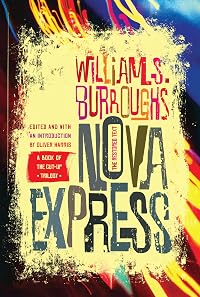
The third and final installment in Burroughs' Nova trilogy, this surrealist novel is part sci-fi, part Swiftian parody, pure Burroughs. The Soft Machine introduced us to the conditions of a universe where endemic lusts of the mind and body prey upon men, hook them, and turn them into beasts. Nova Express takes William S. Burroughs' nightmarish futuristic tale one step further. The diabolical Nova Criminals, Sammy the Butcher, Green Tony, Iron Claws, the Brown Artist, Jacky Blue Note, and show more Izzy the Push, to name only a few, have gained control and plan on wreaking untold destruction. It's up to Inspector Lee of the Nova Police to attack and dismantle the word and imagery machine of these 'control addicts' before it's too late. show lessTags
Recommendations



















Member Reviews
Like watching an avant-garde B-movie through a heap of glass shards. Prose sharp and jagged, cut up and folded in, deforming any light that passes through. Burroughs imparts neither comfort nor ease. He was a soothsayer. He gets bunched in with the Beats, but he was 4 or 5 clicks beyond anything Ginsberg, Kerouac, etc ever imagined they could imagine. No bullshit sentimentality can save us. We’re up against weaponized mescaline, image guns and virus crystals. Don’t be fooled by the hepcat junkie lingo. The authorities know full well that the new mass man is easily manipulated by fear and anger. Run away first chance you get.
The final installment in WSB's Cut-Up Trilogy, and in my opinion the most fully realized one. It employs the same nightmarish sci-fi imagery as The Soft Machine and The Ticket That Exploded, but in a more streamlined manner. The cut-up technique still makes for difficult reading, though, so if you're in the mood for anything even resembling a coherent narrative, this is not the book for you. It isn't precisely what you'd call an example of intellectual honesty, either; Burroughs's admission late in life that apomorphine had not cured him of his junk addiction makes all the glowing testimonials in Nova Express ("You can cut the enemy off your line by the judicious use of apomorphine and silence--Use the sanity drug apomorphine") sound show more almost pitifully absurd. Maybe he sincerely wanted to believe, at the time, that he had found and benefited from a wonder drug, but the fact that he had to take two apomorphine "cures" while writing this novel should have been an indication that the drug's effects were less than miraculous.
But if for no other reason than its deadly accurate appraisal of the ruling class's attitude toward the rest of us, Nova Express remains relevant today. The greatest lines ever written by Burroughs appear in this book, and at the present moment they're even more germane than they were in 1964:
"'Don't let them see us. Don't tell them what we are doing--'
"Are these the words of the all-powerful boards and syndicates of the earth?
"'Premature. Premature. Give us a little more time.'
"Time for what? More lies? Premature? Premature for who? I say to all these words are not premature. These words may be too late. (...) Who took from you what is yours? Now they will give it all back? Did they ever give anything away for nothing? Did they ever give any more than they had to give? Did they not always take back what they gave when possible and it always was? (...) All that they offer is a screen to cover retreat from the colony they have so disgracefully mismanaged. To cover travel arrangements so they will never have to pay the constituents they have betrayed and sold out. Once these arrangements are complete they will blow the place up behind them."
(See "Survival of the Richest: The Wealthy Are Plotting to Leave Us Behind" by Douglas Rushkoff - Medium, July 5, 2018) show less
But if for no other reason than its deadly accurate appraisal of the ruling class's attitude toward the rest of us, Nova Express remains relevant today. The greatest lines ever written by Burroughs appear in this book, and at the present moment they're even more germane than they were in 1964:
"'Don't let them see us. Don't tell them what we are doing--'
"Are these the words of the all-powerful boards and syndicates of the earth?
"'Premature. Premature. Give us a little more time.'
"Time for what? More lies? Premature? Premature for who? I say to all these words are not premature. These words may be too late. (...) Who took from you what is yours? Now they will give it all back? Did they ever give anything away for nothing? Did they ever give any more than they had to give? Did they not always take back what they gave when possible and it always was? (...) All that they offer is a screen to cover retreat from the colony they have so disgracefully mismanaged. To cover travel arrangements so they will never have to pay the constituents they have betrayed and sold out. Once these arrangements are complete they will blow the place up behind them."
(See "Survival of the Richest: The Wealthy Are Plotting to Leave Us Behind" by Douglas Rushkoff - Medium, July 5, 2018) show less
I have a hardback of this but the cover's the same as this paperback so I'll just stick w/ that. "Nova Express" has been published as Science Fiction but it seems like it belongs in a category all its own: part drug vision, part formal experiment, part social criticism, part fantasy, etc.. When I 1st read these Burroughs novels, I was thrilled by the way they mutated in & out of such categories. Burroughs seemes to've felt no need to try to tame his writing into any particular market niche & that's one of its many strong points. "Nova Express" is yet-another exploding ticket to a wild ride thru universes of [b:naked lunch|7437|Naked Lunch The Restored Text|William S. show more Burroughs|http://photo.goodreads.com/books/1219259455s/7437.jpg|4055]es that's been an initiation for many a soft machine wild boy. show less
No one I know writes quite like Burroughs, and, try as I might, I've never acquired the taste. The few moments of lucid technicolor do not offset the grey, bloody-minded impenetrability of the rest of it. I rarely abandon a book once I'm halfway through, but I had to set this aside after weeks of effort because I was getting absolutely nothing out of it except a bout of mild depression. I've given it two stars because I can appreciate its literary merits, but it's just not for me.
I finally plowed my way through this one, and the best I can do is compare it to The Soft Machine -- which, on its own, is a pretty daunting task.
While this text does stick to the maddening "cut-up" and "fold-in" methods of Burroughs's outlandishly avant garde style, there's far more coherence here, as if he realized that a book probably should have SOME semblance of plot after all.
There are moments of clarity that are offset by moments of frustration, and by the end of the work, there is far more confusion than understanding. Thankfully, the explicit sexual and scatological content only shows up in the last pages.
In sum, it's a text that shows an experimental author executing his technique with greater precision, but it's still show more Burroughs. So it's still really bizarre. And, for most, probably not worth the time to slog through these brief 179 pages. show less
While this text does stick to the maddening "cut-up" and "fold-in" methods of Burroughs's outlandishly avant garde style, there's far more coherence here, as if he realized that a book probably should have SOME semblance of plot after all.
There are moments of clarity that are offset by moments of frustration, and by the end of the work, there is far more confusion than understanding. Thankfully, the explicit sexual and scatological content only shows up in the last pages.
In sum, it's a text that shows an experimental author executing his technique with greater precision, but it's still show more Burroughs. So it's still really bizarre. And, for most, probably not worth the time to slog through these brief 179 pages. show less
It's insanity doesn't quite sparkle to use a bad phrase like the other two. Though the WORD virus is complete here, and The Subliminal Kid has won, the text just seems more flat than the others. The idea of writing a novel that tells other novelists (and other artists) to turn of their recording machines is still the most interesting act of resistance I have ever seen.
Part science fiction dystopia, part terrifying inner journey through a damaged mind, part literary experiment (sentences typed onto strips and then cut up and rearranged), reading this book was a great project when I felt I could find the meaning of the world by working hard enough at reading.
Members
- Recently Added By
Lists

David Pringle's Science Fiction: The 100 Best Novels
101 works; 9 members

the nova trilogy & others
5 works; 1 member
Author Information

362+ Works 39,066 Members
William S. Burroughs was a primary figure of the Beat Generation who wrote in the postmodern paranoid fiction genre. Jack Kerouac called Burroughs the "greatest satirical writer since Jonathan Swift," while Norman Mailer declared him "the only American writer who may be conceivably possessed by genius." While he is best known for the novels Naked show more Lunch, Queer, and Junkie, he also collaborated with artists such as Laurie Anderson, Tom Waits, Nick Cave, Gus Van Sant, David Cronen-berg, and Sonic Youth to produce films, music, and performance pieces. show less
Some Editions
Awards and Honors
Awards
Notable Lists
Series

Belongs to Publisher Series
Evergreen Black Cat Books (BC-102)
Work Relationships
Common Knowledge
- Original publication date
- 1964; 1968 - Panther ed.
- First words
- Listen to my last words anywhere.
Classifications
Statistics
- Members
- 1,179
- Popularity
- 21,272
- Reviews
- 12
- Rating
- (3.55)
- Languages
- 11 — Czech, Danish, Dutch, English, French, German, Italian, Japanese, Spanish, Swedish, Turkish
- Media
- Paper, Audiobook, Ebook
- ISBNs
- 33
- ASINs
- 28