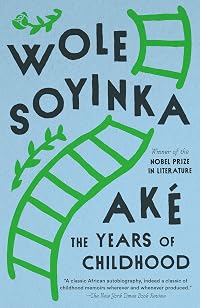
Aké: The Years of Childhood
by Wole Soyinka
On This Page
Description
A dazzling memoir of an African childhood from Nobel Prize-winning Nigerian novelist, playwright, and poet Wole Soyinka. "Ake The Years of Childhood" gives us the story of Soyinka's boyhood before and during World War II in a Yoruba village in western Nigeria called Ake. A relentlessly curious child who loved books and getting into trouble, Soyinka grew up on a parsonage compound, raised by Christian parents and by a grandfather who introduced him to Yoruba spiritual traditions. His vivid show more evocation of the colorful sights, sounds, and aromas of the world that shaped him is both lyrically beautiful and laced with humor and the sheer delight of a child's-eye view. A classic of African autobiography, "Ake" is also a transcendantly timeless portrait of the mysteries of childhood. show lessTags
Recommendations






Member Reviews
Aké, the first volume of Nigerian Nobel prize winner Wole Soyinka's (possibly slightly fictionalised) autobiography, is the first book of his I've read. For most authors, an autobiography is probably not the best place to start; most of the time, I want a reason to care about what the author has done before getting into his life story.
In this case, though, it doesn't disappoint at all. Aké chronicles young Wole's childhood up to about 11 years of age, and given that he was born in 1934, that's a fairly tumultuous time. While the world war rages somewhere just beyond the horizon, Nigeria is somewhere in between the old ways and the new ones, stuck between old tribal kingdoms and the new world, the old religion and Christianity, the old show more language and English, still ruled by the British but beginning to find a new identity of its own - which isn't an easy process, as shown by the occasional sobering flash-forward to Nigeria in the early 80s.
Soyinka spins this into an amazingly vivid tale, which doesn't shy away from dark subjects but tackles it all with a great sense of humour and the wide eyes of a child who, at first, doesn't understand half of what's going on around him. In a slightly unusual but very well-crafted narrative, he tells the whole story from the perspective of himself as a child (I'm somewhat reminded of Roth's The Plot Against America) which means that as he grows up, the story becomes more intricate, the adult characters more three-dimensional, and his observations more astute; mirroring, in a way, a young country starting to find its footing (Nigeria wouldn't achieve independence until 1960). As with many childhood stories, it's more of an episodic tale than a straight narrative, which means that it tends to be a little disjointed and slow-paced at times - but even then the fantastically colourful prose makes it worth it. For all the times the novel makes me crack up laughing, or even be nostalgic for a time I've never lived in in a country I never visited and a culture I was never part of, there's always the sly adult Soyinka somewhere behind it, using his young self as an only mostly reliable narrator to describe how we come to understand - and challenge - the world. show less
In this case, though, it doesn't disappoint at all. Aké chronicles young Wole's childhood up to about 11 years of age, and given that he was born in 1934, that's a fairly tumultuous time. While the world war rages somewhere just beyond the horizon, Nigeria is somewhere in between the old ways and the new ones, stuck between old tribal kingdoms and the new world, the old religion and Christianity, the old show more language and English, still ruled by the British but beginning to find a new identity of its own - which isn't an easy process, as shown by the occasional sobering flash-forward to Nigeria in the early 80s.
Soyinka spins this into an amazingly vivid tale, which doesn't shy away from dark subjects but tackles it all with a great sense of humour and the wide eyes of a child who, at first, doesn't understand half of what's going on around him. In a slightly unusual but very well-crafted narrative, he tells the whole story from the perspective of himself as a child (I'm somewhat reminded of Roth's The Plot Against America) which means that as he grows up, the story becomes more intricate, the adult characters more three-dimensional, and his observations more astute; mirroring, in a way, a young country starting to find its footing (Nigeria wouldn't achieve independence until 1960). As with many childhood stories, it's more of an episodic tale than a straight narrative, which means that it tends to be a little disjointed and slow-paced at times - but even then the fantastically colourful prose makes it worth it. For all the times the novel makes me crack up laughing, or even be nostalgic for a time I've never lived in in a country I never visited and a culture I was never part of, there's always the sly adult Soyinka somewhere behind it, using his young self as an only mostly reliable narrator to describe how we come to understand - and challenge - the world. show less
Wole Soyinka, the first African to ever be awarded the Noble Prize in Literature, grew up in Nigeria in the fifties, when both his native country and much of the rest of Africa was still roiling under imperial European rule. To no one’s surprise, this results in a memoir that very much reads as if the writer is being torn between two priorities, two sets of values, two worlds. Soyinka’s “Ake: The Years of Childhood,” which cover his earliest memories up through approximately age eleven, is no different: he grew up in a world of ancestral religious, social, and cultural practices that mostly coincided easily with, but occasionally butted heads, with the imperial English culture with which it had to share its lebensraum.
This show more volume of Soyinka’s memoirs (there are several more by now: see below) is bound up mostly with his domestic life, though later there are memorable recollections of an emerging political consciousness which I’ll mention later. His father (“Essay”) is a local schoolmaster; his mother (“Wild Christian”), the very embodiment of a free spirit who occasionally takes in boarders to their house. Because the memoir uses the limited perspective of a very young boy in a mostly domestic environment, the voice can have the naiveté of a boy this age; however it never has the provincialism that you would expect to accompany that innocence. From the very first episodes of the story, we are able to envision him as a vibrant, curious, enthusiastic, and very precocious little boy.
Though he is stuck at home, the family’s recent acquisition of a new television set gives Wole an initial way of understanding the complex political world around him. He heard of Hitler faintly and vaguely knew that he was an important figure. Later in “Ake,” Soyinka begins to track the actions of a group called the Egba Women’s Union which fights against excessive taxation. Wild Christian becomes prominent in the Union and begins a series of talks with the Alake of Egbaland, a native administrator.
Soyinka’s recollections of his early childhood resemble the kind of person I have seen him to be in interviews – joyous, thoughtful, intellectually curious, and appreciative. He displays the kind of wonderment and delight that we can only hope to have in fully grown adults. From the first chapter which describes the beautiful geography around Ake to the tumultuous politics of colonial Nigeria, the reader walks away from this memoir feeling that he has inhabited the shoes of a child who is bigger than the land that contains him, but at the same time will grow up to write its stories and tell its histories like none of his contemporaries have. Oh, and the language. The language! I will not quote anything directly, but suffice is to say that’s simply magisterial.
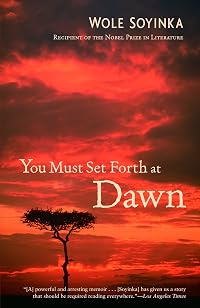
To compliment this volume, readers might also be interested in “Isara: A Voyage Around Essay” (1989) which deals with the years directly before the ones in “Ake,” “Ibadan: The Penkelemes Years” (1994) which discusses tracks Soyinka’s life after “Ake” through the time of his arrest and two-year imprisonment, “The Man Died: Prison Notes” (1972) detailing those two horrific years, and most recently “You Must Set Forth at Dawn” (2006), about his experiences from young manhood until publication. show less
This show more volume of Soyinka’s memoirs (there are several more by now: see below) is bound up mostly with his domestic life, though later there are memorable recollections of an emerging political consciousness which I’ll mention later. His father (“Essay”) is a local schoolmaster; his mother (“Wild Christian”), the very embodiment of a free spirit who occasionally takes in boarders to their house. Because the memoir uses the limited perspective of a very young boy in a mostly domestic environment, the voice can have the naiveté of a boy this age; however it never has the provincialism that you would expect to accompany that innocence. From the very first episodes of the story, we are able to envision him as a vibrant, curious, enthusiastic, and very precocious little boy.
Though he is stuck at home, the family’s recent acquisition of a new television set gives Wole an initial way of understanding the complex political world around him. He heard of Hitler faintly and vaguely knew that he was an important figure. Later in “Ake,” Soyinka begins to track the actions of a group called the Egba Women’s Union which fights against excessive taxation. Wild Christian becomes prominent in the Union and begins a series of talks with the Alake of Egbaland, a native administrator.
Soyinka’s recollections of his early childhood resemble the kind of person I have seen him to be in interviews – joyous, thoughtful, intellectually curious, and appreciative. He displays the kind of wonderment and delight that we can only hope to have in fully grown adults. From the first chapter which describes the beautiful geography around Ake to the tumultuous politics of colonial Nigeria, the reader walks away from this memoir feeling that he has inhabited the shoes of a child who is bigger than the land that contains him, but at the same time will grow up to write its stories and tell its histories like none of his contemporaries have. Oh, and the language. The language! I will not quote anything directly, but suffice is to say that’s simply magisterial.
To compliment this volume, readers might also be interested in “Isara: A Voyage Around Essay” (1989) which deals with the years directly before the ones in “Ake,” “Ibadan: The Penkelemes Years” (1994) which discusses tracks Soyinka’s life after “Ake” through the time of his arrest and two-year imprisonment, “The Man Died: Prison Notes” (1972) detailing those two horrific years, and most recently “You Must Set Forth at Dawn” (2006), about his experiences from young manhood until publication. show less
How often do I call something 'Proustian'? Not that often, yes? So, pay attention, because this work brings to mind that languid tidal wave in all the right ways.
Out of the entirety of ISoLT, Swann's Way is the volumetric portion that stays with me, both out of the initial contact of superb wonder and my penchant for childhood narratives that don't talk down to its younger self. To begin to read those pages is to dive and it is the same here in Aké, land calling to faith calling to logistics within the first paragraph in perhaps not as lengthy a sentence but indeed in as dense a phrase. Each and every sentence is more of a beam than a part, interchange of far reaching wave and concentrating of particle as Soyinka conjures up his show more childhood in as delightfully subsuming a manner as the best fiction often does. He didn't win the Nobel Prize for nothing, I can tell you that.
Of course, that previous reference doesn't persuade as well as I used to think, so there must be more. First off there's the novelty, for how often do you read an autobiography set in a Yoruba village in western Nigeria? Admittedly, the story taking place before and during WWII grounds one a bit, but here the new is traded for the novel lens, a view of things both turned on its head and lushly unique. I wouldn't hold your breath if that's your main incentive for reading, though. Soyinka does not live through the war on paper till he is eleven, and there are memories from three to two to an unnamed farther back in his yearly life to first off contemplate and contend.
If a child is telling you a story, wouldn't you say that it's best they be both precocious and all too young, offering up tales of strange exploits combined with the most precious of thoughts? If that's the case, I cannot think of a more perfect protagonist than little Wole. Always stubborn, always questioning, always following his interests both physical and intellectual, viewing the admonishment of various adults as guidelines he is fully free to evaluate and critique in as vocal a manner as is necessary. That latter audacious insight leads to rampant classifications, formation of definition for everything from the 'without time' guava tree to his own parents, the nickname of his father of especial note:
In contrast, yes there are mentions of colonialism, racism, sexism, and usual age old mix of -isms and co. However, the young Wole's view is always a mix of engagement and critique, accepting what makes sense to him and puzzling over the nonsensical with the aid of knowledgeable adults. I will admit that the last eventsof a powerful feminist uprising combined with a well grounded criticism of the acts of white people in WWII won my heart in the most biased of ways, but I challenge anyone to not be stirred by those dramatic last pages.
Finally, this boy from a young age has a fervent interest in books. What's not to love about that?
Out of the entirety of ISoLT, Swann's Way is the volumetric portion that stays with me, both out of the initial contact of superb wonder and my penchant for childhood narratives that don't talk down to its younger self. To begin to read those pages is to dive and it is the same here in Aké, land calling to faith calling to logistics within the first paragraph in perhaps not as lengthy a sentence but indeed in as dense a phrase. Each and every sentence is more of a beam than a part, interchange of far reaching wave and concentrating of particle as Soyinka conjures up his show more childhood in as delightfully subsuming a manner as the best fiction often does. He didn't win the Nobel Prize for nothing, I can tell you that.
Of course, that previous reference doesn't persuade as well as I used to think, so there must be more. First off there's the novelty, for how often do you read an autobiography set in a Yoruba village in western Nigeria? Admittedly, the story taking place before and during WWII grounds one a bit, but here the new is traded for the novel lens, a view of things both turned on its head and lushly unique. I wouldn't hold your breath if that's your main incentive for reading, though. Soyinka does not live through the war on paper till he is eleven, and there are memories from three to two to an unnamed farther back in his yearly life to first off contemplate and contend.
If a child is telling you a story, wouldn't you say that it's best they be both precocious and all too young, offering up tales of strange exploits combined with the most precious of thoughts? If that's the case, I cannot think of a more perfect protagonist than little Wole. Always stubborn, always questioning, always following his interests both physical and intellectual, viewing the admonishment of various adults as guidelines he is fully free to evaluate and critique in as vocal a manner as is necessary. That latter audacious insight leads to rampant classifications, formation of definition for everything from the 'without time' guava tree to his own parents, the nickname of his father of especial note:
It did not take long for him to enter my consciousness simply as Essay, as one of those careful stylistic exercises in prose which follow set rules of composition, are products of fastidiousness and elegance, set down in beautiful calligraphy that would be the envy of most copyists of any age.This mentality counters and swerves around every aspect of life, portraying in astonishing ways every matter encountered by a child, communal bedrooms and hungry house-guests considered just as thoughtfully as culture clash and the passage of time. Amongst all these disparate scenes of a child's life intersecting with events both tickling and somber, a particular favorite of mine is the eclectic rhetoric birthed by the principal at Wole's Grammar School demanding that every student accused of a misdemeanor defend themselves in a schoolyard trial. If the defense meets Daodu's, the esteemed Winston Churchillesque principal himself, standards, the accused goes free, the obviousness of their crime or the absurdity of their argument having little to no impact on the decision.This surprisingly reasonable stance leads to eloquence regarding the matter of a stolen chicken being conducted along the lines of:
I concurred principal, and there being no time like now because action speaks louder than words time and tide waiteth for no man opportunity once lost cannot be regained saves nine, principal, and finally, one good turn deserves another so, with these thoughts for our guide, we spread out, closed in on this cock in order to catch it and restore to the poultry yard from which it escaped.Delightful.
In contrast, yes there are mentions of colonialism, racism, sexism, and usual age old mix of -isms and co. However, the young Wole's view is always a mix of engagement and critique, accepting what makes sense to him and puzzling over the nonsensical with the aid of knowledgeable adults. I will admit that the last events
Finally, this boy from a young age has a fervent interest in books. What's not to love about that?
I looked at him in some astonishment. Not feel like coming to school! The coloured maps, pictures and other hangings on the walls, the coloured counters, markers, slates, inkwells in neat round holes, crayons and drawing-books, a shelf laden with modelled objects - animals, human beings, implements - raffia and basket-work in various stages of completion, even the blackboards, chalk, and duster...I had yet to see a more inviting playroom! In addition, I had made some vague, intuitive connection between school and the piles of books with which my father appeared to commune so religiously in the front room, and which had constantly to be snatched from me as soon as my hands grew long enough to reach them on the table.show less
'I shall come everyday' I confidently declared.
Nigerian Nobelist Wole Soyinka (b. 1934) gifts readers with a glimpse of his African childhood from his earliest memories until he’s on the brink of leaving for boarding school. Soyinka writes from his younger self’s perspective, so his interpretation of people, places, and events is a bit distorted by his childhood innocence and inexperience. He was a precocious child whose thirst for knowledge had him following his older sibling to school at just two years old. Thankfully, the adults and older children in his life didn’t squelch his curiosity, and the literary world is all the better for it.
http://nwhyte.livejournal.com/1516878.html
Rather a sweet memoir of growing up as the headmaster's son in colonial Nigeria before and during the second world war. I liked it more than Chinua Achebe; there seemed to me to be more interrogation of political and gender power structures - one memorable scene has Soyinka's mother yelling her rage down the phone at the local British official at the Allies for bombing the (non-white) Japanese rather than the (white) Germans. The other point that grabbed me was the lip-smacking portrayal of Nigerian cuisine. I would like to know more about West Africa in general, and I guess Nigeria is the way into it as the regional power; and I guess that Soyinka is one of the better ways into Nigeria.
Rather a sweet memoir of growing up as the headmaster's son in colonial Nigeria before and during the second world war. I liked it more than Chinua Achebe; there seemed to me to be more interrogation of political and gender power structures - one memorable scene has Soyinka's mother yelling her rage down the phone at the local British official at the Allies for bombing the (non-white) Japanese rather than the (white) Germans. The other point that grabbed me was the lip-smacking portrayal of Nigerian cuisine. I would like to know more about West Africa in general, and I guess Nigeria is the way into it as the regional power; and I guess that Soyinka is one of the better ways into Nigeria.
A child's life in colonial Nigeria, 5 September 2015
This review is from: Ake: The Years of Childhood (Vintage International) (Paperback)
Nobel prize winning author Wole Soyinka recalls his early years in 30s/40s Nigeria. Son of a middle class Christian family (his father is a headmaster), the flavour of Yoruba society is nonetheless vividly evoked throughout, whether it's his pagan grandfather cutting his ankles in a coming of age ritual, his father's ideas on bringing up his family ("to him, shoes on the feet of children was the ultimate gesture in the spoiling of the young"), the food ,the animals and the largely communal lifestyle of the people.
Soyinka's early chapters show him as a very small child, just becoming aware of the world show more outside his home. I was reminded of the similar 'feel' that Laurie Lee conjured up in his recollections of infancy in 'Cider with Rosie' (albeit in a very different setting!) Later we see his early intelligence, and his attaining a scholarship. In the last couple of chapters the fairly tame Women's Group to which his mother belongs starts to take up politics, fighting the iniquitous tax levied on the poor and gradually becoming part of the anti-British rule movement.
Extremely well-written with some amusing episodes, bringing his world to life. show less
This review is from: Ake: The Years of Childhood (Vintage International) (Paperback)
Nobel prize winning author Wole Soyinka recalls his early years in 30s/40s Nigeria. Son of a middle class Christian family (his father is a headmaster), the flavour of Yoruba society is nonetheless vividly evoked throughout, whether it's his pagan grandfather cutting his ankles in a coming of age ritual, his father's ideas on bringing up his family ("to him, shoes on the feet of children was the ultimate gesture in the spoiling of the young"), the food ,the animals and the largely communal lifestyle of the people.
Soyinka's early chapters show him as a very small child, just becoming aware of the world show more outside his home. I was reminded of the similar 'feel' that Laurie Lee conjured up in his recollections of infancy in 'Cider with Rosie' (albeit in a very different setting!) Later we see his early intelligence, and his attaining a scholarship. In the last couple of chapters the fairly tame Women's Group to which his mother belongs starts to take up politics, fighting the iniquitous tax levied on the poor and gradually becoming part of the anti-British rule movement.
Extremely well-written with some amusing episodes, bringing his world to life. show less
Episodic, like most autobiographical fiction, and feels like what it is - one segment of a life, with much more to come. But what an observer he is! Some writers really are born, not made, and Soyinka seems to have been one of them.
Members
- Recently Added By
Lists

Childhood: Books for or about children in different cultures around the wor
345 works; 18 members

Best African Books
126 works; 46 members

Books Read in 2021
5,361 works; 113 members

Mustich's 1000 Books to Read Before You Die: A Life Changing List
1,001 works; 19 members

BBC World Book Club
265 works; 5 members

World Book Club (BBC World Service)
112 works; 1 member
Author Information

139+ Works 5,073 Members
Wole Soyinka was born in Abeokuta, Ogun State of Nigeria on July 13, 1934. He attended Government College and University College in Ibadan before receiving a degree in English from the University of Leeds in England in 1958. He has held research and teaching appointments at several universities including the University of Ibadan, the University of show more Ife, Cornell University, Emory University, the University of Nevada, Las Vegas, and Loyola Marymount. He is a distinguished playwright, poet, novelist, essayist, social critic, political activist, and literary scholar. His plays include The Swamp Dwellers, The Lion and the Jewel, A Dance of the Forests, The Bacchae of Euripides, A Play for Giants, Death and the King's Horsemen, From Zia with Love, The Beatification of Area Boy, and King Baabu. His collections of poetry include Idanre and Other Poems, A Shuttle in the Crypt, and Mandela's Earth and Other Poems. His novels include The Interpreters, which won the 1968 Jock Campbell Literary Award, and Season of Anomy. His autobiographical works include Ake: The Years of Childhood, Isara: A Voyage Around Essay, The Open Sore of a Continent: A Personal Memoir of the Nigerian Crisis, and You Must Set Forth at Dawn. His literary essays collections include Myth, Literature and the African World and Art, Dialogue and Outrage. During the civil war in Nigeria, he appealed for cease-fire in an article. Accused of treason, he was held in solitary confinement for 22 months. Two of his works, The Man Died: Prison Notes of Wole Soyinka and Poems from Prison, were secretly written on toilet paper and smuggled out of prison. He won the Nobel Prize for Literature in 1986. (Bowker Author Biography) show less
Awards and Honors
Awards
Distinctions
Series
Belongs to Publisher Series
Work Relationships
Is contained in
Common Knowledge
- Canonical title
- Aké: The Years of Childhood
- Original title
- Ake. The Years of Childhood
- Original publication date
- 1981
- Important places
- Nigeria
- Dedication
- For Eniola (the 'Wild Christian'), and to the memory of 'Essay'. Also for Yeside, Koyode and Folabo, who do not inhabit the memory span of the years recounted in these pages.
- First words
- The sprawling, undulating terrain is all of Ake.
- Last words*
- (Click to show. Warning: May contain spoilers.)Es wurde Zeit, sich auf die geistigen Richtungswechsel einzustimmen, die mir Zutritt zu wieder einer neuen, vernunftswidrigen Welt der Erwachsenen und ihrer Disziplin verschaffen sollten.
- Original language
- English
*Some information comes from Common Knowledge in other languages. Click "Edit" for more information.
Classifications
Statistics
- Members
- 809
- Popularity
- 34,164
- Reviews
- 14
- Rating
- (3.90)
- Languages
- 12 — Czech, Danish, Dutch, English, Finnish, French, German, Hungarian, Italian, Norwegian (Bokmål), Spanish, Swedish
- Media
- Paper, Audiobook, Ebook
- ISBNs
- 35
- ASINs
- 8