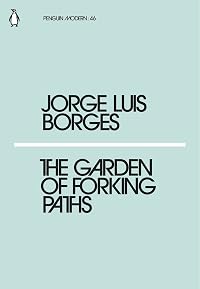
The Garden of Forking Paths
by Jorge Luis Borges
On This Page
Description
'Summer was drawing to a close, and I realised that the book was monstrous.' These labyrinthine short stories dissolve the boundary between reality and illusion and describe the limits of infinity.Tags
Recommendations








Member Reviews
“The basest of art’s temptations: the temptation to be a genius” (from The Approach to Al-Mu’tasm). In this collection, Borges proves that he succumbed. And I’m very glad he did.
I have the Collected Fictions (with copious translator's notes), but am splitting my review of that into its components, listed in publication order: Collected Fictions - all reviews. This is the second, published in 1941, and this is where Borges starts to blow my mind.
Some of these stories are initially rather opaque, but they’re also short and SO worthwhile: with many, I read once to get a feel for what it was about, then immediately reread it to connect with it in context.
• The first time is gloriously disorienting, almost as it’s in a show more subtly different dialect from my own; it creates a hypnotic desire to understand.
• The second time, a switch has been flipped, I have the key to the kingdom, and the ideas slot into place, whilst retaining a pleasing degree of elusiveness.
“There is no intellectual exercise that is not ultimately pointless” (from Pierre Menard, Author of the Quixote, below). I don’t think Borges himself believed that, and these remarkable stories are a justification of such exercises.
The descriptions of individual stories below include minor spoilers; major ones are hidden with spoiler tags. If in doubt, scroll down to the Quotes section at the end.
Tlon, Uqbar, Orbis Tertius 6*
This is the longest and has its own review, here.
The Approach to Al-Mu’tasm 6*
A review of a non-existent book (unless someone has since written it), that even notes the differences between the first and second editions. This piece allegedly had one of Borges’ friends try to order a copy from a bookshop.
The book is described as the “first detective novel written by a native of Bombay” and is an epic, sweeping across India, with a huge cast, but an “uncomfortable amalgam” of overwrought Islamic allegorical poems and European detective fiction.
The story though, is a recursive meditation on the duality of good and evil. “The object of the pilgrimage was itself a pilgrimage.”
A law student rejects his Islamic faith and end up among the poor, where he “perceives some mitigation of the evil: a moment of tenderness, of exaltation, of silence, in one of the abominable men”. He divines that the goodness must be a reflection from an external source, and sets off to find ever purer connections, via a series of connected rooms: “the insatiable search for a soul by means of the delicate glimmerings or reflections this soul has left in others”.
Each of us is like a stone cast in a lake: those nearest us are most affected, but even far away, there are ripples of who and what and how we are.
Pierre Menard, Author of the Quixote
Every reader reads a different book. Even the same reader reads a different book on each encounter.
A self-referential exploration of the paradoxes of original composition, and the “new technique… of deliberate anachronism and fallacious attribution”. The last of those is a recurring habit of Borges himself, including in this story, which purports to be about a real writer.
This is a short essay about the great, but unfinished work, of a writer, who “did not want to compose another Quixote” but “the Quixote” by combining the don and Sancho into a single character and by, in some sense, becoming Cervantes. His tactic is to “learn Spanish, return to Catholicism, fight against the Moor and the Turk” and forget everything that happened after Cervantes published.
Menard’s other writings are listed, but it’s made clear that Quixote is his only important work, “perhaps the most significant writing of our time”, even though, over the course of his life, he only manages to write just over two chapters! A futile quest, perhaps, like Don Quixote’s own?
It becomes stranger as the reviewer describes Menard’s work as being “word for word” the same as Cervantes’, but also “more subtle” and “almost infinitely richer”, and yet different as well, because it “overlooks – or banishes – local colour” and many other incidents. So is it the same, or different? Is the Emperor naked or clothed?
Don Quixote is the obvious book on which to base this story: it was a favourite of JLB’s, mentioned in many of his stories (including "Parable of Cervantes and the Quixote", which is in Dreamtigers). More importantly, Cervantes did something similar to this story. Part two of DQ was written after what would now be called fan-fic. In part two, DQ himself treats part one as true, criticises the unofficial sequel, and responds to the resulting pressure of fame.
Calvino’s If on a Winter's Night a Traveler has Borgesian nods, including a writer following a similar path the Menard. See my review HERE.
Douglas Adams like this story. He wrote "You should read Jorge Luis Borges’s short story ‘Pierre Menard, Author of the Quixote’. It’s only six pages long, and you’ll be wanting to drop me a postcard to thank me for pointing it out to you." It’s in the foreword to P G Wodehouse’s Sunset at Blandings and quoted again in his own (posthumous) The Salmon of Doubt.
The Circular Ruins 6*
A circular story about dreaming reality. Pinocchio meets Inception and The Matrix, in Plato’s cave or Wonderland?
A man arrives at a temple to “dead, incinerated gods”; it is abandoned and he came with a strange purpose. “The goal that led him on was not impossible, though it was clearly supernatural: He wanted to dream a man… to dream him completely, in painstaking detail, and impose him upon reality.” I misread the final phrase, and thought reality would be imposed about the man conjured by dreams. Both ideas are relevant.
It’s a strange and difficult task: “molding the incoherent and dizzying stuff that dreams are made of is the most difficult work a man can undertake… much more difficult than weaving a rope of sand or minting coins of the faceless wind”.
I’ve never quite had a lucid dream, but this describes something tantalisingly like it: “in the dreaming man’s dream, the dreamed man awoke”. Pinocchio wanted to be a real boy, and the dreaming man wants the same for his “son”. He gradually accustoms him to reality, and erases his early memory because he “feared that his son… [would] somehow discover that he was a mere simulacrum… the projection of another man’s dream” – and what could be worse than that? Seriously, what could be worse?The sad irony is that the man himself is another man’s dream.
The Lottery in Babylon 6*
This opens with disorienting paradoxes about the narrator who has led a life of opposites, but also “known that thing the Greeks knew not – uncertainty”. The language and ideas were even more reminiscent of Kafka than some of the other pieces (is Qaphqa, a sacred latrine(!) where informers can leave messages, a pun?).
“The Lottery is an intensification of chance into the order of the universe… chance should intervene in every aspect.”
We are all subject to the whims of fate, nature versus nurture, chaos and order, faith, justice, and chance. But in Babylon, actual lotteries are involved – to an absurd and alarming degree. Conventional ones lost their appeal, “they had not moral force”, so unlucky draws were added to the positive wins. But gradually the people needed a more powerful hit than that. The Company that runs it becomes increasingly powerful (and secretive - the Lottery is drawn in a labyrinth) as every aspect of life, and indeed the draw, is decided by draw.
Although “the number of drawings is infinite”, an infinite amount of time is not required, but rather, “infinitely subdivisible time”.
Does the Company exist – now or in the past – and does it matter?
The Survey of the Works of Herbert Quain
Here, Borges is name-dropping philosophers and writing an amusingly catty review of life and works of a fictitious author, starting by noting the “necrological pieties” in the very short obituary in the Times Literary Supplement. He goes on to say that his first book, The God of the Labyrinth, was good except for “somewhat careless plotting and the hollow, frigid stiltedness of certain descriptions of the sea”! Fortunately Borges was able to salvage one of Quain’s works and turn it into the far superior The Circle of Ruins (see above) – so recursion, about a circle. Neat.
The Library of Babel 6*
This has its own review, here.
The Garden of Forking Paths
This has its own review, here.
Quotes
• “No one saw him step from the boat in the unanimous night.”
• “The mirror hovered, shadowing us.”
• “In life… he was afflicted with unreality, as so many Englishmen are.”
• “Those close English friendships… that begin by excluding confidences and soon eliminate conversation.”
• “The aesthetic act must contain some element of surprise, shock, astonishment.”
• “To speak is to commit tautologies.”
• “He who is to perform a horrendous act should imagine to himself that it is already done, should impose upon himself a future as irrevocable as the past.”
• “A keen and vaguely syllabic song, blurred by leaves and distance, came and went on the gentle gusts of breeze.”
• He “did not believe in a uniform and absolute time; he believed in an infinite series of times.” show less
I have the Collected Fictions (with copious translator's notes), but am splitting my review of that into its components, listed in publication order: Collected Fictions - all reviews. This is the second, published in 1941, and this is where Borges starts to blow my mind.
Some of these stories are initially rather opaque, but they’re also short and SO worthwhile: with many, I read once to get a feel for what it was about, then immediately reread it to connect with it in context.
• The first time is gloriously disorienting, almost as it’s in a show more subtly different dialect from my own; it creates a hypnotic desire to understand.
• The second time, a switch has been flipped, I have the key to the kingdom, and the ideas slot into place, whilst retaining a pleasing degree of elusiveness.
“There is no intellectual exercise that is not ultimately pointless” (from Pierre Menard, Author of the Quixote, below). I don’t think Borges himself believed that, and these remarkable stories are a justification of such exercises.
The descriptions of individual stories below include minor spoilers; major ones are hidden with spoiler tags. If in doubt, scroll down to the Quotes section at the end.
Tlon, Uqbar, Orbis Tertius 6*
This is the longest and has its own review, here.
The Approach to Al-Mu’tasm 6*
A review of a non-existent book (unless someone has since written it), that even notes the differences between the first and second editions. This piece allegedly had one of Borges’ friends try to order a copy from a bookshop.
The book is described as the “first detective novel written by a native of Bombay” and is an epic, sweeping across India, with a huge cast, but an “uncomfortable amalgam” of overwrought Islamic allegorical poems and European detective fiction.
The story though, is a recursive meditation on the duality of good and evil. “The object of the pilgrimage was itself a pilgrimage.”
A law student rejects his Islamic faith and end up among the poor, where he “perceives some mitigation of the evil: a moment of tenderness, of exaltation, of silence, in one of the abominable men”. He divines that the goodness must be a reflection from an external source, and sets off to find ever purer connections, via a series of connected rooms: “the insatiable search for a soul by means of the delicate glimmerings or reflections this soul has left in others”.
Each of us is like a stone cast in a lake: those nearest us are most affected, but even far away, there are ripples of who and what and how we are.
Pierre Menard, Author of the Quixote
Every reader reads a different book. Even the same reader reads a different book on each encounter.
A self-referential exploration of the paradoxes of original composition, and the “new technique… of deliberate anachronism and fallacious attribution”. The last of those is a recurring habit of Borges himself, including in this story, which purports to be about a real writer.
This is a short essay about the great, but unfinished work, of a writer, who “did not want to compose another Quixote” but “the Quixote” by combining the don and Sancho into a single character and by, in some sense, becoming Cervantes. His tactic is to “learn Spanish, return to Catholicism, fight against the Moor and the Turk” and forget everything that happened after Cervantes published.
Menard’s other writings are listed, but it’s made clear that Quixote is his only important work, “perhaps the most significant writing of our time”, even though, over the course of his life, he only manages to write just over two chapters! A futile quest, perhaps, like Don Quixote’s own?
It becomes stranger as the reviewer describes Menard’s work as being “word for word” the same as Cervantes’, but also “more subtle” and “almost infinitely richer”, and yet different as well, because it “overlooks – or banishes – local colour” and many other incidents. So is it the same, or different? Is the Emperor naked or clothed?
Don Quixote is the obvious book on which to base this story: it was a favourite of JLB’s, mentioned in many of his stories (including "Parable of Cervantes and the Quixote", which is in Dreamtigers). More importantly, Cervantes did something similar to this story. Part two of DQ was written after what would now be called fan-fic. In part two, DQ himself treats part one as true, criticises the unofficial sequel, and responds to the resulting pressure of fame.
Calvino’s If on a Winter's Night a Traveler has Borgesian nods, including a writer following a similar path the Menard. See my review HERE.
Douglas Adams like this story. He wrote "You should read Jorge Luis Borges’s short story ‘Pierre Menard, Author of the Quixote’. It’s only six pages long, and you’ll be wanting to drop me a postcard to thank me for pointing it out to you." It’s in the foreword to P G Wodehouse’s Sunset at Blandings and quoted again in his own (posthumous) The Salmon of Doubt.
The Circular Ruins 6*
A circular story about dreaming reality. Pinocchio meets Inception and The Matrix, in Plato’s cave or Wonderland?
A man arrives at a temple to “dead, incinerated gods”; it is abandoned and he came with a strange purpose. “The goal that led him on was not impossible, though it was clearly supernatural: He wanted to dream a man… to dream him completely, in painstaking detail, and impose him upon reality.” I misread the final phrase, and thought reality would be imposed about the man conjured by dreams. Both ideas are relevant.
It’s a strange and difficult task: “molding the incoherent and dizzying stuff that dreams are made of is the most difficult work a man can undertake… much more difficult than weaving a rope of sand or minting coins of the faceless wind”.
I’ve never quite had a lucid dream, but this describes something tantalisingly like it: “in the dreaming man’s dream, the dreamed man awoke”. Pinocchio wanted to be a real boy, and the dreaming man wants the same for his “son”. He gradually accustoms him to reality, and erases his early memory because he “feared that his son… [would] somehow discover that he was a mere simulacrum… the projection of another man’s dream” – and what could be worse than that? Seriously, what could be worse?
The Lottery in Babylon 6*
This opens with disorienting paradoxes about the narrator who has led a life of opposites, but also “known that thing the Greeks knew not – uncertainty”. The language and ideas were even more reminiscent of Kafka than some of the other pieces (is Qaphqa, a sacred latrine(!) where informers can leave messages, a pun?).
“The Lottery is an intensification of chance into the order of the universe… chance should intervene in every aspect.”
We are all subject to the whims of fate, nature versus nurture, chaos and order, faith, justice, and chance. But in Babylon, actual lotteries are involved – to an absurd and alarming degree. Conventional ones lost their appeal, “they had not moral force”, so unlucky draws were added to the positive wins. But gradually the people needed a more powerful hit than that. The Company that runs it becomes increasingly powerful (and secretive - the Lottery is drawn in a labyrinth) as every aspect of life, and indeed the draw, is decided by draw.
Although “the number of drawings is infinite”, an infinite amount of time is not required, but rather, “infinitely subdivisible time”.
Does the Company exist – now or in the past – and does it matter?
The Survey of the Works of Herbert Quain
Here, Borges is name-dropping philosophers and writing an amusingly catty review of life and works of a fictitious author, starting by noting the “necrological pieties” in the very short obituary in the Times Literary Supplement. He goes on to say that his first book, The God of the Labyrinth, was good except for “somewhat careless plotting and the hollow, frigid stiltedness of certain descriptions of the sea”! Fortunately Borges was able to salvage one of Quain’s works and turn it into the far superior The Circle of Ruins (see above) – so recursion, about a circle. Neat.
The Library of Babel 6*
This has its own review, here.
The Garden of Forking Paths
This has its own review, here.
Quotes
• “No one saw him step from the boat in the unanimous night.”
• “The mirror hovered, shadowing us.”
• “In life… he was afflicted with unreality, as so many Englishmen are.”
• “Those close English friendships… that begin by excluding confidences and soon eliminate conversation.”
• “The aesthetic act must contain some element of surprise, shock, astonishment.”
• “To speak is to commit tautologies.”
• “He who is to perform a horrendous act should imagine to himself that it is already done, should impose upon himself a future as irrevocable as the past.”
• “A keen and vaguely syllabic song, blurred by leaves and distance, came and went on the gentle gusts of breeze.”
• He “did not believe in a uniform and absolute time; he believed in an infinite series of times.” show less
“He believed in an infinite series of times, in a growing, dizzying net of divergent, convergent and parallel times. This network of times which approached one another, forked, broke off, or were unaware of one another for centuries, embraces all possibilities of time.”
This is one of Borges’ most famous stories, because it explores ideas later labelled as many-worlds that became a staple of sci-fi: every choice is a fork in the path, with different timelines emanating from each - like one of those choose-your-own-adventure books that were popular in the 1970s.
The central story of Ts'ui Pên's "Garden of the Forking Paths" is typical of Borges in its themes and telling, but the framing story of international spies in WW1 is show more rather less so. On the other hand, that means the story has Borgesian layers and versions, raising doubts about what is real and true: it purports to be an article that refers to a note in a textbook that refers to a document that is the central story.
That document, allegedly missing the first two pages, is by Dr Yu Tsun. He was spying for the Germans, and desperate to send a crucial message before it was too late. He does so by thinking out of the box.
“I thought of a labyrinth of labyrinths, of one sinuous spreading labyrinth that would encompass the past and the future and in some way involve the stars.”
Image: Part of “Emperor’s Labyrinth” wallpaper design (Source)
Race
There’s a race against time (it’s a spy story!), but at a deeper level, it’s a story about time.
There’s also an unexpected angle of racism: Yu Tsun describes himself as cowardly, knows the chief “fears” his race, and thus his motive is “to prove to him that a yellow man could save his armies”
Persist
“A labyrinth of symbols… An invisible labyrinth of time.”
If you find it hard to figure out on first encounter, fear not: all is explained in the penultimate sentence:the only way to send a secret message about a town called Albert was the otherwise motiveless killing of a man called Albert . Along the way, there’s the revelation that “The Garden of Forking Paths” is both a book and a labyrinth, not two separate things. An infinite book - what joy! And thus it’s about splits in time, rather than space, so all possible outcome occur .
Then reread it to fully admire the breadth and depth of the story.
Image: Part of “Emperor’s Labyrinth” wallpaper design (Source)
Quotes
• “Everything happens to a man precisely, precisely now... Only in the present do things happen.”
• “The telephone book listed the name of the only person capable of transmitting the message.”
• “The author of an atrocious undertaking ought to imagine that he has already accomplished it, ought to impose upon himself a future as irrevocable as the past.” [the power of positive thinking]
• “The solitary road. It went downhill, slowly. It was of elemental earth; overhead the branches were tangled; the low, full moon seemed to accompany me.”
• “A high-pitched, almost syllabic music approached and receded in the shifting of the wind, dimmed by leaves and distance.”
• “I leave to the various futures (not to all) my garden of forking paths.”
See also
• This review is of a single story. It’s also the title of one of Borges’ collections, which I reviewed, HERE.
• I’ve reviewed Borges Collected Fictions and all the stories therein, linked from this review, HERE.
• For insight into the playfulness and erudition of Borges in person, read Jay Parini’s delightful memoir of his two-week Scottish roadtrip with an elderly Borges, Borges and Me, which I reviewed, HERE.
Short story club
I reread this as one of the stories in The Art of the Short Story, by Dana Gioia, from which I'm aiming to read one story a week with The Short Story Club, starting 2 May 2022.
You can read this story here.
You can join the group here. show less
This is one of Borges’ most famous stories, because it explores ideas later labelled as many-worlds that became a staple of sci-fi: every choice is a fork in the path, with different timelines emanating from each - like one of those choose-your-own-adventure books that were popular in the 1970s.
The central story of Ts'ui Pên's "Garden of the Forking Paths" is typical of Borges in its themes and telling, but the framing story of international spies in WW1 is show more rather less so. On the other hand, that means the story has Borgesian layers and versions, raising doubts about what is real and true: it purports to be an article that refers to a note in a textbook that refers to a document that is the central story.
That document, allegedly missing the first two pages, is by Dr Yu Tsun. He was spying for the Germans, and desperate to send a crucial message before it was too late. He does so by thinking out of the box.
“I thought of a labyrinth of labyrinths, of one sinuous spreading labyrinth that would encompass the past and the future and in some way involve the stars.”
Image: Part of “Emperor’s Labyrinth” wallpaper design (Source)
Race
There’s a race against time (it’s a spy story!), but at a deeper level, it’s a story about time.
There’s also an unexpected angle of racism: Yu Tsun describes himself as cowardly, knows the chief “fears” his race, and thus his motive is “to prove to him that a yellow man could save his armies”
Persist
“A labyrinth of symbols… An invisible labyrinth of time.”
If you find it hard to figure out on first encounter, fear not: all is explained in the penultimate sentence:
Then reread it to fully admire the breadth and depth of the story.
Image: Part of “Emperor’s Labyrinth” wallpaper design (Source)
Quotes
• “Everything happens to a man precisely, precisely now... Only in the present do things happen.”
• “The telephone book listed the name of the only person capable of transmitting the message.”
• “The author of an atrocious undertaking ought to imagine that he has already accomplished it, ought to impose upon himself a future as irrevocable as the past.” [the power of positive thinking]
• “The solitary road. It went downhill, slowly. It was of elemental earth; overhead the branches were tangled; the low, full moon seemed to accompany me.”
• “A high-pitched, almost syllabic music approached and receded in the shifting of the wind, dimmed by leaves and distance.”
• “I leave to the various futures (not to all) my garden of forking paths.”
See also
• This review is of a single story. It’s also the title of one of Borges’ collections, which I reviewed, HERE.
• I’ve reviewed Borges Collected Fictions and all the stories therein, linked from this review, HERE.
• For insight into the playfulness and erudition of Borges in person, read Jay Parini’s delightful memoir of his two-week Scottish roadtrip with an elderly Borges, Borges and Me, which I reviewed, HERE.
Short story club
I reread this as one of the stories in The Art of the Short Story, by Dana Gioia, from which I'm aiming to read one story a week with The Short Story Club, starting 2 May 2022.
You can read this story here.
You can join the group here. show less
‘’Summer was drawing to a close, and I realised that the book was monstrous.’’
Jorge Luis Borges, one of the most prominent Argentinian writers and one of the forefathers of Magical Realism, created stories where everything takes place in a superbly orchestrated, organized chaos. His world is one of mysteries, bookish cyphers and secrets, a blend of mystical tradition and the Occult. In sceneries made of hallucinatory landscapes, labyrinths, mirrors and gardens, philosophers, men of the law, artists enter dark corridors and strange libraries, stepping on the blurry line between the Real and the Fictional.
‘’From the rear of the secluded house within a lantern approached: a lantern that the trees sometimes striped and sometimes show more eclipsed, a paper lantern that had the form of a drum and the colour of the moon.’’
The Garden of Forking Paths: A story set in WWI, of secret services, strange ancestors, and the unbroken sequence of Cause and Effect.
The Book of Sand: An infinite book, without a first or last page, without a story or characters, leads its unfortunate owner to despair.
The Circular Ruins: A story on the eternal circle of Fate, of our existence and our actions, and the literary immortality of the stories within the stories.
On Exactitude In Science: I doubt you’ll ever read a more bewildering photograph.
‘’Of the many problems which exercised the reckless discernment of Lonnrot, none was so strange - so rigorously strange, shall we say - as the periodic series of bloody events which culminated at the villa of Treste-le- Roy, amid the ceaseless aroma of the eucalypti.’’
Death and the Compass: A story weaved in Kabbala, Jewish tradition, detective puzzles and incarnation.
‘’A yellow, rounded moon defined two silent fountains in the melancholy garden. Lonnrot explored the house. Through anterooms and galleries he passed to duplicate patios, and time after time to the same patio [...] The house is not this large, he thought. Other things are making it seem longer: the dim light, the symmetry, the mirrors, so many years, my unfamiliarity, the loneliness.’’
My reviews can also be found on https://theopinionatedreaderblog.wordpress.com/ show less
Jorge Luis Borges, one of the most prominent Argentinian writers and one of the forefathers of Magical Realism, created stories where everything takes place in a superbly orchestrated, organized chaos. His world is one of mysteries, bookish cyphers and secrets, a blend of mystical tradition and the Occult. In sceneries made of hallucinatory landscapes, labyrinths, mirrors and gardens, philosophers, men of the law, artists enter dark corridors and strange libraries, stepping on the blurry line between the Real and the Fictional.
‘’From the rear of the secluded house within a lantern approached: a lantern that the trees sometimes striped and sometimes show more eclipsed, a paper lantern that had the form of a drum and the colour of the moon.’’
The Garden of Forking Paths: A story set in WWI, of secret services, strange ancestors, and the unbroken sequence of Cause and Effect.
The Book of Sand: An infinite book, without a first or last page, without a story or characters, leads its unfortunate owner to despair.
The Circular Ruins: A story on the eternal circle of Fate, of our existence and our actions, and the literary immortality of the stories within the stories.
On Exactitude In Science: I doubt you’ll ever read a more bewildering photograph.
‘’Of the many problems which exercised the reckless discernment of Lonnrot, none was so strange - so rigorously strange, shall we say - as the periodic series of bloody events which culminated at the villa of Treste-le- Roy, amid the ceaseless aroma of the eucalypti.’’
Death and the Compass: A story weaved in Kabbala, Jewish tradition, detective puzzles and incarnation.
‘’A yellow, rounded moon defined two silent fountains in the melancholy garden. Lonnrot explored the house. Through anterooms and galleries he passed to duplicate patios, and time after time to the same patio [...] The house is not this large, he thought. Other things are making it seem longer: the dim light, the symmetry, the mirrors, so many years, my unfamiliarity, the loneliness.’’
My reviews can also be found on https://theopinionatedreaderblog.wordpress.com/ show less
A series of inventive short stories about mazes, philosophical riddles and mysteries, including discussions of metaphysics that pre-date quantum theory. Even with this complexity and intricacy, the stories are surprisingly approachable and enjoyable. This wafer-thin selection did exactly what I hoped it would: it provided me with a taster for an author I thought I would be interested in but was not entirely sure of. I will certainly be picking up something more substantial from Borges, and I'm glad for the fortuitous path that brought me here.
This is an ingenious story apparently based on a true event related to an offensive by the British against the Germans in 1916.
It is told in the first person by an Asian called Yu Tsun who is obliged to do something that may result in his death.
He is a German spy.
He talks of having the “Secret”, the name of the exact site of the new British artillery park on the “Ancre”, whatever that is.
He searches his pockets and finds a revolver with a single bullet.
A man called Captain Richard Madden is after him. He is an Irishman in the the service of “England” (I presume he means Britain).
He tells us “with the eyes of a man already dead”. “I contemplated the --- day which would probably be my last”.
He goes to the house show more of a Dr Stephen Albert.
He is guided by children who tell him he should take the road to the left and bear left at every crossroad.
He knows that this is what to do to find the centre of certain labyrinths.
Yu Tsun is the great grandson of Ts’u Pen, Governor of Yunnan, who wrote a novel and created a maze “in which all men would lose themselves”.
His novel made no sense and nobody ever found the labyrinth/maze.
Yu Tsun comes to the house and Stephen Albert assumes he has come to see the garden of forking paths.
Yu Tsun says “the garden of my ancestor, Ts’ui Pen”.
Stephen Albert has in him “something of the priest and something of the sailor”. He is thus a man with Neptunian qualities (my comment).’
Albert tells Yu Tsun that at Ts’ui Pen’s death they found only “a mess of manuscripts”.
The book was a mass of contradictory rough drafts. The hero dies in the third chapter, while in the fourth he is alive.
No-one could find the labyrinth. “The novel’s confusion suggested that it was the labyrinth.”
Ts’ui Pen had written “I leave to various future times, but not to all, my garden of forking paths.”
In fiction, when a man is faced with alternatives, he chooses one at the expense of the others. But Ts’ui Pen chooses, simultaneously, all of them.
“He thus creates various futures, various times which start others that will in their turn branch out and bifurcate in other times. This is the cause of the contradictions in the novel.”
Albert reads a few pages of the book to Yu Tsun.
The subject of the book is time, but the word itself is not mentioned.
The Garden of Forking Paths is an incomplete picture of the universe.
Yu Tsun kills Albert with his one bullet: In this way the Chief comes to understand that the secret name of the city to be attacked is Albert.
Madden breaks into the house and arrests Yu Tsun, who is condemned to hang.
Personally, I find it strange that there was not any better way to communicate the name of the city than by killing someone. show less
It is told in the first person by an Asian called Yu Tsun who is obliged to do something that may result in his death.
He is a German spy.
He talks of having the “Secret”, the name of the exact site of the new British artillery park on the “Ancre”, whatever that is.
He searches his pockets and finds a revolver with a single bullet.
A man called Captain Richard Madden is after him. He is an Irishman in the the service of “England” (I presume he means Britain).
He tells us “with the eyes of a man already dead”. “I contemplated the --- day which would probably be my last”.
He goes to the house show more of a Dr Stephen Albert.
He is guided by children who tell him he should take the road to the left and bear left at every crossroad.
He knows that this is what to do to find the centre of certain labyrinths.
Yu Tsun is the great grandson of Ts’u Pen, Governor of Yunnan, who wrote a novel and created a maze “in which all men would lose themselves”.
His novel made no sense and nobody ever found the labyrinth/maze.
Yu Tsun comes to the house and Stephen Albert assumes he has come to see the garden of forking paths.
Yu Tsun says “the garden of my ancestor, Ts’ui Pen”.
Stephen Albert has in him “something of the priest and something of the sailor”. He is thus a man with Neptunian qualities (my comment).’
Albert tells Yu Tsun that at Ts’ui Pen’s death they found only “a mess of manuscripts”.
The book was a mass of contradictory rough drafts. The hero dies in the third chapter, while in the fourth he is alive.
No-one could find the labyrinth. “The novel’s confusion suggested that it was the labyrinth.”
Ts’ui Pen had written “I leave to various future times, but not to all, my garden of forking paths.”
In fiction, when a man is faced with alternatives, he chooses one at the expense of the others. But Ts’ui Pen chooses, simultaneously, all of them.
“He thus creates various futures, various times which start others that will in their turn branch out and bifurcate in other times. This is the cause of the contradictions in the novel.”
Albert reads a few pages of the book to Yu Tsun.
The subject of the book is time, but the word itself is not mentioned.
The Garden of Forking Paths is an incomplete picture of the universe.
Yu Tsun kills Albert with his one bullet: In this way the Chief comes to understand that the secret name of the city to be attacked is Albert.
Madden breaks into the house and arrests Yu Tsun, who is condemned to hang.
Personally, I find it strange that there was not any better way to communicate the name of the city than by killing someone. show less
A Jorge Luis Borges Sampler
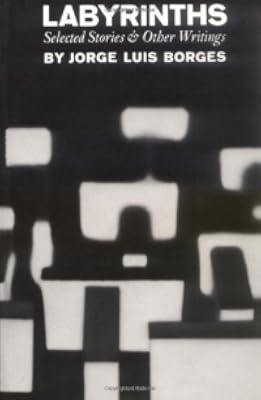
A review of the Penguin Modern paperback (February 22, 2018) collecting 5 short stories as previously published in [book:Labyrinths: Selected Stories & Other Writings|15708707] (1962), [book:Labyrinths: Selected Stories & Other Writings|57613344] (1964) with translations (#1, #3, #5) by [author:Donald A. Yates|986892] & [author:James E. Irby|10857] and [book:Collected Fictions|849860] (1998) with translations (#2 & #4) by [author:Andrew Hurley|3947].
I wanted to sample some further Borges as I've been considering Collected Fictions (565 pages) as a possible candidate for the 2025 Long Books Challenge. I'm thinking now that the complete collection might be more than I can handle 🤯.
This is a decent enough show more sampler, but it took me a bit of research to figure out who translated which story as they didn't bother to identify them 1 to 1. This slim paperback also has no Introduction or Afterword so it is missing things like Borges own commentaries, such as his 1941 note on #1:
So this is recommended as a sampler, but be prepared to google for further background and information.
[4.2 star average for the 5 stories]
1. The Garden of Forking Paths ***** Originally published in [book:El jardín de senderos que se bifurcan|21401849] (1941) and then [book:Ficciones|426504] (1944). On the surface this is a story of a Chinese spy who works for Imperial Germany during the 1st World War. While on the run from the authorities, the spy ends up at the home of a sinologist who has uncovered the secret multiverse labyrinths of the spy's ancestor's novel. That barely scratches the surface of a story which is said to be an example of the multi-worlds theory of quantum mechanics. You can read more (Spoilers obviously) at Wikipedia.
See title page at https://pictures.abebooks.com/inventory/31579414254_3.jpg
Title page of the original 1944 edition of "Ficciones". Image sourced from AbeBooks.
2. The Book of Sand ***** Originally published in [book:el libro de la arena|28447874] (1975). A man buys a book from a Bible seller which is written in an unknown language with occasional illustrations. The cover says that it is holy writ, but it is otherwise known as the book of sand. He discovers that the book is of infinite length. As you turn pages, more pages start to grow in the front and the back.
3. The Circular Ruins **** Originally published in the literary journal Sur (December 1940) and then as in 1. above. A man rests and dreams in the ruins of an abandoned temple. He dreams another man into existence while realizing that he himself is someone else's dream.
4. On Exactitude in Science *** Originally published in a journal March 1946. This is only a half page story describing a fanatical group of cartographers who design a map of an Empire which is as big as the Empire itself.
5. Death and the Compass **** Originally published in the literary journal Sur (May 1942) and then collected in Ficciones (1944). A detective deduces that a series of murders must be following a pattern derived from the Tetragrammaton i.e. the names of God. He follows that trail to a fateful conclusion.
Bonus Track I once designed a JLB bingo card, based on a prompt from the GR is dying? discussion group 😊, so I am recycling it here.
See JLB bingo card at https://scontent-yyz1-1.xx.fbcdn.net/v/t39.30808-6/468932453_28755794420685970_8...
Trivia and Links
See boxset photo at https://shop.penguin.co.uk/cdn/shop/files/PMCBoxSetSquare07_2048x2048_cropped.jp...
Jorge Luis Borges's The Garden of Forking Paths is part of a 50-volume Penguin Modern (May 30, 2019) boxset issued by Penguin Books. The promo description reads:
The box set is a limited edition which may gradually become rarer to source. The books are available individually, but will also likely become rare items.
WARNING Amazon.ca and Amazon.com are showing only a nominal fee ($1.99 Cdn, $2.53 US) for a supposed Kindle edition of the 50-volume boxset. DO NOT FALL FOR THIS SCAM, THE KINDLE ITEM IS A LIST OF TITLES ONLY AND DOES NOT CONTAIN THE ACTUAL COMPLETE BOOKS.
You can read the list of titles for free at the Penguin Modern link above. show less
A review of the Penguin Modern paperback (February 22, 2018) collecting 5 short stories as previously published in [book:Labyrinths: Selected Stories & Other Writings|15708707] (1962), [book:Labyrinths: Selected Stories & Other Writings|57613344] (1964) with translations (#1, #3, #5) by [author:Donald A. Yates|986892] & [author:James E. Irby|10857] and [book:Collected Fictions|849860] (1998) with translations (#2 & #4) by [author:Andrew Hurley|3947].
I wanted to sample some further Borges as I've been considering Collected Fictions (565 pages) as a possible candidate for the 2025 Long Books Challenge. I'm thinking now that the complete collection might be more than I can handle 🤯.
This is a decent enough show more sampler, but it took me a bit of research to figure out who translated which story as they didn't bother to identify them 1 to 1. This slim paperback also has no Introduction or Afterword so it is missing things like Borges own commentaries, such as his 1941 note on #1:
("The Garden of Forking Paths") is a detective story; its readers will witness the commission and all the preliminaries of a crime whose purpose will not be kept from them but which they will not understand, I think, until the final paragraph.
So this is recommended as a sampler, but be prepared to google for further background and information.
[4.2 star average for the 5 stories]
1. The Garden of Forking Paths ***** Originally published in [book:El jardín de senderos que se bifurcan|21401849] (1941) and then [book:Ficciones|426504] (1944). On the surface this is a story of a Chinese spy who works for Imperial Germany during the 1st World War. While on the run from the authorities, the spy ends up at the home of a sinologist who has uncovered the secret multiverse labyrinths of the spy's ancestor's novel. That barely scratches the surface of a story which is said to be an example of the multi-worlds theory of quantum mechanics. You can read more (Spoilers obviously) at Wikipedia.
See title page at https://pictures.abebooks.com/inventory/31579414254_3.jpg
Title page of the original 1944 edition of "Ficciones". Image sourced from AbeBooks.
2. The Book of Sand ***** Originally published in [book:el libro de la arena|28447874] (1975). A man buys a book from a Bible seller which is written in an unknown language with occasional illustrations. The cover says that it is holy writ, but it is otherwise known as the book of sand. He discovers that the book is of infinite length. As you turn pages, more pages start to grow in the front and the back.
Summer was drawing to a close, and I realized that the book was monstrous. It was cold consolation to think that I, who looked upon it with my eyes and fondled it with my ten flesh-and-bone fingers, was no less monstrous than the book.
3. The Circular Ruins **** Originally published in the literary journal Sur (December 1940) and then as in 1. above. A man rests and dreams in the ruins of an abandoned temple. He dreams another man into existence while realizing that he himself is someone else's dream.
This circle was a temple, long ago devoured by fire, which the malarial jungle had profaned and whose god no longer received the homage of men.
4. On Exactitude in Science *** Originally published in a journal March 1946. This is only a half page story describing a fanatical group of cartographers who design a map of an Empire which is as big as the Empire itself.
5. Death and the Compass **** Originally published in the literary journal Sur (May 1942) and then collected in Ficciones (1944). A detective deduces that a series of murders must be following a pattern derived from the Tetragrammaton i.e. the names of God. He follows that trail to a fateful conclusion.
The latter wanted to talk about the murder; Lönnrot preferred to discuss the diverse names of God; the journalist declared, in three columns, that the investigator Erik Lönnrot, had dedicated himself to studying the names of God in order to come across the name of the murderer.
Bonus Track I once designed a JLB bingo card, based on a prompt from the GR is dying? discussion group 😊, so I am recycling it here.
See JLB bingo card at https://scontent-yyz1-1.xx.fbcdn.net/v/t39.30808-6/468932453_28755794420685970_8...
Trivia and Links
See boxset photo at https://shop.penguin.co.uk/cdn/shop/files/PMCBoxSetSquare07_2048x2048_cropped.jp...
Jorge Luis Borges's The Garden of Forking Paths is part of a 50-volume Penguin Modern (May 30, 2019) boxset issued by Penguin Books. The promo description reads:
This box set of the 50 books in the new Penguin Modern series celebrates the pioneering spirit of the Penguin Modern Classics list and its iconic authors. Including avant-garde essays, radical polemics, newly translated poetry and great fiction, here are brilliant and diverse voices from across the globe. Ground-breaking and original in their day, their words still have the power to move, challenge and inspire.
The box set is a limited edition which may gradually become rarer to source. The books are available individually, but will also likely become rare items.
WARNING Amazon.ca and Amazon.com are showing only a nominal fee ($1.99 Cdn, $2.53 US) for a supposed Kindle edition of the 50-volume boxset. DO NOT FALL FOR THIS SCAM, THE KINDLE ITEM IS A LIST OF TITLES ONLY AND DOES NOT CONTAIN THE ACTUAL COMPLETE BOOKS.
You can read the list of titles for free at the Penguin Modern link above. show less
Most pretentious book I will likely ever read.
Members
- Recently Added By
Lists

Favourite Books
1,820 works; 316 members

20th Century Literature
1,161 works; 55 members
1940s
221 works; 25 members

Short Story Collections and Anthologies
261 works; 42 members

One Book, Many Authors
441 works; 40 members

SF & Fantasy in Translation
95 works; 18 members
Author Information

1,016+ Works 59,170 Members
Born in Buenos Aires, Argentina, in 1899, Jorge Borges was educated by an English governess and later studied in Europe. He returned to Buenos Aires in 1921, where he helped to found several avant-garde literary periodicals. In 1955, after the fall of Juan Peron, whom he vigorously opposed, he was appointed director of the Argentine National show more Library. With Samuel Beckett he was awarded the $10,000 International Publishers Prize in 1961, which helped to establish him as one of the most prominent writers in the world. Borges regularly taught and lectured throughout the United States and Europe. His ideas have been a profound influence on writers throughout the Western world and on the most recent developments in literary and critical theory. A prolific writer of essays, short stories, and plays, Borges's concerns are perhaps clearest in his stories. He regarded people's endeavors to understand an incomprehensible world as fiction; hence, his fiction is metaphysical and based on what he called an esthetics of the intellect. Some critics have called him a mystic of the intellect. Dreamtigers (1960) is considered a masterpiece. A central image in Borges's work is the labyrinth, a mental and poetic construct, that he considered a universe in miniature, which human beings build and therefore believe they control but which nevertheless traps them. In spite of Borges's belief that people cannot understand the chaotic world, he continually attempted to do so in his writing. Much of his work deals with people's efforts to find the center of the labyrinth, symbolic of achieving understanding of their place in a mysterious universe. In such later works as The Gold of the Tigers, Borges wrote of his lifelong descent into blindness and how it affected his perceptions of the world and himself as a writer. Borges died in Geneva in 1986. (Bowker Author Biography) show less
Series
Belongs to Publisher Series
Work Relationships
Is contained in
Contains
Common Knowledge
- Canonical title
- The Garden of Forking Paths
- Original title
- El jardín de senderos que se bifurcan
- Original publication date
- 1941
- People/Characters
- Don Quixote de la Mancha
- Original language
- Spanish
Classifications
- Genres
- Fiction and Literature, General Fiction, Fantasy
- DDC/MDS
- 863.6 — Literature & rhetoric Spanish Literature Spanish fiction 20th Century
- LCC
- PQ7797 .B635 .J37 — Language and Literature French, Italian, Spanish and Portuguese literatures Spanish literature Provincial, local, colonial, etc. Spanish America
- BISAC
Statistics
- Members
- 304
- Popularity
- 105,883
- Reviews
- 9
- Rating
- (3.99)
- Languages
- 5 — Dutch, English, Estonian, Hebrew, Spanish
- Media
- Paper, Audiobook, Ebook
- ISBNs
- 4
- ASINs
- 4